


Traumatic Brain Injury · Florida & Nationwide
Who Is Liable for a Traumatic Brain Injury?
When someone else's carelessness leaves you or a loved one with a brain injury, the law may hold them accountable. We explain who can be responsible and what your family can do next.
Serious Injuries. Serious Advocacy.
TBI
Focused on catastrophic brain-injury claims
Nationwide
Florida-based, cases handled across the U.S.
Bilingual
English & Spanish support
Licensed
Florida Bar–admitted attorneys
By CHG Lawyers · Published July 31, 2026
Who Can Be Held Responsible for a Traumatic Brain Injury?
The person whose carelessness caused the injury can usually be held liable. Often, more than one party shares the blame. The responsible party is usually a careless driver, a trucking company, a property owner, a product maker, or a medical provider. Their failure to act with reasonable care led to the harm.
Who is liable depends on how the injury happened. It also depends on who acted carelessly. It is not about who was simply nearby. It is about who had a duty to keep others safe and broke that duty.
This page is educational. Every situation is different. A licensed attorney needs to review your specific facts. For the bigger picture, see our Traumatic Brain Injury Guide.
Not sure what your next step is?
Talk it through with our team — the first consultation is free, confidential, and carries no obligation.
What it takes to hold someone legally responsible
To hold someone responsible for a brain injury, you usually must prove four things: duty, breach, causation, and harm. Together they form a negligence claim. That means a claim that says someone was careless.
- Duty: The other party owed you reasonable care. A driver must drive safely. A property owner must keep the property reasonably safe.
- Breach: They failed to meet that duty. Maybe they drove impaired, ignored a known hazard, or skipped required safety checks.
- Causation: Their failure actually caused your brain injury. This link is the heart of the case.
- Harm: You suffered real losses — medical bills, lost income, and lasting harm.
Knowing who was careless and proving it are two different things. In the serious cases our attorneys handle, one thing often decides everything. It is the record that ties the injury to the incident.
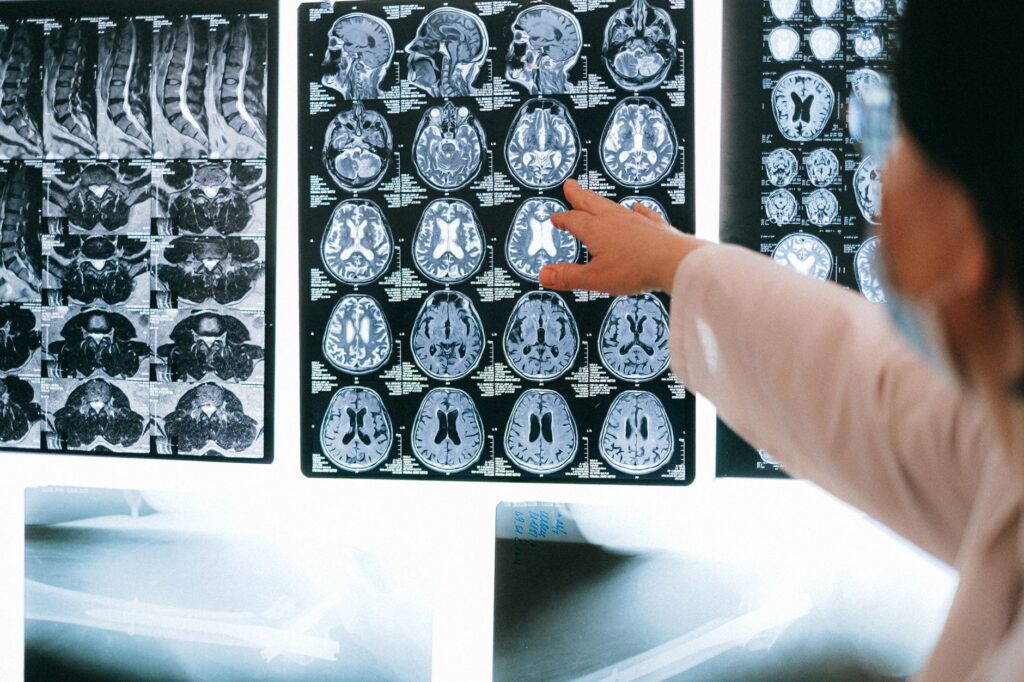
A TBI does not always show up on a first scan. A clear medical timeline is often what connects the head trauma to the accident. That timeline runs from the emergency-room CT scan through neuropsychological testing — memory and thinking tests that show changes in how you think.
This is why we push to save records, crash reports, photos, and witness statements early. We act before memories fade and evidence disappears.
Negligent drivers and trucking companies
A driver who caused your crash can be held liable for your brain injury. This includes driving while distracted, impaired, or reckless. Car and truck crashes are among the leading causes of serious TBI. According to the CDC, there were roughly 69,000 TBI-related deaths in the United States in 2021 — about 190 a day. Motor-vehicle crashes remain a major cause.
When a large truck is involved, the trucking company may share responsibility. A company can be at fault for:
- Unsafe hiring or training of drivers
- Poor truck maintenance
- Pushing drivers past federal hours-of-service limits (49 C.F.R. Part 395), which cap driving time to fight fatigue
- Overloading or unsafe cargo practices
An employer can also be responsible when an at-fault driver was working at the time. The legal rule is respondeat superior (Latin for “let the boss answer”). This matters because a company usually carries far larger insurance than an individual driver. Learn more on our truck accidents page.
A brain injury from a crash is not a minor fender-bender. These cases involve permanent, life-altering harm. The value of the claim reflects that.
Property owners and businesses that failed to keep people safe
A property owner can be held liable for a brain injury in certain cases. This happens when they fail to fix or warn about a known danger — a hidden hazard, a broken stairway, a poorly lit walkway — and someone falls and hits their head.
Owners have a legal duty to keep the property reasonably safe for people allowed to be there. The legal term is premises liability. It means the owner can be held accountable for injuries caused by unsafe conditions. This applies to dangers they knew about, or should have known about, and failed to fix.
When a violent attack causes a brain injury
Say you were assaulted, robbed, shot, or attacked at an apartment complex, a parking garage, a hotel, a bar, a gas station, or a store. And say you suffered a brain injury during that attack. The property owner may share responsibility.
Here is why. Property owners must provide reasonable security for people on their property. That can mean working locks and gates, good lighting, security cameras, or guards. Sometimes an owner ignores a known danger, like a pattern of past crime in the area. If someone is hurt as a result, the owner may be legally at fault.
The legal term for this is negligent security. It is a type of premises-liability claim. You can read more on our negligent security page.
Here is an important practical point. The attacker may also be liable for the harm they caused. But attackers often have no insurance and no money to pay for a lifetime of care. The property owner is often the party with insurance that can actually pay the victim. That is why it matters so much to identify the property owner’s responsibility.
Product manufacturers and defective equipment
A product maker can be held liable when a defective product causes or worsens a brain injury. Examples include faulty vehicle parts, defective helmets, broken safety devices, or dangerous equipment.
Responsibility can fall on more than one company in the chain:
- The manufacturer that designed or built the product
- The distributor that sold it to retailers
- The seller that put it in your hands
A recall, a known design flaw, or a manufacturing defect can be strong evidence. If a safety device failed to do its job, that failure may be part of who is liable for the brain injury.
Have questions about what happened?
Ask our team directly. The first conversation is free, confidential, and there is no obligation to continue.
Medical providers and brain injuries caused by negligence
A medical provider can be held responsible when a preventable medical error causes or worsens a brain injury. Not every bad outcome is negligence. But a clear, avoidable mistake may be. Here are some examples in plain terms:
- Failing to diagnose or treat a serious head injury in time
- Oxygen-loss errors during surgery or childbirth
When the brain loses oxygen, the result can be an anoxic or hypoxic brain injury — an injury from too little oxygen. This is a type of acquired brain injury. It differs from a direct blow to the head. Our anoxic and hypoxic brain injury explainer covers this in more detail.
Medical-negligence claims follow special rules. In Florida, the law requires a presuit investigation before you can file. This means a qualified medical expert must give a written opinion that the claim has merit (Fla. Stat. §766.203). These cases are complex, so early legal guidance is important.
When more than one party is responsible
More than one party can share fault for a single brain injury. A careless driver and a trucking company might both be at fault. A property owner and a maintenance contractor might both share blame for a dangerous condition.
Florida uses a modified comparative-negligence rule. Under Fla. Stat. §768.81, your compensation is reduced by your share of the fault. Since a 2023 change to that law, a person found more than 50% at fault for their own injury usually cannot recover damages in a negligence case. So it is more important than ever to document how the injury happened and who was responsible.
Identifying every responsible party helps protect your ability to recover the full cost of a serious injury — a cost that can last a lifetime.
Workplace brain injuries and third-party responsibility
A brain injury on the job may involve workers’ compensation. But a separate at-fault party can still be held responsible. These are two different paths, and both can matter.
Workers’ comp usually pays certain benefits no matter who was at fault. But it often does not cover the full scope of a serious injury. Sometimes a third party — someone other than your employer — caused the harm. Then you may have a separate claim. Common examples: a defective machine made by an outside manufacturer, or a negligent contractor at the site. That third-party claim can seek damages workers’ comp does not cover.
Frequently asked questions
Can you sue for a traumatic brain injury?
Yes. You can generally pursue a claim for a traumatic brain injury when another party’s carelessness caused it. A licensed attorney can review the facts to see whether you have a valid case.
Can you fully recover from a TBI?
We won’t pretend otherwise: recovery varies widely. Many people with severe TBI face permanent effects. Some regain significant function through rehabilitation. Others live with lasting changes in their body, thinking, or behavior. No attorney or doctor can promise a specific medical outcome. What a legal claim can do is seek compensation for the long-term care, therapy, and support a serious brain injury often requires.
How is fault decided in a brain injury case?
Fault is decided by gathering evidence — medical records, accident reports, witness statements, and expert review. Then Florida’s negligence and comparative-fault rules are applied to the facts.
How long do you have to file a brain injury claim in Florida?
Deadlines called statutes of limitation apply. Under Fla. Stat. §95.11, most negligence claims that started on or after March 24, 2023 must be filed within two years. Older claims may fall under a prior four-year window. Other deadlines apply to claims against government entities or in medical-negligence cases. The correct deadline depends on your facts, and it can be missed for good. So act promptly and consult an attorney.
Can a property owner be liable if I was attacked on their property?
Yes. A property owner may share responsibility if they failed to provide reasonable security and that failure allowed you to be harmed. This is known as a negligent-security claim.

Want to know where you stand?
Tell us what happened and our team will walk you through the options available to you, at no cost.
What families can do next
If a loved one suffered a serious brain injury, a few early steps can protect their rights. Keep all medical records and bills. Save photos, names of witnesses, and any accident or police reports. Don’t throw away damaged equipment or clothing.
Severe TBI can bring emotional and behavioral changes that are hard on the whole family. Our guides on first steps after a loved one’s brain injury and TBI personality and behavior changes for families can help.
CHG Personal Injury Lawyers represents victims of catastrophic brain injuries. Our attorneys are licensed and admitted to the Florida Bar. We handle cases nationwide, and we serve clients in both English and Spanish.
Are you trying to understand who is liable for a traumatic brain injury in your family’s situation? We’re here to help. Request a free, no-obligation case evaluation. There’s no guarantee of any specific outcome, but you deserve clear answers about your options.
Parties That May Be Held Liable
A Negligent Driver or Trucking Company
If a crash caused the brain injury, the at-fault driver — and sometimes the company that owned the truck or employed the driver — may be responsible.
A Property Owner Who Failed to Provide Security
If you or a family member was attacked on someone else's property because locks, lighting, cameras, or guards were missing, the owner may share liability for the harm that followed.
A Medical Provider
When a preventable error during care causes or worsens a brain injury, the provider or facility responsible may be held accountable.
Manufacturers or Multiple Parties
A defective product or unsafe equipment can play a role, and more than one party may share fault in a single catastrophic case.
Evidence Can Disappear Fast
Surveillance video, vehicle data, and witness memories fade quickly after a serious injury. Talking with a licensed attorney early can help protect the facts that matter to your claim.
Common Questions About TBI Liability
Can you sue for a traumatic brain injury?
Generally, yes — when another party's carelessness caused it. A licensed attorney can review the facts to see whether you have a valid case.
Can you fully recover from a TBI?
We won't pretend otherwise: recovery varies widely, and many people with severe TBI face permanent effects. That reality often shapes the long-term care and support a claim seeks to cover.
What if more than one party is at fault?
Catastrophic cases often involve multiple responsible parties. An attorney can investigate each one to help identify every source of accountability.
How long do I have to act?
Deadlines to file vary by state and situation. Because these time limits can be strict, it's wise to speak with a lawyer sooner rather than later.