

Traumatic Brain Injury Claims
Proving Your Brain Injury Came From the Accident
A traumatic brain injury can change a life forever, even when scans look normal. Learn how the evidence connects a TBI to the crash, fall, or attack that caused it.
Serious Injuries. Serious Representation.
Nationwide
Catastrophic injury cases accepted
Licensed
Florida Bar–admitted attorneys
Bilingual
English & Spanish support
Free
Case evaluations
By CHG Lawyers · Published August 05, 2026
What Evidence Proves a Brain Injury Was Caused by the Accident?
The proof that links a traumatic brain injury (TBI) to an accident usually has a few parts. It includes medical records from the scene forward. It includes brain scans and neuropsychological testing (tests of how your brain works). It also includes accounts from people who knew you before and after. Finally, it includes expert opinions. These opinions connect the forces of the accident to the injury.
Together, these pieces answer two questions. Does a brain injury exist? And did this accident cause it?
That second question — the cause — is where many serious claims are fought. This page explains, in plain words, what that evidence looks like. It is written for the injured person and their family, not for lawyers. It is general education, not legal advice. It does not predict any result in your case.

If you're facing this, you don't have to sort out the evidence alone. Talk it through with our team — the first consultation is free, confidential, and carries no obligation.
Why proving the cause of a brain injury is different
Proving the cause of a brain injury is often harder than proving a broken bone. Many brain injuries never show up on a standard scan. A fracture shows up clearly on an X-ray. A concussion with lasting effects often does not.
In a claim, you usually have to prove two separate things. First, that a brain injury exists. Second, that the accident caused the harm — not something before or after it. Lawyers call that second link causation (proof that the accident caused the injury).
Insurance companies know brain injuries can be invisible. So a common defense is to argue the symptoms were there before. They may say the symptoms are unrelated or exaggerated. That is why layered, well-organized evidence matters so much. In the catastrophic-injury cases our attorneys handle, the fight is usually over causation. It is rarely over whether the person is truly hurt.
Medical records: the foundation
Medical records show your symptoms from the moment of the accident forward. The strongest records start at the scene.
Emergency-room and first-responder notes matter most. They may record a loss of consciousness, confusion, vomiting, or a direct blow to the head. The Cleveland Clinic describes a TBI as damage to the brain caused by a hit, jolt, or object. Early notes tie those first signs to the accident date.
Timing is powerful. Prompt care creates a written record. That record connects your symptoms to the crash or the attack. Later notes from neurologists, neuropsychologists, and rehab specialists build the picture over months.
Gaps in treatment can hurt a claim. If you miss appointments or stop following the plan, the other side may argue you weren’t really hurt. Getting care and sticking with it protects both your recovery and your record. Our traumatic brain injury claims page covers the broader process.
Neuroimaging: CT, MRI, and advanced scans
Imaging can show bleeding, swelling, or structural damage. But a normal scan does not rule out a brain injury. This surprises many families.
Standard CT and MRI scans work well for more severe injuries. They can reveal bleeding or a shift in brain tissue. But many TBIs are microscopic or functional. That means the brain isn’t working right, even though it looks intact. The National Institute of Neurological Disorders and Stroke explains that TBIs come from falls, crashes, blasts, or being struck. It also explains that they do not all look the same on imaging.
Some cases use advanced imaging, such as diffusion tensor imaging (DTI) or functional MRI (fMRI). These can sometimes find damage a standard scan misses. Courts and experts accept them differently. So they are one tool among several — never a guarantee.
The takeaway: a “clean” CT scan is not proof that nothing is wrong.
Neuropsychological and cognitive testing
Neuropsychological testing measures how your brain actually works. It can give objective proof of a TBI even when scans look normal. It is often the backbone of a case where imaging is unclear.
A neuropsychologist gives standard tests. These measure memory, attention, processing speed, language, and executive function (planning and problem-solving). The results are compared to what someone with your age, education, and background would be expected to score.
When your results fall below that expected score, the gap is evidence of a real deficit. It shows something changed. Comparing your abilities before and after the accident makes the causation link stronger. These findings carry weight because they are objective. They don’t depend on you saying you feel foggy. The scores speak for themselves.
Before-and-after evidence: how the person changed
Some of the strongest proof in a TBI case shows how the accident changed a real person’s daily life. Juries and adjusters understand human stories.
Family, friends, coworkers, and teachers can describe changes they’ve seen. Maybe a loved one is now forgetful, quick to anger, or unable to keep up at work. The Mayo Clinic notes that some brain-injury symptoms appear days or weeks later. So these first-hand accounts help fill gaps in the timeline.
Work and school records help too. A reliable worker who suddenly can’t finish tasks has a documented decline. Performance reviews, report cards, and attendance records all tell part of the story. Many families keep a “day-in-the-life” journal of daily struggles. Our guide to personality changes after brain injury explains why those shifts matter.
Not sure what your next step is?
Talk it through with our team — the first consultation is free, confidential, and carries no obligation.
Expert testimony that ties the injury to the accident
Expert testimony connects the dots. Experts explain, in medical terms, how the forces of the accident caused the brain injury. This is where causation is often proven directly.
Treating doctors and hired experts describe the mechanism. They explain how the sudden stop of a truck crash, or a blow during an assault, could damage the brain. They also answer the defense head-on. They respond to claims that the injury was there before or is unrelated.
Accident reconstruction or biomechanical analysis can add force. These experts study the physics involved. They can show the crash or fall made enough energy to injure the brain. This counters the argument that the impact was “too minor.” Experts also help a jury or adjuster understand an injury they cannot see.
Evidence about the accident itself
Evidence about the accident itself proves the event was serious enough to cause a brain injury. The event and the injury have to fit together.
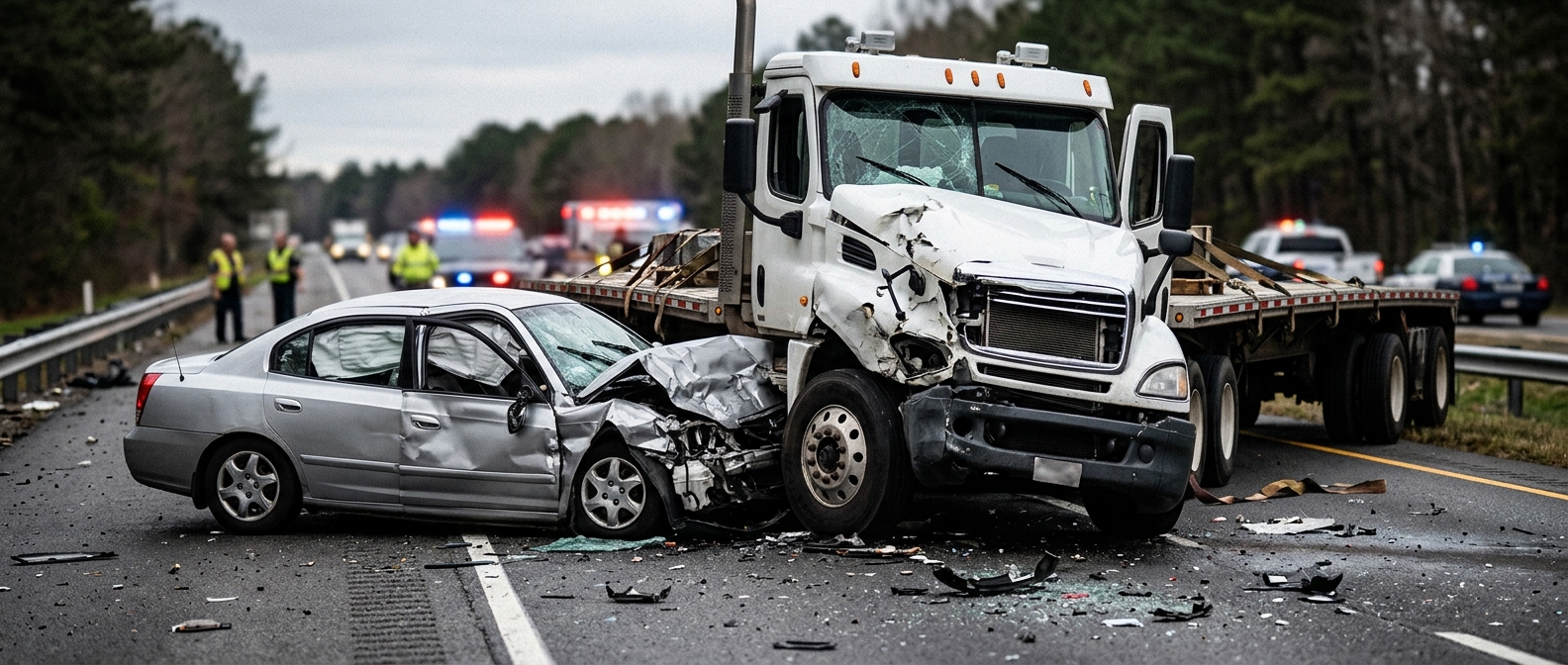
In a truck crash, police and crash reports document how hard the impact was. Photos, dash-cam or surveillance video, and the vehicle damage show the force. A loaded tractor-trailer can weigh up to 80,000 pounds under federal size and weight limits. A passenger car weighs near 4,000 pounds. That weight difference helps explain how catastrophic these forces can be. Our truck accident injuries page has more.
Other brain injuries happen during a violent attack on someone else’s property. Maybe you or a loved one was assaulted, robbed, shot, or beaten. This can happen at an apartment complex, a parking garage, a hotel, a gas station, or a store. If it happened because the owner failed to provide reasonable security, you may have a claim against that property owner. Reasonable security means things like working locks and gates, lighting, cameras, or guards. Lawyers call this negligent security (also known as inadequate-security premises liability).
In those cases, incident reports, surveillance footage, and 911 recordings help prove both the attack and the brain injury. Witness statements describing your condition right afterward matter too. Our negligent security claims page explains this in plain language.
Documenting the lasting impact
Documenting the lasting impact shows a brain injury is permanent and life-altering — not a temporary bump. This is what separates a catastrophic claim from a minor one.
Records of ongoing symptoms build this picture. These include lasting headaches, dizziness, memory loss, and trouble working. Evidence of future care shows what the injury will cost over a lifetime. This includes therapy, medication, and long-term support.
Repeat head trauma is a serious danger. A second injury before the first heals can be devastating. We cover this in our resource on second-impact syndrome and repeat head trauma. A well-documented impact connects the medical facts to a real person’s changed life.
Common defenses, and how evidence answers them
The most common challenge is the “you look fine” problem. Because brain injuries are invisible, people doubt them. Consistent records are the answer.
The defense often argues a condition was there before. A clear treatment history showing new symptoms after the accident helps counter that. Delayed symptoms are another hurdle. Documenting them early, even when they show up weeks later, keeps them tied to the accident. Consistency ties it all together. When records, testimony, and testing point the same way, the story holds.
Have questions about what happened?
Ask our team directly. The first conversation is free, confidential, and there is no obligation to continue.
How a catastrophic-injury attorney gathers this evidence
An attorney’s job is to preserve, collect, and organize this evidence quickly — before some of it disappears. Surveillance footage is the clearest example. Many businesses record over it within days or weeks. So a prompt request or preservation letter can be the difference between having the video and losing it. Lawyers also line up the right medical and technical experts so the causation story is complete.
Two Florida rules are worth knowing early. First, the deadline. For negligence claims that accrue on or after March 24, 2023, Florida generally allows two years to file a personal-injury lawsuit under Fla. Stat. § 95.11. Second, shared fault. Under Florida’s modified comparative-fault statute, Fla. Stat. § 768.81, a person found more than 50% at fault for their own injury generally recovers nothing. These deadlines and rules can turn on the specific facts. Confirm how they apply to your situation.
Our who is liable for a brain injury page explains how liability connects to the harm you suffered. If you’re facing this, you don’t have to sort out the evidence alone. Our attorneys are licensed and admitted to the Florida Bar. They offer a free case evaluation.

Frequently asked questions
Can you have a brain injury if your CT scan or MRI is normal?
Yes. Many traumatic brain injuries are microscopic or functional. They do not show up on standard CT or MRI scans. So a normal scan does not rule out a real injury.
What is the strongest single piece of evidence proving a TBI was caused by an accident?
There usually isn’t one. The case is built by combining several things. These include medical records, imaging, neuropsychological testing, before-and-after accounts, and expert opinion that ties the injury to the accident.
Can brain injury symptoms show up days after the accident?
Yes. The Mayo Clinic notes that some brain-injury symptoms can appear days or even weeks later. That is why early documentation matters.
How long do I have to file a brain injury claim in Florida?
For claims accruing on or after March 24, 2023, Florida generally allows two years under Fla. Stat. § 95.11. But you should confirm the deadline for your specific situation, because exceptions exist.
How is a brain injury from an assault at a business or apartment proven?
Incident reports, surveillance footage, 911 recordings, and witness statements help. They establish both the attack and the resulting brain injury in a negligent-security claim.
A Normal Scan Does Not Mean You're Fine
Many traumatic brain injuries are microscopic or functional and never appear on a standard CT or MRI. If you or a loved one are struggling with memory, focus, mood, headaches, or sleep after an accident, take those symptoms seriously and document them.
How the Evidence Comes Together
Medical Records & Imaging
ER notes, follow-up care, and specialized imaging or neuropsychological testing help document the injury even when standard scans read as normal.
Before-and-After Testimony
Family, friends, and coworkers describe how the person functioned before the accident compared to now — a powerful window into changes others can see.
Accident Documentation
Crash reports, scene photos, and witness accounts tie the injury to a specific event and the force involved.
Expert Analysis
Physicians and other qualified experts connect the mechanism of the accident to the symptoms and the diagnosis.
Why Families Turn to CHG Personal Injury Lawyers
Focused on Catastrophic Injuries
We concentrate on life-altering harm — brain injuries, spinal cord injuries, amputations, severe burns, and wrongful death.
Built on the Evidence
We work to gather the medical, expert, and eyewitness proof that shows how the accident caused the injury.
Support for the Whole Family
A TBI affects everyone around the injured person. We take the time to understand the full impact.
English & Spanish
We provide clear, plain-language guidance so you understand your options every step of the way.