
Tampa Slip and Fall · Serving Florida
Hurt in a Slip and Fall in Tampa? Learn How a Florida Lawsuit Works
A plain-language guide for injured people and their families on when a fall on someone else's property may lead to a claim, and what to do next.
By CHG Lawyers · Published October 15, 2026
How Do I Sue for a Slip and Fall Case in Tampa? A Plain-Language Guide
You may be able to sue for a slip and fall in Tampa. This may be possible if the property owner did not keep the property reasonably safe. It may also be possible if that failure caused your injuries. Whether a lawsuit is possible depends on the facts of your fall. This guide explains how Florida law looks at those facts. It is general information, not legal advice.
Not sure what your next step is?
Talk it through with our team — the first consultation is free, confidential, and carries no obligation.
You Were Hurt on Someone Else’s Property. Can You Sue?
You may be able to sue if you were hurt on property you did not own or control. This may be possible if the people responsible for keeping it safe did not act with reasonable care. Whether you can depends on three things:
- How the fall happened
- Who controlled the property
- What your injuries are
Maybe you slipped on a wet floor in a store. Maybe you tripped on a broken step outside an apartment building. Maybe you fell in a parking lot with no warning sign.
Now you are hurting. You may be missing work. You may be facing medical bills. You may be getting calls from an insurance company. It can be hard to know what comes next.
Here is the plain version of the legal idea. A property owner may be responsible for injuries caused by dangerous conditions on the property. Lawyers call this premises liability. It means the responsibility a property owner may have when unsafe conditions injure someone on the property.
A family may also have a claim when a fall leads to a death. Florida law allows certain claims when a death is caused by negligence, meaning a failure to use reasonable care, or by another wrongful act. This is under § 768.19. Each case differs. No result can be promised.
Slip and Fall Claims in Florida: What the Case Is Built On
A slip and fall claim usually turns on one main question. Did the property owner use reasonable care to keep the property safe and to warn people about hazards? That is the central question in most of these cases.
Every situation is different, so the specific details of what happened on the property matter when your circumstances are reviewed. Those steps include finding and fixing dangers. They also include warning visitors about dangers. Whether those steps were taken is a factual question. The evidence in your case answers it.
Many people first hear from the property owner’s insurance company. A claim with an insurer is not the same as a lawsuit in court. An insurer’s first response, including a denial, does not by itself decide whether a lawsuit is possible.
This page cannot tell you how often falls lead to lawsuits. Each case depends on its own facts. The same fall can look different once the evidence is gathered.
How Is a Slip and Fall Lawsuit Filed in Florida?
A lawsuit starts when a written complaint is filed with a court. The complaint explains who was hurt, what happened, and why the defendant is responsible.
After that, the other side responds. Testimony means sworn statements. This stage is called discovery. It can take time, and the process depends on the court and the claim.
Your lawyer can review that question for your facts.
Many slip and fall cases settle before trial, but some do not. No settlement is promised. The injured person makes the final decision on whether to accept any settlement. The lawyer advises on the law and the offer.
In a wrongful death case, the lawsuit is brought by the decedent’s personal representative. The decedent is the person who died. The personal representative acts for that person’s estate. That person recovers for the survivors and the estate, under § 768.20.
Have questions about what happened?
Ask our team directly. The first conversation is free, confidential, and there is no obligation to continue.
Florida Filing Deadlines and Why Timing Matters
Florida sets a deadline for filing most negligence lawsuits. This deadline is called a statute of limitations. Missing it may prevent a lawsuit from moving forward. The effect depends on the facts.
Under § 95.11, subsection (4)(a) as amended, for causes of action that accrued after March 24, 2023, generally sets a two-year period for an action founded on negligence. Causes of action that accrued before March 24, 2023 may be governed by a different period, and exceptions may apply, so the deadline depends on the facts of each case.
“Accrued” means when the claim begins. When a claim accrues depends on the facts. § 95.031 explains that a cause of action accrues when the last element of the cause of action occurs. Exceptions may apply. So the timing question needs review for your case.
Government property follows different rules. If your fall happened on a city sidewalk or county property, § 768.28 governs. It generally limits payment to $200,000 per person and $300,000 per incident. Larger amounts may be payable only by further act of the Legislature. Claims against government entities also involve notice steps and time limits. These differ from private claims.
Do not wait on an insurance adjuster before learning your options. An adjuster is the insurance company’s claims representative. Some deadlines are short. The rules depend on who owned the property and what kind of claim you have.
What You Must Show: Duty, Hazard, Notice, and Injury
- The owner owed a duty of reasonable care.
- A dangerous condition existed.
- The owner knew or should have known about it.
Each part depends on the facts of your case.
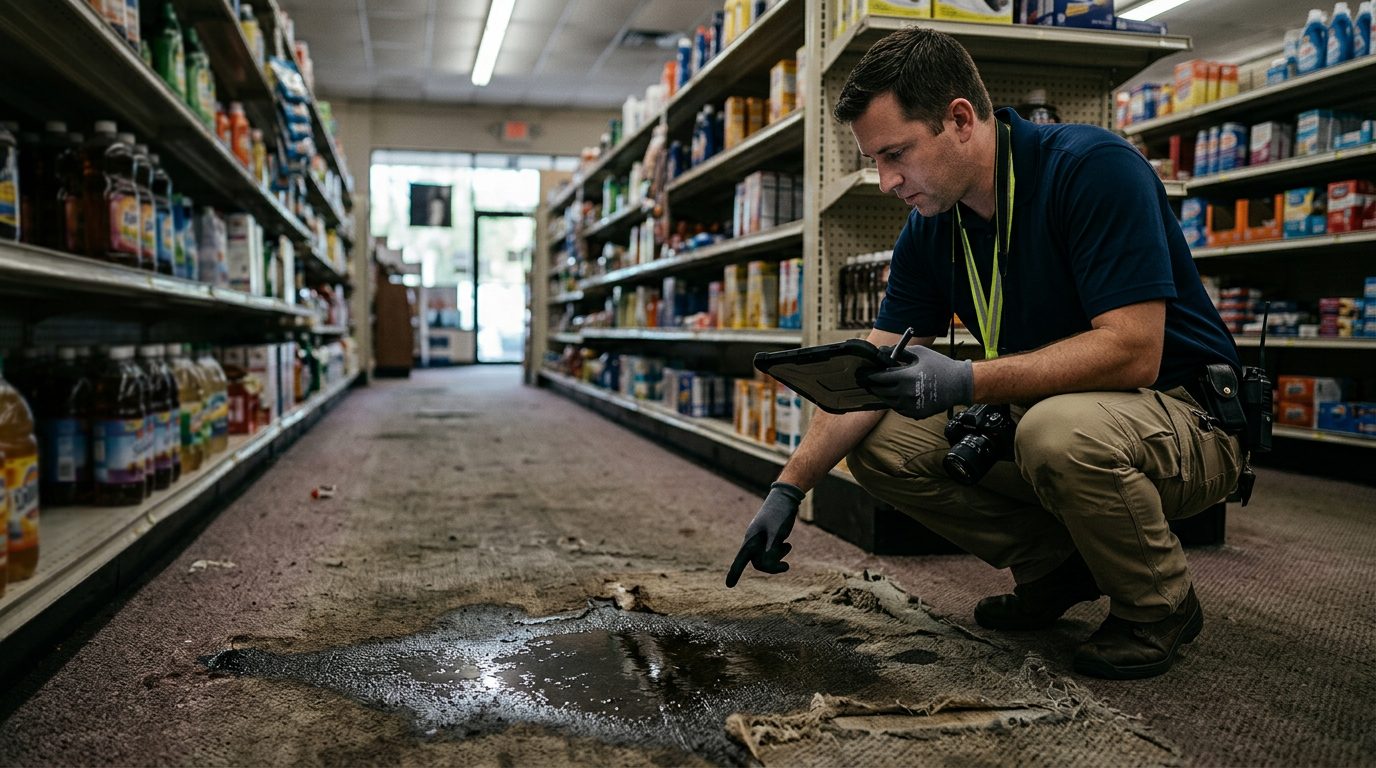
Florida has a specific statute for some floor falls. Under § 768.0755, a person who slips on a transitory foreign substance in a business establishment must prove the business had actual or constructive knowledge of the dangerous condition. A transitory foreign substance is a temporary substance on the floor, such as a spill. It may fall under this statute.
Actual knowledge means the business knew about the condition. Constructive knowledge means the business should have known.
The statute says constructive knowledge may be shown with circumstantial evidence. Circumstantial evidence is indirect proof. One example is proof that the condition existed long enough that, with ordinary care, the business should have known of it. Another is proof that the condition occurred with regularity, so it was foreseeable.
The statute has limits. It covers business establishments and transitory foreign substances. It does not affect the common-law duty of care owed by a person or entity in control of business premises. Common law means law built from court decisions. Other hazards, such as cracked pavement, may be analyzed differently.
Evidence can make a real difference. Useful items may include:
- Photos of the spot
- The incident report
- Witness names
- Medical records
- Video, if it still exists
Report the fall to the property manager. Get medical care. Talk with a lawyer before giving a recorded statement to an insurer.
How Florida Fault Rules May Affect Your Recovery
Florida applies comparative fault, which may affect recovery depending on the facts of each case (Fla. Stat. § 768.81(6)). This means a share of the fault assigned to the injured person can reduce the amount they recover. Comparative fault is the rule that assigns each person’s percentage of responsibility.
Under § 768.81, contributory fault chargeable to the injured person reduces the award in proportion to that fault. Contributory fault means fault on the injured person’s side. It does not, by itself, bar recovery. Under Fla. Stat. § 768.81, for negligence actions filed after March 24, 2023, a party found more than 50 percent at fault for their own harm generally may not recover damages. The statute’s exceptions, including medical negligence actions, and its other conditions may affect how it applies, so each case depends on its facts. Those conditions depend on the facts. They should be checked for your case.
The statute also says a court enters judgment against each liable party based on that party’s percentage of fault. It does not use joint and several liability in that way. Joint and several liability means each party may be responsible for the full amount. Apportionment can matter when more than one party may share responsibility. Apportionment means dividing responsibility by percentage.
Owners and their insurers often raise defenses. A defense is an argument against your claim. Defenses may include arguments about the injured person’s conduct. Footwear, warning signs, lighting, and visibility are common factual questions. The answers come from evidence, not assumptions. No defense is predicted to succeed or fail.
Damages, Settlement Questions, and Why No Amount Can Be Promised
No one can accurately predict what a slip and fall claim is worth from a web page. This firm does not publish settlement or verdict amounts, averages, or ranges. A verdict is a court’s decision after a trial.
Florida law separates economic damages from other losses. Damages means money recovered for harm. Under § 768.81, economic damages include past and future lost income, medical and funeral expenses, and other economic losses caused by the injury. These are documented costs and losses.
Non-economic losses, such as pain and suffering, may be part of some claims. This depends on the facts and Florida law. They are not automatic in every case.
The value of any claim depends on several things. These include the evidence, the injuries, the defenses, and the law that applies. Any settlement offer should be reviewed with a lawyer before a decision is made. The decision to settle belongs to the injured person.

Want to know where you stand?
Tell us what happened and our team will walk you through the options available to you, at no cost.
Your Next Step in Tampa
If you were hurt in a fall, you may be carrying a lot right now. Medical visits, missed work, and insurance calls can pile up quickly.
CHG Personal Injury Lawyers is a Florida personal injury firm handling cases ranging from everyday falls to catastrophic injuries. Responsible lawyer: Igor Hernandez, admitted in Florida as a member of The Florida Bar. We invite you to contact us for a free, confidential, no-obligation initial consultation. You can talk through your fall at our contact page.
CHG charges no attorney’s fees and no case costs unless there is a recovery. In Spanish, the approved statement reads: CHG no cobra honorarios de abogado ni costos del caso si no hay recuperación.
Our office support staff assists with scheduling and intake.
Results are not promised. Each case differs. This page is general information, not legal advice. Reading it does not create an attorney-client relationship.
Steps to Take After a Fall
Get Medical Care
Your health comes first. Follow your doctors' care and keep every record, bill, and referral from your treatment.
Document the Scene
If you can, take photos of the spot, the hazard, the lighting, and any warning signs. Write down what happened while the details are fresh.
Identify Witnesses
Names and phone numbers of people who saw the fall can be valuable later, when the facts are reviewed.
Talk With a Lawyer
Each case depends on its own facts. A confidential conversation with CHG can help you understand what may apply to your situation.
What Shapes a Slip and Fall Claim
Who Controlled the Property
Claims often focus on whether the owner or manager of the property knew, or should have known, about a dangerous condition and failed to address it.
Evidence and Records
Photos, incident reports, medical records, and witness information may all help explain what happened. Their value depends on the facts of each case.
Your Injuries
The effects of a fall can range from minor to life-changing. Your doctors determine your care, and a claim is evaluated on the medical records available.
Florida Communities
CHG represents people throughout Florida, including residents and visitors injured in Tampa and across the state.
Be Careful Before You Speak to an Insurance Adjuster
An insurance company may call you soon after a fall. Before you give a recorded statement or sign any paperwork, consider speaking with a lawyer about what you say and what you agree to.