


Severe Burn Injuries
Third-Degree vs Fourth-Degree Burns: Understanding Depth & Recovery
When a burn destroys skin, nerves, and the tissue beneath, the road to recovery is long and life-altering. Here is what the depth of a serious burn really means — and how a family can move forward.
Standing with Catastrophic Injury Victims
Nationwide
Cases accepted across the U.S.
Bilingual
English & Spanish resources
Licensed
Florida Bar–admitted attorneys
Free
Confidential case reviews
By CHG Lawyers · Published August 06, 2026
Third-Degree vs. Fourth-Degree Burns: What Depth Means for Recovery
The difference between a third-degree and a fourth-degree burn comes down to one thing: how deep the injury reaches. A third-degree burn destroys the full thickness of the skin — both the outer layer (epidermis) and the deeper layer (dermis). A fourth-degree burn goes further still, past the skin into fat, muscle, tendon, and sometimes bone.
That extra depth changes everything: whether the wound can heal on its own, how many surgeries lie ahead, and how much permanent damage remains.
If you’re reading this because someone you love was badly burned, we’re sorry you’re facing it. This page focuses on the two burn types that most often cause permanent, life-altering harm. It’s educational only — not medical or legal advice.
If you're reading this because someone you love was badly burned, we're sorry you're facing it. Talk it through with our team — the first consultation is free, confidential, and carries no obligation.
Why burn depth matters more than burn size
Depth — not width — is the single biggest factor in how a serious burn heals. A burn’s “degree” tells you how far the injury reaches through the skin’s layers, not how much of the body it covers.
A shallow burn can spread across a large area and still heal without surgery. A deep burn over a smaller area can destroy tissue for good. That’s why burn teams focus so heavily on depth when they plan treatment — and why depth, in the cases our firm handles, drives the whole future: the number of operations, the years of therapy, and whether someone loses function or a limb.
How doctors classify burn depth
Doctors classify burns by how deep the injury reaches. Because our firm works only with catastrophic, permanent injuries, this page concentrates on the two deepest categories — but here is the full ladder for context:
- First-degree (superficial): Only the outer layer (epidermis). Red, painful, heals without scarring — a typical sunburn. Not a catastrophic injury.
- Second-degree (partial thickness): Reaches into the dermis, often with blisters and intense pain.
- Third-degree (full thickness): Destroys the epidermis and the dermis, all the way through the skin, per Johns Hopkins Medicine.
- Fourth-degree: Reaches beyond the skin into fat, muscle, tendon, or bone, per the University of Rochester Medical Center.
Third- and fourth-degree burns are the ones that most often lead to lifelong care. Those are the burns this page — and our attorneys — focus on.
What a third-degree (full-thickness) burn actually is
A third-degree burn destroys the entire thickness of the skin, through both the epidermis and the dermis. Doctors call it a “full-thickness” burn.
The skin often looks white, leathery, waxy, brown, or charred — dry rather than blistered. And here is the fact that confuses many families: a third-degree burn can feel less painful than a smaller, shallower one. That’s because the burn destroys the nerve endings in the skin, so the deepest areas may go numb. Less feeling does not mean less serious — it means the opposite. Families sometimes assume a numb wound is minor. It is the reverse.
Because the skin is gone all the way through, it cannot grow back on its own. These burns usually require a skin graft. Untreated, they carry a high risk of infection, fluid loss, and heavy scarring. Scars can also tighten into contractures — bands of scar tissue that pull across a joint and limit how it moves, sometimes permanently.
What a fourth-degree burn is — and how it goes beyond the skin
A fourth-degree burn is the deepest burn doctors commonly recognize. It reaches past every layer of skin into the tissue underneath.
Shriners Children’s describes a fourth-degree burn as one affecting all layers of the skin, muscles, tendons and even bone. The clinical reference UpToDate explains that these deepest injuries reach into fascia, muscle, or bone.
These burns are often charred and dry, and the deepest areas have no feeling. They are frequently life-threatening. When a fourth-degree burn destroys the muscle, tendon, or bone of a hand, foot, arm, or leg, surgeons sometimes cannot save the limb — and amputation may be the only way to save the person’s life. Our page on amputation and limb loss explains what that path involves.
The real accidents that cause these burns
Catastrophic burns don’t happen in a vacuum. In the cases we see, two situations come up again and again.
Truck-crash fuel fires. A large truck can carry hundreds of gallons of diesel. In a serious collision, ruptured tanks and fuel lines can ignite in seconds, and occupants trapped in a vehicle can suffer full- and fourth-thickness burns before help arrives. Our page on truck accident claims covers how these cases are investigated.
Violent attacks on unsafe property. Some of the most severe burns we see aren’t accidents at all. Picture someone attacked, set on fire, or caught in a fire during a robbery or assault in an apartment complex parking lot, a poorly lit garage, a motel, a bar, or a gas station — a place where the property owner failed to provide reasonable security like working locks and gates, lighting, cameras, or guards. When a foreseeable attack happens because those basic protections were missing, the injured person or their family may have a claim against the property owner. The legal term for this is negligent security (a type of premises-liability claim) — but you don’t need to know that term to have a case. You only need to know you were hurt somewhere the owner should have kept safer.
Not sure what your next step is?
Talk it through with our team — the first consultation is free, confidential, and carries no obligation.
What the ER and burn team do
For a deep burn, the first job is to keep the patient alive: airway, breathing, and blood pressure come before anything else.
Severe burns cause the body to lose fluid fast, so the team delivers fluid resuscitation through an IV — often calculated with a formula like the Parkland formula, which is tied to how much of the body the burn covers. You can read how that percentage is estimated on our page about the Rule of Nines and burn severity.
Infection is one of the greatest dangers with deep burns, so the team works aggressively to prevent it and to control pain. Doctors usually remove dead tissue in a step called debridement. When a very deep burn wraps around a limb and cuts off blood flow, surgeons may perform an escharotomy — a surgical cut that relieves dangerous pressure. Patients with severe burns are typically transferred to a specialized burn center. This is general information, not guidance for your specific situation.
Surgery, grafting, and reconstruction
Third- and fourth-degree burns almost always need surgery, because the destroyed skin cannot heal itself. The core procedure is a skin graft, in which surgeons move healthy skin to cover the burned area.
Recovery rarely ends with one operation. Many survivors need reconstructive surgeries done in stages over months or years. Fourth-degree burns may also require repair of muscle or tendon — and when tissue cannot be saved, the surgery may be an amputation. Our overview of skin grafts and reconstructive surgery walks through what to expect.
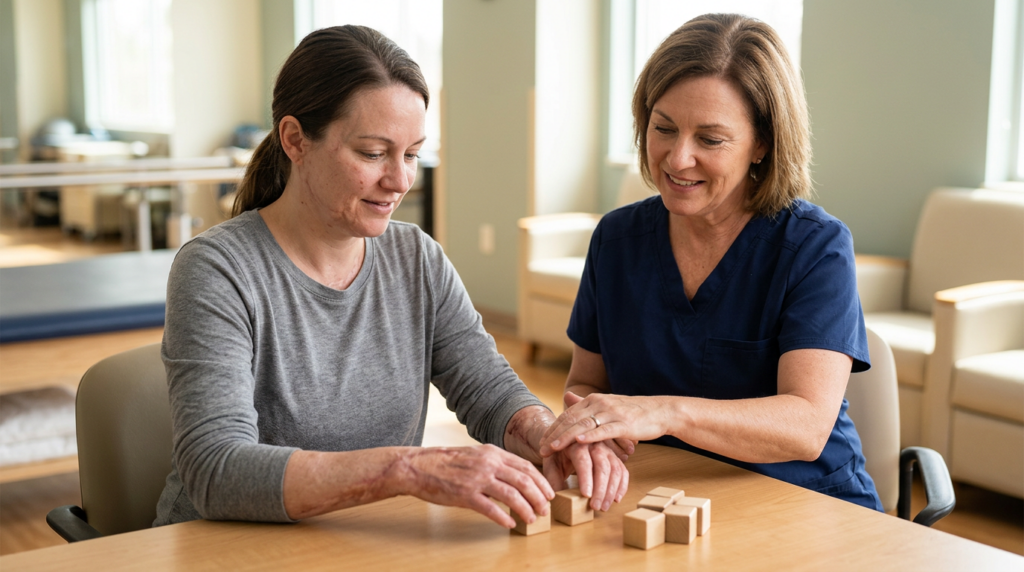
The permanent effects often include heavy scarring, contractures that lock a joint, and loss of function in a hand, arm, or leg. Rehabilitation can mean physical and occupational therapy, custom pressure garments, and long-term scar care. And the toll isn’t only physical — many survivors and families need support for the emotional weight of a life-altering injury.
Are there fifth- and sixth-degree burns?
You may see “fifth-degree” and “sixth-degree” burns online. Be skeptical: these labels are not part of the standard medical classification. Major burn resources — Johns Hopkins, the University of Rochester, Shriners Children’s, and Cleveland Clinic — describe the deepest injuries as third- and fourth-degree (full-thickness) burns, not by higher numbers.
When people write “fifth-degree,” they usually mean a burn reaching deep into muscle; “sixth-degree” sometimes describes a burn charring down to bone. A few pathology and forensic sources use the terms occasionally, but everyday medical practice doesn’t treat them as fixed categories. In fact, the Cleveland Clinic notes a third-degree burn is also called “full-thickness” — a reminder that even the standard labels overlap.
The number matters far less than the reality. A burn that reaches muscle or bone is among the most catastrophic injuries a person can survive, whatever term gets attached to it.
When a burn is fatal
For all the survivors, some catastrophic burns are not survivable. If your family lost someone to a fire caused by a truck crash, an explosion, a defective product, or an attack on unsafe property, we want to be direct and gentle: a death is the most catastrophic outcome there is, and the law recognizes it as such.
In Florida, close family members may be able to bring a wrongful-death claim through a personal representative of the estate, under Florida’s Wrongful Death Act, Fla. Stat. §§ 768.16–768.26. Such a claim can seek to recover for medical and funeral expenses and for the losses surviving family members carry forward. Nothing about this process should feel rushed. When you’re ready, an attorney can explain your family’s options.
When someone else’s negligence caused the burn
If your loved one’s burn came from someone else’s carelessness — a truck crash that caught fire, an explosion, a defective product, a workplace hazard, or an unsafe property — your family may have legal options. A claim can seek to cover medical bills, future care, lost income, and other losses.
Two Florida rules matter most:
- Deadline to file. For general negligence claims that arose on or after March 24, 2023, Florida generally requires you to file within two years under Fla. Stat. § 95.11. Missing the deadline can end a claim before it starts.
- Shared fault. Florida follows a modified comparative-negligence rule under Fla. Stat. § 768.81. Your recovery can be reduced by your share of fault, and a claimant found more than 50% at fault generally recovers nothing.
We can’t promise any particular result — every case is different. Our licensed, Florida Bar–admitted attorneys can explain your options with no pressure. CHG Personal Injury Lawyers handles catastrophic burn cases in Florida and nationwide. You can request a free case evaluation whenever you’re ready.
Have questions about what happened?
Ask our team directly. The first conversation is free, confidential, and there is no obligation to continue.
Learn more
Start with our main guide to severe burn injuries, which ties together how burns are classified, treated, and compensated. You may also want the Rule of Nines and burn severity and our overview of catastrophic injury claims. You don’t have to sort through this alone.

Frequently asked questions
What is the difference between third-degree and fourth-degree burns?
A third-degree burn destroys both layers of the skin (epidermis and dermis). A fourth-degree burn goes deeper still — into fat, muscle, tendon, or bone.
Why can a third-degree burn feel less painful than a smaller burn?
Because it destroys the nerve endings in the skin, the deepest areas can go numb even though the injury is severe. Numbness is a warning sign, not reassurance.
Do third-degree and fourth-degree burns require skin grafts?
Usually, yes. The skin is destroyed too deeply to heal on its own, so surgeons typically graft healthy skin over the wound, often across several operations.
Can a fourth-degree burn lead to amputation?
Yes. When a fourth-degree burn destroys the muscle, tendon, or bone of a limb, amputation is sometimes needed to save the person’s life.
Is a fifth-degree or sixth-degree burn a real medical category?
Not in standard medical classification. Major burn centers describe the deepest injuries as third- or fourth-degree (full-thickness) burns. The higher numbers appear only informally — but the injury is extremely serious regardless of the label.
A Deep Burn Can Feel Deceptively Numb
Because a third- or fourth-degree burn can destroy the nerve endings in the skin, the deepest areas may feel little or no pain. Numbness is not a sign the injury is minor — it can be the opposite. Any severe burn needs emergency medical care right away.
How Burn Depth Is Classified
Third-Degree (Full-Thickness)
Destroys both layers of skin — the epidermis and the dermis. The area may look white, leathery, or charred, and nerve damage can make it feel numb. These burns typically require skin grafts and long-term care.
Fourth-Degree
Reaches even deeper — through the skin and into fat, muscle, tendon, or bone. These are the most severe burns and can lead to amputation, permanent disability, or death.
Why Depth Matters
The deeper the burn, the more the body's own repair ability is lost. Grafts, reconstructive surgery, rehabilitation, and lifelong support are often needed — with costs and consequences that reach far beyond the hospital.
Long-Term Recovery
Survivors of catastrophic burns often face months of treatment, repeated surgeries, scarring, mobility loss, and profound emotional impact. Recovery is measured in years, not weeks.
How CHG Personal Injury Lawyers Can Help
We Focus on Catastrophic Injuries
We represent people and families facing life-altering harm — severe burns, spinal cord injuries, brain injuries, amputations, and more.
We Build the Full Picture
Serious burns carry costs far into the future. We work to account for surgeries, rehabilitation, lost income, and lasting impact.
Support for the Whole Family
When a burn causes permanent impairment or a loss of life, we stand with the family and help them understand what they can do next.
Free, Confidential Consultations
Reach out to speak with our team in English or Spanish. There is no cost to learn where you stand.