


Severe Burn Injuries
Third and Fourth Degree Burn Injury: Catastrophic Damage and Your Path Forward
Full-thickness burns destroy skin and tissue permanently. If negligence caused your injury, you may have a claim. CHG Personal Injury Lawyers focuses exclusively on catastrophic burn cases and helps families across the country.
By CHG Lawyers · Published September 21, 2026
Burn Degrees and Catastrophic Injury: When a Burn Becomes Life-Altering
If you’re reading this in a hospital waiting room or with a bandage nearby, start here: a serious burn is a medical emergency. Get the right care fast. This page explains what burn degrees mean, why deep burns sometimes hurt less than shallow ones, and how to tell a wound that will heal from a burn injury that changes a life. Legal questions can wait until you’re ready.
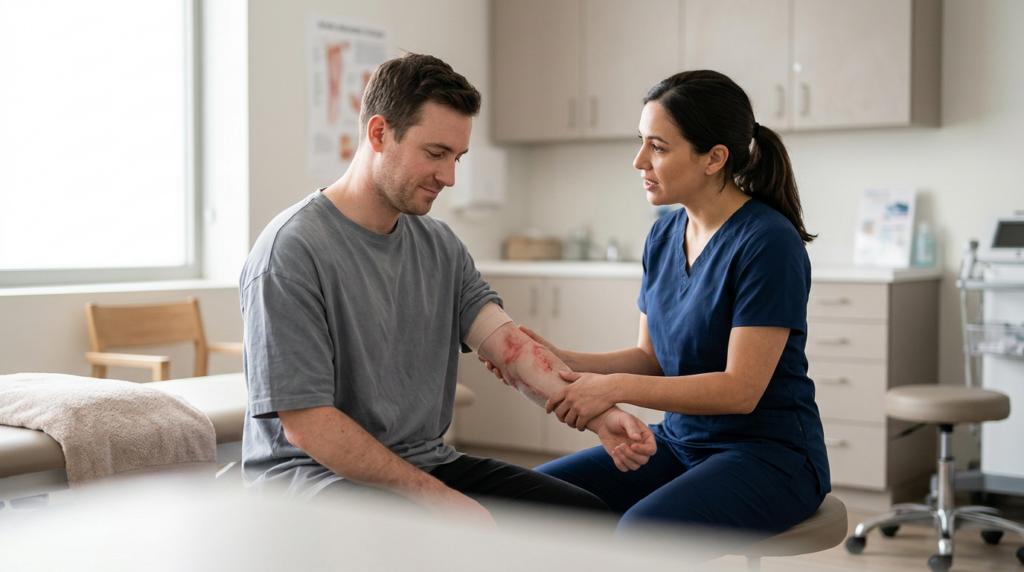
If you or a loved one suffered a severe burn, you don't have to sort through the medical and legal questions alone. Talk it through with our team — the first consultation is free, confidential, and carries no obligation.
Quick answer: the difference between second- and third-degree burns
The difference between a second- and third-degree burn is depth. Depth changes everything.
A second-degree burn damages the outer skin layer (epidermis) and part of the layer beneath it (dermis). According to MedlinePlus, a service of the U.S. National Library of Medicine, these burns destroy the epidermis and part of the dermis.
A third-degree burn destroys both full skin layers and reaches fat and tissue below. MedlinePlus describes third-degree burns as damaging or destroying the deepest skin layer and tissue beneath. A fourth-degree burn goes even deeper, reaching muscle, tendon, and bone—the most severe and life-threatening form.
Here’s how they look and feel:
- A second-degree burn is usually red, wet, swollen, blistered, and very painful.
- A third-degree burn may look white, brown, black, waxy, or leathery—and feel numb in the center.
- A fourth-degree burn appears charred and dry, with visible destruction through skin into deeper tissue.
That numbness is a danger sign, not relief. A deep burn feels numb because it destroyed the nerve endings that sense pain. A burn that hurts less can be worse. This surprises many people, which is why severe burns need rapid evaluation.
We are a personal-injury law firm, not doctors. Nothing here is medical advice. Get emergency care first—always. When you’re ready, we’ll explain your legal options.
How burns are classified: the layers of skin damaged
Doctors grade burns by depth, not just size. Your skin has three layers: the epidermis on the outside, the dermis beneath it, and below that, fat, muscle, and bone.
A burn’s “degree” tells you how many layers are injured. The deeper the damage, the more likely it is permanent. Size and location matter too. Burn teams estimate burned area using the “rule of nines,” which assigns roughly 9% of body surface to the head, each arm, and other regions. This helps them judge fluid needs and severity. A deep burn covering a large area, or one on the face, hands, or airway, is far more dangerous than a small one.
The key idea: shallow burns heal; deep burns often scar permanently, need surgery, or never fully recover.
First-degree burns: surface only
A first-degree burn affects only the epidermis. Skin turns red, dry, and painful, but does not blister. A mild sunburn is the classic example. These usually heal within days and rarely scar. They are minor—not the kind of catastrophic injury our attorneys focus on.
Second-degree burns: what they look like and how they heal
A second-degree burn damages the epidermis and part of the dermis. Clinicians also call this a partial-thickness burn.
These burns look red, wet, and swollen, with blisters, and are often intensely painful. Common causes include scalds from hot liquids, flames, hot surfaces, and chemicals.
Not all second-degree burns behave alike. A shallow (superficial partial-thickness) burn may heal in two to three weeks with little scarring. A deep partial-thickness burn behaves more like a third-degree burn. The Mayo Clinic notes that deep second-degree burns can leave scars and often require skin grafts to heal properly and restore function.
Third-degree burns: full-thickness, permanent damage
A third-degree burn destroys the full epidermis and dermis and can reach the fat below. Skin may look white, brown, black, waxy, or leathery, and the center is often painless because nerves are gone.
A third-degree burn cannot heal on its own. It almost always requires skin grafts—where healthy skin is moved from another part of the body to close the wound—and reconstructive surgery to restore function.
You may hear a newer term: a third-degree burn is now commonly called a full-thickness burn. It’s the same injury, described by depth rather than number.
If your injuries prevent you from working, you may recover lost wages and the diminished earning potential over your lifetime. Talk it through with our team — the first consultation is free, confidential, and carries no obligation.
Fourth-degree burns: beyond the skin
A fourth-degree burn is the deepest and most dangerous. It reaches past the skin into muscle, tendon, and bone. These burns are life-threatening and can destroy so much tissue that amputation becomes necessary to save a life or stop infection. If a burn has led to limb loss, our page on amputation injuries explains what comes next.
From mildest to most severe:
- First degree: outer layer only.
- Second degree: outer layer plus part of the dermis.
- Third degree: both full skin layers and tissue beneath.
- Fourth degree: through the skin into muscle, tendon, or bone.
Side-by-side comparison of burn degrees
| Degree | Modern name | Layers affected | Appearance | Pain | Healing / treatment |
|---|---|---|---|---|---|
| First | Superficial | Epidermis only | Red, dry, no blisters | Painful | Heals in days; rarely scars |
| Second | Partial-thickness | Epidermis + part of dermis | Red, wet, blistered, swollen | Very painful | Weeks; deep ones require grafts |
| Third | Full-thickness | Full epidermis + dermis + tissue below | White, brown, black, leathery | Often numb in center | Multiple surgeries, skin grafts, months of care |
| Fourth | — | Skin into muscle, tendon, bone | Charred, dry | Numb | Life-threatening; may require amputation |
Should you go to the ER for a burn?
Yes—go to the ER or call 911 for any deep, large, or sensitive-area burn. This is general guidance, not medical advice. When in doubt, get seen right away.
Seek emergency care if the burn:
- Covers a large area of the body.
- Is on the face, hands, feet, major joints, or genitals.
- Looks deep, white, leathery, or charred.
- Came from chemicals or electricity.
- Involves smoke or causes trouble breathing (possible airway or inhalation injury—a true emergency).
- Shows signs of infection: spreading redness, pus, or fever.
Serious burns are often treated at focused burn centers verified by the American Burn Association. Teams manage fluids, wound care, and grafting. If a burn is severe, ask whether transfer is appropriate.
For a large second-degree burn or one in a sensitive spot, go to the ER. Don’t pop blisters; cover the area loosely with a clean, non-stick dressing. Follow the treatment team’s instructions, because deep burns need professional wound care.
When a burn injury becomes catastrophic: the long-term medical reality
A burn crosses into catastrophic territory when it causes permanent damage. This includes deep second-, third-, or fourth-degree burns, large surface area, or burns to the face, hands, or airway. It stops being a wound that heals and becomes an injury that reshapes a life.
The recovery path for a severe burn is long, complex, and involves many types of doctors and therapists. Survivors typically face years of treatment involving surgeons, plastic and reconstructive specialists, physical therapists, occupational therapists, psychologists, and wound-care nurses. This is not a single surgery and recovery; it is a lifetime of medical management.
Immediate and acute phase (weeks to months):
- Burn center admission and fluid resuscitation to prevent organ failure
- Surgical debridement (removal of dead tissue)
- Skin grafting—often multiple procedures using autografts (the patient’s own skin from unburned areas) or temporary biological dressings
- Infection prevention and management (a leading cause of death in severe burns)
- Pain management and sedation
Intermediate and rehabilitation phase (months to years):
- Repeated grafting and reconstructive surgeries to improve function and appearance
- Physical therapy to restore joint mobility and prevent contractures (tight scar tissue that locks joints and limits movement)
- Occupational therapy to rebuild ability to perform daily tasks—eating, dressing, self-care
- Scar management using compression garments, silicone treatments, and sometimes laser therapy
- Psychological and psychiatric support for trauma, depression, and adjustment to permanent changes in appearance and function
Long-term and lifelong:
- Chronic pain and nerve damage (neuropathy) requiring ongoing medication
- Scar revision surgeries to improve function and appearance
- Monitoring for infection and skin breakdown
- Continued physical and occupational therapy
- Mental health care for PTSD, body image issues, and social reintegration
- Vocational rehabilitation to return to work (or adapt if return is impossible)
The financial impact is severe. A 2016 study published in Burns found that the average lifetime cost of care for a severe burn survivor exceeded $200,000 in direct medical costs alone. The total economic burden—including lost wages and reduced earning capacity—often exceeds $1 million. For burns affecting a large body surface area or the hands and face, costs are substantially higher.
In the catastrophic injury claims our attorneys handle, future cost of care is often the largest component of a claim. This includes projected surgeries, therapy, medications, home modifications, and lost earning capacity. Courts and juries recognize that a severe burn is not a one-time injury; it is a permanent condition requiring lifelong medical and financial support.
How severe burns happen and when someone else may be responsible
Severe burns often result from someone else’s carelessness. Common causes include:
- Fires and explosions in buildings with inadequate safety systems (broken smoke detectors, blocked exits, faulty fire suppression)
- Truck and vehicle crashes resulting in fuel fires or explosions
- Workplace accidents involving flammable materials, electrical hazards, or chemical exposure
- Defective products (appliances, heaters, or equipment that ignite unexpectedly)
- Premises liability (unsafe conditions on someone else’s property that allow a fire to spread)
When a truck crash sparks a fuel fire, our page on truck accidents explains how those cases work. If a fire spread through an apartment building because the owner ignored fire code violations or failed to maintain safety equipment, the property owner may be liable. When a defective product causes a burn, the manufacturer, distributor, or retailer may share responsibility.
We keep this general on purpose. Every situation is different, and we cannot promise any outcome. But if another party’s negligence caused a serious burn, Florida law may allow you to seek compensation. In Florida, the deadline to file most negligence-based injury claims is generally two years under Fla. Stat. §95.11. Florida also follows a modified comparative-fault rule under Fla. Stat. §768.81. Acting sooner helps preserve evidence and protects your rights.
Not sure what your next step is?
Talk it through with our team — the first consultation is free, confidential, and carries no obligation.
Talk to a catastrophic burn injury lawyer
If you or a loved one suffered a severe burn, you don’t have to sort through the medical and legal questions alone. CHG Personal Injury Lawyers focuses exclusively on catastrophic injury claims, including severe burns. We offer a free, no-pressure case evaluation for burn survivors and their families.
We are a Florida-based firm of licensed attorneys admitted to The Florida Bar. We take catastrophic injury claims nationwide. We serve clients across Florida—including Miami, Orlando, Tampa, and Jacksonville—with support in English and Spanish.
To learn more, visit our severe burn injuries resource. When you’re ready, contact us for a free case evaluation. We cannot promise a specific result, but we can answer your questions and explain your options with care.

Frequently asked questions
What is the difference between second- and third-degree burns?
A second-degree burn damages the outer skin layer and part of the layer below. A third-degree burn destroys both full layers and reaches tissue beneath.
What are third-degree burns called now?
A third-degree burn is now commonly called a full-thickness burn, which describes damage through the entire skin thickness.
Why is a third-degree burn sometimes painless?
A third-degree burn can feel numb because it destroys the nerve endings that sense pain. Less pain can actually mean a deeper, more serious injury.
Can a third-degree burn heal on its own?
No. A third-degree burn usually can’t heal on its own and almost always needs skin grafts and reconstructive surgery.
When does a burn become a catastrophic injury?
A burn becomes catastrophic when it causes permanent damage—such as deep second-, third-, or fourth-degree burns, a large burned area, or burns to the face, hands, or airway. Recovery involves years of multidisciplinary medical care, multiple surgeries, and lifelong support.
What is the cost of treating a severe burn?
Direct medical costs for a severe burn often exceed $200,000 over a lifetime. The total economic burden—including lost wages and reduced earning capacity—frequently exceeds $1 million. This is why future cost of care is a critical part of a catastrophic burn injury claim.
Understanding Third and Fourth Degree Burns
Third-Degree (Full-Thickness) Burns
Destroy the entire outer and middle skin layers and reach the tissue beneath. The skin appears white, charred, or leathery. These burns cause permanent scarring and often require skin grafts and reconstructive surgery.
Fourth-Degree Burns
Extend beyond skin and tissue into muscle and bone. These are the most severe burns and almost always result in permanent disability, amputation, or death. Recovery requires intensive medical care and lifelong treatment.
How They Differ from Lesser Burns
First and second-degree burns damage outer layers only and often heal without permanent scarring. Third and fourth-degree burns destroy tissue completely—the damage is irreversible and life-altering.
Immediate and Long-Term Impact
Victims face severe pain, infection risk, shock, and organ failure in the immediate aftermath. Long-term consequences include permanent scarring, loss of function, psychological trauma, and the need for ongoing medical care.
Critical: Act Quickly
If your burn was caused by someone else's negligence—a workplace accident, a defective product, a fire due to unsafe conditions, or a premises liability incident—evidence must be preserved immediately. Delay can harm your claim.
Why CHG Personal Injury Lawyers Handles These Cases
Catastrophic Injury Focus
We focus exclusively on severe, life-altering injuries including catastrophic burns. We understand the medical, financial, and emotional toll these injuries inflict on families.
Complex Medical Evidence
Burn cases require detailed medical records, burn center documentation, and testimony from physicians who treated you. We know how to build the evidence needed to prove liability and damages.
National Reach
We take burn injury cases nationwide. Whether your injury occurred in Florida or elsewhere, we can help you pursue the claim you deserve.
Compassionate Representation
Burn injuries are traumatic. We listen, we care, and we fight for fair compensation so you can focus on healing and rebuilding your life.
Common Causes of Catastrophic Burn Injuries
Workplace Accidents
Chemical spills, explosions, electrical fires, or failure to follow safety protocols. Employers and contractors have a duty to protect workers.
Defective Products
Faulty appliances, flammable materials, malfunctioning heaters, or unsafe consumer goods that ignite or explode unexpectedly.
Premises Liability
Fires caused by negligent maintenance, blocked exits, missing fire suppression systems, or failure to warn of hazards in apartments, hotels, businesses, or rental properties.
Vehicle Accidents
Fuel tank ruptures, electrical fires, or crashes involving hazardous materials that trap occupants in flames.
Damages You May Recover
Medical Expenses
Emergency care, hospitalization, surgery, skin grafts, reconstructive procedures, physical therapy, and ongoing treatment—often totaling hundreds of thousands of dollars.
Lost Income and Earning Capacity
If your injuries prevent you from working, you may recover lost wages and the diminished earning potential over your lifetime.
Pain and Suffering
Compensation for the physical pain, emotional trauma, scarring, disfigurement, and loss of quality of life caused by your injury.
Disability and Rehabilitation
Costs for adaptive equipment, home modifications, vocational retraining, and ongoing care to help you rebuild independence.