

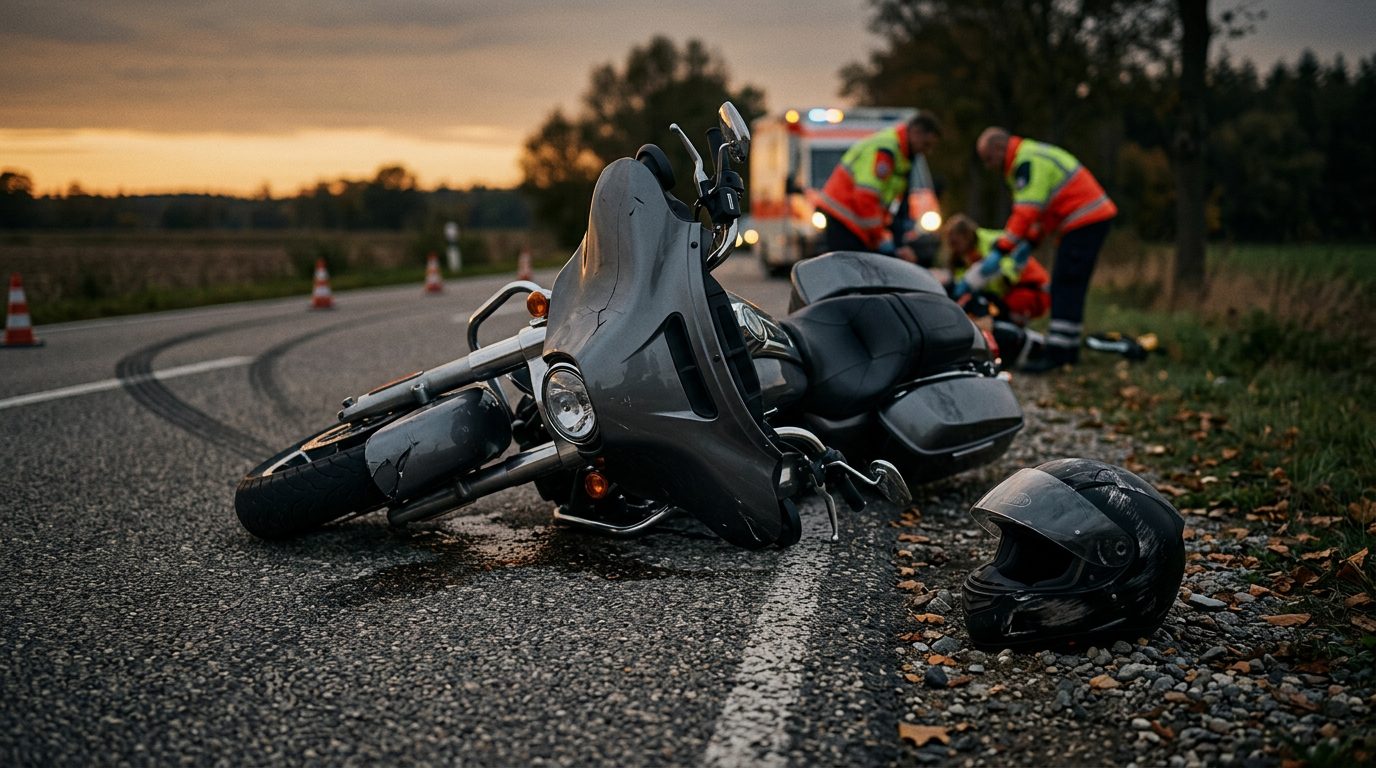
Motorcycle Accidents
What Is the Leading Cause of a Motorcycle Accident?
Understanding the risks and your rights after a crash
By CHG Lawyers · Published September 09, 2026
Leading Cause of Motorcycle Accidents: Driver Negligence & Your Legal Claim
Other drivers failing to see motorcycles is the leading cause of multi-vehicle motorcycle accidents. Motorcycles take up only a fraction of a car’s visual space. They vanish into blind spots, peripheral vision, and gaps between what drivers expect to see.
When another driver doesn’t see you—or fails to check before turning or changing lanes—the results are often catastrophic: spinal cord injury, traumatic brain injury, amputation, or death.
Understanding what caused your accident matters for one critical reason: it determines who was at fault and whether you have a legal claim.

Not sure what your next step is?
Talk it through with our team — the first consultation is free, confidential, and carries no obligation.
Why Motorcycles Disappear: The Leading Cause Explained
Other drivers failing to spot motorcycles is the single most common cause of multi-vehicle crashes. This isn’t rider error. It’s the other driver failing to exercise reasonable care—a legal duty they owed you.
Why motorcycles vanish from view:
A motorcycle takes up roughly one-tenth the visual space of a car. In peripheral vision or from a distance, it disappears. Riders often travel where car drivers cannot see them without deliberately turning their head or checking mirrors.
A rider alongside your vehicle, slightly behind your shoulder, may be completely invisible. Even with a headlight on, a motorcycle fades into the background of oncoming traffic, streetlights, or daylight.
Drivers suffer from expectation bias. On a busy road, drivers expect to see other cars. A motorcycle doesn’t fit that pattern. The driver’s brain fails to register it—even though it’s there.
This is why “I didn’t see the motorcycle” is such a common statement after a crash. It’s often true. But it’s also negligence: failure to exercise reasonable care.
How Driver Negligence Creates Your Legal Claim
Under Florida’s negligence law, a driver has a legal duty to:
- Keep a proper lookout for other vehicles, including motorcycles
- Check mirrors and blind spots before turning or changing lanes
- Maintain control of their vehicle
- Obey traffic laws
When a driver violates these duties and causes your injury, they are negligent. If that negligence caused a catastrophic injury—spinal cord damage, paralysis, traumatic brain injury, amputation, or severe burns—you may have a claim for damages.
The connection is straightforward: negligent conduct → accident → catastrophic injury → legal liability → your right to recover.
The Most Dangerous Motorcycle Accident Scenarios
Left turns at intersections: A car turning left across an oncoming motorcycle’s path is one of the most dangerous scenarios. The driver may not see the motorcycle or may misjudge its speed and distance. These crashes often result in head-on collisions, causing severe spinal cord injury, traumatic brain injury, or death.
Unsafe lane changes: Drivers changing lanes without signaling or checking mirrors strike riders traveling alongside them. A quick lane change leaves no time for a rider to brake or swerve. The rider is often ejected or crushed between vehicles.
Rear-end strikes: A driver following too closely or not paying attention strikes a motorcycle from behind. The rider may be thrown over the handlebars or crushed beneath the motorcycle.
Speeding: Excessive speed reduces a rider’s ability to brake or maneuver. It dramatically increases crash severity. A high-speed impact with another vehicle or fixed object can cause catastrophic injury or death.
Distracted driving: Texting, phone use, eating, or adjusting controls prevent drivers from seeing or reacting to motorcycles. A distracted driver is far more likely to miss a motorcycle and far less likely to brake in time.
Driving under the influence: Impaired drivers have slower reaction times and poorer judgment. They’re more likely to collide with a motorcycle and more likely to cause severe injury.
Single-Vehicle Motorcycle Accidents: Road Hazards and Property Owner Liability
Not all serious motorcycle accidents involve another vehicle. If you crashed because of a pothole, defective pavement, debris left on the roadway, poor road maintenance, inadequate road markings or signage, or gravel or sand on the shoulder—the government entity or property owner responsible for that road may be liable.
Road hazards that cause a rider to lose control can result in the same catastrophic injuries as multi-vehicle crashes.
Have questions about what happened?
Ask our team directly. The first conversation is free, confidential, and there is no obligation to continue.
Understanding the 12-Second Rule (and Its Limits)
The 12-second rule is a defensive riding guideline: maintain a 12-second following distance behind the vehicle ahead.
How it works: Pick a fixed object that the vehicle ahead passes. Count the seconds until your motorcycle reaches that same object. If you count fewer than 12 seconds, you’re too close and should increase your distance.
In normal conditions, a 12-second gap is roughly equivalent to three to four car lengths. In poor weather, at higher speeds, or on slippery surfaces, even more distance is prudent.
This extended distance gives riders more time to perceive a hazard, process what they’re seeing, and brake safely. It’s a proven defensive riding practice.
However, the 12-second rule cannot protect you against driver negligence. Even a rider following the 12-second rule can be struck by a car turning left, changing lanes into your path, or pulling out from a side street. Defensive riding reduces risk but does not eliminate the danger posed by negligent drivers.
Motorcycle Fatality Statistics: The Disproportionate Risk
According to the National Highway Traffic Safety Administration (NHTSA), motorcycle riders face a disproportionate risk of death and serious injury:
- Motorcycle riders are approximately 28 times more likely to be killed in a crash than passenger vehicle occupants.
- Motorcycle riders are 5 times more likely to be injured than passenger vehicle occupants.
- The majority of fatal motorcycle crashes involve a collision with another vehicle, not a single-vehicle crash.
- According to the National Safety Council, many fatal motorcycle accidents occur at speeds above 30 mph, where forces involved are severe enough to cause death or catastrophic injury.
- Helmet use significantly reduces the risk of death and serious brain injury, yet many riders do not wear helmets.
These statistics underscore why driver awareness and safe driving practices are critical to motorcycle safety. When a motorcycle accident does occur, the consequences are often severe or fatal.
Determining Fault: What the Law Says
In multi-vehicle motorcycle accidents, the other driver is often at fault—particularly when the driver failed to see the motorcycle or made an unsafe maneuver.
Under Florida’s comparative negligence statute, fault is determined by examining the specific facts: what each driver was doing, whether they were paying attention, whether they signaled, whether they checked mirrors and blind spots, and whether they violated traffic laws.
Even if you were partially at fault, you may still recover damages. Florida allows recovery as long as you were not more than 50% responsible (Fla. Stat. § 768.81(6)). Your recovery will be reduced by your percentage of fault.
What Happens After a Catastrophic Motorcycle Injury
If you or a loved one has been seriously injured in a motorcycle accident, the immediate priority is medical care. Once you’re stable, you may want to understand what caused the crash and whether another party’s negligence played a role.
If the accident resulted in a catastrophic injury—spinal cord damage, paralysis, traumatic brain injury, amputation, or severe burns—the consequences are life-altering. Medical bills mount quickly. Rehabilitation is long and expensive. You may not be able to work. Your family’s entire future has changed.
Gathering information about the accident is critical:
- Police report and case number
- Witness statements and contact information
- Photos of vehicle damage and the accident scene
- Traffic camera footage (if available)
- Medical records documenting your injuries
- The other driver’s insurance information and policy limits
If the accident caused a death, the timeline and process are different. Under Florida law, a wrongful-death claim must generally be brought within two years, but the family’s legal rights and damages available are substantial. Don’t delay—evidence disappears and memories fade.
An attorney who focuses exclusively on catastrophic injury cases can help you understand your options, investigate what happened, and determine what you may be entitled to recover. Learn more about motorcycle injury compensation and how traumatic brain injury compensation works in these cases.

Want to know where you stand?
Tell us what happened and our team will walk you through the options available to you, at no cost.
Frequently Asked Questions
Can I recover damages if another driver caused my motorcycle accident?
Yes, if another driver’s negligence caused your injury, you may have a claim for damages. These include medical expenses, lost income, pain and suffering, and other losses. The specific amount depends on the severity of your injury, the clarity of fault, and the defendant’s insurance coverage.
What should I do immediately after a motorcycle accident?
Seek medical attention first, even if you feel okay. Then, if safe, move to a clear area, call police, exchange information with the other driver, take photos, and get witness contact information. Do not admit fault or discuss the accident with the other driver’s insurance company without legal advice.
How long do I have to file a lawsuit after a motorcycle accident in Florida?
Under Florida law, you generally have two years from the date of injury to file a personal injury lawsuit. However, don’t wait. Evidence disappears, witnesses become harder to locate, and memories fade.
What if I was partially at fault for the motorcycle accident?
Florida follows comparative negligence law (Fla. Stat. § 768.81(6)). Even if you were partially at fault, you may still recover damages as long as you were not more than 50% responsible. Your recovery will be reduced by your percentage of fault.
What if the accident caused a death?
If a motorcycle accident caused the death of a rider or passenger, the surviving family members may bring a wrongful-death claim. These claims seek damages for the loss of the deceased’s income, companionship, and other losses. The process and timeline are different from personal injury claims. Consult an attorney immediately.
If you’ve been seriously injured in a motorcycle accident—or if a loved one was killed—and you’re trying to understand what happened and whether someone else bears responsibility, we’re here to help. Contact us for a free case evaluation.
Common Causes of Motorcycle Accidents
Operator Error
Loss of control, excessive speed, improper braking, and failure to navigate curves safely account for a significant portion of motorcycle crashes. Inexperienced riders face elevated risk.
Other Drivers' Negligence
Drivers of cars and trucks fail to see motorcycles, make unsafe lane changes, turn left in front of oncoming riders, or follow too closely. These collisions often cause severe injury.
Road and Environmental Hazards
Potholes, debris, loose gravel, oil slicks, and poor road maintenance can cause a motorcycle to lose traction. Rain, fog, and darkness increase accident risk.
Defective Motorcycles
Brake failure, tire defects, steering problems, or design flaws in the motorcycle itself can cause crashes independent of rider behavior.
Motorcycle Injuries Are Often Severe
Because motorcycles offer no protective shell, airbags, or crumple zones, riders face a much higher risk of catastrophic injury—spinal cord damage, traumatic brain injury, amputation, severe burns, and death—even in collisions that would be survivable in a car.
What to Do After a Motorcycle Accident
Seek Medical Attention
Get emergency care immediately, even if you feel okay. Some injuries—internal bleeding, brain injury, spinal damage—are not obvious at first.
Document the Scene
If you are able, take photos of the crash scene, vehicle damage, road conditions, traffic signs, and weather. Get the names and contact information of witnesses.
Report the Accident
Call police and file a report. Request a copy of the accident report number. Do not admit fault or sign anything except for police and medical personnel.
Preserve Evidence
Keep all medical records, repair estimates, photos, and communications. Do not discard the motorcycle or allow it to be scrapped without legal advice.
Why CHG Personal Injury Lawyers Focuses on Motorcycle Accident Cases
Experience with Catastrophic Injuries
We focus exclusively on serious and catastrophic injuries—including spinal cord damage, traumatic brain injury, amputation, and severe burns—that result from motorcycle crashes.
Thorough Investigation
We investigate the cause of your accident, identify all liable parties, and gather evidence—police reports, witness statements, vehicle data, and expert analysis.
National Reach, Local Knowledge
Based in Florida and handling cases nationwide, we understand motorcycle accident law in your jurisdiction and know how to value your claim fairly.
Empathetic Representation
We understand that a motorcycle accident can change your life. We listen to your story and fight for fair compensation for your medical care, lost income, and pain and suffering.