

Spinal Cord Injuries
How Doctors Diagnose a Spinal Cord Injury
MRI, CT scans, and neurological testing tell the story of a spinal injury — and that story matters for both your recovery and your claim. Here's what to expect, in plain language.
By CHG Lawyers · Published August 05, 2026
How Doctors Diagnose a Catastrophic Spinal Cord Injury: The Bedside-to-Grading Journey
Someone you love was just brought into a trauma bay after a serious crash. You are probably standing in a hallway. You keep hearing words like “C5,” “incomplete,” and “ASIA grade.” None of them mean anything to you yet.
This guide follows the diagnosis in the order you will live through it. We start at the ambulance. We end at the moment a doctor sits down and grades the injury.
We are a personal-injury law firm, not a medical provider. Nothing here is medical advice. Treatment decisions belong to your doctors. Our goal is simple. We want to help you understand what is happening at the bedside. We also want you to know why the record being built right now matters — both for recovery and for any future claim.
Not sure what your next step is?
Talk it through with our team — the first consultation is free, confidential, and carries no obligation.
Why these first hours carry so much weight
Car crashes are the leading cause of spinal cord injury in the United States. Falls are the second. This comes from the National Spinal Cord Injury Statistical Center (NSCISC) at the University of Alabama at Birmingham. It is the federally chosen tracker of these injuries. The NSCISC also estimates about 18,000 new spinal cord injuries happen nationwide each year.
In the catastrophic cases our attorneys handle, the record made in the first hours often becomes the most important set of facts. It does two things at once. It guides your loved one’s care. Later, it anchors any injury or wrongful-death claim your family may bring. Here is the order in which that record gets built.
Step 1 — The scene: they treat the spine as broken until proven otherwise
Before anyone confirms anything, paramedics assume the spine is hurt. That is why they fit a stiff neck collar. They also secure the head and body before moving the patient. Clinicians call this spinal motion restriction (the older term was “immobilization”).
The logic is simple and protective. A partial injury can become a complete one if a broken or unstable spine shifts during transport. So they lock it in place first and ask questions later.
Step 2 — The trauma bay: airway, breathing, circulation, then the neck
At the hospital, the team runs the ABCs first — airway, breathing, circulation. Then they turn to the spine. This does not mean they are ignoring the injury. A high neck injury can weaken the muscles a person needs to breathe. So protecting breathing is protecting the spinal cord patient.
Only after the basics are stable does a physician do the emergency neurological exam. If your loved one is awake, expect this to happen fast and often.
What the bedside neurological exam actually checks
The exam is hands-on and low-tech. It drives every decision that follows:
- Motor function — the doctor asks the patient to push, pull, and squeeze. This tests muscle groups from the shoulders down to the toes and scores strength.
- Sensation — light touch and a pinprick are tested at set points down both sides of the body.
- Reflexes and rectal tone — this includes a check of anal sphincter tone and feeling. It sounds invasive, but it tells doctors whether any signal is crossing the injury.
- The level where function stops — the lowest point on the body with normal feeling and movement.
That last finding points to the likely level of injury along the spine. That may be the neck (cervical, C1–C8), the mid-back (thoracic, T1–T12), or the lower back (lumbar/sacral). The higher up the neck, the more of the body is affected. That is why a C4 injury is discussed so differently from an L2.
Step 3 — CT: the fast bone answer
A CT scan (computed tomography, layered X-ray images) is almost always the first scan in trauma. It is fast and shows bone clearly. In the trauma bay, speed is everything. The CT answers one urgent question. Is a broken or shifted bone pressing on the spinal cord right now?
That answer often decides whether the patient goes to surgery within the hour. A CT shows fractures, dislocations, and bleeding around the spine in minutes. But it has a real limit. It does not show the spinal cord itself clearly, because cord tissue is soft. For that, doctors turn to MRI.
Have questions about what happened?
Ask our team directly. The first conversation is free, confidential, and there is no obligation to continue.
Step 4 — MRI: the detailed look at the cord
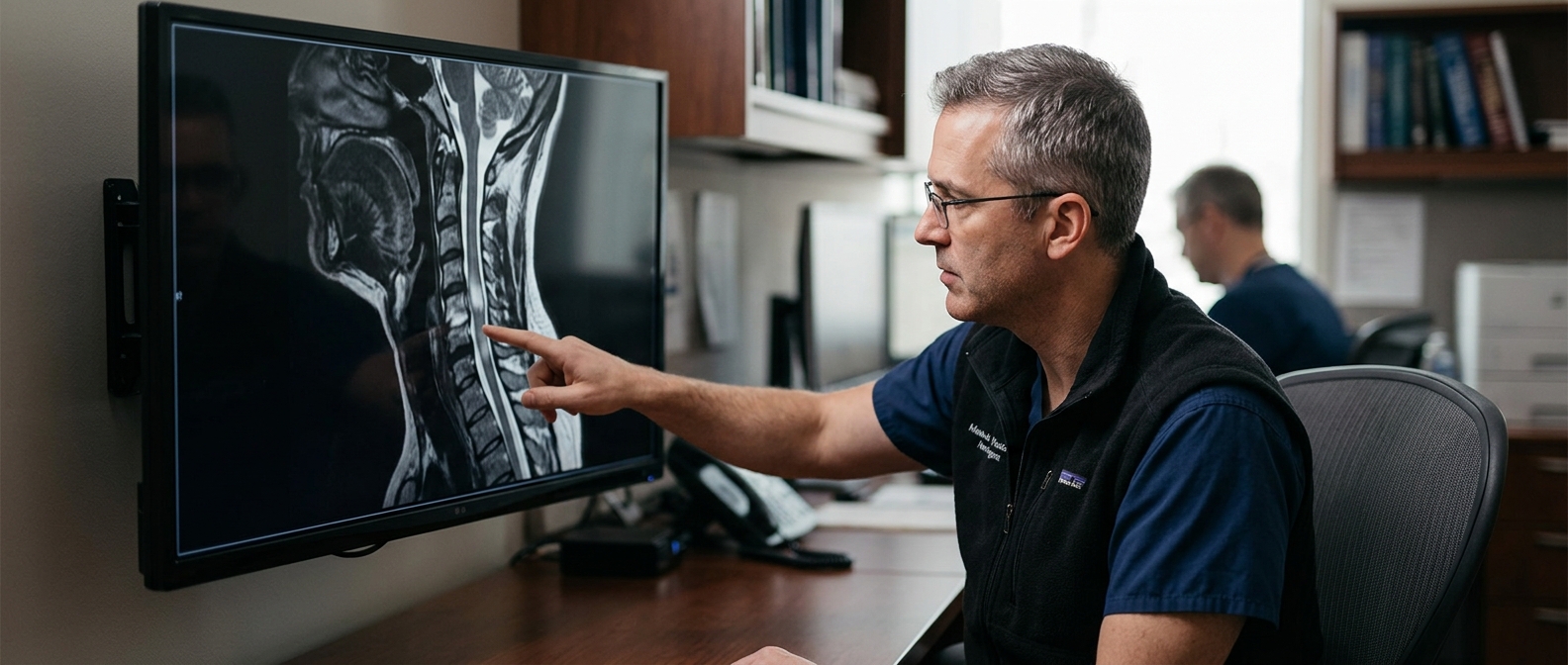
An MRI (magnetic resonance imaging, which uses a strong magnet and radio waves instead of X-rays) is the key test for seeing the spinal cord, discs, and nerves. It shows what CT cannot. On MRI, doctors look for:
- Cord compression — something physically squeezing the cord, such as a herniated disc, a bone fragment, or a hematoma (a pool of blood).
- Contusion — bruising of the cord tissue.
- Edema and hemorrhage — swelling and bleeding inside or around the cord.
These findings speak directly to how severe and how permanent the injury may be. A cord that looks intact tells a very different story than one that is bruised, swollen, or bleeding across several segments.
An MRI takes longer than a CT. The patient also has to be stable enough to lie still in the scanner. That is one reason a CT usually comes first.
CT vs. MRI: they don’t compete
Think of it as two different questions. CT answers the bone question fast. MRI answers the cord question in detail. In a catastrophic case, doctors nearly always use both. They use CT to rule out a surgical emergency. They use MRI to map what happened to the cord and nerves. Neither one alone gives the full picture.
Step 5 — Grading: putting a name to the severity
Once the imaging and the exam come together, doctors classify the injury. This way, every specialist describes it the same way. The first and most important difference is complete versus incomplete:
- Complete — no motor or sensory function below the injury, including the lowest sacral segments.
- Incomplete — some function remains below the level of injury. Even a small amount changes the talk about recovery.
The ASIA Impairment Scale, in plain terms
The standard tool is the ASIA Impairment Scale (AIS). It comes from the American Spinal Injury Association and its International Standards for Neurological Classification of Spinal Cord Injury (ISNCSCI). It grades the injury from A to E:
- A — complete; no sensory or motor function in the sacral segments.
- B — sensory incomplete; feeling but no movement below the level.
- C — motor incomplete; movement below the level, but most key muscles are weak (less than half-strength).
- D — motor incomplete; movement below the level with at least half-strength in most key muscles.
- E — normal on testing.
Doctors pair the grade with the neurological level (the lowest normal segment). This creates a shared shorthand — for example, “C6 AIS B.” That one phrase tells any rehab specialist across the country roughly what a person can do and what recovery might look like.
The tests that sometimes get added
When the picture is unclear, doctors may add:
- Nerve conduction studies (NCS) — how fast signals travel along a nerve.
- Electromyography (EMG) — the electrical activity of muscles.
- Somatosensory evoked potentials (SSEPs) — whether signals reach the brain from the limbs.
They also repeat the neurological exam over hours and days. This is not indecision. Spinal shock — a temporary shutdown of reflexes right after injury — can hide what function will return. Swelling also peaks and then fades.
Repeating the exam after spinal shock ends gives a truer read of the lasting injury. That is why the honest answer to “will this be permanent?” often takes days or weeks, not hours.
What the results tell your family about the future
The finished diagnosis brings together the level, the AIS grade, and the imaging. Together, they let doctors speak honestly about the road ahead. This includes the expected path for movement, sensation, breathing, and independence.
When a doctor calls an injury “permanent,” that is a medical conclusion. It is drawn from the exam, the scans, and how the injury behaved over time. It is not a guess.
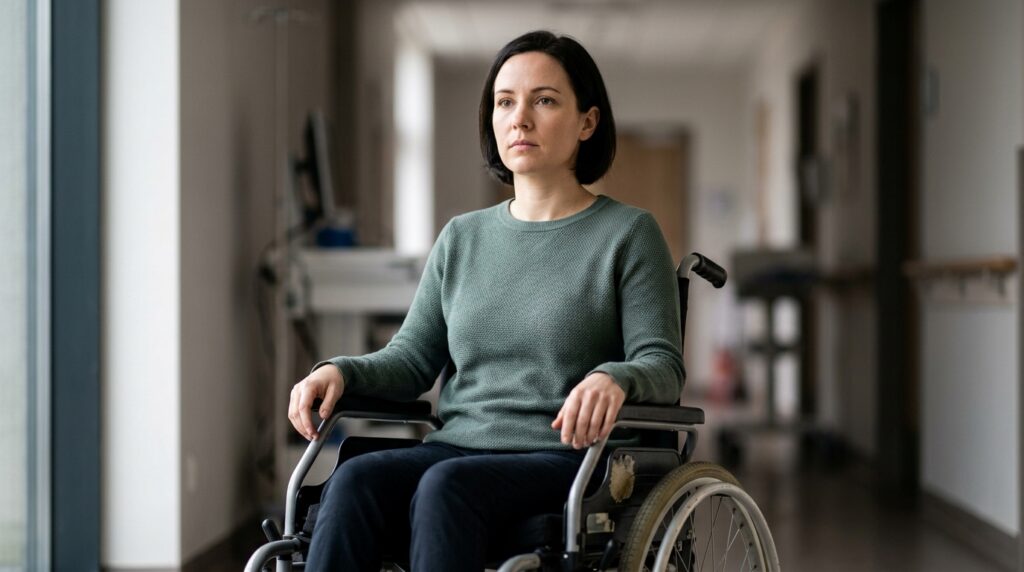
After the acute phase, physiatrists (rehabilitation physicians) and therapists take over. In catastrophic cases, a life-care planner may build a projection of lifetime needs. That may include therapy, a power wheelchair, home changes, and attendant care. This matters for the patient’s health. Later, it matters for valuing a claim accurately.
We want to be honest and gentle. Outcomes vary. Two injuries at the same level can heal very differently. Your medical team is the only source for your loved one’s specific outlook.
Why the complete record protects your family
The record proves two things: what happened and how serious it is. Imaging, exam scores, and specialist reports together tell the full story.
Gaps cause real problems later. A missed follow-up or a delay in care can make a truly catastrophic injury look milder than it is. That makes its true impact harder to prove when it counts.
Here are practical steps families can take now:
- Request copies of every scan, exam note, and specialist report. You have a right to them.
- Keep a journal of symptoms, pain, and daily limits as they change.
- Follow through on every referral to a specialist or therapist.
- Save appointment records, including dates and provider names.
Maybe your family is working to connect an injury to the crash that caused it. Our guide on proving a back or neck injury was caused by the accident explains what evidence tends to matter most.
Want to know where you stand?
Tell us what happened and our team will walk you through the options available to you, at no cost.
How the diagnosis connects to a legal claim
The medical evidence that documents what happened is the same evidence that supports a claim. That claim can cover future medical costs, lost income, and the loss of quality of life.
Catastrophic spinal cord injuries usually trace to a specific cause. Often it is a serious crash, such as a truck accident, where the forces are enormous. It can also be a fall or a violent incident on unsafe property. The diagnosis helps tie the injury to that cause.
We can’t guarantee any result, and we won’t pretend otherwise. Two Florida rules matter early:
- Comparative fault. Under Fla. Stat. § 768.81, a person found more than 50% at fault for their own injury generally cannot recover damages.
- Deadline to file. For negligence claims that accrued on or after March 24, 2023, the deadline is generally two years, under Fla. Stat. § 95.11. Every case turns on its own facts.
Our attorneys are licensed and admitted to The Florida Bar. If your family wants to understand its options, you can request a free case evaluation.
For related reading, see our resources on paralysis (paraplegia and quadriplegia) claims and spinal cord injury claims.

Frequently asked questions
How are spinal injuries diagnosed if the patient is unconscious?
Doctors rely on CT and MRI, plus reflexes and physical responses. An unconscious patient can’t report movement or feeling. The full neurological exam and ASIA grading are repeated once the person is awake and can respond.
Is an MRI or a CT scan better for a spinal cord injury?
They do different jobs. CT is faster and best for bone and bleeding, so it comes first in an emergency. MRI shows the spinal cord and soft tissue in detail. Doctors usually use both.
How long before doctors know if paralysis is permanent?
There is no single answer. Spinal shock and swelling can hide what function will return. So doctors usually repeat exams over days or weeks before drawing firm conclusions.
Can a spinal cord injury show up on X-ray alone?
An X-ray can show broken or shifted bones. But it can’t clearly show the cord itself. A suspected spinal cord injury needs CT or MRI to assess fully.
What is an ASIA grade, and why do I keep hearing it?
The ASIA Impairment Scale grades severity from A (complete) to E (normal). Paired with the injury level, it gives every treating specialist a shared, precise description of your loved one’s injury.
This article is educational and is not legal or medical advice. Reading it does not create an attorney-client relationship. Treatment decisions belong to your doctors. For guidance on your specific situation, contact a licensed attorney.
The Main Tools Used to Diagnose a Spinal Injury
CT Scan
A CT scan uses X-rays to build detailed images of the bones of the spine. It's fast and excellent for spotting fractures, dislocations, and bone damage — often the first imaging done in an emergency.
MRI
An MRI uses magnetic fields to show soft tissue: the spinal cord itself, nerves, discs, ligaments, bleeding, and swelling. It reveals cord damage that a CT scan can miss.
Neurological Exam
Doctors test movement, sensation, strength, and reflexes to map exactly where function is affected — and how severely — after a suspected cord injury.
ASIA Grading
The ASIA Impairment Scale classifies an injury as complete or incomplete and tracks changes over time. It's a standard measure used across spinal cord medicine.
Keep Every Scan, Report, and Bill
Imaging results and neurological findings are central evidence in a catastrophic-injury case. Save copies of MRI and CT reports, discharge paperwork, and medical bills — and don't sign anything from an insurer before speaking with an attorney.
Why the Diagnosis Matters for Your Claim
It Documents the Harm
Objective imaging and exam findings help establish the true extent of a permanent, life-altering injury.
It Guides Long-Term Care
Test results shape the treatment plan, rehabilitation, and the future medical needs a claim must account for.
It Speaks for the Unconscious
When a patient can't respond, CT, MRI, and reflex testing provide critical answers until a full exam can be repeated.
We Work With the Records
Our attorneys review medical evidence with your care team's findings to build a clear picture of what happened and what's needed.