

Spinal Cord Injuries · Florida & Nationwide
What It Really Costs to Make a Home Accessible After a Spinal Cord Injury
A permanent spinal cord injury changes where and how you can live. Understanding the true cost of home modifications is a critical part of any full-value claim. We help catastrophic-injury survivors and their families account for every dollar.
Why Families Turn to CHG
Licensed
Florida Bar–admitted attorneys
Nationwide
Catastrophic cases across the U.S.
Bilingual
English & Spanish resources
Focused
Only serious, life-altering injuries
By CHG Lawyers · Published August 08, 2026
Home and Vehicle Modifications After a Catastrophic Spine Injury: Costs and Compensation
Home changes after a spinal cord injury can cost a few thousand dollars. That covers ramps and grab bars. A full accessible remodel with a ceiling lift can cost tens of thousands. Adapting a car can add tens of thousands more.
These are not upgrades. They are the real cost of living with a permanent, life-altering injury. And you can often recover these costs when someone else’s carelessness caused the harm.
Maybe you or someone you love now uses a wheelchair after a spinal cord injury. Your house and your car may no longer fit your daily life. This guide explains what these changes cost. It explains why the costs keep coming back over a lifetime. It shows how the level of your injury sets the size of the work. And it explains how it all fits into an injury claim.
We won’t quote a dollar figure or promise a result. Every spine injury, every home, and every case is different.
Not sure what your next step is?
Talk it through with our team — the first consultation is free, confidential, and carries no obligation.
The level and completeness of the injury drive everything
Two people can both “use a wheelchair” yet need very different homes. Why? It depends on where the spinal cord was hurt, and how badly.
Doctors sort spinal cord injuries using the International Standards for Neurological Classification of Spinal Cord Injury (ISNCSCI). This gives an ASIA Impairment Scale grade (AIS A through E). It also gives a neurological level. That is the lowest part of the spine that still works normally.
That one medical finding tells you a lot. It shows how much of the body still works. So it shows how much a home has to do for the person.
Paraplegia comes from injury at the thoracic, lumbar, or sacral levels (roughly T1 and below). The arms and hands usually work normally. A person with paraplegia often has the upper-body strength to move on their own. They can push a manual wheelchair and drive with hand controls. Their home usually needs structural work. That means a no-step entrance, wider doorways, a roll-in shower, lower counters, and roll-under sinks.
Quadriplegia (tetraplegia) comes from injury at the cervical (neck) levels (C1–C8). It affects the arms, hands, and trunk as well as the legs. The higher the injury on the neck, the greater the need.
- A C6–C7 injury may leave some wrist and shoulder use.
- A C1–C4 injury may need a power wheelchair run by head or breath controls.
- The highest injuries may need a ventilator (a machine that helps with breathing).
These homes need far more. They often need:
- Ceiling track lifts to move between bed, chair, shower, and toilet
- Environmental control units that let a person work lights, doors, and the thermostat by voice or a single switch
- Space and power for a caregiver and medical equipment
An AIS “A” (complete) injury usually means more permanent need than an incomplete “D” injury. With a “D,” some function stays below the injury level. So it is key to match the AIS grade and neurological level to the exact home work. A strong claim documents this link. This is also where generic cost estimates fall apart.
The Mayo Clinic notes that spinal cord injuries can cause permanent loss of movement and feeling below the injury. This creates an ongoing need for adaptive equipment and care. And this is not rare. The Christopher & Dana Reeve Foundation reports that nearly 1 in 50 people in the U.S. live with some form of paralysis.
Home modification costs: what to expect, category by category
Most families face several of these projects at once. What each one costs depends on your region and your current layout. A single-story home needs less work than a two-story home with narrow halls. As noted above, your injury level matters too.
Entrances and getting inside
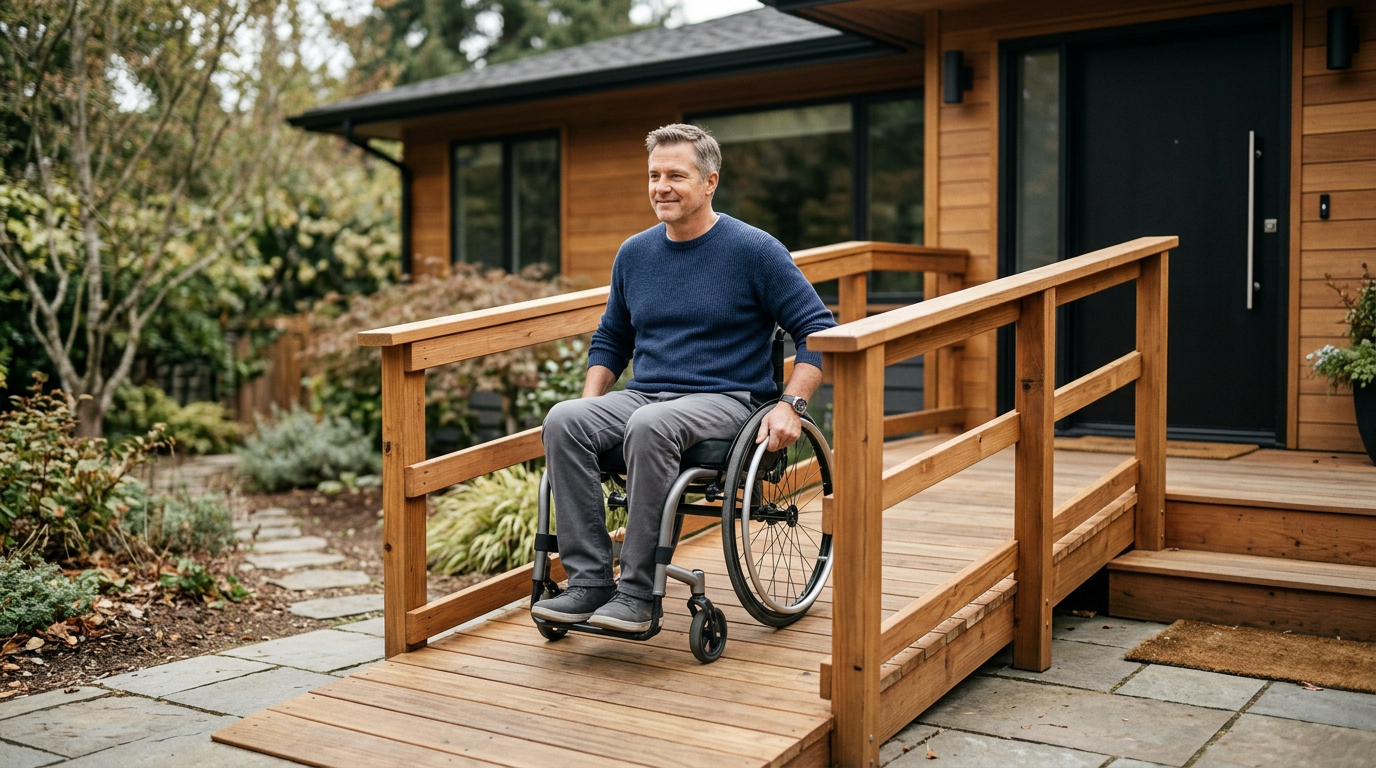
- A wheelchair ramp or graded walkway (building codes usually call for a gentle slope, so even a small rise needs a long ramp)
- A platform or stair lift for multi-level homes
- A wide, level threshold you can roll over
Doorways, halls, and floors
Standard interior doors are often too narrow for a wheelchair. So doorways and tight hallways get widened for room to pass. Thick carpet is usually replaced with hard, smooth flooring. This makes it easier to push a chair and removes trip hazards.
Bathrooms — usually the biggest project
- A roll-in (curbless) shower big enough for a chair or a caregiver
- A toilet at transfer height, with grab bars
- A roll-under sink and a tilted or lowered mirror
- For higher-level injuries, a ceiling lift over the toilet and shower
Kitchens
Lower counter sections, roll-under sinks and cooktops, and appliances moved within seated reach. This lets a person cook and clean safely.
Environmental controls and lifts (higher-level injuries)
Ceiling track lift systems and environmental control units, as described above, matter a great deal. For many people with quadriplegia, they are the difference between depending on others and having some independence.
We won’t publish a fixed price. An honest number depends on your region, home, and injury. The right step is a professional accessibility assessment and written contractor estimates. Be careful with any source that guarantees an exact renovation cost without seeing your home.
Vehicle modifications and accessible transportation
Some people can still drive — often someone with paraplegia. They may add hand controls, a transfer seat, or modified steering to a car they already own.
Others cannot drive, or they use a power chair. This is more common with quadriplegia. They usually need a fully converted wheelchair van with a power lift or ramp and a lowered floor. These conversions can cost more than the vehicle itself.
The expense comes back again and again. Adaptive equipment needs upkeep. Vehicles wear out and must be replaced over a lifetime. Many people also lose the ability to use a standard car or ordinary transit. This reshapes daily life.
Ongoing and lifetime costs — not a one-time bill
A single estimate almost always falls short of a permanent injury. If you move, a new home may need changes from scratch. Lifts, ramps, and control systems wear out over decades. Needs also change with aging and as a condition evolves.
That is why serious cases rely on a life care plan. This is a detailed report from medical and vocational experts. It projects every future need across a person’s expected lifetime — care, equipment, home and vehicle changes, and medical treatment.
In the catastrophic cases our attorneys handle, a well-built life care plan matters. It is often the difference between capturing true lifetime costs and settling for a number that runs out far too soon.
You can learn more on our page about future care costs and life care plans.
Have questions about what happened?
Ask our team directly. The first conversation is free, confidential, and there is no obligation to continue.
Can you recover these costs in an injury claim?
Home and vehicle modifications are a recognized type of economic damages. That means the measurable money harm caused by an injury. You can recover them when another party’s carelessness caused a permanent spine injury. Economic damages also include medical bills, lost income, and future care.
Because a spine injury is permanent, future costs are often the largest part of the claim. Whether you recover, and how much, depends on the facts and evidence.
These injuries come from many kinds of serious harm. A truck accident can cause a catastrophic spine injury in an instant, as can other severe crashes.
They can also come from a violent attack. Maybe you were assaulted, shot, robbed, or otherwise hurt on someone else’s property. That could be an apartment complex, a parking lot or garage, a hotel, a bar, a gas station, or a store. Maybe it happened because the owner failed to provide reasonable safety measures. That could mean working locks and gates, lighting, cameras, or security staff. If so, you may have a claim against that property owner. The law calls this negligent security, a form of inadequate-security premises liability. Read more on our negligent security page.
We can’t promise any specific result, and Florida law shapes recovery. Under Fla. Stat. §768.81, Florida follows modified comparative negligence. A person found more than 50% at fault generally recovers nothing. There is also a deadline. Under Fla. Stat. §95.11, most Florida negligence claims must be filed within two years for causes of action that arose on or after March 24, 2023.
How these costs get proven
You prove modification costs with documents, not by naming a number. The core proof usually includes:
- Contractor estimates and accessibility assessments for the exact work your home needs
- A life care plan from a qualified life care planner
- Physician records tying your neurological level and AIS grade to the equipment and care required
- An economist’s analysis that puts future costs in today’s dollars (present value)
- Receipts and invoices for work already paid
Medical evidence connects everything. It links your documented injury to the changes you truly need. That injury is classified under the outcome standards tracked by the National Spinal Cord Injury Statistical Center. Expect the other side to argue about the cause or a pre-existing condition. Clear, consistent records answer those arguments before they take hold.
When the injury is fatal: costs in a wrongful-death claim
Sometimes a catastrophic spine injury leads to death. Then the family may pursue a wrongful-death claim. Costs the family paid before their loved one passed — modifications, care, and medical treatment — may be recoverable as part of that claim. Other economic losses may be recoverable too.
A death is the most catastrophic outcome of all. The focus here is on what a grieving family can do next to address the financial weight left behind. It is not about reliving the loss.
Talk to a catastrophic injury attorney about your situation
You don’t have to guess whether these costs are recoverable. A free case evaluation can help you understand your options after a permanent spine injury.
CHG Personal Injury Lawyers represents people with catastrophic injuries in Florida and nationwide, including Miami, Orlando, Tampa, and Jacksonville. We serve clients in both English and Spanish. So a family facing a spinal cord injury can get clear answers in the language they know best, wherever they are. We can explain how home and vehicle modification costs may fit into a claim built on your facts.
No pressure, no promise of a specific outcome — just clear answers. For the bigger picture, see our pillar page on catastrophic back and neck injuries. When you’re ready, contact us for a free case evaluation.
Want to know where you stand?
Tell us what happened and our team will walk you through the options available to you, at no cost.
Frequently asked questions
Does quadriplegia require more home modifications than paraplegia?
Usually, yes. Paraplegia (injury at T1 and below) often keeps arm and hand function. So the home needs structural work — ramps, wider doors, a roll-in shower, lower counters. Quadriplegia (a neck injury affecting arms, hands, and trunk) often also needs ceiling lifts, environmental control units, and space for caregivers and equipment. Your ASIA grade and neurological level drive the specifics.
How much does it cost to make a home wheelchair accessible?
It can range from a few thousand dollars for ramps and grab bars to tens of thousands for a full accessible remodel with a lift. Region, home size, and injury level all affect the total. That is why a written assessment matters.
How much does a wheelchair-accessible van cost?
A fully converted van with a power lift and lowered floor can cost more than a standard vehicle on its own. A professional evaluation gives the most accurate estimate for your needs.
Can I recover home and vehicle modification costs in an injury claim?
Yes. They are a recognized type of economic damages when another party’s carelessness caused your permanent injury. Recovery depends on the facts and evidence, and no result is guaranteed.
How long do I have to file a spinal cord injury claim in Florida?
Under Fla. Stat. §95.11, most Florida negligence claims must be filed within two years for causes arising on or after March 24, 2023. Talk to an attorney promptly to protect your rights.
Don't Settle Before You Know the Lifetime Cost
Home modifications are often needed again and again as your condition, equipment, and family situation change. An early settlement that only covers the first ramp or bathroom remodel can leave you paying for decades of future work out of your own pocket. Speak with an attorney before accepting any offer.
Common Home Modifications and What Drives Their Cost
Structural Access
Ramps, widened doorways, and reinforced flooring so a wheelchair can move safely through the home. Costs rise with the size of the home and the amount of framing that must be rebuilt.
Bathrooms
Roll-in showers, grab bars, accessible sinks, and lowered fixtures. Bathrooms are among the most complex and expensive rooms to convert because of plumbing and waterproofing work.
Lifts & Controls
Ceiling track lifts and environmental control units matter most for quadriplegia, where arm and hand function is limited. These add significant equipment and installation costs.
Space for Care
Room for caregivers, medical equipment, and turning space. Some families need additions or a move to a different home entirely — a cost that belongs in the claim.
How We Help Document These Costs in Your Claim
Life-Care Planning
We work with medical and life-care experts to project the modifications you'll need now and over your lifetime, based on your neurological level and ASIA grade.
Family-Centered
Paraplegia and quadriplegia affect the whole household. We account for caregiver needs and the daily realities your family will live with.
Full Accounting
Ramps, bathrooms, lifts, and possible relocation — we push to have the complete cost of accessible living recognized, not just the obvious first expenses.
One Point of Contact
Reach a member of our team when you have questions. We explain your options in plain language, in English or Spanish.