


Spinal Cord Injury Claims
The Medical Evidence That Proves a Spinal Injury Claim
A spinal cord injury can change your life in an instant. To recover full compensation, the right medical proof has to show the injury is real, severe, permanent, and caused by the accident. Here is what that evidence looks like.
Why Families Turn to CHG
Nationwide
Catastrophic injury cases accepted
Florida Bar
Licensed, admitted attorneys
EN / ES
Bilingual client support
Free
No-cost case evaluation
By CHG Lawyers · Published August 08, 2026
What Medical Evidence Proves a Catastrophic Spine Injury? MRIs, Records, and Experts
The strongest proof for a spinal injury claim comes from your medical file. That means MRI, CT, and X-ray images. It also means hospital and surgical records, nerve tests, and opinions from your doctors. Together, these answer three questions. Is the injury real? Is it severe and permanent? Did the accident cause it?
Maybe you or someone you love has a catastrophic spine injury. If so, you’re facing a flood of medical terms and paperwork. This guide explains, in plain language, what proof matters and why. It’s general information. It is not legal or medical advice about your case. For the bigger picture, see our overview of catastrophic back and neck injuries.

If you're facing this loss, please know you don't have to gather evidence alone. Talk it through with our team — the first consultation is free, confidential, and carries no obligation.
Why medical evidence is the foundation of a spinal injury claim
The medical record tells the story your body can’t tell on its own. A jury or insurance adjuster can’t feel your pain. But they can see a burst fracture on a CT scan. They can see a bruised cord on an MRI. Objective proof carries weight that words alone can’t.
Here’s good news for overwhelmed families. Much of this evidence already exists. It was created the moment you reached the emergency room. Your job — with help — is to gather it, keep it, and connect the dots.
Imaging: MRIs, CT scans, and X-rays
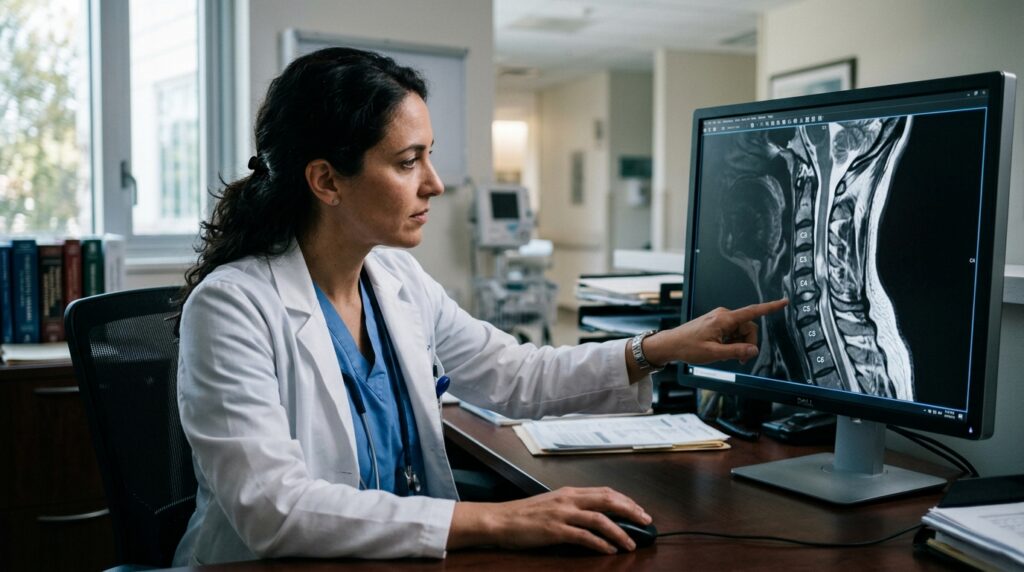
Imaging is often the clearest proof of a catastrophic spine injury. It shows the damage directly. Each scan reveals something different.
What each scan shows
An MRI (magnetic resonance imaging) shows soft tissue. That means the spinal cord itself, pinched nerves, and injured discs and ligaments. When the cord is bruised, swollen, or torn, an MRI usually shows it. This makes it the key test for many serious spine injuries.
A CT scan shows bone in detail. It reveals fractures, dislocations, and crushed vertebrae. A plain X-ray gives a fast first look at how the spine lines up. Doctors call this its alignment. In a truck crash or a bad fall, doctors usually start with X-ray and CT in the ER. Then they order an MRI to see the cord.
Why timing and repeat scans matter
Scans taken soon after the accident tie the injury to that event. Repeat scans over weeks or months are called serial imaging. They show whether the damage is healing or is here to stay. That difference matters. A permanent injury changes the value of a claim.
A radiologist reads these images and writes a report. It should line up with what your treating doctor finds. When imaging and diagnosis agree, your proof gets stronger. The Mayo Clinic explains how spinal cord injuries can cause lost movement, changed feeling, and loss of bladder and bowel control. Those are the exact effects imaging helps confirm.
Medical records that document severity and permanence
Imaging shows the damage. Records show the human cost.
Start with the emergency and hospital admission records. These establish the injury right after the crash. Next come the surgical and operative reports. These are the surgeon’s own notes from procedures. One example is a spinal fusion, which joins vertebrae. Another is a laminectomy or decompression, which relieves pressure on the cord. These notes show exactly what the surgeon saw and did. The rods and screws also show up on later imaging.
Then come the ongoing records. These include physician notes, neurology reports, rehabilitation charts, and physical-therapy logs. Pay attention to any record that describes function. How far can you walk? Do you have feeling in your legs? Can you control your bladder and bowel? These details show how the injury reshapes daily life.
One practical point. Consistent, complete records help you. Gaps hurt. Follow your prescribed treatment and keep your appointments. When a chart shows missed visits, the insurer may argue you weren’t really hurt. That’s rarely fair, but it happens.
Diagnostic tests beyond imaging
Nerve and muscle tests measure function, not just structure. They can prove damage a picture alone might miss.
A nerve conduction study measures how well signals travel through your nerves. An EMG (electromyography) measures the electrical activity in your muscles. Together they document nerve and muscle damage in a clear, objective way.
Then there’s the neurological exam. It grades strength, reflexes, and sensation. For spinal cord injuries, doctors use the ASIA Impairment Scale. It is part of the International Standards for Neurological Classification of Spinal Cord Injury, published by the American Spinal Injury Association. In plain language, it is a letter grade from A to E. It measures how much movement and feeling remain below the level of injury:
- AIS A — complete: no movement or feeling remains in the lowest sacral segments (S4–S5).
- AIS B — sensory incomplete: some feeling remains below the injury, but no movement.
- AIS C — motor incomplete: some movement returns. But more than half the key muscles below the injury are too weak to move against gravity.
- AIS D — motor incomplete: movement returns. At least half the key muscles below the injury can move against gravity.
- AIS E — normal: movement and feeling test normal (in someone who had earlier problems).
This gives every doctor, insurer, and juror one shared vocabulary. It describes how severe the injury is. Where it falls on the scale is often central to a catastrophic claim.
Medical experts and what they add
Experts turn raw records into clear conclusions a claim can use.
Your treating physicians and surgeons are usually the most believable voices. They explain the diagnosis. They explain the prognosis — the likely future. And they say whether the injury is permanent. Because they cared for you directly, their opinions carry real weight.
Some cases also need an independent specialist. This could be a neurologist or a physiatrist, which is a rehabilitation-medicine doctor. This expert reviews the file and explains causation — how the accident led to the injury.
A life-care planner is often critical in catastrophic cases. This expert projects your future needs over a lifetime. Those needs include surgeries, therapy, home changes, wheelchairs, and caregivers. To show how lasting and costly these injuries are, the National Spinal Cord Injury Statistical Center keeps national data on spinal cord injury. The Christopher & Dana Reeve Foundation publishes statistics on living with paralysis. A serious spine injury also affects your ability to earn a living. That ties into lost earning capacity.
Not sure what your next step is?
Talk it through with our team — the first consultation is free, confidential, and carries no obligation.
Connecting the injury to the accident (causation)
Causation means proving the accident caused your injury. It’s often where the defense fights hardest. Insurers often claim the injury was “pre-existing.”
Strong records defeat this argument. Imaging taken right after the accident shows fresh damage. A clear timeline — from the crash forward — links the harm to the event. This is why prompt treatment matters so much. When you get care the same day or the next, there’s little room to argue you were fine before.
Our attorneys handle truck-crash and fall cases. In those cases, a documented timeline is one of our most powerful tools. It connects a specific careless act to a specific spinal harm, step by step. Were you hurt by a large commercial vehicle? Our page on truck accidents explains more about those claims.
When a spine injury is fatal: evidence in a wrongful-death claim
The most catastrophic outcome is the loss of a loved one. A wrongful-death claim relies on records that document the fatal injury and its cause. We handle this with care. Behind every file is a grieving family.
Key evidence includes the death certificate and the autopsy report from the medical examiner. It also includes the hospital records and the treating doctors’ notes. These establish what happened to your loved one and what caused their death.
Families can help by keeping these records early. Ask the hospital for a complete copy of the chart. Keep any documents the medical examiner provides. If you’re facing this loss, please know you don’t have to gather evidence alone. An attorney can request these records for you, so you can focus on your family.
How to preserve and gather your medical evidence
Protect your claim by collecting complete records and imaging — not just summaries — from every provider.
- Request full records, not summaries. Ask each hospital, clinic, and imaging center for the complete file. That includes the actual image files, on a disc or digital link, not just the written report.
- Keep a personal journal. Write down your symptoms, your limits, and how life has changed. Note the pain, the sleepless nights, and the tasks you can no longer do. This everyday record adds a human voice to the medical facts.
- Be careful with releases. Don’t sign a broad medical-records release from an insurance company before you understand it. A wide release can hand over unrelated history the other side may misuse.
- Let an attorney help. A lawyer can gather records, order missing imaging reviews, and hire qualified experts. The Florida Bar offers consumer resources on working with an attorney.
Two Florida rules also matter. Most negligence claims that started on or after March 24, 2023 must be filed within two years, under Fla. Stat. §95.11. Before that change, the period was four years. Florida now also uses a modified comparative-fault rule. A person found more than 50% at fault generally recovers nothing. Any award is otherwise reduced by the injured person’s share of fault, under Fla. Stat. §768.81. Acting early keeps your evidence fresh and protects your rights.
Talk to a catastrophic injury attorney
Do you or a family member have a serious or fatal spine injury? We’re here to listen. CHG Personal Injury Lawyers is a Florida-based firm. Our attorneys are licensed and admitted to the Florida Bar. We take cases nationwide, and we offer bilingual help in English and Spanish.
We can’t promise a specific result — no honest lawyer can. But we can help you gather the medical evidence for your spinal injury claim. We can review the records you already have and act while the proof is still fresh. Learn more about our work on catastrophic back and neck injuries, or request a free case evaluation today.
Have questions about what happened?
Ask our team directly. The first conversation is free, confidential, and there is no obligation to continue.
Frequently asked questions
What medical evidence do I need to prove a spinal cord injury?
You need imaging (MRI, CT, or X-ray) and hospital and surgical records. You also need diagnostic tests like nerve conduction studies and EMG. And you need opinions from your treating doctors. Together they show the injury is real, severe, permanent, and caused by the accident.
Does an MRI show a spinal cord injury?
Yes. An MRI shows soft tissue. So it can reveal damage to the spinal cord, nerves, discs, and ligaments. It’s often the clearest imaging proof of a catastrophic spine injury.
How do doctors classify how severe a spinal cord injury is?
For spinal cord injuries, they use the ASIA Impairment Scale (from the American Spinal Injury Association). It’s a grade from A to E, based on movement and feeling below the injury. Grade A is a complete injury with no movement or feeling in the lowest sacral segments. Grade E tests normal.
How do you prove a spine injury is permanent and not pre-existing?
A few things help. Imaging taken soon after the accident. Repeat (serial) scans over time. And a consistent treatment timeline. Prompt care leaves little room for the defense to claim the injury existed before the crash.
How long do I have to file a spinal injury claim in Florida?
For most negligence claims that started on or after March 24, 2023, Florida gives you two years, under Fla. Stat. §95.11. Deadlines vary by situation, so speak with an attorney promptly.
The Core Pieces of Spinal Injury Evidence
Diagnostic Imaging
MRI, CT, and X-ray studies visually document damage to the spinal cord, vertebrae, and surrounding tissue. An MRI is often the clearest way to show soft-tissue and cord injury.
Hospital & Surgical Records
Emergency-room notes, operative reports, and inpatient charts trace your injury from the moment of the crash through diagnosis and treatment.
Nerve & Function Testing
Nerve conduction studies and EMG measure how signals travel through your nerves, helping confirm the extent of paralysis or permanent impairment.
Treating Doctor Opinions
Statements from the physicians who actually treated you carry real weight in showing that the injury is permanent and connected to the accident.
Get Consistent Medical Care — Gaps Can Hurt Your Claim
Missing appointments or delaying treatment can create gaps in your records that others may use to question how serious your injury is. Follow your doctors' instructions and keep every follow-up. If you are unsure how your records affect your claim, ask us.
What Strong Evidence Must Prove
The Injury Is Real
Imaging and clinical testing document objective, physical damage to the spine and spinal cord — not just symptoms you describe.
It Is Severe & Permanent
Records and physician opinions establish that the impairment — paraplegia, quadriplegia, or lasting nerve damage — will not fully resolve.
The Accident Caused It
A clear medical timeline links the crash, fall, or violent incident to the spinal injury, closing the door on 'pre-existing' arguments.
The Cost of the Harm
Care records, rehabilitation plans, and life-care projections show the true lifetime cost of living with a spinal cord injury.