

Car Accidents in Westchester
Hit by a Car in Westchester? Here's What to Do Next
Immediate steps after a crash, how to protect your claim, and how to recover the compensation you deserve.
By CHG Lawyers · Published September 24, 2026
Car Accidents in Westchester, Florida: Know Your 2-Year Deadline & Rights
If you’ve been in a car accident in Westchester, you face a hard deadline: 2 years from the date of the crash to file a personal injury claim. Miss that deadline, and you lose your right to recover—permanently.
The decisions you make in the first hours and days after a crash directly determine whether you can recover damages at all.
This guide walks you through what to do immediately, how Florida’s insurance system works, why Westchester’s traffic patterns create specific risks, and what you need to know to protect your claim.

Not sure what your next step is?
Talk it through with our team — the first consultation is free, confidential, and carries no obligation.
Westchester’s Traffic Risks: Why Accidents Happen Here
Westchester is a densely populated residential and commercial area in Miami-Dade County. It sits between major transportation corridors, creating predictable accident patterns.
I-95 and the Palmetto Expressway funnel thousands of vehicles daily through or near Westchester. High-speed interstate collisions—rear-end crashes, lane-change accidents, and multi-vehicle pile-ups—occur regularly. When a vehicle traveling 65+ mph strikes another, injuries are often catastrophic: spinal cord injuries, traumatic brain injuries, amputations, or fatal crashes.
Local intersections and surface streets see frequent accidents caused by speeding, red-light running, and distracted driving. Westchester’s grid of residential streets combined with commercial traffic creates congestion and impatience—conditions that breed collisions.
Weather and road conditions add risk. South Florida’s afternoon thunderstorms reduce visibility and create hydroplaning hazards. Poorly maintained road surfaces and inadequate drainage increase accident risk.
Some crashes leave people with permanent paralysis, cognitive impairment, or worse. If you’ve been hurt, understanding your legal rights and the claim process is critical—and time-sensitive.
The 2-Year Deadline: Why It Matters & What Happens If You Miss It
Under Florida Statute §95.11, you have exactly 2 years from the date of the accident to file a personal injury lawsuit. For wrongful death, the family has 2 years from the date of death.
This is not a suggestion—it is a hard legal deadline. If you do not file a claim or lawsuit within 2 years, you lose the right to recover damages forever, regardless of how strong your case is or how serious your injuries are.
Why does this matter?
- Evidence disappears. Surveillance footage from businesses and traffic cameras is often overwritten or deleted after 30–90 days. Witness memories fade. Photos deteriorate.
- Witnesses move away. People relocate, change phone numbers, or become hard to find. The longer you wait, the harder it is to locate them.
- Medical records have gaps. Gaps in treatment make it harder to prove the accident caused your injuries.
- Insurance companies use delay against you. The longer you wait, the more they can argue your injuries aren’t serious or aren’t connected to the crash.
What happens if you miss the deadline? Your case is barred by the statute of limitations. No court will hear it. You cannot recover anything—not medical bills, not lost wages, not pain and suffering, not even funeral costs if a loved one died.
Contact an attorney immediately. Do not wait months or years. The sooner you act, the stronger your case becomes.
What to Do Immediately After a Car Accident in Westchester
Your actions in the first moments after a crash protect both your safety and your legal claim.
Check for injuries and call 911. If anyone is hurt or the accident is serious, call emergency responders immediately. Do not move injured people unless they’re in immediate danger. Emergency responders create an official record of the crash.
Move to safety. If your vehicle is drivable and it’s safe, move it out of traffic. Turn on your hazard lights to warn other drivers.
Call the police. Florida law requires you to report accidents that result in injury, death, or property damage over $500. Get the police report number—you’ll need it for insurance and legal claims. The police report is critical evidence.
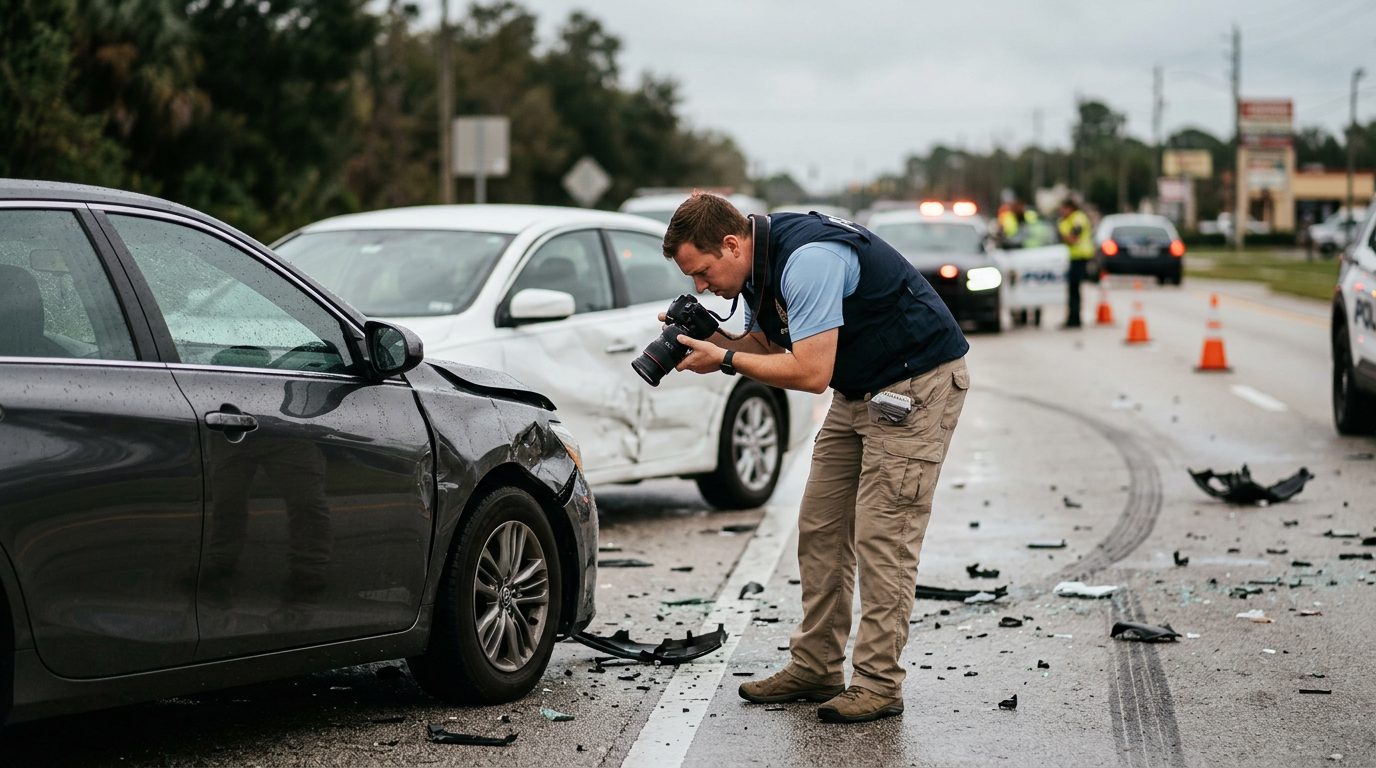
Document the scene thoroughly. Take photos and video of: – Vehicle damage (all angles) – Road conditions, potholes, or hazards – Traffic signals, stop signs, and street markings – The other vehicle’s license plate and VIN – Skid marks or debris patterns – Weather and lighting conditions – Your injuries (bruises, cuts, visible trauma)
Photos taken at the scene are powerful evidence. Insurance companies cannot argue about what the scene looked like if you have clear documentation.
Get information from other drivers and witnesses. Collect: – Full names, phone numbers, and addresses – Driver’s license numbers and insurance information – Vehicle make, model, year, and license plate – Witness names, phone numbers, and addresses – What witnesses saw (get their account in writing if possible)
Do not admit fault or sign anything except for police and emergency responders. Even casual statements like “I’m sorry” or “I didn’t see you” can be used against you later in court or in settlement negotiations.
Seek medical attention promptly. Some injuries—whiplash, internal injuries, traumatic brain injury—don’t show symptoms immediately. You may feel fine at the scene but develop severe pain or cognitive problems days or weeks later. Get checked by a doctor even if you feel fine. Medical records link the accident to your injuries and strengthen your claim.
Report the accident to your insurance company promptly. Provide factual information but avoid detailed statements until you’ve spoken with an attorney. Insurance adjusters are trained to minimize claims; anything you say can be used against you.
Florida’s No-Fault Insurance System: How It Works & Why It’s Different
Florida is a “no-fault” state—and this is critical to understand because it works differently than most states.
In a no-fault state, your own insurance covers your medical bills and lost wages up to your policy limit, regardless of who caused the accident. PIP pays 80% of reasonable medical expenses and 60% of lost income, up to the $10,000 policy limit, if you get initial care within 14 days of the crash (Fla. Stat. § 627.736). You don’t have to prove the other driver was at fault to get your medical bills paid. Your Personal Injury Protection (PIP) coverage pays first, up to your limit (typically $10,000).
But you can step outside the no-fault system if your injuries are serious. If your injury meets Florida’s “serious injury threshold,” you can pursue a claim against the at-fault driver’s insurance company for additional damages, including pain and suffering, permanent disability, and loss of enjoyment of life.
What qualifies as a “serious injury”?
If your injury is permanent and affects your ability to work or enjoy life, you likely qualify. Spinal cord injuries, traumatic brain injuries, amputations, severe burns, and permanent paralysis all meet this threshold.
Modified Comparative Fault in Florida: A Concrete Example
Florida follows a modified comparative-negligence rule. This means your recovery is reduced by your percentage of fault—but only if you are 50% or less at fault (Fla. Stat. § 768.81(6)). If you are found more than 50% at fault, you cannot recover anything.
Here’s a concrete example:
You’re driving on the Palmetto Expressway and are struck by a truck that ran a red light. You suffer a spinal cord injury and permanent paralysis. Your damages total $500,000.
At trial or in settlement negotiations, the insurance company argues that you were traveling 5 mph over the speed limit and could have avoided the crash if you’d been more alert. An accident reconstruction expert testifies that you were 40% at fault, and the truck driver was 60% at fault.
Under Florida’s modified comparative fault rule, you recover 60% of your damages: $300,000.
Your award is reduced by your 40% share of fault. But you still recover substantially. If you had been found 51% or more at fault, you would recover nothing.
Why this matters to you: Even if you bear some responsibility for the accident, you may still recover. An experienced attorney will fight to minimize your percentage of fault and maximize your recovery.
Have questions about what happened?
Ask our team directly. The first conversation is free, confidential, and there is no obligation to continue.
Common Causes of Car Accidents in Westchester
Understanding what caused your accident helps establish liability—who is legally responsible. Common causes include:
- Distracted driving (phone use, texting, eating, adjusting controls)
- Speeding and reckless driving (especially on I-95 and the Palmetto Expressway)
- Impaired driving (alcohol or drugs)
- Failure to obey traffic signals or stop signs
- Unsafe lane changes and failure to yield
- Tailgating and aggressive driving
- Poor road maintenance or hazardous conditions
- Vehicle defects or mechanical failure
In serious injury cases, we often find the at-fault driver was engaging in multiple risky behaviors simultaneously—speeding while texting, or driving impaired. The clearer the negligence, the stronger your claim and the higher your recovery.
Types of Injuries from Car Accidents
Car accidents can cause injuries ranging from minor to catastrophic and fatal:
- Whiplash and neck injuries from rear-end collisions
- Back and spinal cord injuries that can cause chronic pain or permanent paralysis (paraplegia or quadriplegia)
- Traumatic brain injuries from impact or sudden deceleration, causing cognitive impairment, memory loss, personality changes, and permanent disability
- Broken bones and fractures
- Internal injuries and organ damage
- Severe burns (in fires following crashes)
- Amputation or limb loss (in high-impact collisions)
- Psychological trauma and PTSD
- Wrongful death—the most catastrophic outcome
If you’ve suffered a spinal cord injury, you may face permanent paralysis, ongoing medical care, rehabilitation, and a lifetime of adaptive equipment and home modifications. Spinal cord injuries affect over 17,000 people annually in the United States, and many result from motor vehicle crashes.
Traumatic brain injuries can permanently alter cognition, personality, and earning capacity. These injuries are not minor—they’re life-altering, and they deserve full compensation.
If a loved one was killed in a crash, the family may recover wrongful death damages, including funeral and burial costs, lost financial support, and loss of companionship. Wrongful death claims are among the most serious and deserve immediate legal attention.
Compensation You May Recover
Depending on the severity of your injuries and the circumstances of the accident, you may recover:
- Medical expenses: emergency care, hospitalization, surgery, rehabilitation, ongoing treatment, and future medical needs
- Lost wages: income lost while recovering and unable to work
- Permanent disability: compensation for lasting impairment and reduced earning capacity
- Pain and suffering: damages for physical pain, emotional distress, and reduced quality of life
- Scarring and disfigurement: additional damages for visible, permanent injuries
- Loss of enjoyment of life: compensation if the injury prevents you from activities you once enjoyed
- Wrongful death damages: if a loved one was killed, funeral costs, lost financial support, and loss of companionship
The amount you recover depends on the severity of your injury, the clarity of fault, your medical costs, lost income, and the strength of your case.
The Car Accident Claim Process in Florida
Here’s how a typical car accident claim unfolds:
- Report the accident to the at-fault driver’s insurance company and your own insurer.
- Provide documentation: medical records, bills, proof of lost wages, photos from the scene, and the police report.
- The insurance company investigates and makes an initial settlement offer (often far below what you deserve).
- You can negotiate or reject the offer. An attorney will advise you on whether the offer is fair.
- If settlement talks stall, your attorney may file a lawsuit before the statute of limitations expires.
- Most cases settle before trial, but some proceed to court where a judge or jury decides the outcome.
- Your attorney handles all communication with insurance companies and protects your rights throughout.
This process can take months or years, especially in serious injury cases. An experienced attorney knows how to build a strong case, gather expert testimony, and present your damages persuasively.
Want to know where you stand?
Tell us what happened and our team will walk you through the options available to you, at no cost.
Why You Need a Car Accident Attorney in Westchester
Going up against an insurance company alone is like trying to negotiate a contract in a language you don’t speak. The other side has teams of adjusters and lawyers working to minimize your claim.
An attorney investigates the accident, gathers evidence, obtains expert testimony, and builds a compelling case for maximum compensation.
Your attorney negotiates with insurance companies on your behalf, handling all communication and protecting your rights.
If a fair settlement cannot be reached, your attorney can file a lawsuit and represent you in court.
You pay nothing upfront. Most car accident attorneys, including ours, work on contingency. You pay a fee only if we recover money on your behalf. This aligns our interests with yours: we succeed only when you do.
What Happens If the Other Driver Was Uninsured or Underinsured?
If the at-fault driver has no insurance or insufficient coverage, your own uninsured/underinsured motorist (UM/UIM) coverage may apply. UM/UIM coverage protects you when the other driver cannot pay.
Your attorney can file a claim against your own policy. This is another reason to have legal representation. The process is complex, and insurance companies often deny valid UM/UIM claims. An experienced attorney knows how to fight for the coverage you’re entitled to.

Frequently Asked Questions
Q: How long do I have to file a claim after a car accident?
A: You have 2 years from the date of the accident to file a personal injury lawsuit (Fla. Stat. § 95.11(5)(a)). This deadline is absolute. If you miss it, you lose your right to recover forever. Contact an attorney immediately.
Q: Do I have to file a lawsuit, or can my case settle?
A: Most car accident cases settle before trial through negotiation with the insurance company. Your attorney will pursue the best outcome—whether that’s a fair settlement or litigation.
Q: How long does a car accident case take?
A: Simple cases may settle in months. Serious injury cases often take 1–3 years or longer, depending on complexity and the insurance company’s willingness to negotiate fairly.
Q: Can I still recover if I was partially at fault for the accident?
A: Yes. Florida follows a modified comparative-negligence rule. If you are found 50% or less at fault, you can recover damages, but your award is reduced by your percentage of fault (Fla. Stat. § 768.81(6)). If you are found more than 50% at fault, you cannot recover.
Q: What if I didn’t go to the hospital immediately after the accident?
A: Delayed medical treatment can complicate your claim, but it doesn’t eliminate it. Seek medical attention as soon as you realize you’re injured. Be honest with your attorney about the timeline.
Q: Will my case go to trial?
A: Most cases settle, but if the insurance company refuses a fair offer, your attorney will be prepared to take your case to trial and present it to a judge or jury.
If you’ve been injured in a car accident in Westchester and are facing medical bills, lost wages, or uncertainty about what comes next, do not wait. You have only 2 years to file a claim.
Contact CHG Personal Injury Lawyers for a free case evaluation today. Our firm focuses exclusively on personal injury claims, and we understand the physical, emotional, and financial toll a serious accident takes on you and your family.
Call us now to discuss your case—time is critical.
What to Do Right After a Car Accident
Check for Injuries & Call 911
Your safety comes first. Move to a safe location if possible. Call emergency services immediately if anyone is hurt, even if injuries seem minor. Shock can mask pain.
Document the Scene
Take photos of vehicle damage, road conditions, traffic signs, and the accident scene from multiple angles. Get the names, phone numbers, and insurance details of the other driver(s) and any witnesses.
Report the Accident
File a police report and get the report number. Notify your insurance company, but do not admit fault or sign anything without legal advice.
Seek Medical Attention
See a doctor even if you feel fine. Some injuries—whiplash, internal injuries, traumatic brain injury—develop over hours or days. Medical records create a crucial link between the crash and your injuries.
Do Not Delay—Time Matters
You have a limited window to file a personal injury lawsuit after a car accident. The sooner you contact an attorney, the sooner we can preserve evidence, interview witnesses, and begin building your case.
Why Choose CHG Personal Injury Lawyers
Focused on Catastrophic & Serious Injury
We focus exclusively on personal injury cases, from car accidents and slip-and-fall incidents to traumatic brain injuries, spinal cord damage, and life-altering harm. We know how to value and fight for your claim.
No Attorney’s Fees Unless There Is a Recovery
We work on contingency. You pay nothing upfront, and we only collect a fee if your case settles or wins. Your recovery is our priority.
Available Nationwide, Rooted in Florida
Based in Florida and licensed to practice throughout the state, we also handle serious injury cases across the country. Wherever the accident happened, we can help.
Clear, Honest Communication
We explain your rights and options in plain language—no legal jargon. You'll always know where your case stands and what happens next.
Common Questions About Car Accident Claims
How Long Do I Have to File a Claim?
Time limits apply. An attorney can explain the deadline that applies to your situation and make sure your claim is filed on time. Do not wait.
Do I Have to Go to Trial?
Most car accident cases settle before trial. Your attorney will negotiate with the insurance company and the other party's legal team. If a fair settlement cannot be reached, we are prepared to take your case to court.
What Damages Can I Recover?
Depending on your injuries and the circumstances, you may recover medical expenses, lost wages, pain and suffering, and other losses. An attorney will evaluate what your case is worth.
What If I Was Partially at Fault?
Florida law allows recovery even if you share some responsibility for the accident. An attorney can explain how this affects your claim and what you may still be able to recover.