

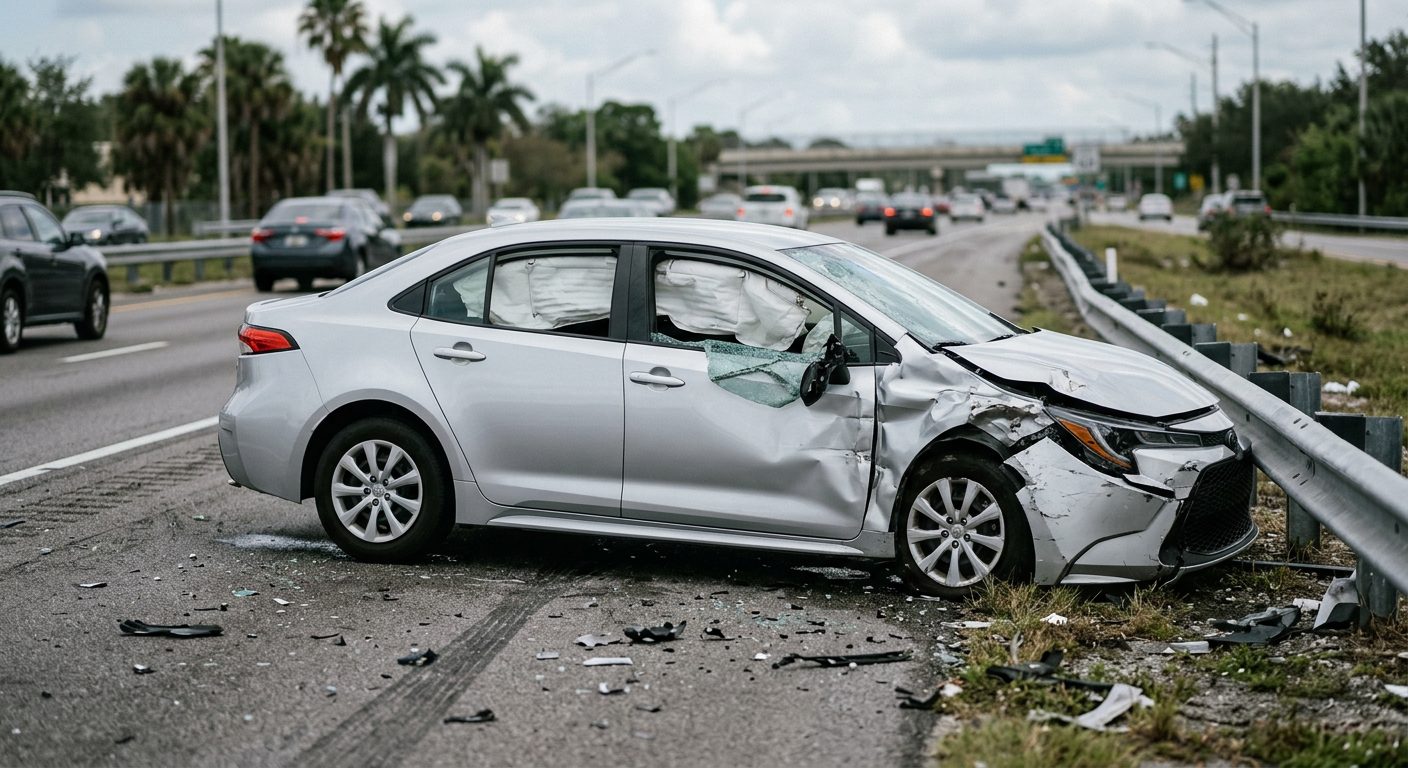
Car Accident Payouts in Florida
What Determines Your Car Accident Payout?
Settlement amounts depend on injury severity, liability, and damages. Learn what factors influence the value of your claim.
Average Car Accident Payout in Florida: Causes, Liability & Settlement Amounts
The average payout for a car accident in Florida depends on how badly you were hurt, your medical costs, lost income, and who was at fault. There’s no fixed number.
The amount a claim may involve varies widely with the type and severity of the injury, and no single figure applies to every case. Catastrophic injuries—spinal cord damage, paralysis, traumatic brain injury, amputation, or severe burns—can involve substantially higher damages, and each case differs.
Understanding what drives these numbers starts with understanding what caused the crash and who bears responsibility.

If you’ve been in a car accident, understanding your options early can help. Remember: claims are subject to filing deadlines, and these can vary depending on the facts of each case. Talk it through with CHG Personal Injury Lawyers. CHG charges no attorney’s fees and no case costs unless there is a recovery.
The Most Common Causes of Car Accidents in Florida
Establishing liability (who is responsible) determines who pays the settlement.
Distracted driving remains one of the leading causes. Cell phones, eating, adjusting controls, or looking away from the road for even a few seconds can cause a crash. Drivers who cause accidents while distracted may be found liable for the injuries they cause, depending on the facts of the case.
Speeding and aggressive driving account for many serious crashes. Driving too fast for conditions—especially in heavy rain or construction zones—reduces a driver’s ability to stop or avoid another vehicle. An aggressive driver who speeds, tailgates, or makes reckless moves may be found at fault for a resulting crash, depending on the facts.
Impaired driving (alcohol, drugs, or fatigue) severely impairs judgment and reaction time. A driver impaired by alcohol or drugs may be found liable for the crash and resulting injuries, depending on the facts of the case.
Failure to yield and traffic-signal violations cause intersection crashes. Running a red light, failing to yield at a stop sign, or turning left into oncoming traffic may make the violating driver liable, depending on the facts of the case.
Reckless lane changes and improper passing cause sideswipe and rear-end collisions. A driver who cuts off another vehicle or passes unsafely is at fault.
Weather-related factors like heavy rain and hydroplaning create dangerous conditions. A driver who was speeding, following too closely, or driving recklessly for the weather may be found liable, depending on the facts of the case. Poor maintenance or defective vehicles (failed brakes, blown tires) can also cause crashes; the vehicle owner or manufacturer may be liable.
Why does cause matter? Because establishing liability determines who pays. If the other driver caused the crash by running a red light, speeding, or driving drunk, that conduct may be central to establishing liability, though every case differs.
How Car Accident Settlement Payouts Are Calculated
Settlement amounts are built from two types of damages:
Economic damages are your documented financial losses: medical bills, emergency room visits, surgery, physical therapy, lost wages, property damage to your vehicle, and future medical care or lost earning capacity if your injury is permanent.
Non-economic damages compensate for pain, suffering, emotional distress, and loss of enjoyment of life. These are harder to quantify but are real and significant, especially for serious injuries.
Attorneys and insurers often use the multiplier method to estimate settlement value. This method multiplies your economic damages by an injury severity factor (typically 1.5 to 5 or higher).
For example:
- Two people with similar medical bills may have claims valued differently, depending on how the injury affects their work and daily life.
Insurance policy limits may restrict how much you can recover from a given policy. If the at-fault driver’s policy covers only $50,000, your recovery from that policy is generally limited to that amount, even if your damages are $200,000. This is why many serious-injury cases involve claims against multiple policies (the at-fault driver’s, your own underinsured motorist coverage, or a business’s liability policy if the crash happened on their property).
Comparative fault in Florida directly reduces your payout. Florida follows modified comparative fault: if you are found 20% at fault and your damages total $100,000, you recover $80,000. If you are found more than 50% at fault, you generally recover nothing under Fla. Stat. §768.81.
How Much Are Most Car Accident Settlements?
Settlement ranges vary widely based on injury severity:
Minor injuries (whiplash, soft-tissue sprains, minor cuts) generally involve lower damages than more serious injuries, and each case differs.
Moderate injuries (broken bones, longer physical therapy, temporary lost wages) generally involve damages between minor and serious injuries, and each case differs.
Serious injuries (permanent scarring, chronic pain, permanent loss of function, significant lost earning capacity) generally involve higher damages than moderate injuries, and each case differs. These injuries permanently change your life.
Catastrophic injuries (spinal cord injury and paralysis, traumatic brain injury, amputation, severe burns, or wrongful death) are among the most serious harms a car accident can cause. Every case is different, and no result can be guaranteed. These injuries require lifelong care, mobility aids, home modifications, ongoing therapy, and lost career earnings.
A spinal cord injury resulting in paraplegia or quadriplegia is a serious medical condition, and the damages in each case differ.
Is $50,000 a Good Settlement for a Car Accident?
Whether $50,000 is fair depends entirely on your injury and damages.
For a moderate injury, $50,000 may be fair or low. If you had surgery, months of physical therapy, $40,000 in medical bills, and $20,000 in lost wages, $50,000 barely covers your documented costs.
For a serious or permanent injury, $50,000 is almost certainly too low. Permanent injuries command higher payouts because they affect your entire life—your earning capacity, your ability to work, your quality of life.
Compare the offer to your actual costs: add up your medical bills, lost wages, and ongoing treatment. If the offer is close to or only slightly above that total, it may not fairly compensate you for pain and suffering.
If you were partly at fault (say, 30%), a lower offer may reflect that reduction. If the at-fault driver’s insurance policy maxes out at $50,000, that may be the practical ceiling—though your own underinsured motorist coverage or other sources may provide additional recovery.
What Is a Good Settlement Offer for a Car Accident?
A good settlement offer covers all your documented losses plus fair compensation for pain and suffering. It should:
- Cover all medical bills and lost wages documented by receipts, pay stubs, and employer statements
- Account for future medical care if your injury requires ongoing treatment, therapy, or medication
- Reflect the severity of your injury and its permanence; permanent injuries are worth significantly more than injuries that heal completely
- Account for your age and earning capacity if your injury affects your ability to work; a 30-year-old with 35 years of work ahead may recover more than a 65-year-old retiree with the same injury
- Reflect the strength of liability if the other driver was clearly at fault (running a red light, speeding, driving drunk), your settlement is typically higher
A red flag is an offer that seems far below your medical bills and lost wages alone. For example, if your medical bills total $60,000 and you lost $30,000 in wages, an offer of $40,000 doesn’t fairly compensate you.
Getting independent legal review helps you understand whether an offer is reasonable for your specific injury and circumstances.
Not sure what your next step is?
Talk it through with our team — the first consultation is free, confidential, and carries no obligation.
Key Factors That Influence Your Car Accident Settlement
Several factors directly affect how much you recover:
Injury severity and permanence are the biggest drivers of settlement value. A permanent injury—one that leaves you with chronic pain, scarring, limited mobility, or lost earning capacity—is worth far more than a minor injury that heals completely.
Medical evidence matters enormously. Clear documentation of your injuries, treatment, and expected recovery strengthens your claim. Medical records, imaging, surgery reports, and ongoing therapy notes all support a higher settlement.
Lost income documented by pay stubs, tax returns, and employer statements adds directly to your damages. If your injury forced you to miss work or reduced your earning capacity permanently, that loss is compensable.
Liability clarity affects settlement significantly. If the other driver was clearly at fault—they ran a red light, were speeding, or were driving drunk—your settlement is typically higher because the insurance company’s exposure is clear.
Insurance coverage sets a practical ceiling. Even if your damages are $500,000, you cannot recover more than the at-fault driver’s policy limits. If their policy covers only $100,000, that’s the maximum you can recover from their insurance.
Your own percentage of fault under Florida’s comparative fault rule directly reduces your payout (Fla. Stat. § 768.81(6)). If you were 25% at fault, your settlement is reduced by 25%.
Catastrophic Injury Settlements: When Payouts Reach $500,000 and Beyond
Catastrophic injuries—those that permanently alter your life—command significantly higher settlements because they involve lifelong care, lost earning potential, and profound quality-of-life impacts.
Spinal cord injuries and paralysis (paraplegia or quadriplegia) require lifelong care, mobility aids, home modifications, and ongoing medical treatment. Settlements often range from $1 million to $5 million or more, depending on age, earning capacity, and severity. A younger person with decades of work ahead may recover $3 million to $5 million; an older person with the same injury may recover $1 million to $2 million.
Traumatic brain injury affecting thinking, memory, personality, or earning capacity often settles for $500,000 to $5 million. The long-term impact on employment and quality of life drives these higher values.
Amputation and limb loss require prosthetics, retraining for a new career, and lifelong care. Settlements typically range from $500,000 to $3 million, depending on which limb was lost, the person’s age, and their pre-injury career.
Severe burns requiring reconstructive surgery, skin grafts, and psychological treatment often settle for $500,000 to $2 million. Scarring, pain, and emotional trauma are factored in.
Wrongful death (when a crash kills someone) allows the family to recover for loss of financial support and companionship. Settlements vary widely—often $500,000 to $2 million—depending on the deceased’s age, earning potential, and family circumstances.
Understanding Florida’s Comparative Fault Rule
Florida is a comparative fault state, meaning your settlement is reduced by your percentage of fault. Under Fla. Stat. §768.81, you can recover damages even if you were partly at fault—as long as you were 50% or less at fault.
Example: You’re rear-ended at a red light. The other driver was clearly speeding and distracted. You’re found 10% at fault for not leaving enough following distance. Your damages total $100,000. You recover $90,000 ($100,000 minus your 10% share).
If you’re found more than 50% at fault, you generally recover nothing. Liability investigation is critical: the other driver’s actions (speeding, running a red light, distracted driving, failing to yield) strengthen your claim and reduce the likelihood of comparative fault being assigned to you (Fla. Stat. § 768.81(6)).
Why Settlement Amounts Vary So Widely
No two car accidents are identical. Settlement ranges are wide because:
- Injury severity differs dramatically. A minor whiplash injury is worth far less than a spinal cord injury.
- Medical costs vary. Emergency surgery, hospitalization, and long-term therapy cost far more than an urgent-care visit.
- Lost income differs. A high-earning professional loses more income than someone in a lower-wage job; a retiree may lose none.
- Age and earning potential matter. A 35-year-old with 30 years of work ahead may recover more than a 70-year-old with the same injury.
- Insurance policy limits set a ceiling. A serious injury may settle lower if the at-fault driver’s coverage is limited.
- Liability strength varies. If the other driver was clearly at fault, your settlement is higher; if liability is disputed, it may be lower.
- Long-term impact differs. An injury that ends a career is worth more than one that heals completely and doesn’t affect work.
Next Steps: Understanding Your Own Situation
If you’ve been in a car accident and are trying to understand what your case might be worth, start here:
- Gather your medical records and bills. Document every treatment, visit, and cost.
- Keep records of lost wages. Collect pay stubs, employer statements, and tax returns showing income lost.
- Document the accident. Get the police report, take photos of vehicle damage and the scene, collect witness contact information, and note the other driver’s insurance details.
- Understand the cause. Was the other driver speeding, distracted, impaired, or violating a traffic law? Liability directly affects your payout.
- Get independent legal review. An attorney can tell you whether an insurance offer is fair for your specific injury and circumstances—and whether you should pursue the claim further.
Remember: you have a deadline to file a claim. Under Fla. Stat. §95.11, most Florida negligence and personal-injury claims must be filed within two years of the accident. Don’t wait.
Have questions about what happened?
Ask our team directly. The first conversation is free, confidential, and there is no obligation to continue.
Frequently Asked Questions
How much are most car accident settlements?
Most car accident settlements for minor injuries range from $3,000–$15,000; moderate injuries settle for $15,000–$100,000; serious injuries often reach $100,000–$500,000+; and catastrophic injuries frequently exceed $500,000 and can reach $1 million to $25 million.
How is a car accident settlement calculated?
Settlements are calculated by adding economic damages (medical bills, lost wages, property damage) and non-economic damages (pain and suffering), then multiplying by an injury severity factor (typically 1.5 to 5+), subject to the at-fault driver’s insurance policy limits and reduced by your percentage of fault under Florida law.
Does Florida’s comparative fault rule apply to my case?
Yes—if you were partly at fault, your settlement is reduced by your percentage of fault, but you can still recover as long as you were 50% or less at fault (Fla. Stat. § 768.81(6)).
What if the at-fault driver’s insurance policy doesn’t cover my full damages?
You may have a claim against your own underinsured motorist coverage, or against other parties (a business on whose property the crash occurred, a manufacturer if a vehicle defect caused the crash, or a rideshare company if you were a passenger).
How long do I have to file a claim in Florida?
You generally have two years from the date of the accident to file a lawsuit in Florida; don’t wait (Fla. Stat. § 95.11(5)(a)).
If you’ve been injured in a car accident in Florida and you’re uncertain whether an insurance offer is fair—or whether you even have a claim worth pursuing—reach out for a free case evaluation. People in your situation can contact us, and we’re here to help you understand what your case might be worth and what your options are.
Settlement Ranges by Injury Severity
Minor Injuries
Soft-tissue damage, minor cuts and bruises, and whiplash typically settle between $3,000 and $15,000.
Moderate Injuries
Broken bones, significant sprains, and injuries requiring surgery often settle between $15,000 and $100,000.
Serious Injuries
Severe fractures, organ damage, and injuries with lasting effects frequently reach $100,000 to $500,000 or more.
Catastrophic Injuries
Spinal cord injuries, paralysis, traumatic brain injuries, amputations, and permanent disability often exceed $500,000, sometimes reaching $1 million to $25 million.
Key Factors That Influence Your Payout
Liability and Fault
Who caused the accident matters. Clear liability—where the other driver is obviously at fault—typically results in higher settlements. Shared fault can reduce your recovery.
Medical Evidence
Documented injuries, treatment records, and medical bills form the foundation of your claim. Serious, well-documented injuries command larger payouts.
Lost Income and Future Earnings
If your injury prevents you from working now or in the future, those lost wages are part of your claim. Catastrophic injuries that end careers significantly increase settlement value.
Pain, Suffering, and Quality of Life
Permanent scarring, chronic pain, disability, and reduced ability to enjoy life all factor into damages. Catastrophic injuries that alter your life forever typically result in substantial compensation.
Insurance Policy Limits
The at-fault driver's insurance coverage caps what you can recover from that policy. Multiple liable parties or underinsured motorist coverage may increase available funds.
Accident Circumstances
Truck accidents, rideshare collisions, and accidents in construction zones often involve multiple liable parties and higher damages due to the severity of impact.
Don't Accept the First Offer
Insurance companies often offer less than your claim is worth. An initial settlement offer may not account for future medical needs, long-term disability, or the full scope of your suffering. Before accepting, understand what your case is truly worth.
Common Causes of High-Value Car Accident Claims
Truck Accidents
Commercial trucks cause severe injuries due to their size and weight. These accidents often involve multiple liable parties—the driver, the trucking company, and maintenance contractors—increasing recovery potential.
High-Speed Collisions
Accidents at highway speeds or in construction zones produce catastrophic injuries. The greater the force of impact, the more severe the injury and the higher the settlement value.
Rideshare and Commercial Vehicle Accidents
Rideshare drivers and commercial operators carry higher insurance limits. These accidents often result in larger settlements due to available coverage and corporate liability.
Negligent or Reckless Driving
Accidents caused by speeding, drunk driving, distracted driving, or street racing demonstrate clear negligence and may support higher damages, including punitive damages in some cases.
Why Settlement Amounts Vary
Multiple Defendants
Accidents involving multiple at-fault parties—such as a truck driver and a trucking company—can significantly increase available compensation.
Strength of Evidence
Dashcam footage, witness statements, accident reconstruction reports, and police records strengthen your claim and support higher settlements.
Permanent Disability
Injuries that result in permanent impairment, chronic pain, or the need for ongoing care dramatically increase claim value.
Jurisdiction
Florida juries and judges may award damages differently depending on the county and local factors. Your location matters.