


Traumatic Brain Injury Guide
From the ER to Rehab: What a Brain Injury Recovery Really Looks Like
A traumatic brain injury changes life in an instant. This plain-language guide walks families through each stage of recovery — from the emergency room to long-term rehabilitation — so you know what to expect and what to ask.
By CHG Lawyers · Published July 27, 2026
Brain Injury Recovery Timeline: How a TBI Diagnosis Changes From the ER to Rehabilitation
It is 3 a.m. in the ICU family room. A neurosurgeon told you one thing at midnight and something different an hour ago. You are trying to write down words like “intracranial pressure” and “sedation holiday” on the back of a parking receipt. You have one question no one seems able to answer straight: Is my person going to come back to me?
If that is where you are right now, this page is for you. We are a catastrophic-injury law firm, not your medical team. But we have sat with many families through these exact hours. This is the honest version of what happens next, from the emergency room through rehab. It is written for the person waiting and for survivors far enough along to research their own path.
Prefer Spanish? See our companion guide: Lesión cerebral traumática: preguntas frecuentes.
Not sure what your next step is?
Talk it through with our team — the first consultation is free, confidential, and carries no obligation.
Why the prognosis keeps changing (and why that is normal)
The hardest part of a traumatic brain injury (TBI) is not always the first news. It is that the news keeps changing.
Here is why. The first injury happens in the instant of the crash, fall, or blow. But a second wave follows. Swelling, bleeding, and rising pressure inside the skull unfold over hours and days. Doctors call this secondary injury — more harm that builds after the first hit. Preventing it is much of what the ICU team is fighting for. Because that second wave is still moving, the picture at 8 p.m. can look different by morning.
So when the assessment shifts, it usually does not mean anyone was wrong. It means the brain is still declaring itself. Families we have worked with often say the “wait and see” stretch was the most frightening part. An early grim assessment is not the final word. An early hopeful one is not a promise. Both are snapshots of a situation still in motion.
Is there a set brain injury recovery timeline?
No. There is no single timeline that fits everyone. Two people with similar scans can heal at very different rates. It depends on how severe the injury is, where in the brain the damage sits, the person’s age, and their overall health.
Doctors do use a rough framing. Mild TBI often improves over weeks. Moderate-to-severe TBI recovery usually stretches across months to years. The fastest gains often come in the first six months. But real progress can continue well past the first year.
Expect a jagged line, not a smooth slope. Good days follow hard days. Plateaus and setbacks are part of the process, not signs of failure. The CDC reports there were over 69,000 TBI-related deaths in the United States in 2021 — roughly 190 a day. It is a reminder that these are serious, life-altering injuries, and that steady, expert care matters.
Stage 1: The emergency room and the first diagnosis
The first stage is about two things: finding the injury and keeping the person alive.
On arrival, the team almost always orders a CT scan. This is a fast X-ray that looks for bleeding, swelling, and skull fractures. An MRI may follow. They also score the person on the Glasgow Coma Scale (GCS) — a 3-to-15 measure of eye, verbal, and motor response. In broad terms, a GCS of 13–15 is mild, 9–12 is moderate, and 3–8 is severe. That label guides treatment, but it can move as swelling changes. That is why the earliest prognosis is the least certain one you will hear.
If you are at the bedside, a few clear questions cut through the fog:
- What did the scan actually show — where is the injury, and is there bleeding?
- Is the swelling stable, or still increasing?
- What exactly are you watching for over the next 24 to 48 hours?
- If things change overnight, who calls me, and at what number?
Stage 2: Intensive care and the critical days
In the ICU, the goal shifts. The team moves from surviving the first hit to preventing the second wave. They work to control pressure inside the skull, keep oxygen and blood pressure steady, and stop infection. Your person may be in a coma or under deliberate sedation. They may not respond to your voice yet.
That silence is terrifying. It is also often protective. The brain sometimes needs deep rest to limit further damage. Not responding today is not the same as the final outcome.
Some families face wrenching talks about life-sustaining care in these days. If that is you, hold on to one thing. The tools used early to predict outcome have real limits. Physicians themselves warn that the first days do not always reveal what recovery will look like. It is reasonable to ask for time, to request a second opinion, and to ask the team to explain — in plain words — what the numbers do and do not tell them.
The stages of recovery: the Rancho Los Amigos levels
Once your person stabilizes, rehab teams often describe progress using the Rancho Los Amigos Levels of Cognitive Functioning. This is a widely used framework. It maps the journey from no response toward independence. It will not tell you when. But it tells you what to look for.
Levels 1–3 — from no response to localized response. At Level 1, there is no reaction to sound, touch, or sight. At Level 2, you may see a general response to any stimulus — a movement or a sound. At Level 3, responses get more specific: turning toward your voice, sometimes following a simple command.
Levels 4–6 — the confused stages. These middle levels are often the hardest for families, and the most misunderstood. At Level 4, the person may be confused and agitated — restless, upset, saying things that make no sense, sometimes not recognizing you. This is the brain waking back up, not a new personality. At Level 5, the confusion continues but the agitation eases. At Level 6, the person is confused but more appropriate. They can follow simple routines and recognize familiar faces more consistently.
Levels 7–10 — later recovery. Behavior moves from automatic toward purposeful and independent. Daily tasks need less supervision. Memory, judgment, and problem-solving keep improving. Some people reach full independence. Others reach a stable “new normal” with ongoing support.
Not everyone passes through every level. People move at wildly different speeds. The framework is a map, not a schedule.
Have questions about what happened?
Ask our team directly. The first conversation is free, confidential, and there is no obligation to continue.
Stage 3: Rehabilitation — what the work actually looks like
Rehab is where much of the long-term recovery is built, one repetition at a time. A team of specialists usually works together:
- Physical therapy — strength, balance, and movement.
- Occupational therapy — relearning dressing, cooking, bathing, and daily routines.
- Speech-language therapy — talking, understanding, and safe swallowing.
- Cognitive therapy — memory, attention, and problem-solving.
- Neuropsychology — mood, behavior, and emotional adjustment (for the survivor and, often, the family).
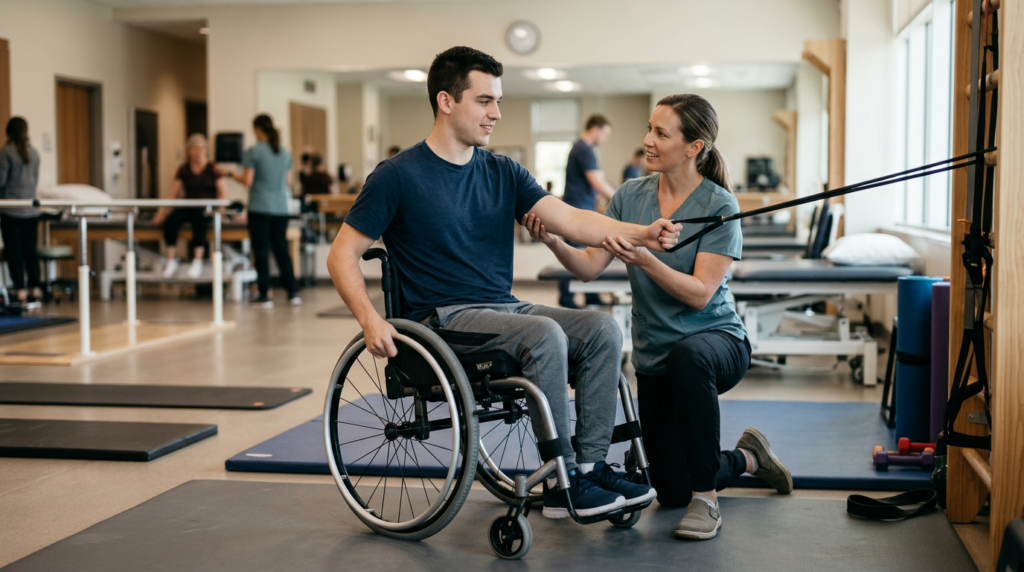
Rehab may begin as inpatient care at a specialized facility. Later it may shift to outpatient visits you travel to from home. A typical day is often several short therapy sessions with rest in between. The team measures progress and resets goals as things change. Small wins — a longer attention span, a word that returns — add up.
Signs the brain is healing
Families often ask what improvement looks like. Common signs include more alertness, following commands, recognizing loved ones, steadier sleep-wake cycles, and the return of speech or movement. These can be subtle. It may be a hand squeeze one day, then eyes tracking you across the room the next. Emotional and behavioral changes count as healing too. Always check what you see with the care team. What feels like a setback to you may be expected. What feels like a tiny gain may be a milestone to them.
Can you recover from a traumatic brain injury?
Many people recover meaningfully — though severe TBI often leaves permanent changes. The honest answer lives between “fully back to normal” and “lifelong impact.” It is different for every person.
It helps to separate two meanings of recovery. One is returning close to who someone was before. The other is reaching a new normal through adaptation and rehab. Many survivors regain a great deal of function. Many also live full lives with lasting differences in memory, mood, or movement. No honest source can predict how a specific person will heal. What is fair to say is this: consistent therapy, patience, and support give a person the best chance to reach their own potential.
What is the life expectancy of someone with a TBI?
Severe TBI can affect life expectancy. But many survivors live long lives with the right care. Outcomes depend on severity, age, and other health conditions. Ongoing medical care, rehab, home support, and preventing complications all make a real difference over the years. This is a deeply personal question, and general statistics cannot answer it for your family. For an individual answer, ask your person’s medical team. They know the specific injury and the whole health picture.
What families can do at the bedside
Presence, patience, and consistency matter more than most people expect. Sitting nearby, reading aloud, playing familiar music, keeping a calm and predictable routine, and helping practice the skills therapists assign can all support recovery. One caution: follow the rehab team’s specific plan. Do not use self-directed programs from the internet. What helps one brain can overwhelm another. Therapists tailor activities to the exact stage.
The long financial picture — and why records matter from day one
Severe TBI care can span emergency treatment, weeks of rehab, home modifications, assistive devices, and, for many families, lifelong support. Those costs add up fast and often continue for years. This is exactly the kind of catastrophic, permanent injury where the difference between “getting by” and “getting proper care” can come down to whether someone was held accountable.
That is why documentation matters early — long before anyone is thinking about a lawyer. Keep the diagnosis, treatment notes, imaging reports, and bills. Note how the injury happened and who was there. If someone else caused it, that record can matter later.
Want to know where you stand?
Tell us what happened and our team will walk you through the options available to you, at no cost.
When a brain injury was caused by someone else
When another party’s carelessness caused the injury, the family may have a legal claim that helps cover this care. Two situations come up again and again.
A serious truck crash. A loaded commercial truck can weigh far more than a passenger car. Federal rules exist precisely because the consequences of a mistake are so severe. These rules — the Federal Motor Carrier Safety Regulations — cover driver hours, maintenance, and inspection. When a driver or trucking company ignores them, the head injuries that follow are often catastrophic.
Being hurt on an unsafe property. Say someone was assaulted, shot, robbed, or attacked in an apartment complex, a parking garage, a hotel, a gas station, or a store — and suffered a brain injury as a result. The property owner may share responsibility if they failed to provide reasonable security. That means working locks and gates, adequate lighting, cameras, or guards. Most families have never heard the legal term for this. It is called negligent security, a kind of premises-liability claim (a claim about an unsafe property). That is completely okay. What matters is the situation: a person got hurt because a property was not kept reasonably safe.
In Florida, timing matters. Under Fla. Stat. §95.11, the deadline to file most personal-injury cases is generally two years for claims arising on or after March 24, 2023. Florida also follows a modified comparative-negligence rule under Fla. Stat. §768.81. This means a person found more than 50% at fault generally recovers nothing.
CHG Personal Injury Lawyers is a Florida-based firm. Our attorneys are admitted to the Florida Bar, and we handle catastrophic-injury cases nationwide. If your family is facing a serious brain injury after a crash or an unsafe-property attack, you can request a free case evaluation. We cannot promise a result — no honest firm can — but we can explain your options clearly, in English or Spanish.
Frequently asked questions
Is there a set brain injury recovery timeline?
No. Recovery depends on the injury’s severity, its location, the person’s age, and overall health. Mild injuries may improve in weeks. Severe TBI recovery often takes months to years.
How long does it take to recover from a traumatic brain injury?
The fastest gains usually come in the first six months. But real progress can continue for years. There is no single timeline that fits everyone.
Why does the doctor’s prognosis keep changing?
Because swelling, bleeding, and pressure inside the skull change over hours and days after the injury. The early picture is a snapshot of a situation still in motion, not the final answer.
What are the signs that the brain is healing after a TBI?
More alertness, following commands, recognizing loved ones, steadier sleep-wake cycles, and returning speech or movement. Always confirm what you see with the care team.
What should a family do after a loved one suffers a brain injury in an accident?
Focus on medical care first. Then keep records of the diagnosis, treatment, and how the injury happened. If someone else caused it, you can ask a licensed attorney about your options.
Related resources
- Traumatic brain injury: an overview — our main TBI resource page
- Truck accident brain injury lawyer in Florida
- Brain injury from an assault: a claim against the property owner
- Lesión cerebral traumática: preguntas frecuentes — para lectores en español
Every Brain Injury Follows Its Own Path
There is no single, fixed timeline for TBI recovery. Progress depends on the injury's severity and location, the person's age, and their overall health. Be cautious of anyone who promises a set outcome — real recovery unfolds one milestone at a time.
The Stages of TBI Recovery
1. Emergency & Acute Care
In the ER and ICU, the priority is stabilizing the brain and preventing further damage — controlling swelling, pressure, and bleeding. Families often face difficult decisions here with little warning.
2. Early Recovery & Awakening
As the patient stabilizes, doctors watch for signs of awareness and responsiveness. Progress can be slow and uneven, and early gains do not always predict the full picture.
3. Inpatient Rehabilitation
Once medically stable, many survivors move to a rehab facility for intensive physical, occupational, speech, and cognitive therapy — often the source of the fastest gains in the first six months.
4. Long-Term Adjustment
Recovery can continue for months or years. Some survivors return to independence; others live with permanent impairment requiring lifelong care, therapy, and support.
Why Families Turn to CHG Personal Injury Lawyers
Focused on Catastrophic Injuries
We concentrate on life-altering harm — traumatic brain injury, paralysis, amputation, severe burns, and wrongful death — not routine claims.
Licensed, Florida Bar-Admitted Attorneys
Our lawyers are licensed and admitted to the Florida Bar, and we take serious injury cases nationwide.
We Help Document the True Cost
TBI care can span a lifetime. We work to account for future medical needs, rehabilitation, lost income, and the toll on your family.
Bilingual Support
We publish and communicate in both English and Spanish so families can understand their options clearly.