


Traumatic Brain Injury Claims
Evidence for a Brain Injury Claim: What You Need
A traumatic brain injury can change every hour of your life while leaving little that a stranger can see. Proving it takes the right records, the right experts, and a clear line connecting the injury to the accident that caused it.
Focused on catastrophic, life-altering injuries
Nationwide
Cases accepted across the U.S.
Bilingual
English & Spanish resources
Licensed
Florida Bar–admitted attorneys
TBI
Serious brain injury focus
By CHG Lawyers · Published August 08, 2026
Evidence That Proves a Severe Brain Injury: Imaging, Neuropsych Testing, and Experts
If a serious brain injury has upended your family’s life, you are probably the one making phone calls, sitting through appointments, and trying to understand what it will take to prove what happened to your loved one. This guide is written for you — the spouse, parent, adult child, or caregiver acting on someone else’s behalf — not for lawyers.
Here is the short version: no single test proves a severe traumatic brain injury (TBI) on its own. The strongest proof is layered — brain imaging, medical records, neuropsychological testing, and expert opinions that all point to the same conclusion and tie the injury to the crash, fall, or attack that caused it. Below, we explain each layer in plain language, show how insurers try to dispute these injuries, and cover the Florida rules that quietly decide many claims.
This page is educational, not a promise of any result. Every case is different. For a broader overview, see our traumatic brain injuries guide.
Not sure what your next step is?
Talk it through with our team — the first consultation is free, confidential, and carries no obligation.
Why proving a severe brain injury is different
A severe brain injury is hard to prove because the damage often can’t be seen. Your loved one may look “fine” while struggling with memory, thinking, personality, and the ability to work or live independently.
The National Institute of Neurological Disorders and Stroke explains that a TBI can affect consciousness, awareness, and alertness, and that effects can be temporary or permanent. That invisibility is the whole problem: unlike a broken bone that shows plainly on an X-ray, a serious brain injury usually needs several layers of proof — you have to show both the extent of the damage and its link to what caused it.
This page covers serious, life-altering brain injuries, not minor concussions that fully heal.
The building blocks: how the evidence fits together
Think of a brain injury claim as something you build brick by brick. One scan or one doctor’s note rarely settles the question, and insurers know it, so they hunt for weak spots. The real strength comes from consistency: when the imaging, the treating doctors, the test scores, and your family’s daily observations all say the same thing, the picture becomes hard to dispute.
The building blocks are:
- Emergency and first-response records
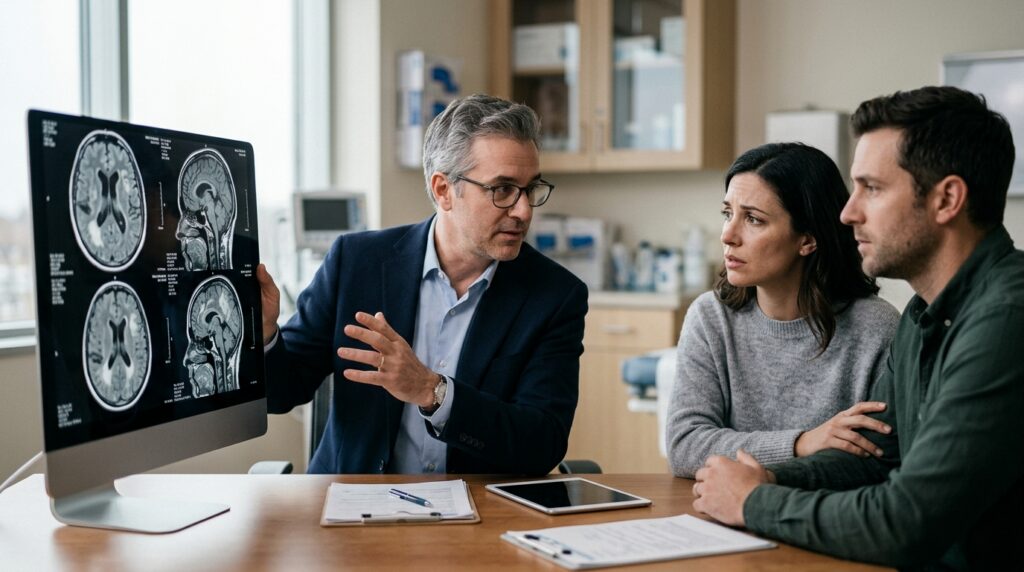
- Brain imaging (CT, MRI, and advanced scans)
- Neuropsychological testing
- Ongoing medical records
- Documented daily impact and witness accounts
- Expert opinions that connect it all
We break down each one below.
Emergency records and the first 24 hours
Emergency records capture the injury at the moment it happened. Paramedic (EMS) run reports, emergency-room charts, and trauma-center records often note loss of consciousness, confusion, vomiting, and the mechanism of injury — how the head was struck or shaken.
They also record the Glasgow Coma Scale (GCS) score. This is a 3-to-15 rating of how well a person opens their eyes, speaks, and moves. Lower scores point to a more serious injury: clinicians generally treat GCS 13–15 as mild, 9–12 as moderate, and 8 or below as severe. That dated number becomes early, objective proof.
What if the early records are thin?
Do not lose hope if the injury wasn’t caught right away. Delayed diagnosis is common. Adrenaline, shock, or more visible injuries (a broken leg, heavy bleeding) can mask brain symptoms in the first hours.
In the catastrophic cases our attorneys handle, we regularly see symptoms surface days later — trouble concentrating, headaches, mood changes, sleep problems, sensitivity to light or noise. That delay does not mean there is no injury. It is one reason ongoing records and daily notes matter so much.
Also preserve the crash or incident report and any scene evidence. Photos, vehicle damage, and any available speed or event-data-recorder information help show the force involved, which supports the medical picture.
Brain imaging: CT, MRI, and advanced scans
Imaging is often the first hard evidence — but it has real limits you should understand. Different scans reveal different things.
- CT scans are standard in the ER. They quickly show bleeding, swelling, and skull fractures that may need urgent surgery.
- MRI is more sensitive to structural damage and can reveal injuries a CT misses, especially in the days and weeks afterward.
- Advanced imaging such as diffusion tensor imaging (DTI), SPECT, or functional MRI (fMRI) can sometimes detect damage standard scans don’t. DTI, for example, maps the brain’s white-matter “wiring” and can flag torn nerve fibers.
Here is the honest caveat: imaging can look normal even when someone has a real, disabling brain injury. Microscopic damage doesn’t always appear on a picture. That is exactly why the other evidence carries so much weight.
Neuropsychological testing: measuring the invisible damage
Neuropsychological testing measures the thinking and behavior problems that imaging misses. A neuropsychologist (a specialist, not a treating physician) administers a battery of standardized tests, often over several hours across one or more sessions.
The testing measures memory, attention, processing speed, executive function (planning and decision-making), language, and mood. Scores are compared to what a person of similar age and education would normally achieve. When your loved one’s scores fall well below their expected baseline, that gap is objective evidence of impairment.
This is often the single strongest piece of evidence when scans are inconclusive. It puts numbers to problems your family sees every day but that never show up on a picture.
Have questions about what happened?
Ask our team directly. The first conversation is free, confidential, and there is no obligation to continue.
Medical records that show the full picture
Ongoing records prove a brain injury is serious and lasting, not a passing complaint. Steady treatment over months tells a clearer story than a single visit. A treating team may include:
- Neurologists and neurosurgeons who diagnose and treat the brain damage
- Physiatrists (physical medicine and rehabilitation doctors) who oversee recovery
- Therapists — physical, occupational, speech, and cognitive — who work on daily function
Prescription records, therapy notes, and rehabilitation plans document the arc of recovery — or of permanent impairment. When care continues month after month, it shows the injury is real. For the hardest cases, our page on recovery after a coma explains what long-term care can look like.
Documenting symptoms and daily impact
This is where families make the biggest difference, and it costs nothing.
Keep a symptom journal. Write down headaches, memory lapses, mood swings, fatigue, and confusion, with dates. Patterns over time support the medical file.
Ask people who know your loved one to describe the “before and after.” Statements from family, friends, coworkers, and caregivers carry real weight. They can explain changes in personality, work performance, relationships, and independence that no scan can capture.
Short videos help, too. Footage of your loved one struggling with a task they once did easily makes the impact clear in a way words can’t. Do this while details are fresh — memories fade, and so do the small, telling changes.
Expert witnesses who explain the injury
Expert witnesses translate complex medicine into a clear story of what happened and what it means going forward:
- Medical experts — a neurologist, neurosurgeon, neuropsychologist, or radiologist — interpret the findings and explain the diagnosis.
- Life-care planners project future medical and support needs: therapy, home care, equipment, home modifications.
- Vocational and economic experts measure lost earning capacity when someone can no longer work as before.
Together, they connect the dots — showing how the incident caused the injury and how that injury will affect decades of life. That future cost must be proven, not guessed, which is why these experts matter.
How insurers try to dispute a brain injury — and how evidence answers back
Insurers often dispute severe brain injuries by downplaying them. Knowing the common tactics helps you protect the claim.
Calling it “mild.” The word “mild” describes how an injury started, not how bad it turns out. A so-called “mild” TBI can cause lasting problems. Neuropsychological testing and ongoing records show the true severity.
Blaming pre-existing conditions. They may argue the symptoms come from an old problem. Prior medical records plus a clear “before and after” from witnesses show what actually changed.
Arguing delayed symptoms aren’t related. Because TBI symptoms often appear later, insurers may call them unconnected. Consistent reporting to every provider ties them back to the event.
Using record gaps against you. Missed appointments and scattered records give insurers an opening — so follow through on care and keep everything.
There is also a Florida-specific tactic: shifting blame onto the injured person. Florida uses a modified comparative negligence rule under Fla. Stat. § 768.81. Since the 2023 amendment, a person found more than 50% at fault for their own injury generally recovers nothing, and any recovery is reduced by the injured person’s share of fault. That is a major shift from Florida’s old “pure” comparative rule, and it is exactly why insurers try to pin responsibility on the victim. Solid evidence is how you counter blame-shifting.
Practical steps to protect your evidence
You can protect a claim by getting consistent care and keeping careful records from the start. These steps give your family real control:
- Get medical care and keep going. Follow through on every referral. Gaps weaken the record.
- Request and keep copies of all records, imaging, and bills. Ask for the actual scan files (the images), not just the written reports.
- Start a symptom journal early and note what others observe.
- Be careful with the insurance company. Avoid giving a recorded statement before speaking with an attorney. A casual “I feel okay” can be replayed later — especially while TBI symptoms are still emerging.
Timing also matters, and Florida’s deadline is strict. Under Fla. Stat. § 95.11, most Florida negligence claims must generally be filed within two years for causes of action accruing on or after March 24, 2023 (the prior deadline was four years). Miss it, and the claim can be barred no matter how strong the evidence. A lawyer who handles catastrophic injuries can help gather the right proof, retain the right experts, and preserve records before they disappear.
Want to know where you stand?
Tell us what happened and our team will walk you through the options available to you, at no cost.
Talk with a catastrophic injury attorney
If your loved one suffered a severe brain injury in a crash, fall, or attack — including an attack that happened because a property owner failed to provide reasonable security — our team is ready to listen. We know how overwhelming this is, and we will explain your options in plain language.
CHG Personal Injury Lawyers is a Florida-based firm with licensed attorneys admitted to the Florida Bar, and we handle catastrophic injury cases nationwide.
No honest lawyer can promise a specific outcome. But a free case evaluation can help you understand what evidence your claim may need and what steps come next. Contact us for a free case evaluation.
You may also want to read about catastrophic injury claims, truck accidents, and negligent security.

Frequently asked questions
What evidence do I need to prove a traumatic brain injury?
Brain imaging, ongoing medical records, neuropsychological test results, and documented daily impact that all connect the injury to the accident — with expert opinions tying the pieces together. The strength comes from consistency across every source.
Can you prove a brain injury if the CT or MRI scan looks normal?
Yes. A scan can look normal even with a real, disabling brain injury, because microscopic damage doesn’t always appear on imaging. Neuropsychological testing, treating-doctor records, and daily-impact evidence can prove the injury when imaging is inconclusive.
What is neuropsychological testing and why does it matter?
It is a battery of standardized tests, given by a neuropsychologist, that measures memory, attention, processing speed, and thinking against an expected baseline. It is often the strongest evidence when brain scans don’t show the damage.
Why do insurance companies call severe brain injuries “mild”?
The term “mild” describes how an injury started, not how serious it becomes. Insurers use it to undervalue claims, but ongoing records and testing show the true, lasting severity.
Do delayed brain-injury symptoms hurt my claim?
Not if you document them consistently. Delayed symptoms are common with TBI. Reporting them to every provider and recording them in a journal ties them back to the accident.
How long do I have to file a brain injury claim in Florida?
Under Fla. Stat. § 95.11, most Florida negligence claims must generally be filed within two years for causes of action accruing on or after March 24, 2023. Talk with an attorney about the deadline that applies to your specific situation.
Should I give a recorded statement to the insurance company?
It is usually best to wait until you have spoken with an attorney. Early statements can be misread, especially while brain injury symptoms are still developing.
The evidence that builds a strong TBI claim
Medical imaging and records
CT scans, MRIs, and specialized studies, along with every emergency, hospital, and follow-up record that documents your diagnosis and treatment over time.
Neuropsychological testing
Standardized cognitive and behavioral testing that measures memory, attention, processing, and mood changes that imaging alone may not reveal.
Documented daily impact
Statements from family, coworkers, and caregivers describing the changes they see, plus a personal journal noting symptoms, missed work, and lost abilities.
Expert opinions
Physicians and other qualified experts who tie the pieces together and explain how the accident caused the injury and its lasting effects.
A 'normal' scan does not mean you are fine
Many traumatic brain injuries do not appear on a standard CT or MRI. Do not let anyone tell you there is no injury because a scan looked clear. Advanced testing and consistent medical documentation can still show what happened — but the record has to be built carefully from the start.
What to do to protect your evidence
Get and continue care
Follow through with every appointment and referral. Gaps in treatment can be misread as recovery, and consistent care creates the medical trail your claim depends on.
Keep everything
Save discharge papers, prescriptions, bills, and any notes about symptoms. Photos, receipts, and a symptom journal all help show the injury's day-to-day toll.
Write down the changes
Headaches, memory lapses, mood shifts, trouble concentrating — record when they happen. These details connect a clinical diagnosis to your real life.
Act before evidence fades
Crash data, security footage, and witness memories disappear quickly. The sooner an attorney preserves them, the stronger your case can be.