

Catastrophic Injury Claims · Florida & Nationwide
Home Modifications After Paralysis: The Costs You Can Recover
A spinal cord injury changes where you live and how you move through your own home. When someone else's negligence caused it, the cost of making your home accessible can be part of your claim. Here's what that includes.
Why families turn to CHG
Licensed
Florida Bar–admitted attorneys
Nationwide
Catastrophic cases across the U.S.
Bilingual
English & Spanish support
Free
No-cost case evaluation
By CHG Lawyers · Published July 28, 2026
Home and Vehicle Modifications After Paralysis: Costs You Can Recover
Yes. If someone else’s carelessness caused your paralysis, you can usually recover the cost of home and vehicle changes. These count as damages in a personal injury or wrongful-death claim. The law treats them as future medical and care costs. This covers the changes you need now and the ones you’ll need for life.
This guide explains, in plain language, what changes a home and vehicle usually need after paralysis. It shows where to find trustworthy cost data. It also explains why we won’t make up a number. And it shows how these costs get proven and paid in a claim.
Do you live with paraplegia or quadriplegia? Do you care for someone who does? This guide is here to help you understand your options. It does not promise a result.

Not sure what your next step is?
Talk it through with our team — the first consultation is free, confidential, and carries no obligation.
Why a home and vehicle rarely work the same after paralysis
Paralysis changes how a person moves around their home. It also changes how they get from place to place. A spinal cord injury can cause loss of movement and feeling. It can also cause loss of bowel and bladder control. It can bring trouble with breathing and body temperature too. This is according to the Mayo Clinic.
Because of this, everyday features become barriers. Stairs, narrow doorways, standard bathrooms, high counters, and a normal car can turn dangerous or impossible.
Accessibility isn’t a luxury. It’s what allows independence, safety, and dignity after a serious injury.
Our attorneys handle catastrophic-injury cases. In these cases, these changes are often among the largest lifetime costs a family faces. The National Spinal Cord Injury Statistical Center (NSCISC) is a federally supported registry. It is based at the University of Alabama at Birmingham. It reports that lifetime costs after a spinal cord injury run into the millions of dollars. The main drivers are the level of injury and the person’s age when it happens. That is why it helps to understand these needs early.
Common home modifications after paralysis
Home changes after paralysis usually cover the entrance, bathroom, kitchen, and moving around the house. The exact list depends on the injury level and the home’s layout.
One helpful reference is the federal accessibility standard for public buildings. It’s the ADA Standards for Accessible Design. It calls for a clear doorway width of at least 32 inches. It also calls for a wheelchair turning space of about 60 inches. Private homes don’t have to meet the ADA. But planners often use these numbers as a starting point for what “usable” really means.
Common changes include:
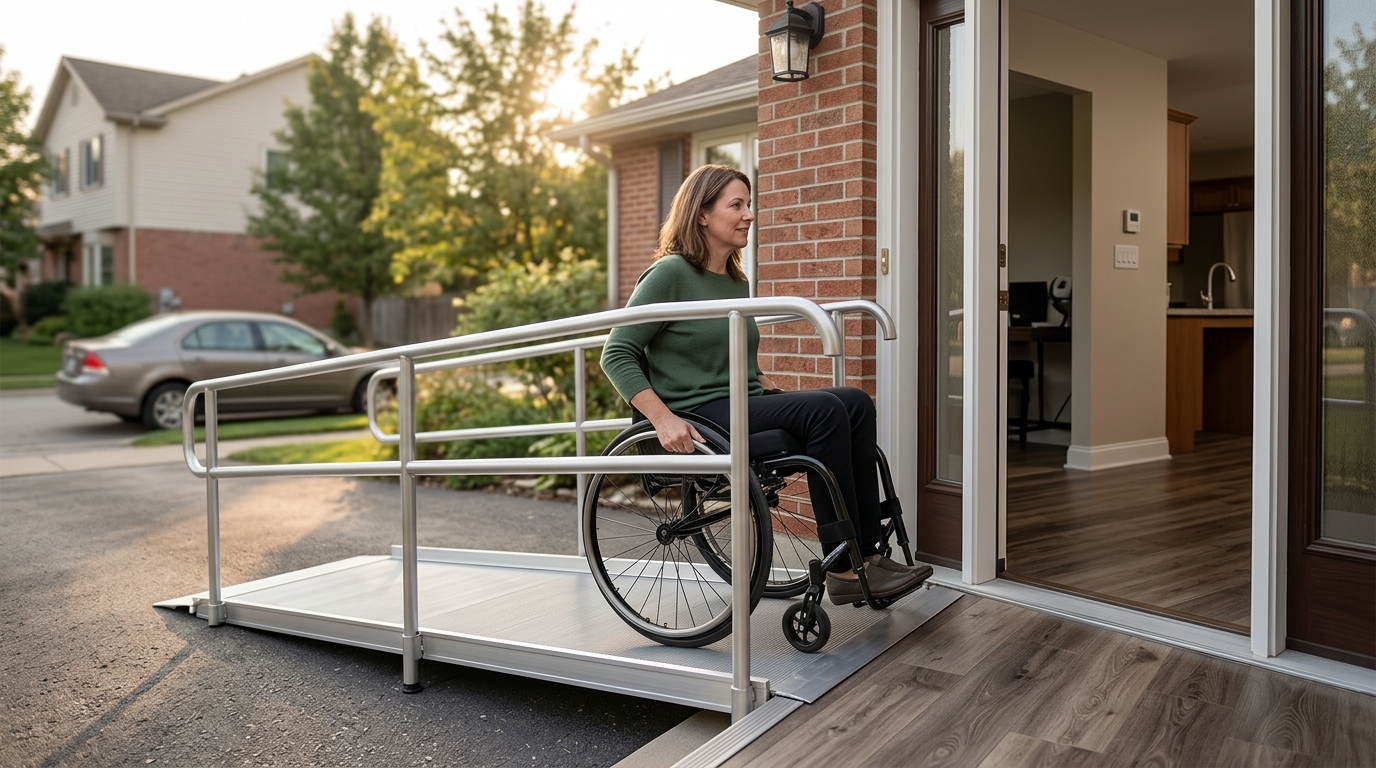
- Entrance and access: ramps, threshold changes, wider doorways (usually 32–36 inches of clear width), and lever-style handles instead of knobs.
- Bathroom: roll-in showers, grab bars, accessible sinks and toilets, and anti-scald water controls.
- Kitchen: lower counters and cabinets, accessible appliances, and pull-out shelving.
- Getting around inside: stair lifts, home elevators or platform lifts, and ceiling track lifts. These help with moving in and out of a wheelchair or bed.
- Space to move: new flooring, wider hallways, and enough turning space for a wheelchair.
For higher-level injuries, families often add environmental controls and smart-home systems. These let a person control lights, doors, and the thermostat by voice or a simple switch. Sometimes a full renovation makes more sense. Moving to a home built for accessibility can be easier than changing an older house.
The level of injury drives how much is needed. The American Spinal Injury Association’s ISNCSCI/ASIA scale is the standard used to describe how high and how complete a spinal cord injury is.
For example, a person with a high neck (C1–C4) injury may rely on ceiling lifts, a power wheelchair, and voice-controlled systems. Someone with a lower back injury may need ramps, a roll-in bathroom, and hand controls to drive. That is why quadriplegia usually needs far more changes than paraplegia.
Vehicle modifications and adaptive driving equipment
After paralysis, a standard car often can’t simply be adapted. Many families need a converted van or a special vehicle. Getting around is part of independence. So vehicle needs belong in any honest cost picture.
Common vehicle changes include:
- Wheelchair-accessible van conversions: lowered floors, ramps or lifts, and tie-down systems to secure the wheelchair.
- Adaptive driving equipment: hand controls, steering aids, and transfer seats for people who can still drive.
Here’s a detail families often don’t hear until later. The National Highway Traffic Safety Administration runs an Adaptive Equipment page. It explains that adaptive driving equipment should be prescribed after an evaluation. A certified driver rehabilitation specialist should do that evaluation. You should not pick equipment off a shelf. And that evaluation itself is a cost you can document.
These conversions are specialized. And they don’t last forever. Vans wear out, equipment breaks, and needs change. So the real cost includes maintenance, replacement, and re-fitting over the years — not just one purchase.
How much do home and vehicle modifications cost?
Costs vary widely. No honest source can give one fixed number. The total depends on the injury level, your home’s layout, your region, and how severe your condition is. Quadriplegia generally needs more changes than paraplegia — and costs more.
Instead of inventing figures, we point families to the groups that actually manage this data:
- The National Spinal Cord Injury Statistical Center (NSCISC) publishes yearly estimates of first-year and recurring lifetime costs by injury level.
- The Christopher & Dana Reeve Foundation keeps paralysis statistics and practical living-with-paralysis resources.
- United Spinal Association offers peer support and guides for home changes and adaptive vehicles.
Here’s the most important point: these costs repeat. You must update and replace changes over decades. You do not pay just once. That’s why home modification costs are one large piece of a broader life care plan. A life care plan is a document. It maps out every future need a catastrophic injury creates.
Can you recover the cost of home modifications after paralysis?
Yes. When someone else’s carelessness caused the injury, you can usually recover reasonable and necessary accessibility costs as damages. These costs fall under future medical and care expenses. Lawyers call these economic damages (the measurable money losses). A claim can include both:
- Current, needed changes — the ramp, bathroom, and van you need today.
- Expected future changes — the replacements and upgrades you’ll need over your lifetime.
Did a loved one die from a catastrophic injury? Then the family’s wrongful-death claim works differently. It focuses on the losses the family suffered. You can learn more on our page about catastrophic injury claims.
One honest caution: no lawyer can promise a specific result. Outcomes depend on the facts, who was at fault, and how much insurance is available.
Florida also follows a modified comparative-negligence rule. This is a rule about shared fault. Under Fla. Stat. §768.81, a person found more than 50% at fault generally recovers nothing. Partial fault reduces recovery by that percentage.
Have questions about what happened?
Ask our team directly. The first conversation is free, confidential, and there is no obligation to continue.
How these costs get proven in a claim
Future accessibility costs get proven with expert evidence, documents, and detailed records — not guesswork. Several kinds of proof usually work together:
- A life care planner and rehabilitation or occupational therapy experts identify exactly what changes and equipment the injury requires.
- Contractor and vendor estimates put real dollar figures on accessible building and vehicle conversions.
- Physician documentation ties each change to the medical needs of the injury.
- Economists calculate future costs. This includes replacement cycles and inflation over a person’s lifetime.
Your records matter from day one. Keep every receipt, invoice, estimate, and medical report. This includes the driver-rehabilitation evaluation and the ASIA classification from your treating doctors. In the cases our attorneys handle, strong records early on make the future-cost picture far more believable later.
Where the money can come from
Money for these changes usually comes from the at-fault party’s insurance. Sometimes it comes from more than one source. The right source depends on how the injury happened.
Common funding sources include:
- The at-fault party’s liability insurance — auto, commercial, or premises coverage.
- Commercial policies in truck crashes. A serious truck accident can involve several at-fault parties — the driver, the trucking company, a cargo loader, or a maintenance contractor. Each may carry its own insurance. Interstate trucking companies must carry minimum liability limits under Federal Motor Carrier Safety Administration rules (commonly $750,000, and higher for hazardous loads), per 49 CFR §387.9.
- A claim against a property owner when someone is hurt because a property failed to keep them reasonably safe.
That last point deserves plain words. Say you or a loved one was attacked, shot, robbed, or assaulted on someone else’s property. Maybe it was an apartment complex, parking garage, hotel, bar, gas station, or store. Did you get hurt because the owner ignored basic safety — working locks, gates, lighting, cameras, or guards? Then you may have a claim against that owner. Lawyers call this a negligent security claim. You can read more on our page about negligent security.
What if the at-fault driver has no insurance or too little? Your own uninsured/underinsured motorist coverage may step in. See our page on who pays when the driver is uninsured or underinsured.
Health insurance, VA benefits, and workers’ compensation can also help. But they often don’t fully cover accessibility needs. That’s one reason a full claim matters. Available coverage limits can affect what you finally recover.
Planning for a lifetime of needs, not just today
The biggest mistake families make is treating changes as a one-time cost. Needs change over time. People age, and new health problems develop. Technology improves. Equipment wears out and needs replacing.
This is why timing is critical. Once a claim settles, you generally can’t reopen it for costs you didn’t count. Do you settle before a full life care plan values your future needs? Then you may pay for later changes out of your own pocket.
There’s also a legal clock. Under Fla. Stat. §95.11, most negligence claims that start on or after March 24, 2023 must generally be filed within two years. Waiting too long can end a claim before it starts. So it’s wise to get advice early.
Talk to a catastrophic injury lawyer about your situation
Every paralysis case and every home is different. So a real answer starts with your facts. A free case evaluation can help you understand what changes and future costs may be recoverable in your situation.
CHG Personal Injury Lawyers are licensed Florida attorneys. We handle catastrophic injury cases nationwide, with bilingual (English/Spanish) support. To learn more, visit our pages on paralysis injury claims, spinal cord injuries, and paralysis from medical negligence.
Want to know where you stand?
Tell us what happened and our team will walk you through the options available to you, at no cost.
Frequently asked questions
Can you recover the cost of home modifications after paralysis?
Yes. When another party’s carelessness caused the injury, you can usually recover reasonable and necessary home modification costs. They count as economic damages in a personal injury claim.
How much does a wheelchair-accessible van conversion cost?
Costs vary widely by vehicle and equipment. Vans also need maintenance and replacement over time. NHTSA recommends an evaluation by a certified driver rehabilitation specialist before you buy adaptive equipment. Contractor and vendor estimates in your case give the most accurate figure.
Can you claim future home modification costs, not just current ones?
Yes. A claim can include expected future changes and replacements. These are valued over your lifetime with help from a life care planner and an economist.
Does quadriplegia require more home modifications than paraplegia?
Usually yes. Higher and more complete injuries typically need more extensive home and vehicle changes, including environmental controls. Doctors classify these injuries using the ASIA/ISNCSCI scale.
Who pays for home modifications if the at-fault driver is uninsured?
Your own uninsured/underinsured motorist coverage may apply. Health insurance, VA benefits, or workers’ compensation can also help. But they often don’t fully cover accessibility needs.
What is the deadline to file a spinal cord injury lawsuit in Florida?
Under Fla. Stat. §95.11, most negligence claims that start on or after March 24, 2023 must generally be filed within two years. So it’s best to seek advice early.
Common modifications you may be able to recover
Ramps and entry access
Wheelchair ramps, widened doorways, and threshold changes so you can safely enter and move through your home.
Bathroom and bedroom retrofits
Roll-in showers, grab bars, lowered sinks and counters, and adapted bedrooms designed around a wheelchair or lift.
Lifts and elevators
Ceiling track lifts, stair lifts, or residential elevators for homes with more than one level.
Vehicle and transport needs
Wheelchair-accessible van conversions and hand controls that let you keep getting to work, therapy, and appointments.
How these costs fit into your claim
They count as economic damages
Reasonable and necessary home modification costs are part of the economic damages a court and insurers recognize in a serious injury claim.
Expert life-care planning
We work with life-care planners and medical experts to document what your home will need now and over your lifetime.
Built around your daily life
The goal is a home that supports your independence and dignity — not a one-size-fits-all estimate.
Keep every receipt and estimate
Save contractor bids, receipts, and doctor's recommendations tied to your accessibility needs. Well-documented, necessary costs are far easier to include in your claim than expenses reconstructed from memory. Talk to a lawyer before you settle — future modification needs are easy to undervalue.
Facing a life-changing injury? Let's review what your recovery should cover.
Related practice areas
- Tetraplegia
- How Paralysis Settlements Are Calculated | Damages