
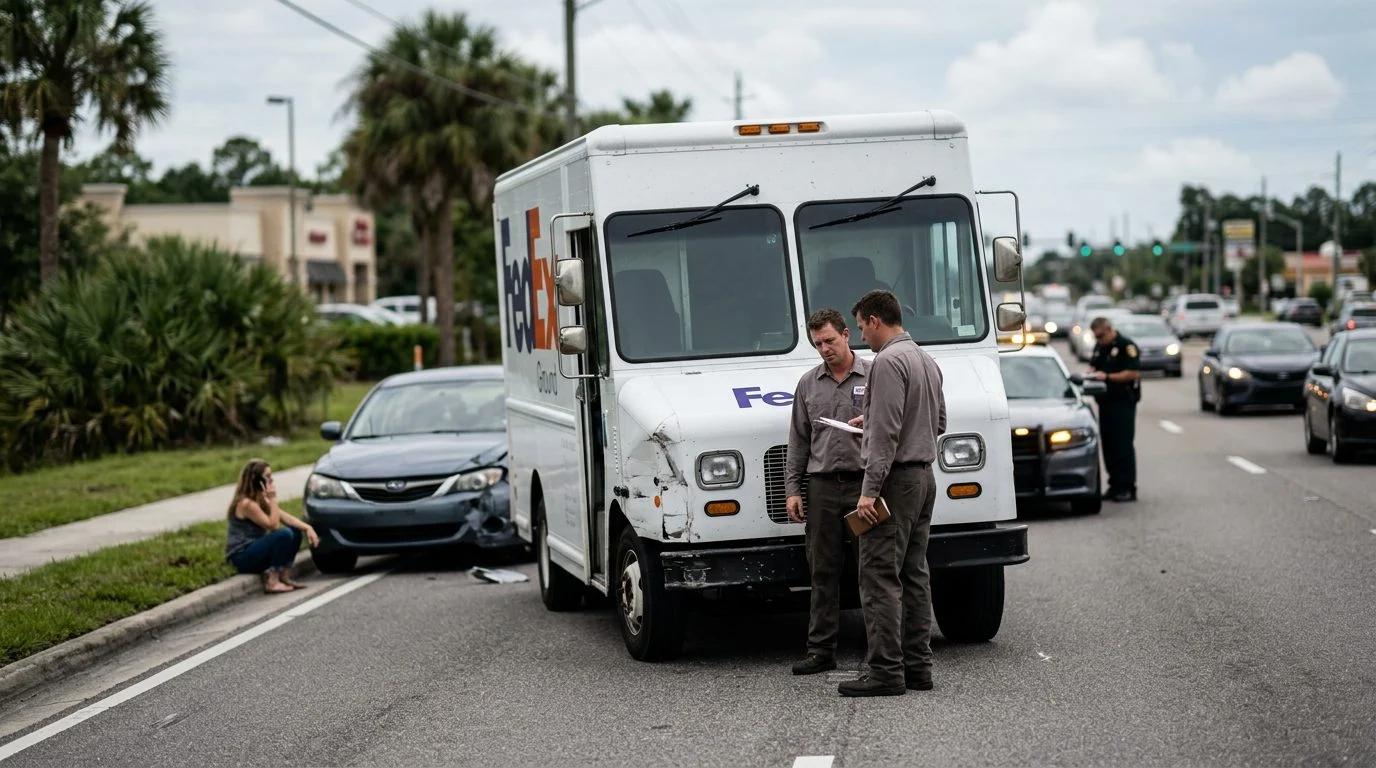
FedEx Delivery Contractor Accident Liability Florida
When a FedEx delivery contractor causes a crash, the driver may not be the only one responsible. Under Florida law, a claim may reach the contractor company. In some cases, it may also reach FedEx itself. The answer depends on who controlled the work and the vehicle.
Who This Page Is For and What It Covers
You may be hurt right now. You may be caring for someone who is. An insurance adjuster (the insurance company’s claims worker) may have called. A letter may have used words like “contractor” and “liability.” You may not understand them. That is a hard place to be.
This page answers four questions:
- Who may be responsible?
- How does Florida law affect the money?
- What can a claim cover?
- What should you do early?
This is general information about Florida law. It is not a prediction about any one crash.
Why the “Contractor” Label Does Not Settle Who Pays
A contractor label does not, by itself, decide who is responsible for a crash. Many delivery routes are run by contractor companies. These companies hire and manage their own drivers.
Courts look at the facts, including:
- Questions about who set the driver’s routes, schedule, and work can be important to understanding a truck crash.
- The name or branding shown on a vehicle is one detail that can be worth documenting after a crash.
- Records about how the operator was prepared for the job and how the route was scheduled
- Who owned or leased the vehicle
A claim usually starts with the driver’s conduct on the road. Speeding, distraction, fatigue, or failing to yield can be negligence (careless conduct that causes harm). This is true no matter what the paperwork says.
A common mistake is assuming the contractor label ends the question. Often, it does not.
Parties Who May Be Responsible
More than one party may share responsibility for a delivery van crash. Possible parties include:
- The driver, for negligent driving.
- The contractor company, for negligent hiring, training, supervision, or retention.
- Florida law can also hold a vehicle owner responsible when someone drives with permission. Both points depend on the facts.
- Maintenance providers or parts makers, if their work or product contributed to the crash.
- Insurers. More than one policy may apply. Florida law generally requires a settlement or verdict (a final agreement or a court’s decision) against the insured. This must happen before a person not covered by the policy can sue the insurer. See Fla. Stat. § 627.4136.
In 2026, the U.S. Supreme Court decided Montgomery v. Caribe Transport II. The Court held that a state-law claim was not blocked by federal law (preempted). The claim said a freight broker negligently hired an unsafe motor carrier. That case involved a freight broker, not a delivery company. It shows that courts can let negligent-hiring claims move forward past a federal defense.
How Florida Law Shapes Recovery
Florida uses a comparative fault rule (Fla. Stat. § 768.81(2)): contributory fault diminishes proportionately the damages awarded but does not bar recovery, subject to subsection (6), under which Fla. Stat. § 768.81(6) provides that any party found to be greater than 50 percent at fault for his or her own harm may not recover any damages, except in personal injury or wrongful death actions arising out of medical negligence under chapter 766. This means blame can be shared between the parties, but under § 768.81(6), any party found to be greater than 50 percent at fault for his or her own harm may not recover any damages, except in an action for personal injury or wrongful death arising out of medical negligence pursuant to chapter 766. Your share of blame can reduce what you recover, but under § 768.81(6), any party found to be greater than 50 percent at fault for his or her own harm may not recover any damages, except in an action for personal injury or wrongful death arising out of medical negligence pursuant to chapter 766. If you were more than half at fault, you may recover nothing, unless your claim is for personal injury or wrongful death arising out of medical negligence pursuant to chapter 766.
- Shared fault reduces damages. Under Fla. Stat. § 768.81, fault you share reduces the damages awarded for your injury. Damages are the money awarded for your losses.
- The 50 percent bar. A party found more than 50 percent at fault for their own harm may not recover any damages. This bar does not apply to medical negligence claims under chapter 766.
- Each party pays its own share. The court enters judgment (the court’s final order) against each liable party. The judgment is based on that party’s percentage of fault. The court does not hold them jointly responsible for the full amount.
- Under Fla. Stat. § 95.11, most negligence lawsuits in Florida, including many car, truck, and slip-and-fall claims, must be filed within two years, and other types of claims have their own time limits. Because these deadlines can be strict, contact our firm promptly after an injury. Other deadlines can apply. Waiting is the costliest mistake.
What a Claim Can Cover, Including Wrongful Death
A claim can cover the costs of your injury. It can also cover the harm the injury does to your daily life. Claims often include:
- Past and future medical care, and lost wages or lost earning ability
Catastrophic injuries, such as spinal cord injuries, traumatic brain injuries, and amputations, often need long-term planning. That planning covers care and equipment.
When a crash causes a death, the family’s path is different. Under Fla. Stat. § 768.20, the decedent’s personal representative (the person handling the deceased person’s estate) brings the action for the survivors and estate. Under Fla. Stat. § 768.21, a surviving spouse may recover for loss of companionship and for mental pain and suffering. Minor children may recover for lost parental companionship, instruction, and guidance.
Grieving families can take this one step at a time.
Evidence to Protect and Early Steps
The first days after a crash often decide what evidence survives.
- Get medical care and follow your doctors’ treatment plan. Keep every record, bill, and receipt.
- Get the crash report. Under Fla. Stat. § 316.066, the officer’s Florida Traffic Crash Report, Long Form, must be submitted within 10 days after the investigation is completed for a crash that resulted in death of, personal injury to, or any indication of complaints of pain or discomfort by any party or passenger, involved a violation of s. 316.061(1) or s. 316.193, rendered a vehicle inoperable requiring a wrecker, or involved a commercial motor vehicle. Parties and their legal representatives may access the report.
- Photograph the scene. Capture vehicles, injuries, road conditions, and signs while they are still visible.
- Write down witness names and contact details.
- Note what delivery records may exist. Vehicle data, driver logs, dispatch and route records, dashcam footage, and maintenance history can matter. These records can be lost over time. Early requests help.
- Be careful with recorded statements. Talk with a lawyer before giving a recorded statement to any insurer.
What to Expect From Consultation to Resolution
The process starts with a conversation. It then moves through investigation, a demand, and negotiation. Each step follows the facts of your case.
- Free consultation. You share the crash facts and your injuries. The first consultation is free, confidential, and carries no obligation to continue.
- Investigation. We gather company records, vehicle data, the crash report, and reports from accident reconstruction professionals (people who study how a crash happened).
- Demand. We document injuries and losses. We then present a demand, which is a formal request for payment, to the responsible insurers.
- Negotiation and suit. If needed, a lawsuit is filed in the proper Florida court before the deadline.
- Resolution. The case ends by settlement or trial. The timeline depends on the complexity and medical course of each case.
CHG charges no attorney’s fees and no case costs unless there is a recovery.
Frequently Asked Questions
Can I sue FedEx if the driver works for a contractor? Yes, a claim against FedEx may be possible if the facts support it.
Does comparative fault mean I cannot recover? Not always. Florida reduces your recovery by your share of fault. It bars recovery only when you are more than 50 percent at fault.
Other deadlines can apply. Act promptly.
Do I have to pay anything upfront? Your first consultation is free, confidential, and carries no obligation to continue.
Who files a wrongful death claim? The decedent’s personal representative files it for the survivors and estate under Florida law.
Can I sue the insurer directly? Florida generally requires a settlement or verdict against the insured first.
Talk With Igor Hernandez About Your Crash
If you’re waiting on insurers, caring for an injured family member, or grieving a loss, you don’t have to sort out the contractor question alone. Our team can review your crash, your injuries, and who may be responsible. Request a free case evaluation today.
Igor Hernandez, the responsible lawyer for this page, is one of our lawyers and is admitted to The Florida Bar. CHG Personal Injury Lawyers is a Florida-based firm serving people throughout Florida. Every case is different, and no outcome can be promised.