

Vehicle Design & Defects
What Is Crashworthiness? When Vehicle Design Fails to Protect You
A vehicle's job is to protect you in a crash. When poor design, faulty components, or inadequate safety features cause catastrophic injury, you may have a claim against the manufacturer—even if you didn't cause the accident.
By CHG Lawyers · Published August 30, 2026
Crashworthiness Claims: When Vehicle Design Fails to Protect You
Your body hits the steering wheel. The dashboard. The windshield. The roof caves inward. You lose consciousness. When you wake up, you’re paralyzed from the waist down, or you can’t remember your own name, or your arm is gone.
That moment—when your body collides with the inside of your vehicle—is where most catastrophic injuries happen. And it’s where a separate legal claim often exists that many injury victims never discover.
That claim is called a crashworthiness claim. It holds vehicle manufacturers responsible for designing and building cars, trucks, and SUVs that actually protect you when a crash occurs. This is not about who caused the accident. This is about whether your vehicle did its job.
If you suffered a serious, permanent injury in a crash and you believe the vehicle's design or safety features failed to protect you, reach out. Talk it through with our team — the first consultation is free, confidential, and carries no obligation.
The “Second Collision”: Where Catastrophic Injuries Happen
Most people don’t understand what happens in serious crashes.
The first collision is the vehicle hitting another car, truck, tree, guardrail, or pavement. That’s the impact you hear and feel.
The second collision happens in the next fraction of a second. Your body strikes the vehicle’s interior. The steering wheel. The dashboard. The windshield. The seat. The roof. The door frame. Your head, spine, chest, and limbs absorb forces they were never designed to withstand.
The second collision is where vehicle design either protects you or fails you.
When a vehicle’s safety systems and structural design fail during that second collision, the result can be:
- Spinal cord injury or paralysis from a collapsing seat or crushing roof
- Traumatic brain injury from an airbag that doesn’t deploy, deploys too slowly, or deploys with excessive force
- Amputation or severe limb damage from the vehicle’s structure intruding into the passenger compartment
- Severe burns from a fuel system that leaks or ignites after impact
- Catastrophic back or neck injury from inadequate seat support or restraint failure
These injuries are preventable. Manufacturers have the technology, crash-test data, and decades of safety research to prevent them. When they don’t use it, people suffer life-altering injuries.
Common Crashworthiness Defects
Crashworthiness failures fall into specific categories:
Airbag system failures: Airbags that don’t deploy, deploy too slowly, deploy with excessive force, or fail to deploy in side-impact or rollover crashes. Defective airbag sensors, wiring, or control modules can prevent deployment entirely.
Seat and restraint failures: Seats that collapse backward during impact, seat backs that fold forward, or seat belts that don’t lock or hold occupants in place. Defective seat tracks or anchor points can cause seats to slide or collapse.
Roof crush: The roof structure fails to resist crushing forces, collapsing inward and causing spinal cord injury, paralysis, or death. This is particularly common in rollover crashes.
Interior hazards: Sharp edges, hard plastic surfaces, or components that become projectiles during impact. Inadequate padding on the dashboard, steering wheel, or door panels.
Door and window failures: Doors that open during a crash, allowing occupants to be ejected. Windows that shatter and lacerate occupants or fail to protect against intrusion.
Fuel system defects: Fuel tanks or fuel lines that rupture or leak after impact, leading to fires or explosions that cause severe burns.
Structural intrusion: The vehicle’s frame or body panels collapse inward into the passenger compartment, crushing occupants or causing amputation of limbs.
Federal Safety Standards: The Baseline Manufacturers Must Meet
The National Highway Traffic Safety Administration (NHTSA) sets federal crashworthiness standards that all vehicle manufacturers must meet. These standards define minimum requirements for airbag systems, seat strength, restraint systems, roof rigidity, and interior design.
Vehicles are crash-tested at specific speeds and angles—frontal impacts at 35 mph, side impacts at 38.5 mph, and rollover scenarios. NHTSA publishes crash-test ratings for new vehicles based on these tests, assigning star ratings (1 to 5 stars) for frontal crash, side crash, and rollover protection.
The Insurance Institute for Highway Safety (IIHS), an independent research organization, also conducts crashworthiness testing and publishes ratings. IIHS tests are often more rigorous than federal minimums. For example, IIHS conducts frontal offset crash tests at 40 mph (higher than the federal 35 mph standard) and evaluates crash avoidance and mitigation features.
Failure to meet federal standards is negligence. Florida presumes the rear driver was negligent, but the presumption can be rebutted and fault can be shared. So is failure to use available technology to exceed those standards when doing so would reduce injury risk. Florida presumes the rear driver was negligent, but the presumption can be rebutted and fault can be shared. If a manufacturer knew that a particular design change or safety feature would reduce injuries but chose not to implement it to save costs, that decision can form the basis of a crashworthiness claim.
Not sure what your next step is?
Talk it through with our team — the first consultation is free, confidential, and carries no obligation.
Crashworthiness Is Separate from Who Caused the Accident
This is the critical insight many injury victims miss:
You can have a crashworthiness claim even if you were partially or entirely at fault for the crash.
Here’s a concrete example: You’re driving through an intersection when another driver runs a red light and T-bones your vehicle on the driver’s side. That driver is at fault for causing the accident. But your vehicle’s side-impact airbag fails to deploy, and you suffer a traumatic brain injury that leaves you with permanent cognitive impairment.
You now have two separate claims:
- A claim against the at-fault driver’s insurance for causing the accident
- A claim against the vehicle manufacturer for the defective airbag system
The manufacturer’s liability doesn’t depend on who caused the crash. It depends on whether the vehicle protected you as well as it should have.
Even in a survivable crash—one where a well-designed vehicle would result in minor or moderate injuries—a poorly designed vehicle can turn that crash into a catastrophic injury event. Manufacturers are responsible for that difference.
Why Timing Matters: Florida’s Two-Year Deadline
You have two years from the crash date to file a negligence lawsuit, including a crashworthiness claim (Fla. Stat. § 95.11(5)(a)).
Many injury victims delay. They focus on immediate medical treatment. They work with health insurance or auto insurance. Months pass. A year passes. By the time they consider a crashworthiness claim, the deadline is approaching or has passed.
Once the two-year deadline expires, you lose the right to sue, regardless of your claim’s strength (Fla. Stat. § 95.11(5)(a)).
If you suffered serious, permanent injuries in a crash, don’t wait to explore whether a crashworthiness claim exists. The sooner you investigate, the sooner evidence can be preserved and experts can be retained.
How Crashworthiness Claims Are Investigated
If you’re considering a crashworthiness claim, here’s what the investigation typically involves:
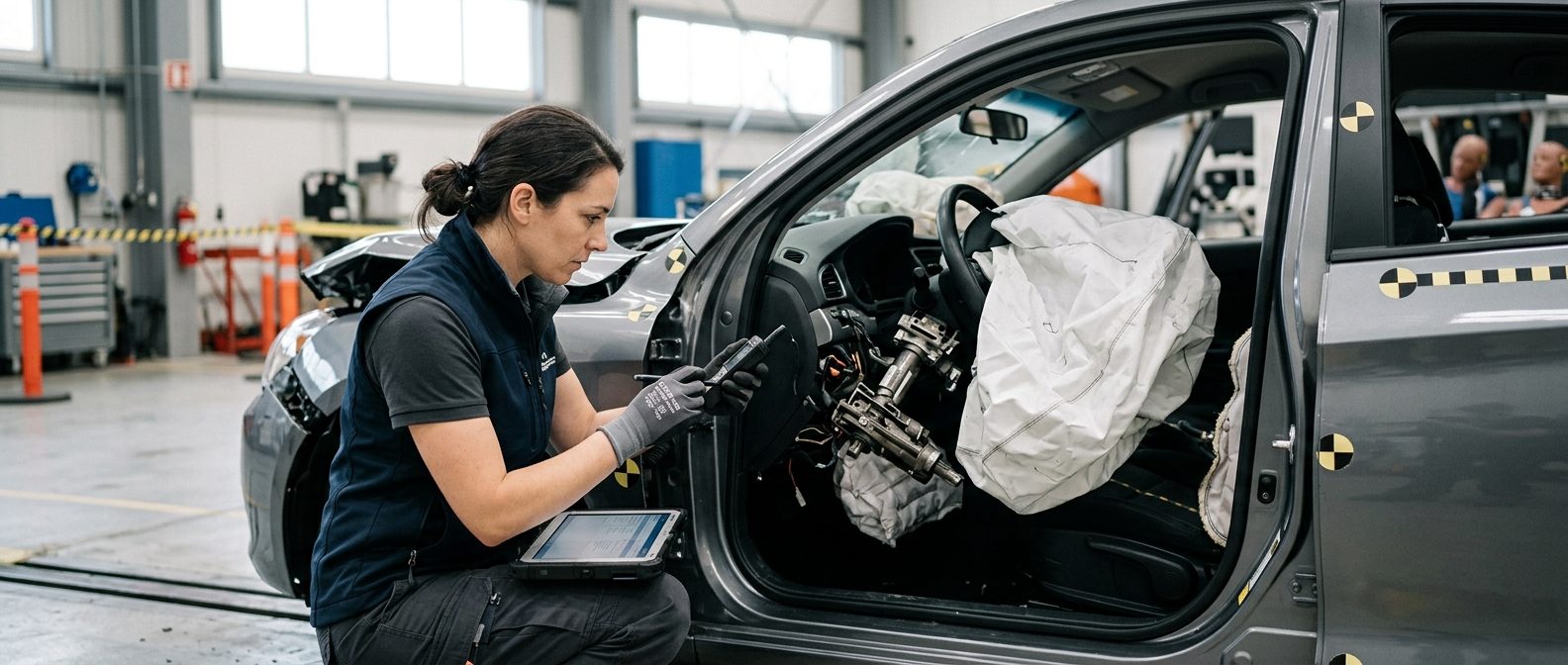
Vehicle inspection and documentation: Experts physically examine the vehicle for design defects and safety failures. They inspect the airbag system, seats and seat tracks, restraint systems, roof structure, door frames, window assemblies, fuel system components, and interior surfaces. Photographs and measurements document the vehicle’s condition and any defects.
Crash data retrieval: Modern vehicles (typically 1996 and newer) record crash data on onboard computers called Event Data Recorders (EDRs). This data includes impact speed, airbag deployment timing, whether seat belts locked, brake application, throttle position, and other critical information. Specialized technicians retrieve and decode this data to establish exactly what happened during the crash.
Comparison and standards analysis: Engineers compare your vehicle’s design and performance to federal safety standards (NHTSA FMVSS regulations), IIHS test results for similar vehicles, and industry best practices. They determine whether your vehicle met the minimum standard or performed worse than comparable vehicles of the same year and class.
Medical records correlation: Your medical documentation—emergency room records, imaging (CT, MRI), surgical reports, rehabilitation records—shows the specific injuries you sustained. Medical professionals correlate those injuries to the crash forces and the vehicle’s failure to protect you.
Manufacturer records and prior complaints: Internal manufacturer testing data, design documents, prior complaints about the same defect, and recall information can show that the manufacturer knew about the problem and chose not to fix it. This evidence can establish negligence or even recklessness.
Expert testimony: Automotive engineers explain the defect, how it occurred, and why the vehicle failed to meet safety standards. Medical professionals explain how the crash forces and the vehicle’s failure to protect you caused your specific injuries.
Have questions about what happened?
Ask our team directly. The first conversation is free, confidential, and there is no obligation to continue.
Frequently Asked Questions
Can I have a crashworthiness claim if I was partially at fault for the accident?
Yes. Crashworthiness liability is about the vehicle’s duty to protect you, not about who caused the crash. Even if you were partially or entirely at fault, you can still pursue a claim against the manufacturer if the vehicle failed to protect you.
What’s the difference between crashworthiness and crash-avoidance systems?
Crashworthiness focuses on protecting occupants during a crash—airbags, seat strength, roof rigidity, restraint systems. Crash-avoidance systems (like automatic emergency braking or lane-keeping assist) are designed to prevent a crash from happening in the first place. Both matter, but they’re separate legal concepts.
Does the age of the vehicle matter?
No. A used vehicle can still have a crashworthiness defect if the design or component was defective when it left the manufacturer. The vehicle’s age doesn’t eliminate your claim, though the statute of limitations applies from the date of your crash, not the date the vehicle was manufactured.
How long does a crashworthiness investigation take?
It depends on complexity. Vehicle inspections and crash data retrieval can take weeks. Expert analysis, discovery, and litigation can take months or years. But remember: you have a two-year deadline from the crash date to file suit (Fla. Stat. § 95.11(5)(a)).
What if the vehicle was modified or had aftermarket parts?
Aftermarket modifications can complicate a crashworthiness claim. However, if the original manufacturer’s design or safety system was defective, that defect is still the manufacturer’s responsibility. An attorney can evaluate whether modifications affected your claim.
What to Do Next
If you suffered a serious, permanent injury in a crash and you believe the vehicle’s design or safety features failed to protect you, reach out. We help people in this situation understand whether a crashworthiness claim is available and what the next steps are.
The two-year deadline is real. Evidence deteriorates. Memories fade. Expert availability changes. The sooner you investigate, the stronger your position.
Contact us for a free case evaluation. We’ll listen to what happened and help you understand your options.
Common Crashworthiness Failures
Structural Collapse
The vehicle's frame, roof, or pillars fail to maintain integrity in a crash, crushing the passenger compartment and causing spinal cord injuries, paralysis, or traumatic brain injury.
Defective Seat Belts & Restraints
Seat belts that fail to lock, anchor points that tear away, or airbag systems that malfunction leave occupants unprotected during impact.
Inadequate Padding & Cushioning
Hard interior surfaces, missing or insufficient padding, or poorly designed dashboards and steering columns increase the risk of severe head trauma and facial injuries.
Fuel System Defects
Fuel tanks positioned where they rupture easily or fuel lines that break during a crash can cause severe burn injuries and fire.
Crashworthiness ≠ Crash Causation
You can pursue a crashworthiness claim even if you were partially or entirely at fault for the accident. The question is not who caused the crash—it's whether the vehicle's design failed to protect you from the injuries you suffered. A defective vehicle can turn a survivable crash into a catastrophic one.
Why Crashworthiness Matters
Protection Is a Legal Duty
Manufacturers have a responsibility to design vehicles that reasonably protect occupants in foreseeable crashes. When they cut corners or ignore known hazards, they can be held accountable.
Design Defects Are Discoverable
Through investigation, expert analysis, and discovery, we can uncover internal documents, testing data, and engineering decisions that show the manufacturer knew about a danger and failed to fix it.
Catastrophic Injuries Demand Justice
Spinal cord injuries, paralysis, severe burns, amputations, and traumatic brain injuries from preventable design failures warrant compensation for lifetime care, lost income, and pain and suffering.
Evidence Tells the Story
Crash test data, prior complaints, recall notices, and expert testimony can prove that a safer design was feasible and that the manufacturer chose profit over safety.
Frequently Asked Questions
Can I have a crashworthiness claim if I was partially at fault for the accident?
Yes. Crashworthiness liability is about the vehicle's duty to protect you, not about who caused the crash. Even if you were partially or entirely at fault, you can still pursue a claim against the manufacturer if the vehicle failed to protect you.
What's the difference between crashworthiness and crash-avoidance systems?
Crash-avoidance systems (like automatic braking or lane-keeping assist) are designed to prevent accidents. Crashworthiness is about how well the vehicle protects you if a crash does occur. Both can be defective, but they involve different legal theories.
How do we prove a design defect caused my injuries?
We work with accident reconstruction experts, biomechanical engineers, and vehicle safety specialists to analyze the crash, examine the vehicle, review manufacturer data, and show that a safer design was available and would have prevented or reduced your injuries.
What if the vehicle was recalled after my crash?
A recall can be powerful evidence that the manufacturer knew about the defect. It shows the problem was real, fixable, and serious enough to warrant a recall—strengthening your claim.