


Truck Accidents · Florida & Nationwide
A Truck Crash Insurance Claim Is Not Like a Car Insurance Claim
When a commercial truck causes a spinal cord injury, brain injury, amputation, or the death of someone you love, you're up against large insurers and their lawyers. Here's what to understand before you talk to them.
Why Families Reach Out to Us
Nationwide
Catastrophic truck cases across the U.S.
Bilingual
Guidance in English & Spanish
Licensed
Florida Bar–admitted attorneys
Free
Confidential case evaluations
By CHG Lawyers · Published August 03, 2026
Commercial Truck Insurance and Why Serious-Injury Claims Are Fought So Hard
A commercial truck insurance claim after a serious injury is not like a normal car-crash claim. The coverage limits are much higher. More parties may share the blame. And the insurer has far more money at stake. That is why trucking insurers fight catastrophic-injury claims harder than almost any other kind.
Were you or someone you love badly hurt in a crash with an 18-wheeler? This page explains how trucking insurance works. It also explains, in plain words, why the insurer is pushing back. We wrote this for injured people and grieving families. We did not write it for anyone shopping for a truck insurance policy.
For the full picture of these cases, see our main guide on catastrophic truck accident injuries.
Not sure what your next step is?
Talk it through with our team — the first consultation is free, confidential, and carries no obligation.
Why a commercial truck insurance claim is different from a car crash claim
A crash with a large truck often causes permanent, life-changing harm. So the claim is handled very differently than a fender-bender. A loaded tractor-trailer can weigh 20 to 30 times more than a car. When it hits someone, the results can be devastating.
Our attorneys handle catastrophic cases. These crashes cause spinal cord injuries, paralysis, traumatic brain injury (TBI), amputations, severe burns, and death. A severe spinal cord injury can cause permanent loss of movement and feeling, according to the Mayo Clinic.
These injuries are permanent, and the money at stake is far larger. So a truck claim draws a very different response. The insurer knows the true cost could reach millions. So it works to limit what it pays. Often it starts on the very first day.
How commercial truck insurance works
Commercial trucks carry much higher liability coverage than ordinary drivers. Federal rules require it. The Federal Motor Carrier Safety Administration (FMCSA) sets the minimum coverage for interstate trucking companies. That minimum is often $750,000 or $1 million. It can be higher for trucks carrying dangerous cargo.
Here are the main types of coverage, in plain words:
- Bodily injury liability — pays for injuries the truck driver or company causes to other people.
- Cargo insurance — covers the goods the truck is carrying.
- Physical damage — pays to repair or replace the truck itself.
- Umbrella or excess policy — extra coverage that sits on top of the main policy for large losses.
Often there is more than one policy in play. The driver may have coverage. The motor carrier (trucking company) may have its own. A trailer owner or a broker may carry policies too. Stacked together, these policies can add up to far more than a family first realizes.
Higher limits matter with catastrophic injuries. Lifetime medical care, lost earning ability, and home and vehicle changes can cost a lot. They can cost far more than a standard auto policy ever pays. That is why finding every available policy is so important.
Who can be responsible after a serious truck crash
Most car crashes have one at-fault driver. But after a serious truck crash, several parties may share the blame. That is one reason these claims are so complex.
The list of parties who may be responsible can include:
- The truck driver who made an error.
- The trucking company that hired, trained, or scheduled the driver.
- A cargo loader whose bad loading shifted the weight.
- A maintenance contractor who failed to fix brakes or tires.
- A parts maker whose defective equipment failed.
Each of these parties may have its own insurer and its own legal team. That means several companies may all work to reduce or deny the claim at once.
Finding every liable party matters when a family faces a lifetime of care costs. Under Florida’s fault rules, damages are divided based on each party’s share of fault, per Fla. Stat. §768.81. Missing a responsible party can leave money on the table that a family needs.
Why insurers fight serious-injury truck claims so hard
The larger the possible payout, the harder an insurer works to limit it. That is the simple truth behind most contested truck claims.
Trucking companies and their insurers often move fast. They may send investigators and defense attorneys to the crash scene within hours or days. These teams start building a defense before the injured person even leaves the hospital.
Common insurer tactics include:
- Disputing who was at fault, to shift blame away from the driver or company.
- Arguing the injuries are less severe, or claiming they existed before the crash.
- Pushing a quick, low settlement, before the full cost of care is known.
That last tactic is the most damaging. A catastrophic injury can cost money for the rest of a person’s life. An early check may look like a lot. But it can fall far short of the true lifetime cost.
Insurers may also raise comparative fault (shared blame). In Florida, a person found more than 50% at fault generally recovers nothing, under Fla. Stat. §768.81. So the insurer has a strong reason to argue you were partly to blame. This is general information, not advice about your specific case.
Key evidence insurers may try to control
Some of the most important truck-crash evidence can disappear quickly. That is why acting early matters so much.
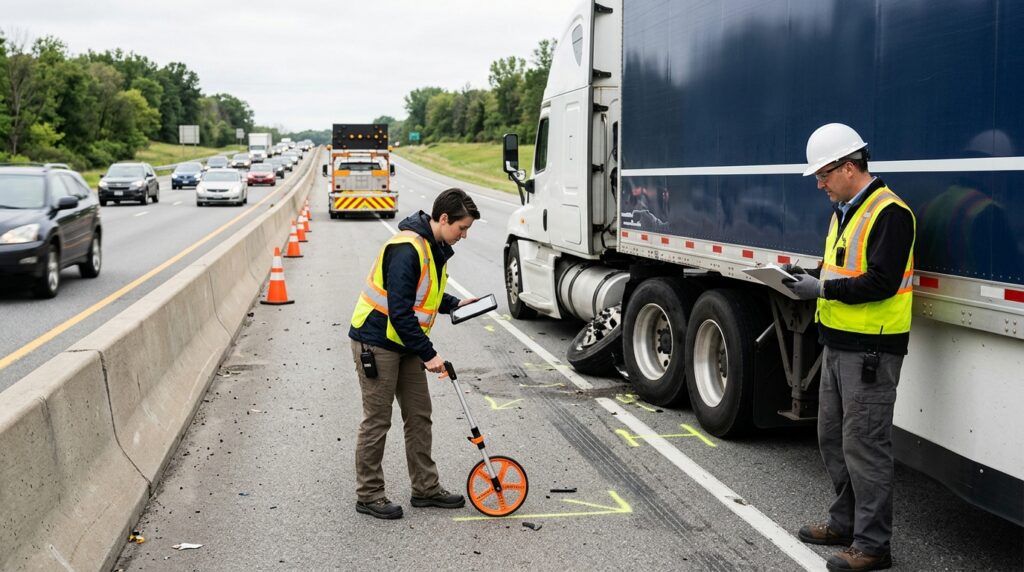
Trucks record a lot of data. This includes electronic logging device (ELD) records and the truck’s “black box” (event data recorder). It also includes driver hours-of-service logs and maintenance files. Some of this data can be overwritten or lost in weeks. Once it’s gone, it’s very hard to prove what happened.
Lawyers often send a spoliation letter early on. In plain terms, this is a formal notice. It tells the trucking company to keep evidence and not destroy it. Sending it fast can protect records that matter later.
Other key evidence includes the police report, witness statements, and clear medical records of a permanent injury. Doctors use tools like the ASIA Impairment Scale to classify how serious a spinal cord injury is, as explained by the American Spinal Injury Association. Strong medical records help show the full extent of the harm.
To learn the practical steps, see our companion guide on what to do after a catastrophic truck accident.
Have questions about what happened?
Ask our team directly. The first conversation is free, confidential, and there is no obligation to continue.
What should I avoid saying in an injury claim?
Do not guess about fault. Do not downplay your injuries. And do not give a recorded statement before you understand your rights. Words spoken early can be used later to reduce or deny a claim.
Right after a crash, it’s natural to say “I’m fine” out of politeness or shock. But some serious injuries do not show all their symptoms right away. Brain injuries are one example. Telling an adjuster you feel okay can be used to argue your injuries aren’t severe.
It’s also wise not to guess about how the crash happened. Say something like “I didn’t see him,” and an insurer may twist it into an admission of fault. Stick to facts you’re sure of. Don’t guess.
Be careful with early recorded statements too. An adjuster may sound friendly. But their job is to limit what the insurer pays. Anything you say may be used to lower the value of your commercial truck insurance claim injury case. This is general education, not a substitute for legal advice.
How much are most truck accident settlements?
There is no typical or guaranteed settlement amount. Every case depends on its own facts. Anyone who promises a specific figure isn’t being honest with you. Florida Bar rules also bar lawyers from guaranteeing results.
That said, several things shape the value of a catastrophic case:
- How severe and permanent the injury is. Paralysis, TBI, amputation, and severe burns often mean lifelong needs.
- Lifetime medical and care costs. This can include surgeries, therapy, equipment, and in-home care.
- Lost income and lost earning ability. A permanent injury may end someone’s career.
- How much coverage is available. More policies can mean more money on the table.
Catastrophic and wrongful-death claims usually involve far larger stakes than minor-injury claims. The lifetime cost of paralysis, for example, can be enormous. You can see this in data from the National Spinal Cord Injury Statistical Center. That is exactly why insurers fight these claims so hard.
Is $50,000/$100,000 bodily injury liability enough?
For a catastrophic injury, standard $50,000/$100,000 limits are almost never enough. Those split limits mean $50,000 per person and $100,000 per crash. That may sound like a lot. But it rarely covers even the first year of care for a severe injury.
This is exactly why federal rules require commercial trucks to carry far higher limits. A single spinal cord injury, TBI, amputation, or death can create costs well into the millions over a lifetime.
So what happens when the damages are larger than the available coverage? This is where finding every policy matters. There may be an umbrella policy. There may be a separate motor carrier policy. There may be coverage tied to another responsible party. Finding all of them can be the difference between a family being cared for and being left short.
When wrongful death is the outcome
When a truck crash takes a life, the family may bring a wrongful-death claim. Trucking insurers contest these cases too. A death is the most catastrophic outcome there is. We approach these claims with care for the family left behind.
Large-truck crashes can be deadly. Public crash data shows how serious they are. National traffic-fatality datasets are published by the National Highway Traffic Safety Administration. These numbers help show why courts and insurers treat these cases so seriously.
A wrongful-death claim can help a family cover final expenses, lost financial support, and the deep loss they’ve suffered. We can’t promise any particular result. But families don’t have to face a trucking insurer alone while they grieve. You may want to review our resource on wrongful death claims.
Want to know where you stand?
Tell us what happened and our team will walk you through the options available to you, at no cost.
Getting help understanding your claim
Families facing a permanent injury don’t have to deal with trucking insurers by themselves. These claims move fast. They involve multiple companies. And they turn on evidence that can vanish. Understanding your rights early can make a real difference.
CHG Personal Injury Lawyers is a Florida-based firm. Our licensed attorneys are admitted to The Florida Bar. We focus on catastrophic and life-changing injuries. We take cases nationwide. And we publish resources in both English and Spanish.
Keep in mind that Florida sets a deadline to file most injury claims. For causes of action on or after March 24, 2023, it’s generally two years, under Fla. Stat. §95.11. Waiting too long can end a claim before it starts.
Are you trying to understand a commercial truck insurance claim injury situation? You can request a free case evaluation. There’s no promise of any specific result, just clear answers about your options. You can also explore our guide to catastrophic truck accident injuries.

Frequently asked questions
How much liability coverage must trucking companies carry?
Federal rules require interstate trucking companies to carry high liability limits. That is often $750,000 or $1 million, and more for hazardous cargo. That’s far above what ordinary drivers carry.
Who can be held liable after a serious truck crash?
Several parties may share fault. This can include the truck driver, the trucking company, a cargo loader, a maintenance contractor, or a parts maker. Each may have its own insurer.
Why do trucking insurers fight catastrophic-injury claims so hard?
The larger the possible payout, the harder an insurer works to limit it. Catastrophic injuries can cost millions over a lifetime. So insurers push back hard.
Can I still recover if I was partly at fault for the crash?
In Florida, you may still recover if you’re 50% or less at fault. But your recovery is reduced by your share, under Fla. Stat. §768.81. Being more than 50% at fault generally bars recovery.
How long do I have to file a truck accident claim in Florida?
For most injury claims accruing on or after March 24, 2023, the deadline is generally two years, per Fla. Stat. §95.11. Don’t wait to learn your specific deadline.
Before You Give a Recorded Statement
A trucking company's insurer may contact you within days of a serious crash and ask for a recorded statement or a quick settlement. You are not required to give one, and early offers rarely reflect the lifetime cost of a catastrophic injury. Consider speaking with an attorney first.
What Makes Commercial Truck Claims Different
Higher Insurance Limits
Interstate trucking companies are often required to carry $750,000 or $1 million in liability coverage — and more for hazardous cargo — far above what an ordinary driver carries.
More Than One Responsible Party
Fault may be shared among the driver, the trucking company, a cargo loader, a maintenance provider, or a parts manufacturer. Identifying every liable party matters.
Evidence Disappears Fast
Driver logs, electronic control module data, and dash-cam footage can be lost or overwritten. Preserving this evidence early can be critical to a catastrophic-injury case.
Insurers Move Quickly
Large carriers often send investigators to the scene right away. Their goal is to limit what they pay — not to protect the injured family.
Steps to Protect Your Claim
Prioritize Medical Care
For catastrophic injuries like paralysis, TBI, severe burns, or limb loss, follow through on all treatment. Your medical records document the true impact of the crash.
Keep Everything
Save the crash report, medical bills, photos, and any correspondence from insurers. Do not sign or agree to anything you don't fully understand.
Be Careful What You Say
Avoid discussing fault or accepting blame with insurers or on social media. Statements can be used to reduce or deny your claim.
Get Legal Guidance Early
An attorney can help preserve evidence, identify all liable parties, and deal with the insurers so you can focus on recovery — or on your family.