

Truck Accidents · Florida & Nationwide
The Truck's Black Box May Hold the Truth About Your Crash
After a catastrophic truck collision, critical electronic data can prove what really happened in the seconds before impact — but only if it's preserved before it's lost. Learn what this evidence is and why acting quickly matters.
By CHG Lawyers · Published July 25, 2026
Truck “Black Box” Data: The Evidence That Can Prove What Really Happened in a Catastrophic Crash
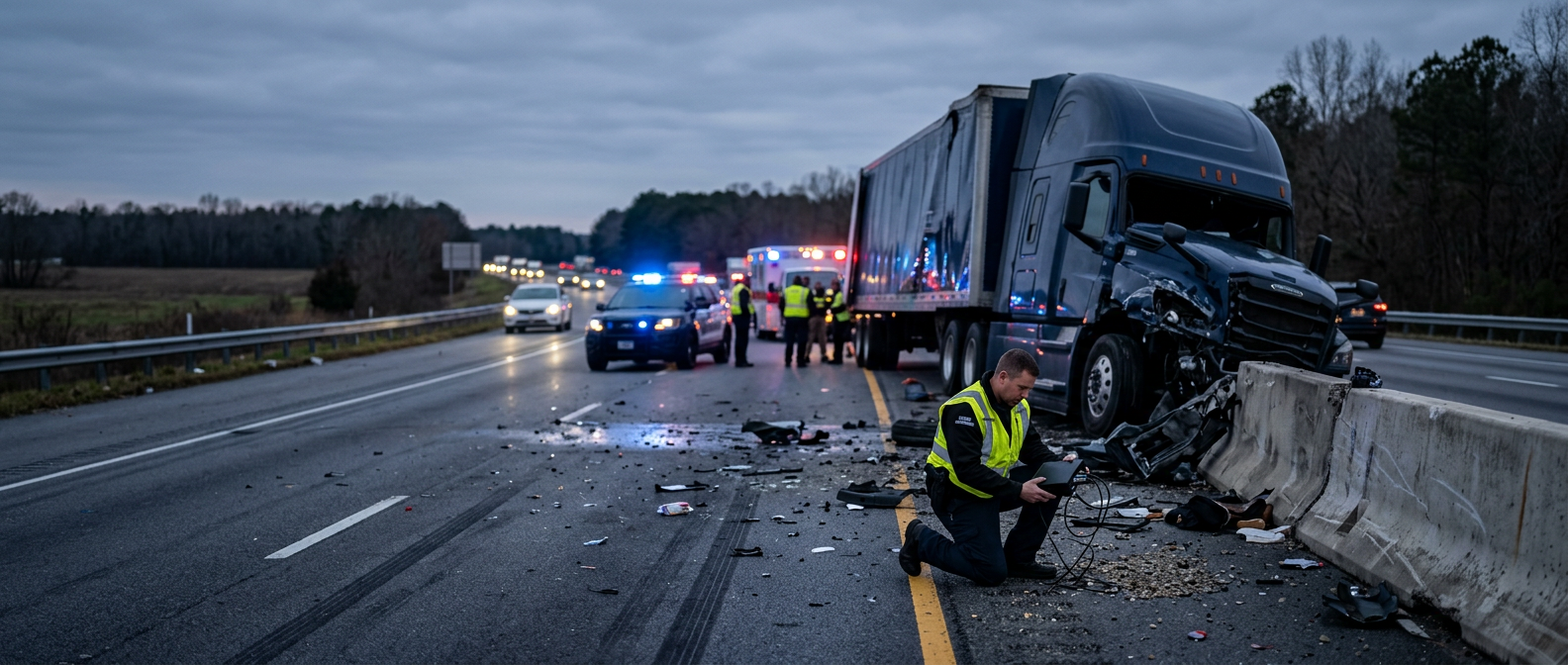
Truck black box data can show how fast a truck was going, whether the driver braked, and how the crash unfolded in the final seconds. After a serious crash, this electronic record often reveals what a driver or trucking company won’t admit. But it can be erased within days unless someone acts quickly to protect it.
Did a truck crash leave a loved one paralyzed, brain-injured, or fighting for life? Then you face hard decisions. This page explains what a truck’s “black box” is, what it records, and why speed matters.
Our focus here is on serious, permanent, life-altering injuries and wrongful death. For a broader overview, see our truck accidents page.

Not sure what your next step is?
Talk it through with our team — the first consultation is free, confidential, and carries no obligation.
What people mean by a truck’s “black box”
A commercial truck doesn’t have one single “black box” like an airplane. It usually has several separate systems, and each records different things. People call all of them the “black box,” but they aren’t the same device.
The most common source of crash data is the truck’s event data recorder (EDR) or the engine’s electronic control module (ECM).
You don’t need to memorize the technical terms. What matters is this: modern trucks quietly record data that can help prove what really happened.
The different systems that record truck data — and why they aren’t the same
A truck may carry four or five separate data systems. Each one is stored differently, owned differently, and erased on a different schedule. Understanding them explains why fast action matters.
Electronic Control Module (ECM)
The ECM is the engine’s computer. On heavy trucks, it’s typically a Detroit Diesel, Cummins, or Caterpillar unit. It stores performance data like road speed, engine RPM, throttle position, and hard-braking events. It’s often the richest single source of crash data. But the values, and how many “trigger” events it holds, vary by engine maker.
Event Data Recorder (EDR)
The EDR captures a short snapshot of key values. It covers the seconds before and after a hard-braking or crash event. Under 49 CFR Part 563, that snapshot usually spans about five seconds before the event through the moment of impact. Think of it as a freeze-frame of the truck’s final moments.
Electronic Logging Device (ELD)
The ELD records the driver’s hours behind the wheel. The Federal Motor Carrier Safety Administration (FMCSA) has required ELDs for most interstate commercial drivers since December 18, 2017. This data can reveal fatigue and Hours-of-Service violations. A property-carrying driver may drive a maximum of 11 hours after 10 hours off duty (49 CFR §395.3).
GPS and telematics
Systems like Samsara, Motive, or Omnitracs track location, route, speed over time, and stops. They can show whether a driver was rushing or skipping breaks.
Dash cameras
Many trucks have forward-facing or driver-facing cameras. Footage may show the road ahead and the driver’s actions just before impact.
Each system is controlled differently. The ECM lives in the truck. ELD and telematics data may sit on a company or third-party vendor server. Dash-cam footage often loops and records over itself. That’s why no single request captures everything.
What information a truck’s black box can actually record
Depending on the truck, black box data can show speed, braking, throttle, engine RPM, cruise-control use, and sudden slowing around a crash. The exact fields depend on the truck’s make, model, and equipment.
Here’s what these systems commonly capture:
- Vehicle speed in the seconds before impact.
- Braking — whether the driver braked, how hard, and how late.
- Throttle and acceleration data.
- Engine RPM and whether cruise control was on.
- Seatbelt use and certain warning-system activations, on some trucks.
- Sudden slowing or “hard braking” events that flag a collision.
No two trucks record exactly the same way. Reading Detroit Diesel Diagnostic Link or Cummins INSITE data, for example, takes the right software and cabling. That’s why qualified experts are needed to pull and read it.
How black box data helps prove fault in a catastrophic truck accident case
Truck black box data can help prove fault by showing, in hard numbers, how fast the truck was going and whether the driver reacted in time. Let’s be precise about what that means. Objective data can help prove what happened. It is not a promise of any outcome. No honest lawyer can guarantee a result, a win rate, or that any case is “the best.” What recorded data does is give a claim a factual foundation that is harder to dispute.
Here’s how this evidence can help in a serious case:
- Unsafe speed. Recorded speed data can show the truck was going too fast for the road or conditions.
- Late braking or no braking. If the driver never hit the brakes, the data may point to distraction or inattention.
- Fatigue. ELD data can reveal a driver who exceeded the 11-hour limit, or a company that pushed unrealistic schedules.
- Testing the driver’s story. The numbers can confirm or contradict what the driver told police.
- Reconstructing the crash. An accident reconstruction expert can combine data sources to rebuild the sequence second by second.
A trucking company and its insurer will have their own version of events. Objective data can counter that version with something measured, not merely argued.
Have questions about what happened?
Ask our team directly. The first conversation is free, confidential, and there is no obligation to continue.
Why this evidence disappears fast after a crash
Truck black box data is time-sensitive. It can be overwritten, looped over, or lost within days or weeks of a crash. This is the single most urgent thing families should understand.
Here’s how the evidence slips away:
- ECM and EDR data can be overwritten as the truck is driven again, or after a set number of ignition cycles.
- ELD records must be kept by carriers for only six months under 49 CFR §395.8(k). Supporting documents follow a similar timeline.
- Dash-cam footage loops and records over itself, sometimes within hours or days.
- The truck itself may be repaired, sold, or scrapped, taking the data with it.
There’s another hard reality. The trucking company and its insurer control this evidence. They have little reason to save it for the person their driver hurt. The job of protecting it often falls on the victim’s side.
How black box and related evidence is legally preserved and obtained
Attorneys protect this evidence by sending a spoliation letter. This is a formal notice that legally warns the trucking company not to destroy, alter, or lose the data. “Spoliation” simply means the destruction of evidence.
A preservation letter puts the company on notice right away. From there, lawyers can move to inspect the truck and download its data, sometimes with a court order. The download itself matters. Pulling ECM and EDR data takes experts who know the specific systems. A botched download can corrupt or misread the very numbers a case depends on.
Black box data is only part of the picture. Alongside it, attorneys gather:
- Maintenance and repair records.
- Driver qualification files — history, training, and medical certification, required under 49 CFR §391.51.
- Inspection reports and prior violations, often visible in FMCSA’s Safety Measurement System.
In catastrophic cases, speed is everything. A damaged truck may be scheduled for repair or disposal within days. Once it’s gone, so is its data.
Other key evidence in serious truck accident cases
Beyond the black box, serious truck cases often turn on company records. These reveal how a crash was allowed to happen. They can show negligence that goes beyond one bad moment on the road:
- Hiring, training, and supervision records.
- Maintenance and repair history — was the truck safe to drive?
- Cargo loading and weight records — was the truck overloaded or badly loaded?
- Witness statements and physical evidence from the scene.
To learn more about specific injuries, see our pages on spinal cord injuries and traumatic brain injuries.
What families of catastrophically injured victims should do now
First, focus on medical care. Then act quickly to protect the electronic evidence before it’s gone.
- Put the injured person’s health first. Everything else can follow.
- Understand that evidence is time-sensitive. Preserving black box data usually requires prompt legal help.
- Be careful with the insurer. Don’t give a recorded statement to the trucking company’s insurer before you understand your rights.
There’s also a legal deadline. In Florida, most negligence claims that arose on or after March 24, 2023 must be filed within two years, under Fla. Stat. §95.11. Florida also follows a modified comparative-negligence rule. A person found more than 50% at fault generally recovers nothing, under Fla. Stat. §768.81. Solid evidence helps guard against unfair blame.
Motor vehicle crashes are a leading cause of spinal cord injury in the United States, according to Mayo Clinic. When the stakes are this high, the evidence has to be protected.
CHG Personal Injury Lawyers is based in Florida and handles catastrophic truck-crash cases nationwide. Is your family facing a permanent injury or the loss of a loved one? We’re here to explain your options. Request a free case evaluation — there’s no cost to talk.

Want to know where you stand?
Tell us what happened and our team will walk you through the options available to you, at no cost.
Frequently asked questions
What does a truck’s black box record?
It can record speed, braking, throttle position, engine RPM, and sudden slowing in the seconds around a crash. For EDR-equipped vehicles, 49 CFR Part 563 sets standards for much of what is captured.
How long does truck black box data last before it’s overwritten?
It varies by system. ECM and EDR data can be overwritten within days as the truck is driven. Dash-cam footage may loop over itself within hours.
Who owns the black box data in a commercial truck?
The trucking company usually controls the data. That’s why a formal preservation letter is often needed to stop it from being lost or destroyed.
What is a spoliation letter?
A spoliation letter is a formal notice that warns a trucking company not to destroy or alter evidence. If the company ignores it, a court may impose penalties.
Can ELD data show a truck driver was fatigued?
Yes. ELD data records driving hours. It can reveal Hours-of-Service violations, such as exceeding the 11-hour driving limit, that point to fatigue.
Should I give a recorded statement to the trucking company’s insurer?
It’s wise to understand your rights first. Speak with an attorney before giving any recorded statement to a trucking company’s insurer.
This Evidence Can Disappear
Black box and engine data can be overwritten, and trucks are often repaired or returned to service quickly after a crash. If a serious truck collision caused a spinal cord injury, brain injury, amputation, or the loss of a loved one, contact a lawyer promptly so steps can be taken to help preserve this evidence.
What a Truck's Black Box Can Reveal
Speed & Throttle
Recorded vehicle speed and throttle position in the seconds around a crash can show whether a truck was traveling too fast for the conditions.
Braking & Sudden Slowing
Data on braking and hard, sudden deceleration can help reconstruct how and when the driver reacted before impact.
Engine & RPM Data
Engine control module readings, including RPM, add detail to the picture of how the truck was being operated.
Federal Standards
For EDR-equipped vehicles, 49 CFR Part 563 sets standards governing much of what is captured, which helps professionals interpret the data.
Why This Evidence Matters in a Catastrophic Truck Case
Objective Record
Electronic data can offer a factual account of a truck's operation that isn't dependent on memory or conflicting witness statements.
Time-Sensitive
ECM and EDR data can be overwritten, and access often requires prompt action before the vehicle is repaired or put back in service.
Handled by Licensed Attorneys
Our attorneys are admitted to the Florida Bar and focus on serious, life-altering injury cases across Florida and nationwide.
Built Around You
We work in plain language with injured people and families facing paralysis, TBI, amputation, severe burns, and permanent impairment.