

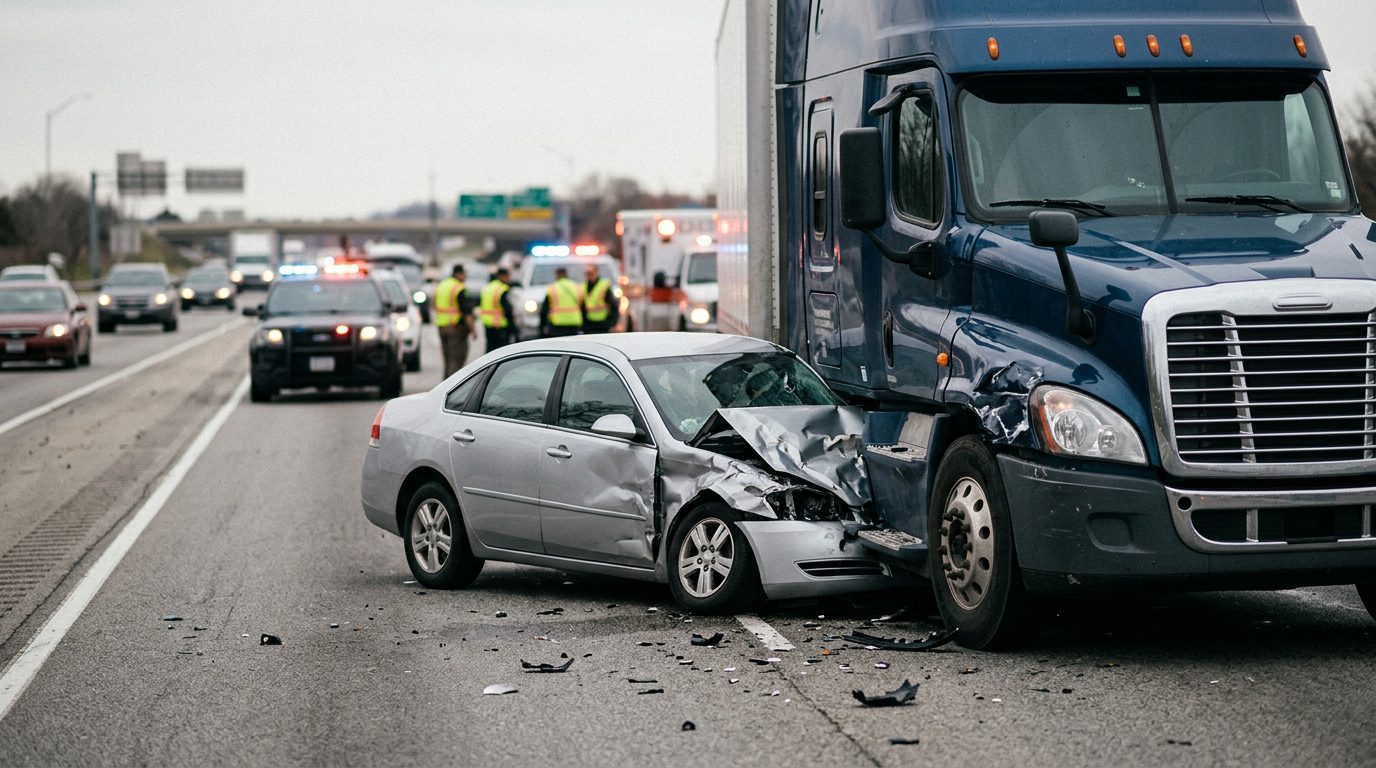
Truck Accidents
Multiple Parties Liable in Truck Accidents
When a catastrophic truck crash leaves you permanently injured, more than one party may be responsible. Understanding who can be held liable is the first step toward fair compensation.
By CHG Lawyers · Published September 03, 2026
Multiple Parties Liable in Truck Accidents: How to Recover from Every Source
When a catastrophic truck crash occurs, fault rarely lies with one person alone. The trucking industry involves many interconnected responsibilities:
- The driver must follow safety rules and hours-of-service regulations.
- The carrier must hire qualified drivers, maintain the truck, and enforce safety policies.
- The shipper and loader must secure cargo properly.
- The manufacturer must design and produce safe equipment.
When any of them fail, they contribute to the crash and share liability for injuries and deaths.
Why this matters to your family: Multiple liable parties mean multiple insurance policies and multiple sources of compensation. A single defendant may have limited coverage. Three or four defendants can mean the difference between partial recovery and the full compensation your family needs for lifelong care after spinal cord injury, paralysis, traumatic brain injury, or amputation.
Not sure what your next step is?
Talk it through with our team — the first consultation is free, confidential, and carries no obligation.
Why Truck Accidents Cause Catastrophic Injuries—And Why Multiple Parties Are Often Responsible
A fully loaded commercial truck weighs up to 80,000 pounds. When it hits a passenger vehicle, the physics are devastating. The National Highway Traffic Safety Administration (NHTSA) reported that in 2022, large trucks were involved in 5,932 fatal crashes in the United States. That accounted for 13.5% of all traffic fatalities, even though large trucks represent only 5% of registered vehicles.
When a truck crash occurs, injuries are rarely minor. Spinal cord damage, paralysis (paraplegia or quadriplegia), traumatic brain injury, amputation, severe burns, and wrongful death are common outcomes.
These catastrophic crashes rarely result from a single act of negligence. They result from a chain of failures:
- The driver speeds, drives drowsy, or violates hours-of-service rules under pressure to meet unrealistic schedules.
- The carrier fails to maintain the truck’s brakes, tires, or steering system—or pressures the driver to cut corners.
- The loader overloads the cargo, fails to secure it properly, or distributes weight unevenly, causing the truck to tip or jackknife.
- The manufacturer produces a defective brake system, tire, or coupling device that fails during normal use.
Each failure contributes to the crash. Each party that failed bears liability. Identifying every responsible party is essential. It determines how much compensation is available to pay for your medical care, assistive equipment, home modifications, lost wages, and pain and suffering for the rest of your life.
The Truck Driver’s Role and Liability
The truck driver is often the most visible party in a crash. But driver negligence alone does not always tell the whole story. Driver liability includes:
- Speeding (a leading cause of large-truck crashes)
- Drowsy driving (often caused by pressure to meet unrealistic schedules or violations of hours-of-service limits)
- Distracted driving (cell phone use, eating, adjusting controls)
- Failure to maintain safe following distance
- Improper lane changes or failure to check blind spots
- Violation of Federal Motor Carrier Safety Administration (FMCSA) hours-of-service rules (49 CFR Part 395)
Even a negligent driver may not be the only party at fault. The carrier may have pressured the driver to violate safety rules, failed to train the driver properly, hired a driver with a history of violations, or ignored documented safety concerns. When multiple parties contributed to the crash, they all share liability.
The Trucking Carrier’s Responsibility and Liability
The trucking company (carrier) can be held liable for the driver’s negligence under vicarious liability. This legal term means the company is responsible for what its employees do on the job, even if the company itself did not act negligently.
Carriers are also directly liable when they:
- Fail to hire qualified drivers or conduct adequate background checks
- Fail to train drivers properly on safety procedures
- Fail to maintain the truck (brakes, tires, steering, coupling devices, lights)
- Ignore or fail to report safety violations
- Pressure drivers to violate hours-of-service rules to meet delivery deadlines
- Fail to enforce safety policies or discipline drivers who violate them
- Operate trucks with known mechanical defects
Carriers have a duty to ensure their fleet is safe and their drivers are competent. When they cut corners to save money, they share liability for crashes and the catastrophic injuries that result. Or dispatch records show the driver was pressured to exceed safe hours. These are evidence of direct carrier liability.
The Shipper and Cargo Loader’s Role
Improperly loaded or secured cargo can cause a truck to become unstable, tip over, or lose its load. This can create a catastrophic crash that injures occupants of other vehicles or causes the truck to jackknife and strike multiple cars.
Shippers and loaders are liable when they:
- Overload the truck beyond safe weight limits (the maximum gross vehicle weight rating is set by the manufacturer and federal regulation)
- Fail to secure cargo properly with straps, chains, or other restraints
- Load cargo unevenly, creating an imbalanced center of gravity
- Fail to follow weight distribution rules (heavier cargo must be loaded low and centered)
- Load hazardous materials unsafely or without proper placarding
A truck that tips or loses its load because of improper loading can cause severe injuries—spinal cord damage, paralysis, traumatic brain injury, amputation—to innocent people on the road. The loader and shipper can be held responsible for those injuries. Cargo documentation and weight tickets are critical evidence in identifying loader liability.
Equipment Manufacturers and Maintenance Providers
Defective truck parts—brakes, tires, steering systems, coupling devices—can cause or contribute to a crash. Manufacturers can be liable for:
- Design defects: a brake system that fails during normal use, or a tire design prone to blowouts
- Manufacturing defects: a tire produced with a flaw, or a coupling device assembled incorrectly
- Failure to warn: known hazards not disclosed to carriers or drivers
Maintenance providers and trucking companies can be liable for failing to inspect, repair, or replace worn or defective parts. A brake failure or tire blowout caused by neglect or defect is a basis for liability against the manufacturer or the carrier’s maintenance team. These component failures often cause catastrophic crashes because the driver has no time to react.
Expert examination of the truck after the crash can reveal whether a defect existed and contributed to the collision. Maintenance records and inspection logs can show whether the carrier knew of a problem and failed to address it.
Have questions about what happened?
Ask our team directly. The first conversation is free, confidential, and there is no obligation to continue.
How Comparative Fault Works When Multiple Parties Are Liable
When multiple parties share responsibility, Florida law uses comparative fault to determine each party’s percentage of liability. Under Florida Statute §768.81, each defendant pays a share of damages proportional to their degree of fault.
Example: The driver is 40% at fault (speeding), the carrier is 35% at fault (failed brake maintenance), and the loader is 25% at fault (overloaded cargo). If your total damages are $2 million, the driver’s insurance pays $800,000, the carrier’s insurance pays $700,000, and the loader’s insurance pays $500,000—for a total recovery of $2 million.
If you are found to be more than 50% at fault, you generally recover nothing under Florida’s modified comparative fault rule. However, if you are 30% at fault and the defendants are 70% at fault combined, you can recover 70% of your total damages.
Critical point: Some defendants may have substantial insurance coverage. Others may have minimal coverage or be judgment-proof (unable to pay). Identifying all liable parties ensures you pursue every available source of compensation. A carrier with a $5 million commercial liability policy, a manufacturer with a $10 million product liability policy, and a loader with a $2 million policy can provide recovery that a single defendant cannot.
Can You Sue Multiple Parties in a Truck Accident?
Yes. You can name multiple defendants in a single lawsuit: the driver, the carrier, the shipper, the loader, the manufacturer, and others. Filing one claim against multiple parties is often more efficient and more likely to result in full compensation than pursuing them separately.
Your attorney will:
- Investigate the crash scene, vehicle damage, and road conditions
- Obtain the truck’s maintenance records, inspection logs, and repair history
- Review the truck driver’s logbook and hours-of-service compliance
- Obtain cargo documentation, weight tickets, and loading records
- Examine the truck’s condition and identify any defective parts
- Identify all potentially liable parties and their insurance policies
- Retain expert witnesses (accident reconstructionists, engineers, medical specialists) to establish causation and damages
Each defendant will be included in the claim, and their insurance policies will be pursued for compensation.
What Happens When Multiple Parties Are at Fault?
Insurance coverage becomes complex when multiple parties are at fault. The driver’s personal auto policy, the carrier’s commercial liability policy, the shipper’s policy, the loader’s policy, and the manufacturer’s product liability policy may all be involved. Multiple insurance policies often mean multiple sources of compensation available to you.
The defendants and their insurers will dispute fault and liability. Your attorney negotiates with all parties or litigates in court to hold all responsible parties accountable. Settlement or judgment may come from one defendant, multiple defendants, or their combined insurance coverage. The goal is to maximize recovery from every available source.
Why Identifying All Liable Parties Matters—And Why Speed Matters
A single defendant may have limited insurance coverage. Multiple defendants mean multiple policies and larger total recovery potential. Some parties may be judgment-proof (unable to pay), but their insurance is not. Identifying all parties ensures you pursue every available source of compensation.
Procedural urgency: Failing to name a liable party early may bar you from adding them later. Statutes of limitations and procedural rules can prevent you from bringing a claim against a defendant you discover too late. Thorough investigation upfront is critical.
Catastrophic injuries—spinal cord damage, paralysis, traumatic brain injury, amputation, severe burns, wrongful death—require maximum recovery. A person with a spinal cord injury faces a lifetime of medical care, assistive equipment, home modifications, personal care attendants, and lost earning capacity. Pursuing all liable parties is essential to ensure that compensation is adequate for the rest of your life.
Steps to Take After a Catastrophic Truck Crash
Preserve evidence immediately:
- Photograph the crash scene, vehicle damage, road conditions, weather, and the truck’s cargo
- Obtain the truck driver’s logbook and hours-of-service records
- Request the carrier’s maintenance records and safety inspection logs
- Obtain the police report and any citations issued
- Document your injuries, medical treatment, and ongoing care needs
- Preserve the vehicles and truck for inspection by experts
Do not settle or sign anything without legal counsel. Early settlement offers often undervalue catastrophic injury claims. Insurance adjusters may pressure you to settle quickly before you understand the full extent of your injuries or the liability of all parties.
Contact an attorney who focuses exclusively on catastrophic truck accidents to investigate and identify all liable parties before any statute of limitations expires. Under Florida Statute §95.11, you generally have two years from the date of the crash to file suit. In cases of wrongful death, the statute of limitations is also two years from the date of death.
Want to know where you stand?
Tell us what happened and our team will walk you through the options available to you, at no cost.
Frequently Asked Questions
Can I recover damages from multiple defendants even if they blame each other?
Yes. Each defendant is liable for their own negligence regardless of what other defendants did. Your claim can pursue all of them simultaneously, and the court or jury will assign fault percentages to each.
What if one defendant settles before trial—do I lose my claim against the others?
No. You can settle with one defendant and continue your claim against the others, though the settlement may reduce the total available from remaining defendants depending on your state’s rules and the language of the settlement agreement.
How do I know if a truck manufacturer can be held liable?
If the crash was caused or contributed to by a defective part—a brake failure, tire blowout, steering defect, or coupling failure—the manufacturer may be liable. An attorney will retain an expert to examine the truck and determine whether a defect existed and caused or contributed to the crash.
What if the truck driver was an independent contractor, not an employee?
Liability may still attach to the carrier if the carrier controlled the driver’s work, failed to maintain the truck, hired an unqualified driver, or pressured the driver to violate safety rules. The legal analysis is more complex, but multiple parties can still be liable.
What if I was partially at fault for the crash?
Under Florida’s comparative fault rule, you can still recover damages even if you were partially at fault—as long as you were not more than 50% at fault. Your recovery will be reduced by your percentage of fault.
Next Steps: Getting Help After a Catastrophic Truck Crash
If you or a family member has suffered a catastrophic injury in a truck crash—spinal cord injury, paralysis, traumatic brain injury, amputation, severe burns, or wrongful death—the question of who is liable is urgent and complex. Determining whether the driver, carrier, loader, manufacturer, or multiple parties share fault requires investigation, expert analysis, and legal experience.
The difference between identifying all liable parties and missing one can be millions of dollars. The difference between acting quickly and waiting can be the difference between preserving evidence and losing it forever.
There is no cost to explore whether you have a claim against multiple parties. Contact us for a free case evaluation to discuss what happened, understand your options, and learn how we can help your family recover the compensation you need.
Who Can Be Held Liable
The Truck Driver
Negligent operation—speeding, drowsy driving, distracted driving, or violating traffic laws—is a direct cause of catastrophic crashes. The driver's employer is often liable for the driver's negligence under the legal principle of respondeat superior.
The Trucking Company
Companies can be liable for negligent hiring, inadequate training, failure to maintain the vehicle, or pressuring drivers to violate safety regulations or hours-of-service rules. They may also be responsible for failing to properly inspect or repair the truck.
The Vehicle Manufacturer or Parts Supplier
If a defect in the truck's design, manufacture, or a critical component (brakes, tires, coupling systems) caused or contributed to the crash, the manufacturer or supplier can be held liable for the injuries that resulted.
Third Parties
Cargo loaders, maintenance contractors, other drivers, or property owners whose negligence contributed to the accident may also share liability. Each party's responsibility depends on their actions and their duty of care.
Why Multiple Liability Matters in Your Case
Broader Recovery
Identifying all liable parties increases the potential sources of compensation, which is critical when injuries are catastrophic and lifelong medical care, lost income, and adaptive equipment are needed.
Shared Fault Does Not Eliminate Your Claim
Even when defendants blame each other, each party remains liable for their own negligence. The court or jury assigns fault percentages, and you can pursue compensation from all responsible parties simultaneously.
Complex Investigation Required
Determining liability in multi-party truck crashes requires detailed evidence: accident reconstruction, driver records, maintenance logs, vehicle inspection reports, and expert analysis. This investigation must begin immediately.
Settlement Does Not End Your Case
If one defendant settles before trial, your claims against other liable parties remain intact. You can continue pursuing full compensation from all responsible parties.
Act Quickly—Evidence Disappears
Truck companies and manufacturers routinely preserve or destroy evidence after crashes. Skid marks fade, vehicle data is overwritten, and witness memories dim. The sooner you contact an attorney, the sooner critical evidence can be secured and preserved.
Common Questions About Multiple Liability
Can I recover from multiple defendants even if they blame each other?
Yes. Each defendant is liable for their own negligence regardless of what other defendants did. Your claim can pursue all of them simultaneously, and the court or jury will assign fault percentages to each.
What if one defendant settles before trial?
Your claims against the other liable parties remain active. A settlement with one defendant does not eliminate your right to pursue compensation from all others who contributed to your injury.
How do you prove multiple parties were negligent?
Through evidence collection and expert analysis: driver logs, maintenance records, vehicle inspection reports, accident reconstruction, and testimony from medical and engineering specialists. Each party's conduct is examined separately.
What if the truck driver was an independent contractor?
The trucking company may still be liable if they negligently hired, trained, or supervised the driver, or if they failed to maintain the vehicle. The contractual relationship does not automatically shield the company from liability.