

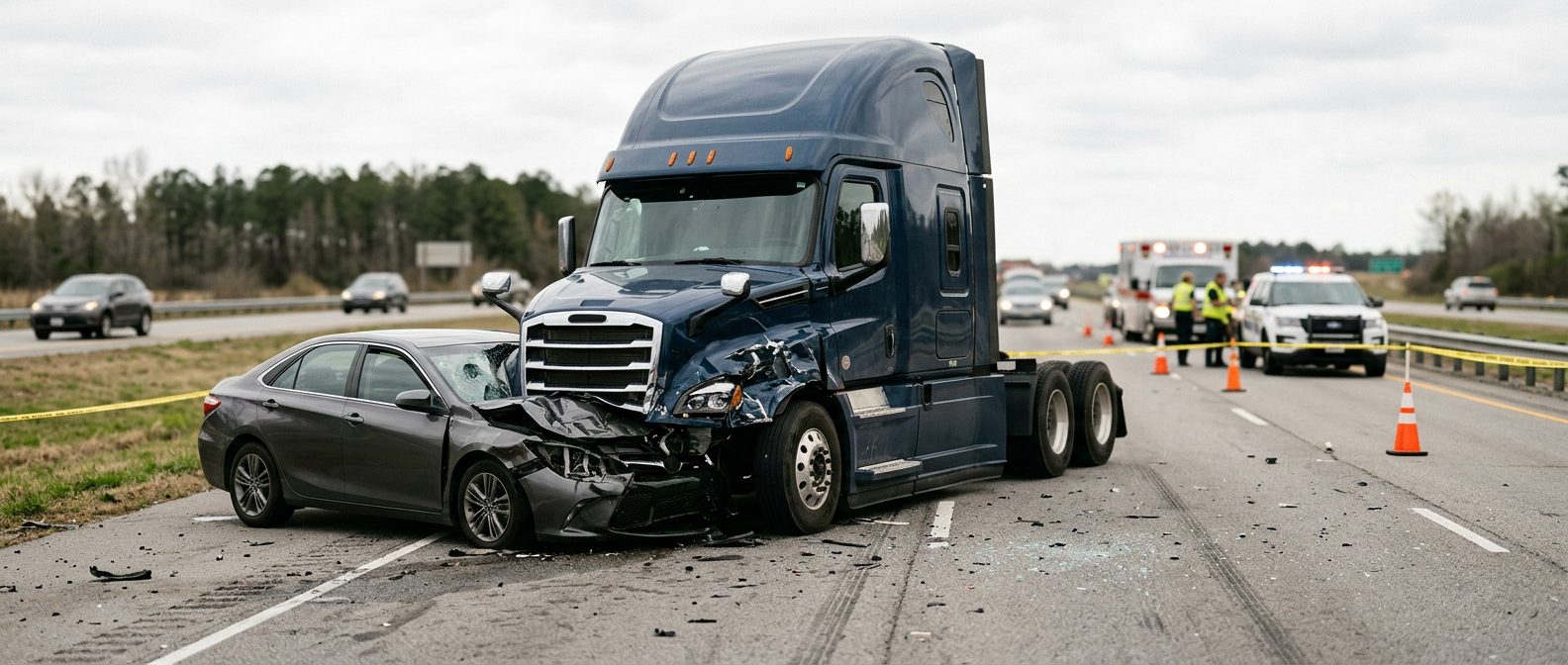
Truck Accident Claims
FMCSA Regulations & Your Truck Accident Claim
Federal safety rules exist to prevent catastrophic crashes. When a trucking company violates them and you're seriously injured, those violations can be powerful evidence of negligence.
By CHG Lawyers · Published August 31, 2026
Federal Trucking Safety Regulations (FMCSA) and How Violations Strengthen Your Claim
When a commercial truck crashes and causes catastrophic injury or death, the driver and company are often breaking federal safety rules. The Federal Motor Carrier Safety Administration (FMCSA) sets nationwide standards for trucking safety. These rules are designed to prevent exactly the kind of crash that harmed you or your family. When those rules are violated, that’s evidence of negligence. This page explains the most common FMCSA regulations, what violations look like, and how they support your claim.

Not sure what your next step is?
Talk it through with our team — the first consultation is free, confidential, and carries no obligation.
What Are FMCSA Regulations and Why Do They Matter After a Truck Crash?
The FMCSA is a federal agency. It writes and enforces safety rules for commercial trucks and drivers. These regulations exist to prevent crashes and protect the public.
When a truck driver or company violates these rules, it shows they failed to follow the law designed to keep people safe. That failure can be evidence of negligence in a personal injury or wrongful-death claim.
A violation alone doesn’t automatically mean the company is liable. But courts recognize FMCSA regulations as the standard of care for the trucking industry. If the driver was violating hours-of-service rules when the crash occurred, or if the truck had known mechanical defects that weren’t repaired, or if the driver was unqualified or impaired—those violations are powerful evidence of negligence.
In the catastrophic-injury cases our attorneys handle, FMCSA violations often tell a clear story: the company prioritized profit over safety, and someone paid the price.
Hours of Service Rules and Driver Fatigue
FMCSA limits how many hours a driver can work without rest. The goal is to prevent fatigue-related crashes. The current rules are strict: a driver may not drive after 14 consecutive hours following coming on duty, and may drive a total of no more than 11 hours within that period.
Electronic logging devices (ELDs) now track driving hours automatically. This makes it easy to prove when a driver violated these limits.
Fatigue is a leading cause of catastrophic truck crashes. A tired driver’s reaction time slows. Judgment fails. The risk of a jackknife or rollover increases dramatically.
If the truck driver was violating hours-of-service rules when the crash occurred—for example, driving 14 hours without a break—this is strong evidence that fatigue played a role. Your attorney will obtain the driver’s ELD records and logbooks to prove the violation.
Vehicle Inspection and Maintenance Requirements
FMCSA requires trucking companies to inspect and maintain their vehicles regularly. Drivers must perform pre-trip inspections. They must report defects in brakes, tires, steering, lights, and other safety-critical systems. Companies must fix reported problems before the truck returns to the road.
Brake failure, tire blowouts, and steering problems are common in catastrophic truck crashes. If the company knew about a defect—because the driver reported it—and failed to repair it, that’s negligence. Maintenance records and inspection logs can show whether the company ignored safety.
Your attorney will subpoena these records to prove that the company knew the truck was unsafe and sent it on the road anyway.
Driver Qualification and Licensing Standards
FMCSA requires drivers to hold a valid Commercial Driver’s License (CDL) with appropriate endorsements. Companies must verify driver qualifications and maintain personnel files. Drivers must pass medical examinations and meet vision and hearing standards. Companies cannot hire drivers with disqualifying safety violations or serious medical conditions.
If the driver was unqualified, unlicensed, or medically unfit to drive—for example, with untreated sleep apnea or a seizure disorder—this is strong evidence of negligence by the company. Your attorney will review the driver’s qualification file and medical records to determine whether the company hired someone it shouldn’t have.
Drug and Alcohol Testing Requirements
FMCSA mandates drug and alcohol testing for all commercial drivers. Testing must occur:
- Before employment
- Randomly during employment
- After an accident
- When there is reasonable suspicion of impairment
Drivers with positive tests or refusals are disqualified from driving. Companies must maintain testing records and follow strict protocols.
Impairment is a leading cause of catastrophic truck crashes. If the driver was under the influence when the crash occurred, or if the company failed to conduct required testing, this supports your claim. Post-accident drug and alcohol tests are particularly important: they can show whether the driver was impaired at the time of the crash.
Have questions about what happened?
Ask our team directly. The first conversation is free, confidential, and there is no obligation to continue.
Cargo Securement and Weight Limits
FMCSA sets strict rules for how cargo must be secured and how much weight a truck can carry. Improperly secured cargo can shift during braking or turning. This can cause the truck to jackknife or roll. Overweight trucks are harder to control and take longer to stop. This increases crash risk.
Cargo securement violations are common in catastrophic crashes. If the cargo was not properly secured or the truck was overweight, this is evidence of negligence. Your attorney will obtain the truck’s weight records and cargo documentation to prove the violation.
What Makes a DOT Reportable Accident?
Under FMCSA rules, a crash involving a commercial motor vehicle is reportable if it results in a fatality, bodily injury requiring immediate medical treatment away from the scene, or disabling damage that requires a vehicle to be towed from the scene. These reports become part of the company’s safety record and can be obtained during discovery in a lawsuit.
Accident reports often contain admissions, witness statements, and details about what went wrong. If your crash was reportable—and any crash causing catastrophic injury or death almost certainly is—the company’s accident report is a valuable piece of evidence. Your attorney will obtain this report and use it to support your claim.
How FMCSA Violations Strengthen Your Claim
A single violation is powerful evidence. Multiple violations paint a damning picture.
Each violation shows the company cut corners on safety. Together, they support claims of negligence, recklessness, or gross negligence.
Courts take FMCSA violations seriously because they reflect federal standards designed to protect the public. When a company violates these rules, it’s not a minor slip—it’s a failure to follow the law. In cases of gross negligence or reckless disregard for safety, violations can also support punitive damages. Punitive damages are designed to punish the company and deter similar conduct in the future.
Your attorney will obtain FMCSA records, inspection reports, maintenance logs, driver files, ELD data, and accident reports. These documents form the foundation of your case.
How to Obtain FMCSA Records for Your Case
FMCSA maintains a public database of safety violations, inspections, and crashes for each trucking company. Your attorney can request the company’s safety record, driver qualifications files, and maintenance records through discovery. Discovery is the legal process of exchanging evidence before trial. Accident reports, ELD data, and drug-testing records can be subpoenaed.
An attorney handling a truck accident claim in Florida can help obtain and interpret these records. These documents are often the key to proving negligence and holding the company accountable.
Want to know where you stand?
Tell us what happened and our team will walk you through the options available to you, at no cost.
Statute of Limitations and Comparative Negligence in Florida
If you were injured in a truck crash in Florida or another state, you have the right to pursue compensation. This includes medical expenses, lost income, pain and suffering, and other damages. But time limits apply.
Under Florida law, you must file a personal injury claim within 2 years of the date the injury occurred.
Florida also follows a comparative-negligence rule. If you were more than 50% at fault for the crash, you generally recover nothing.

Frequently Asked Questions
What is the definition of an accident according to the FMCSA?
Can FMCSA violations be used as evidence of negligence?
Yes. Courts recognize FMCSA regulations as the standard of care for the trucking industry. Evidence of violations supports claims of negligence, recklessness, or gross negligence.
How long do I have to file a truck accident claim in Florida?
You generally have 2 years from the date of the injury to file a personal injury claim under Florida law (Fla. Stat. § 95.11(5)(a)).
What if I was partly at fault for the crash?
Florida’s comparative-negligence rule allows you to recover damages even if you were partly at fault—as long as you were not more than 50% responsible for the crash (Fla. Stat. § 768.81(6)).
How can my attorney prove the driver violated hours-of-service rules?
Electronic logging device (ELD) records, driver logbooks, and dispatch records all show driving hours and can prove violations.
If a truck crash left you or a family member with a catastrophic injury—spinal cord damage, paralysis, traumatic brain injury, amputation, severe burns, or death—FMCSA violations may be the key to your claim. Many people in your situation reach out to understand what happened and whether they have the right to pursue compensation. We’re here to review the facts, obtain the records, and explain your options.
FMCSA Violations Are Evidence
When a truck driver or company breaks federal safety rules—hours-of-service limits, maintenance requirements, driver qualification standards—that violation is evidence of negligence, though you must still prove it caused or contributed to your injury. Proof that a driver or company broke a federal safety rule is evidence of negligence, but you must still prove that the violation caused or contributed to your injury.
Common FMCSA Violations in Catastrophic Crashes
Hours-of-Service Violations
Drivers required to rest are often pushed to drive fatigued. Federal limits exist to prevent drowsy-driving crashes that cause spinal cord injuries, paralysis, and traumatic brain injuries.
Vehicle Maintenance Failures
Trucks must pass regular inspections. Brake failure, tire blowouts, and steering defects caused by neglected maintenance lead to catastrophic collisions and amputations.
Driver Qualification & Training Gaps
Unqualified or inadequately trained drivers cause preventable crashes. FMCSA rules require background checks and training to protect the public.
Cargo Securement Violations
Improperly loaded cargo can shift, causing the truck to jackknife or roll. These crashes result in severe burns, spinal injuries, and wrongful death.
How FMCSA Regulations Strengthen Your Claim
Standard of Care
FMCSA rules set safety requirements for commercial trucking, and a violation is evidence, though not conclusive proof, that the driver or company failed to meet the standard of care. A violation is evidence that the driver or company failed to meet that standard.
Evidence in Your File
FMCSA violations are documented in inspection records, logbooks, maintenance reports, and crash investigations—evidence we can obtain and use.
Prima Facie Evidence of Negligence
In Florida, breaking a federal safety rule is generally prima facie evidence of negligence rather than negligence per se, and you must still prove that the violation caused your injury.
Expert Testimony
We work with trucking safety specialists and accident reconstruction experts who can explain how FMCSA violations caused your catastrophic injury.
What We Investigate in FMCSA-Related Claims
Driver Records & Logbooks
We obtain the driver's hours-of-service logs, violation history, and training records to prove fatigue, unqualified operation, or a pattern of unsafe conduct.
Vehicle Maintenance & Inspection Files
Truck maintenance records, pre-trip inspection reports, and repair histories show whether the company neglected safety—especially critical in brake, tire, or steering failures.
Crash Data & Scene Evidence
We work with accident reconstruction experts to connect FMCSA violations to the mechanism of your spinal cord injury, amputation, traumatic brain injury, or other catastrophic harm.
Company Safety Policies
We examine whether the trucking company enforced FMCSA rules or created a culture of shortcuts that led to the crash that injured you.
Time Matters in Truck Accident Claims
Evidence—logbooks, maintenance records, driver files, and vehicle data—can be lost or destroyed if claims are not filed promptly. The sooner we investigate, the stronger your case.