
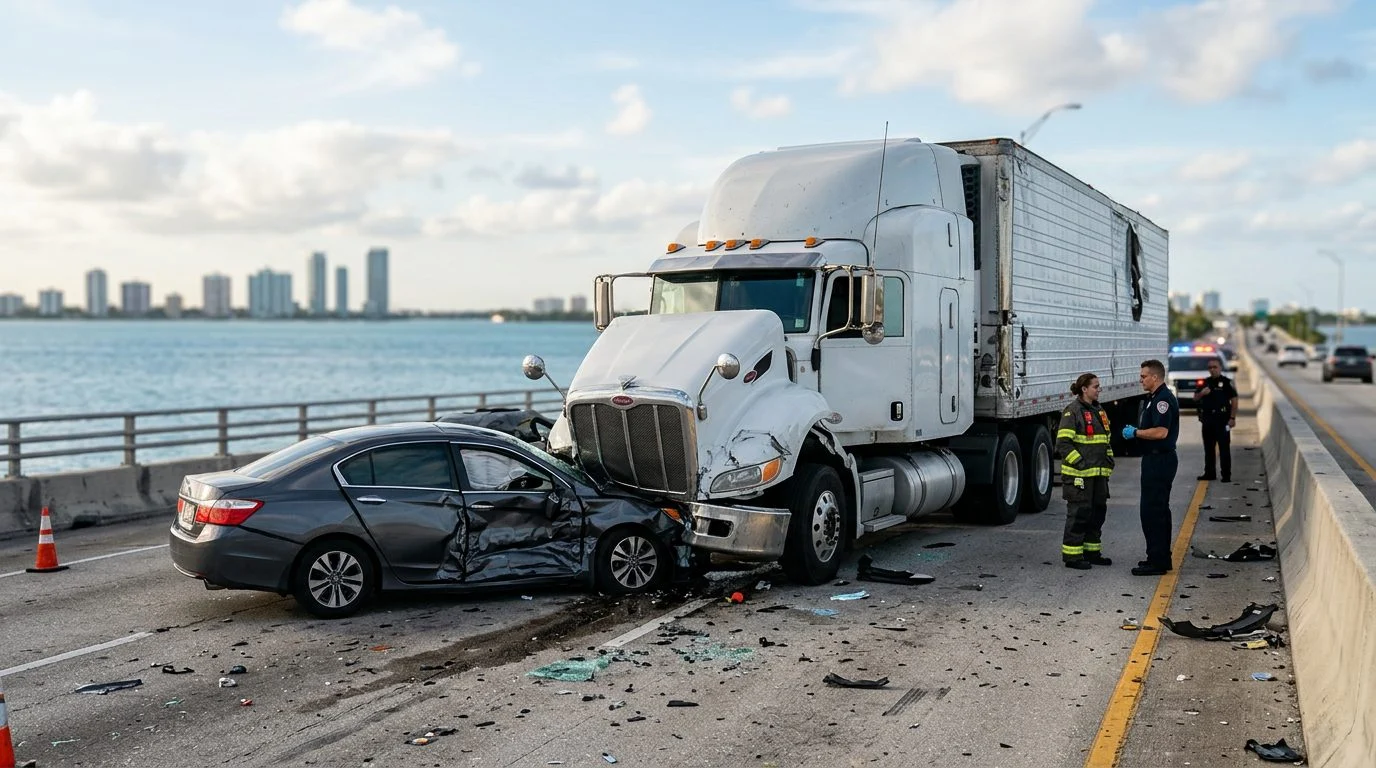
Truck Accidents | Key Biscayne, Florida
Hurt in a Truck Crash in Key Biscayne? Here Is What to Do Now
A collision with a big rig, delivery truck, or commercial vehicle can leave your family facing medical bills, lost income, and hard questions. CHG Personal Injury Lawyers helps injured people and their families across Florida understand their options, starting with a free, confidential consultation.
About CHG Personal Injury Lawyers
Florida
Florida-based firm serving clients throughout the state
Free
First consultation, confidential and without obligation
Licensed
Attorneys admitted to The Florida Bar
By CHG Lawyers · Published October 26, 2026
Truck accidents in Key Biscayne can change a family’s life in a single afternoon. If a commercial truck hurt you or someone you love, you may have a claim against the people responsible. Florida sets firm time limits, and the first weeks after a crash often decide what evidence is still available. This guide explains the basics in plain language.
Key Biscayne is known for the Cape Florida Lighthouse, its beaches and its quiet, tree-lined streets. The same roads also carry delivery vans, service trucks and construction vehicles. Cyclists, walkers and families heading to the water share those lanes every day.
CHG Personal Injury Lawyers is a Florida-based personal injury firm that serves clients throughout Florida. Igor Hernandez is the responsible lawyer for this page.
Why truck crashes on Key Biscayne carry local risks
Truck crashes on Key Biscayne can happen on the island’s main streets or on the Rickenbacker Causeway. The causeway is the main link between the island and the mainland. Island residents, workers and visitors all use the same limited routes.
Trucks serving homes, condominiums and businesses come and go throughout the day. Moving vans, landscaping trucks and delivery vehicles often share lanes with cyclists and pedestrians. Visitors heading to the beaches and parks may not expect a large truck to turn or stop suddenly.
Crashes on the causeway or its approaches can also involve traffic moving between the island and the mainland. One crash can stop traffic for a long time and affect people who were never near the first impact.
The setting also matters later. Crashes on a causeway or bridge approach are documented by the responding agency, and those details can shape a claim. Small facts about the location, the time and the lanes can count.
Not sure what your next step is?
Talk it through with our team — the first consultation is free, confidential, and carries no obligation.
Traffic deaths in Florida: where the numbers come from
Official figures on traffic deaths come from crash records kept by law enforcement. Federal data also tracks fatal crashes. The National Highway Traffic Safety Administration maintains a fatality database, and Florida publishes its own crash statistics.
These figures count deaths each year. They show how many people were killed, but they do not tell the full story of any one crash. Each number represents a person, and each person belongs to a family.
When a crash is fatal, the family often faces hard questions. They want to know what happened, who is responsible and what to do next. Families often have many questions after a loss, and our team is glad to talk through them with you.
What drives most serious truck crashes
Serious truck crashes usually involve more than one contributing factor. A claim turns on the specific facts of each crash, not on a general rule.
Trucks behave differently than cars. A loaded truck needs much more distance to stop. Large blind spots can hide cars and cyclists. Wide turns can swing a trailer into the next lane.
Fatigue is a risk that federal rules address directly. Under 49 C.F.R. § 395.3, a driver may not drive after 14 consecutive hours on duty that follow 10 consecutive hours off duty. The driver may drive a total of 11 hours in that period.
The same rule limits continuous driving. Driving is not permitted after more than 8 hours of driving time without at least a 30-minute break, subject to listed short-haul exceptions. Weekly duty limits apply too.
Federal rules also say a driver may not operate a truck when fatigue, illness or another cause makes it unsafe. See 49 C.F.R. § 392.3. Tight delivery schedules can create pressure to skip rest, which is why carrier records matter.
Who may share responsibility in a Key Biscayne truck crash
Many parties can share responsibility in a truck crash, not only the driver. The motor carrier that employs or contracts the driver may be involved. So may the truck’s owner, cargo loaders and maintenance contractors.
Federal rules place duties on the carrier as well as the driver. Under 49 C.F.R. § 390.11, when a rule in part 325 of subchapter A or in this subchapter places a duty on a driver, the motor carrier must require that the driver follow it.
Federal law also sets minimum financial responsibility levels for commercial carriers. The rules are described in 49 U.S.C. § 31139, which covers public liability, property damage, and environmental restoration.
Many delivery trucks carry the name of a large retailer or shipping company, such as Amazon or FedEx. Often, a separate contracted company runs the truck and employs the driver. The name on the side may not show who is responsible, which affects who may be named in a claim.
In a May 14, 2026 decision, the U.S. Supreme Court held that a state-law claim that a broker negligently hired an unsafe carrier falls within a federal safety exception. See Montgomery v. Caribe Transport II, LLC.
Have questions about what happened?
Ask our team directly. The first conversation is free, confidential, and there is no obligation to continue.
Finding out whether someone you love was in a crash
If you cannot reach someone after a possible crash, start with the hospitals nearby. Ask whether the person was brought in. Then contact the law enforcement agency that responded to the scene.
For a crash that causes injury or death, the driver must remain until the required steps are complete. See Fla. Stat. § 316.027.
Crash reports come from the responding officer. Parties, their legal representatives and their insurers may access it.
To request a report, a person must present a valid driver license or other photographic identification, proof of status, or identification that demonstrates his or her qualifications to access that information. The person must also file a written sworn statement, for each report requested, that the report will not be used for commercial solicitation of accident victims or knowingly disclosed to any third party for that purpose.
Write down what you know while it is fresh. Include dates, times, names of witnesses, photos and what the other driver said. Bring these notes to your first conversation with a lawyer.
Injuries that can change a life after a truck crash
Truck crashes can cause catastrophic injuries that change daily life for years. These include spinal cord injuries, paralysis, traumatic brain injuries, amputations, severe burns and serious back and neck injuries.
Florida defines serious bodily injury as a physical condition that creates a substantial risk of death, serious personal disfigurement, or protracted loss or impairment of a body part or organ. See Fla. Stat. § 316.027.
Recovery can take months, and the full impact may not be clear early on. Please follow the care plan your doctors set. This page does not give medical advice.
When a truck crash causes a death, Florida law allows a wrongful death claim. Under Fla. Stat. § 768.19, a person whose wrongful act, negligence, default, or breach causes a death can be liable for damages under the wrongful death act, if the injured person could have sued and recovered damages had death not ensued.
The claim is brought by the decedent’s personal representative. Under Fla. Stat. § 768.20, that representative recovers for the survivors and the estate. Families often face lost income, medical bills and the loss of a parent, spouse or child.
Florida deadlines and fault rules you should know
Florida sets a time limit for filing most injury and wrongful death lawsuits. Missing that limit can block a lawsuit entirely. The rules are in Fla. Stat. § 95.11.
The clock depends on the type of claim, so the deadline for your case should be reviewed with a lawyer promptly. Do not assume you have plenty of time. Acting early keeps more options open.
Florida uses comparative fault. Under Fla. Stat. § 768.81, if the injured person is partly at fault in a negligence action, the amount awarded is reduced proportionately, and the claim is not barred unless that person is found greater than 50 percent at fault for his or her own harm, in which case no damages may be recovered. Your own share of fault can affect what you recover. How that plays out depends on the facts.
Insurers may ask early questions about who caused the crash. Answers given before you understand the rules can be used later, so take time before you respond.
Protecting evidence and your claim in the first weeks
The first weeks matter most because some evidence can be overwritten or lost. Video, electronic records and witness memories fade quickly.
Start with the basics. Take photos of the scene, the vehicles and any injuries. Get names and contact information for witnesses. Keep every medical record and bill. Ask nearby businesses whether they have video, since dashcam and store footage may be overwritten fast.
Trucking companies keep their own records. Under 49 C.F.R. § 395.8, carriers operating commercial vehicles must install and require drivers to use electronic logging devices to record duty status no later than December 18, 2017, though a motor carrier may require manual recording for some drivers and vehicles under the rule’s conditions. Carriers must keep those records for at least 6 months from the date of receipt.
Six months is a minimum, not a promise that records will last. A written request to preserve logs, maintenance files and dispatch records is a common early step.
Avoid giving a recorded statement to a trucking company’s insurer before speaking with a lawyer. Do not sign papers you do not understand. CHG charges no attorney’s fees and no case costs unless there is a recovery.

Want to know where you stand?
Tell us what happened and our team will walk you through the options available to you, at no cost.
Talking with CHG about a Key Biscayne truck crash
CHG Personal Injury Lawyers offers a free, confidential first consultation with no obligation to continue. The firm is Florida-based and serves clients throughout Florida. The firm’s lawyers are licensed to practice in Florida.
How long do I have to file a truck accident lawsuit in Florida?
Florida sets the filing deadline in Fla. Stat. § 95.11. The date depends on the type of claim and when the crash happened.
How do I get a crash report after a truck accident in Florida?
For a crash that results in death, personal injury, or any indication of complaints of pain or discomfort, the responding officer must submit the Florida Traffic Crash Report, Long Form, within 10 days after the investigation is completed. Parties involved in the crash and their legal representatives may access it, and it may be made immediately available to them.
Can a family file a wrongful death lawsuit after a truck crash?
Yes. Florida law has the decedent’s personal representative bring the claim for the survivors and the estate.
Who can be responsible in a truck accident?
The driver, the motor carrier and others may share responsibility. The answer depends on who employed the driver and how the crash happened.
Your family does not have to sort out the crash report, the deadlines and the insurance calls alone. Contact the CHG contact page to schedule your free, confidential first consultation.
This is attorney advertising. Past results do not predict future outcomes.
Steps to Take After a Truck Crash
Get Medical Care
Some injuries, including back, neck, and head injuries, may not show symptoms right away. Follow your doctors' care and keep every appointment and record.
Document the Scene
If you are able, photograph the vehicles, the road, visible injuries, and any skid marks or debris. Write down names, badge numbers, and contact details of everyone involved.
Request the Crash Report
Police reports help document what happened. Ask for a copy and keep it with your medical records and bills.
Speak With a Lawyer First
Trucking companies and their insurers may contact you quickly. Talk with our team before you give a statement or sign anything.
Important: Be Careful With Recorded Statements
An insurance representative for a trucking company may ask you to give a recorded statement or sign a release soon after the crash. Those words can be used later in your claim. Deadlines apply to every injury claim in Florida, so contact a lawyer promptly.
Why Families Across Florida Contact CHG
Serving Florida
We represent injured people and their families throughout Florida, including Key Biscayne and the surrounding Miami-Dade communities.
Licensed Attorneys
Our attorneys are admitted to The Florida Bar. Igor Hernandez is the responsible attorney for this page.
Plain-Language Guidance
We explain the process clearly, in English or Spanish, so you know what to expect at each step.
No Fees Unless There Is a Recovery
CHG charges no attorney's fees and no case costs unless there is a recovery.