

Wrongful Death | Truck Accidents
Fatal Truck Accident Lawyer in Florida
If a loved one was killed in a truck crash caused by negligence, surviving family members can pursue a wrongful-death claim. CHG Personal Injury Lawyers helps families across Florida and nationwide seek fair compensation.
By CHG Lawyers · Published October 07, 2026
Fatal Truck Accident Lawyer Florida: Wrongful Death Claims for Families
Did a truck crash take someone you love? Your family may have the right to bring a wrongful-death claim in Florida. You don’t have to face the trucking company or its insurers alone. A fatal truck accident lawyer in Florida can hold the responsible parties accountable and free you to grieve.
No lawsuit brings back the person you lost. This page is for the people left behind. We explain what a claim is, who can file, what it covers, and how the process works.
You owe nothing to talk with us. Contact CHG Personal Injury Lawyers for a free, private case evaluation. We help families across Florida and take cases nationwide.
Not sure what your next step is?
Talk it through with our team — the first consultation is free, confidential, and carries no obligation.
Why large-truck crashes are so often deadly
Physics is unforgiving. A loaded tractor-trailer weighs up to 80,000 pounds. That’s roughly 20 to 30 times heavier than a typical car. When that weight hits a smaller vehicle, the car’s occupants absorb most of the force.
The Federal Motor Carrier Safety Administration publishes Large Truck and Bus Crash Facts. The data shows most people killed in large-truck crashes are in the other vehicle, not the truck. That is why these crashes turn fatal. And why the family left behind usually bears the loss.
These cases involve large commercial vehicles: semis, 18-wheelers, tractor-trailers, box trucks, tankers, and delivery trucks. They differ from ordinary car crashes in important ways:
- Federal safety rules apply to interstate trucking companies.
- More than one company or person may share the blame.
- Trucking insurance policies are usually far larger than personal car policies.
- Key evidence is complex and can disappear within days.
A wrongful-death claim is separate from any criminal case. The state may charge a driver with a crime. Your civil claim seeks money and accountability. A lawyer can pursue the civil claim for you.
Who can file a wrongful death claim in Florida
The claim is filed under the Florida Wrongful Death Act. Under Florida law, when a death is caused by wrongful act or negligence, the person or company that would have been liable if the victim had survived remains liable for damages.
The personal representative of the deceased person’s estate files the claim. The court puts this person in charge of the estate. The recovery goes to the surviving family, not just the estate.
Florida law defines who may recover as a “survivor.” Survivors can include:
- The surviving spouse
- The children (minor children receive different damages than adult children)
- The parents
- Certain blood relatives and adoptive siblings who depended on the deceased for support or services
Can family members of someone killed in a truck accident file a claim? Yes. Eligible survivors recover through the estate’s personal representative, who acts for them.
Has your family not yet opened an estate or named a personal representative? That’s normal. We explain how that step works. Not sure whether you qualify? A free case evaluation can answer that quickly.
What compensation a Florida wrongful death claim may cover
Florida splits the losses into two groups: what the survivors lose and what the estate loses.
The estate’s damages can include:
- Lost earnings from the injury to the date of death
- Lost net accumulations—what the person likely would have saved or left behind, if survivors include a spouse, lineal descendants, or surviving parents
- Medical and funeral bills charged to the estate
The categories depend on your relationship to the person who died. A surviving spouse’s claim looks different from a minor child’s, an adult child’s, or a deceased minor’s parents’. We match these legal categories to your family’s real situation.
Every case is different. No lawyer can promise or guarantee a specific outcome. Our goal is accountability and stability for your family’s future.
Who may be legally responsible after a fatal truck crash
More than the driver may be liable. Finding every responsible party is one of the most important parts of a truck case. Possible defendants include:
- The truck driver
- The trucking company (the motor carrier)
- The company that owns the truck or trailer
- A maintenance or repair contractor
- The company that loaded or shipped the cargo
- A freight broker
- A parts maker, if a defect helped cause the crash
A company can be responsible for its employee-driver’s on-the-job conduct. This is called vicarious liability. A carrier may also be liable for negligent hiring, training, or supervising a driver. For example, it may have put a driver with a known unsafe record back on the road.
Why does this matter to your family? More responsible parties often mean more available insurance. That can mean a more realistic path to full recovery.
Florida’s comparative-fault rule: you may recover even if your loved one was partly at fault
Trucking insurers often argue the person who died was partly at fault. Florida law matters here. Under Florida’s comparative-fault rule, a claimant found more than 50% at fault for their own harm generally cannot recover.
Below that line, recovery is reduced by the percentage of fault assigned—but you still recover. This is a crucial difference from older law. Even if your loved one was found 40%, 45%, or 50% at fault, the family can still pursue damages, reduced proportionally.
This is exactly why it matters to document how the crash happened. We push back on an insurer’s blame-shifting with evidence. We handle that argument for you.
Federal and Florida trucking rules that strengthen your case
Interstate trucking companies must follow the Federal Motor Carrier Safety Regulations. These are enforced by the Federal Motor Carrier Safety Administration (FMCSA). When a company breaks these rules, that can be strong evidence of negligence.
These rules cover:
- Hours-of-service limits that fight driver fatigue
- Mandatory rest breaks
- Drug and alcohol testing
- Driver qualification standards
- Vehicle inspection, repair, and maintenance
- Cargo securement—how loads are tied down
Modern trucks record a lot of data. An electronic logging device (ELD) records driving hours automatically. GPS and telematics can show speed and location. Together, these records can reveal fatigue, speeding, or a driver on the road longer than the law allows.
Have questions about what happened?
Ask our team directly. The first conversation is free, confidential, and there is no obligation to continue.
Why acting quickly matters: the black box and evidence preservation
Critical evidence can disappear within days. The truck’s “black box” is the engine control module (ECM). It records speed, braking, and throttle in the moments before a crash. But it can be overwritten when the truck goes back in service.
Other evidence that can vanish includes:
- Driver logs and inspection records
- Dashcam and nearby business video
- Truck maintenance and repair history
- Physical evidence at the scene
One of our first steps is to send a legal preservation letter. This tells the trucking company not to destroy or overwrite these records.
Meanwhile, the trucking company’s insurer often sends a rapid-response team to the scene within hours. That team works to protect the company, not your family. Your family deserves its own advocate just as early. Contact us now so we can move to preserve the evidence.
How the process works, step by step
- Free case evaluation. You tell your story. We listen and explain your options.
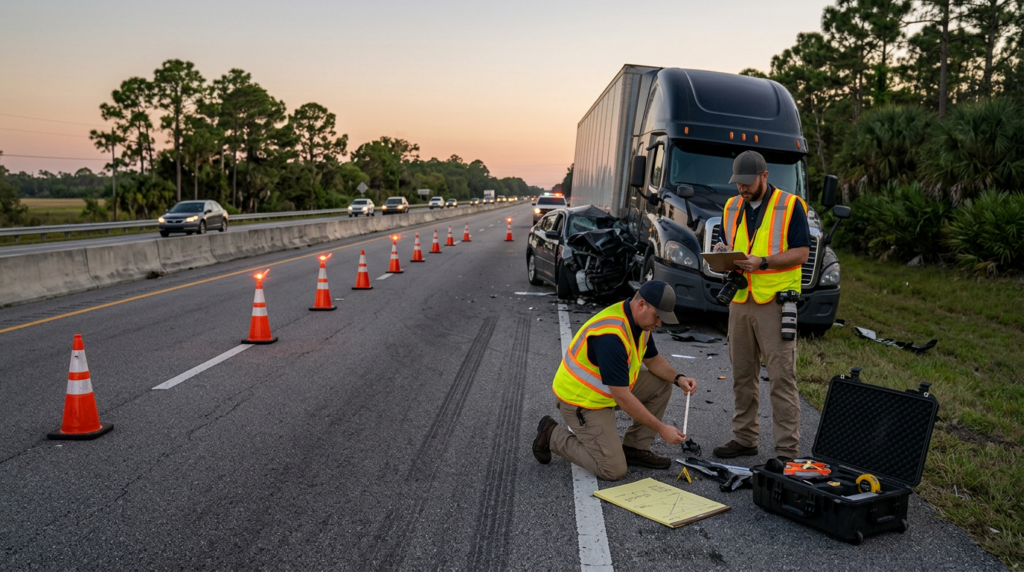
- Investigation. We secure crash evidence, ECM data, logs, and witness accounts. We hire accident-reconstruction and other experts as needed.
- Open the estate. We help set up the estate and personal representative so the claim can move forward correctly.
- Build damages. We document your family’s survivor and estate losses in detail.
- Demand and negotiate. We present the claim to the insurers and push for a fair resolution.
- File suit and litigate. If a fair offer doesn’t come, we file a lawsuit and prepare for trial.
Complex truck cases can take months to years. We set honest expectations and stay in touch throughout.
How long you have to file in Florida
A wrongful-death claim in Florida must be brought within the time allowed by law, so it is important to speak with a lawyer early. A lawyer can explain the filing deadline that applies to your family’s situation.
Understanding how medical expenses are handled can be an important part of a personal injury or wrongful-death case, and the rules in this area have changed over time. The law has tightened what evidence of damages is admissible. This makes early, thorough documentation critical.
Certain facts can shorten or extend this window. Missing it usually ends the claim entirely. This is general information, not legal advice about your situation. Please reach out promptly so we can confirm the deadline that applies to your family.
How our fees work
We handle these cases on a contingency-fee basis, so you can ask us about how fees work before you decide anything. We handle these cases on a contingency fee, with no up-front cost to you. The first case evaluation is free. We explain the specific terms in writing before you sign anything. We cannot guarantee any particular outcome.
Why families choose CHG Personal Injury Lawyers
We focus on catastrophic and fatal-injury cases—including fatal truck crashes—not routine claims. That focus matters when you’re up against a large trucking company and its insurers.
- Credentials: Our attorneys are licensed and admitted to The Florida Bar.
- Resources: We have the tools to investigate serious commercial-truck cases.
- Approach: Caring, plain-language guidance in English and Spanish. Your family can grieve while we handle the legal fight.
- Reach: We serve Miami, Orlando, Tampa, and Jacksonville, and take cases nationwide.
Schedule your free, confidential case evaluation.
Want to know where you stand?
Tell us what happened and our team will walk you through the options available to you, at no cost.
Frequently asked questions
Can you sue if a truck driver caused a fatal crash?
Yes. Eligible surviving family members can bring a Florida wrongful-death claim through the estate’s personal representative.
What should I not say to the insurance company?
Don’t guess or speculate. Don’t give a recorded statement. Don’t sign anything before you understand it. Be honest, and let your attorney talk to the trucking insurer for you.
What is the average payout for a fatal truck accident in Florida?
Be careful with any “average payout” figure you see online. It tells you nothing about your case. No honest lawyer can promise a result. Florida wrongful-death recoveries depend on the survivors involved and the losses proven. They also depend on how liability and comparative fault work out, and on the available insurance (Fla. Stat. § 768.81(6)). A free evaluation is the honest way to understand what your case may involve.
What if the insurer says my loved one was partly at fault?
Under Florida’s comparative-fault rule, being partly at fault does not automatically bar recovery. It only bars recovery if the claimant is found more than 50% responsible. We work to rebut blame-shifting with evidence.
Do fatal truck accident cases go to trial or settle?
Many resolve through negotiation. But we prepare every case as if it will go to trial.
What does it cost to get started?
Nothing. The evaluation is free, and we work on a contingency fee.
Talk to a fatal truck accident lawyer serving Florida families
Losing someone you love in a truck crash is among the most catastrophic losses a family can face. You deserve answers, dignity, and someone in your corner.
Working with a fatal truck accident lawyer in Florida costs nothing up front. You pay no fee unless we recover for your family. We carry the legal burden so you can focus on each other.
Contact CHG Personal Injury Lawyers today for a free, confidential case evaluation. You can also learn more about our work on truck accident claims and catastrophic injury claims.
Why Families Choose CHG
Focused on Catastrophic Injury Claims
Our practice focuses exclusively on serious and fatal accidents, including truck crashes. We understand the stakes and the long-term impact on your family.
Compassionate, Direct Guidance
We communicate in plain language about your rights and next steps. No jargon—just honest answers when you need them most.
No Fees Unless There Is a Recovery
We work on contingency. You pay nothing upfront, and we only collect a fee if your claim results in a settlement or judgment.
National Reach, Local Knowledge
Based in Florida and licensed to practice nationwide, we handle wrongful-death cases across the country.
Do Not Delay
Wrongful-death claims are subject to strict time limits under Florida law. The sooner you contact an attorney, the sooner we can protect your family's right to pursue compensation and preserve critical evidence.
What to Know About Wrongful-Death Claims
Who Can File a Claim?
What Can a Claim Cover?
Wrongful-death damages may include funeral and medical expenses, lost income and benefits the deceased would have earned, loss of companionship, and pain and suffering. Each case is unique.
How Do We Prove Negligence?
We investigate the crash thoroughly—examining police reports, vehicle data, driver records, maintenance logs, and witness statements—to establish that the truck driver or company failed to act reasonably and caused the fatal accident.
What Should I Tell the Insurance Company?
Do not give a recorded statement or sign anything before consulting an attorney. Be honest if you must speak with them, but let your lawyer handle all negotiations and communications on your behalf.