

Jet Ski Accidents
Jet Ski Accident in Tampa? Here's What to Do Next
Immediate steps to protect yourself, your family, and your claim—plus what you need to know about holding negligent operators and property owners accountable.
By CHG Lawyers · Published September 27, 2026
Jet Ski Accidents in Tampa: Catastrophic Injuries, Liability, and Your Legal Claim
Tampa Bay, Hillsborough Bay, and the Alafia River see thousands of jet skis every year. Some are rented at marinas in Hyde Park and Carrollwood. Others are operated by experienced riders on open water. Most trips end safely. But jet ski accidents do happen regularly, and they often cause serious, life-altering injuries: spinal cord damage leading to paralysis, traumatic brain injuries, amputations, and drowning deaths.
If you’ve been injured in a jet ski accident in Tampa, the choices you make in the first hours and days directly affect your legal claim and your recovery. This guide explains what to do right after a crash, how Florida’s liability system works, and why acting quickly matters.
Not sure what your next step is?
Talk it through with our team — the first consultation is free, confidential, and carries no obligation.
Immediate Steps After a Jet Ski Accident in Tampa
Check for injuries and call 911 if anyone is hurt. Get yourself and passengers to safety if you can. If you can stay near the accident scene safely, do so. The U.S. Coast Guard or Florida Fish and Wildlife Conservation Commission (FWC) will need to document what happened.
Call the FWC or U.S. Coast Guard to report the accident. You need an official incident report. For Tampa Bay accidents, call the FWC at 1-888-404-3922. The Coast Guard also responds to serious incidents on navigable waters. Ask for the report number at the scene, or request it in writing afterward. This report is critical evidence.
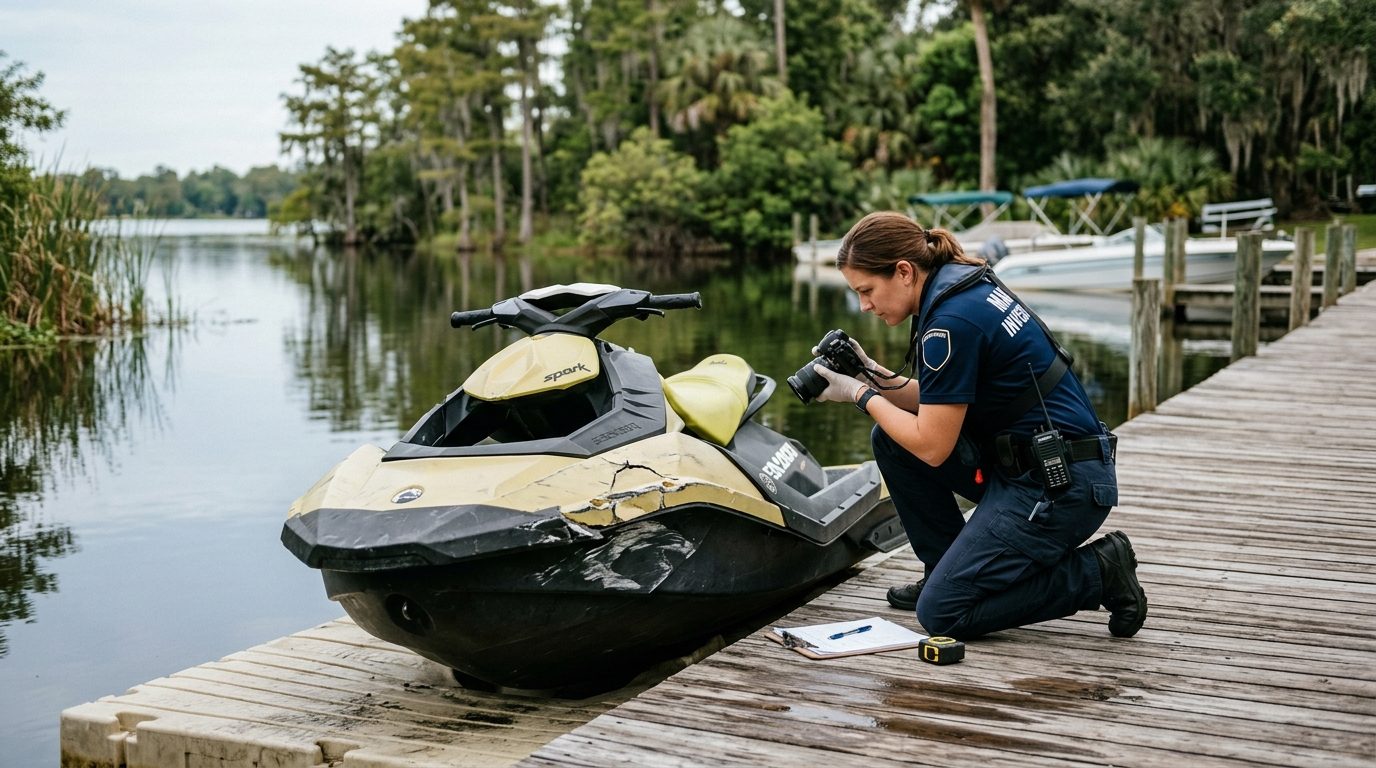
Document everything at the scene with photos and video: – Damage to both jet skis – Water and weather conditions (rough water, visibility, time of day) – Other vessels nearby – Registration numbers of other jet skis – Visible injuries to any person – Location markers (distance from docks, navigation buoys, shoreline landmarks)
Collect detailed information from the other operator: – Full name, phone number, address – Jet ski registration number and owner name (may differ from operator) – Insurance company and policy number – Rental company name (if the jet ski was rented)
Get witness contact information. Write down names, phone numbers, and addresses of anyone who saw the accident. Witness memories fade quickly. Contact them within days if possible.
Do not admit fault or apologize. Even if you believe you caused the accident, let authorities and insurers determine liability. Statements you make at the scene can be used against you later.
Request a copy of the official incident report. You’ll need it for your insurance claim and any legal case. Follow up in writing if necessary.
The Liability Landscape: Who Can Be Held Responsible
Jet ski accident claims are more complex than car accidents. Multiple parties may share liability:
- The other operator: If they were speeding, operating under the influence, failing to maintain a proper lookout, or violating navigation rules
- The jet ski owner: If they owned the machine but didn’t operate it, they may still be liable if they knew or should have known the operator was negligent or reckless
- The rental company: If the jet ski was rented, the rental company may be liable for poor maintenance, failure to warn renters of hazards, or renting to an impaired or incompetent operator
- The waterfront property owner: If the accident occurred near a dock, marina, or private property, the owner may be liable for negligent security, failure to maintain safe conditions, or failure to warn of hazards
An experienced attorney investigates all potential defendants and pursues claims against each party responsible for your injury.
Common Jet Ski Accident Scenarios in Tampa
Head-on collisions occur when operators fail to see each other or misjudge speed and distance on crowded waterways like Hillsborough Bay during peak season.
Rear-end collisions happen when a faster jet ski strikes one that’s slowing or stopped, often in narrow channels or near marinas.
Sideswipe accidents occur when operators don’t maintain proper lane awareness or fail to signal turns.
Collisions with fixed objects—docks, pilings, seawalls, sandbars, or submerged debris—cause severe trauma, particularly when operators are speeding or distracted.
Operator ejection accidents occur when a jet ski hits a wave or obstacle and throws the rider overboard, often resulting in drowning or impact injuries.
Multi-vessel pile-ups can involve three or more jet skis in seconds, especially in congested areas near rental hotspots.
Catastrophic Jet Ski Accident Injuries
Jet ski accidents cause injuries ranging from minor to permanently life-altering. Some appear immediately; others develop over days or weeks.
Spinal cord injuries resulting in paraplegia (paralysis of the lower body) or tetraplegia/quadriplegia (paralysis of all four limbs) are among the most catastrophic outcomes. These injuries require immediate specialized medical care, lifelong rehabilitation, home modifications, and ongoing assistance. A person with a spinal cord injury faces decades of medical expenses and lost earning capacity.
Traumatic brain injuries (TBI) result from impact or sudden deceleration. Symptoms may not appear right away. Watch for confusion, headaches, memory loss, difficulty concentrating, personality changes, or mood disturbances. Even “mild” TBI can cause permanent cognitive and behavioral changes. Moderate to severe TBI can result in lifelong disability.
Amputation or limb loss occurs in catastrophic collisions, particularly when a limb is caught between the jet ski and a fixed object or another vessel. Amputation requires immediate surgery and lifelong prosthetic care, rehabilitation, and adaptation.
Severe burns can occur if a jet ski catches fire or if the operator is exposed to hot engine components. Burn injuries often require multiple surgeries, skin grafts, and long-term wound care.
Internal injuries and organ damage may not be visible but are serious and life-threatening. Blunt-force trauma to the abdomen can cause bleeding, organ rupture, or internal injuries that develop over hours.
Drowning or near-drowning can result in brain damage from oxygen deprivation, even if the person is rescued.
Whiplash and neck strain are common in rear-end collisions but often underestimated. Neck injuries can cause chronic pain, reduced mobility, and nerve damage.
Broken bones and fractures require surgery and extended recovery. Compound fractures (bone breaking through skin) carry risk of infection and permanent disability.
Wrongful death leaves surviving family members facing funeral expenses, lost financial support, and the grief of losing a loved one.
Even if you feel “fine” after a jet ski accident, see a doctor immediately. Some injuries—internal bleeding, traumatic brain injury, spinal cord damage—show no symptoms right away. A medical evaluation creates a critical record linking the accident to your injuries.
Why Medical Documentation Matters Immediately After a Jet Ski Accident
Insurance companies use delays in seeking care to argue that injuries aren’t serious or weren’t caused by the accident. If you wait days or weeks to see a doctor, the insurer may claim your injuries are unrelated to the crash.
A medical record created shortly after the accident is crucial evidence. Your doctor’s notes establish a direct link between the crash and your injuries. This documentation protects your claim and strengthens your negotiating position.
For catastrophic injuries—spinal cord damage, brain injury, amputation—immediate emergency care is both medically necessary and legally essential. The medical records from the emergency room, hospital admission, and initial treatment become the foundation of your damages claim.
Have questions about what happened?
Ask our team directly. The first conversation is free, confidential, and there is no obligation to continue.
How Jet Ski Insurance Works in Florida
Florida is a “no-fault” state for motor vehicle accidents, but jet ski liability works differently. Jet ski operators are typically covered under homeowners’, renters’, or focused watercraft liability insurance. Unlike cars, there is no mandatory PIP (Personal Injury Protection) coverage for jet skis.
You may need to pursue a claim directly against the other operator’s liability insurance, or against your own uninsured/underinsured watercraft coverage if the other operator has no insurance.
Liability for jet ski accidents is determined by negligence—whether the other operator failed to operate safely and that failure caused your injuries.
Florida’s Statute of Limitations: Why Acting Quickly Matters
Under Florida law, you generally have 2 years from the date of the accident to file a lawsuit. However, this deadline is strict. If you miss it, you lose your right to sue, regardless of how strong your claim is.
Insurance claims and settlement negotiations often move faster than the 2-year window suggests. Waiting too long results in: – Lost or degraded evidence – Faded witness memories – Difficulty obtaining accident scene photos or video – Challenges reconstructing the accident – Reduced negotiating leverage with insurance companies
If you’ve been injured in a jet ski accident in Tampa, contact an attorney as soon as possible—even if you’re still in treatment. Early legal consultation protects your rights and ensures critical deadlines are met.
Florida’s Modified Comparative Fault Rule
Florida follows a modified comparative fault rule. If you are found to be more than 50% at fault for the accident, you cannot recover damages. If you are 50% or less at fault, you can recover, but your damages are reduced by your percentage of fault (Fla. Stat. § 768.81(6)).
Example: If you are found to be 20% at fault and your total damages are $100,000, you can recover $80,000 (reduced by your 20% share of fault).
An experienced attorney investigates the accident thoroughly to minimize your assigned fault and maximize your recovery. Insurance adjusters will attempt to shift blame to you. An attorney counters this strategy with evidence and expert analysis.
Damages You Can Recover in a Jet Ski Accident Claim
If you establish negligence, you can recover:
- Medical expenses (past and future): emergency care, surgery, rehabilitation, ongoing treatment, adaptive equipment, home modifications, and assistive devices
- Lost income: wages you lost while recovering or unable to work
- Loss of earning capacity: if your injury prevents you from returning to your prior work or earning at the same level
- Pain and suffering: compensation for physical pain, emotional distress, and reduced quality of life
- Permanent disability or disfigurement: if the injury causes lasting disability
- Loss of enjoyment of life: if the injury prevents activities you once enjoyed
- Cost of future care: for catastrophic injuries requiring lifelong care, rehabilitation, or medical treatment
- Punitive damages (in rare cases): if the operator’s conduct was reckless, willful, or intentional
In wrongful death cases, surviving family members can recover funeral and burial expenses, lost financial support the deceased would have provided, and loss of companionship and society.
Why You Need an Attorney for a Serious Jet Ski Accident
Insurance adjusters are trained to minimize payouts. They are not on your side.
An attorney investigates the crash, gathers evidence, interviews witnesses, obtains the official incident report, and builds a strong case. Legal representation levels the playing field against insurance companies and their lawyers.
An experienced attorney negotiates on your behalf and knows when a settlement offer is too low. If a fair settlement cannot be reached, your attorney can file a lawsuit and represent you in court.
Most personal injury attorneys work on contingency—you pay nothing upfront. Attorney fees come from your recovery, so your attorney has every incentive to fight for maximum compensation.
For catastrophic injuries, an attorney with experience in these cases understands the full scope of your needs—from immediate emergency care to lifelong care planning—and fights for compensation that reflects the true cost of your injury.
Want to know where you stand?
Tell us what happened and our team will walk you through the options available to you, at no cost.
Wrongful Death from a Jet Ski Accident in Tampa
If a loved one was killed in a jet ski accident, surviving family members can file a wrongful death claim under Florida law. Wrongful death damages include funeral and burial expenses, lost financial support the deceased would have provided, and loss of companionship and society.
The claim is filed on behalf of the deceased’s estate or by the surviving spouse, children, or parents. Wrongful death cases are emotionally difficult and legally complex. Experienced representation is essential. Families who have lost someone in a crash often find that filing a claim honors the deceased and helps secure the family’s financial future.
What to Expect When You Contact a Jet Ski Accident Attorney
A free initial consultation gives you the chance to discuss your crash, injuries, and questions with an experienced attorney. The attorney will review your case, explain your options, and answer your questions—with no obligation to hire them.
If you decide to move forward, the attorney handles all communication with insurance companies and the other party. You’ll receive regular updates and be involved in all major decisions.
Most cases settle without trial. If settlement negotiations fail, your attorney will prepare for court. You pay nothing upfront. Attorney fees come from your recovery.
Frequently Asked Questions
What should I do immediately after a jet ski accident in Tampa?
Check for injuries, call 911 if necessary, get to safety, call the FWC or Coast Guard (1-888-404-3922), document the scene with photos, get the other operator’s information and witness contact details, and request the incident report number.
How much can I recover from a jet ski accident claim in Florida?
Damages depend on the severity of your injury, medical expenses, lost income, and whether negligence can be established. For catastrophic injuries, damages can be substantial and may include lifelong care costs. An attorney can evaluate your specific case.
What is the statute of limitations for a jet ski accident lawsuit in Florida?
You generally have 2 years from the date of the accident to file a lawsuit. Early action protects your evidence and rights.
Do I need an attorney for a jet ski accident claim in Tampa?
For serious injuries or disputes with insurance companies, an attorney protects your rights and maximizes your recovery. Most work on contingency, so there’s no upfront cost.
What counts as “negligence” in a jet ski accident case?
Negligence means the other operator failed to operate safely and that failure caused your injuries. Reckless speed, operating under the influence, failure to maintain a lookout, ignoring navigation rules, and operating a poorly maintained jet ski are common examples.
How does jet ski insurance work in Florida?
Jet ski operators are typically covered under homeowners’, renters’, or focused watercraft liability insurance. Unlike cars, there is no mandatory no-fault PIP coverage for jet skis. You may pursue a claim against the other operator’s liability insurance or your own uninsured/underinsured coverage.
Can I be found partially at fault and still recover?
Yes. Under Florida’s modified comparative fault rule, if you are 50% or less at fault, you can recover damages reduced by your percentage of fault (Fla. Stat. § 768.81(6)). An attorney works to minimize your assigned fault.
If you’ve been injured in a jet ski accident in Tampa—whether a minor collision or a serious, life-altering injury—our team focuses exclusively on representing people with catastrophic injuries. People in your situation can contact us to understand their options and protect their rights. Get a free case evaluation today.
What to Do Right After a Jet Ski Accident
Check for Injuries & Call for Help
Assess yourself, your passengers, and others involved for injuries. Call 911 immediately if anyone needs medical attention. Your health and safety come first—get to shore or a safe location if possible.
Report to the Right Authorities
Contact the Florida Fish and Wildlife Conservation Commission (FWC) or the U.S. Coast Guard at 1-888-404-3922 to report the accident. Request the incident report number for your records.
Document Everything
Take photos and video of the accident scene, all vessels involved, visible injuries, weather conditions, and any property damage. Write down the date, time, and location while details are fresh.
Gather Information & Witnesses
Get the other operator's name, contact details, insurance information, and vessel registration. Collect contact information from anyone who saw the accident. These witnesses can be crucial to your claim.
Don't Delay—Preserve Your Claim
Talking to an attorney early protects your rights. Evidence fades, memories blur, and legal deadlines exist. The sooner you act, the better your position.
Why You May Have a Claim
Operator Negligence
If another operator was reckless, speeding, impaired, or violated boating laws and caused your injury, you may have a claim against them for damages.
Defective Equipment
A jet ski with faulty brakes, steering, or throttle that caused or worsened your injury may make the manufacturer or seller liable.
Unsafe Property or Rental
If you rented from a company that failed to maintain the jet ski, provide proper safety instruction, or warn of hazards, they may be responsible for your injuries.
Catastrophic Injury
Jet ski accidents can cause spinal cord injuries, paralysis, traumatic brain injuries, amputations, and severe burns. These life-altering injuries deserve full compensation.