

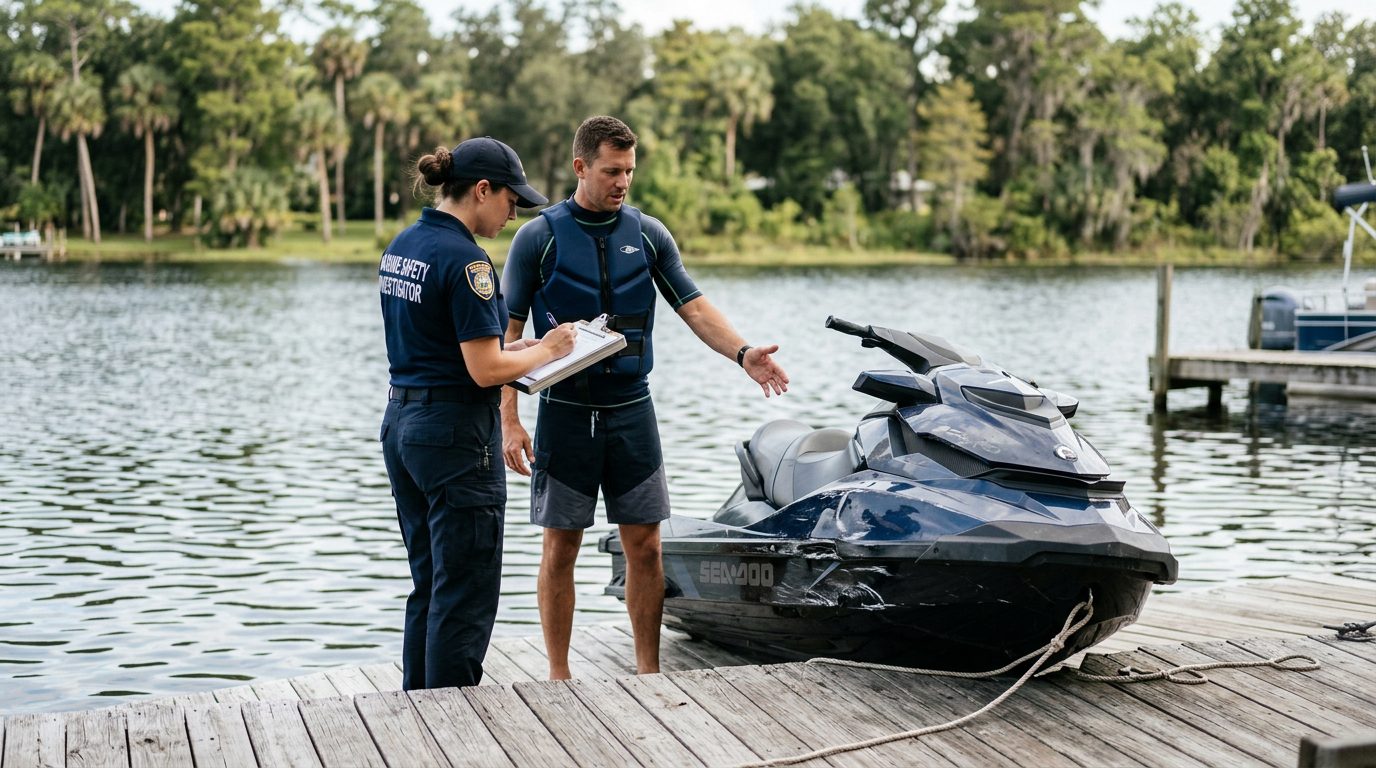
Jet Ski Accidents | Florida
What Causes Jet Ski Accidents in Florida?
Operator error, mechanical failure, and unsafe conditions lead to serious injuries every year. If you or a loved one was hurt, you may have a claim.
By CHG Lawyers · Published October 03, 2026
Jet Ski Crashes in Florida: Why Unrestrained Riders Face Catastrophic Injury
If you or someone you care about was seriously hurt in a jet ski crash on Florida waters, understanding what caused it matters. It determines who is responsible and whether you have a claim.
Jet ski crashes that result in catastrophic injury—spinal cord damage, traumatic brain injury, amputation, severe burns, or drowning—follow patterns. But one fact distinguishes jet ski accidents from crashes in enclosed vehicles: jet ski operators and passengers are completely unrestrained and exposed to the water, the machine itself, and the environment. This exposure makes injuries far more severe than they would be in a boat with a cabin, a windshield, or safety railings.
Not sure what your next step is?
Talk it through with our team — the first consultation is free, confidential, and carries no obligation.
Why Jet Ski Injuries Are Uniquely Severe
A person thrown from a jet ski at 50 mph strikes the water with the force of hitting concrete. There is no airbag, no seatbelt, no cabin to absorb impact. The jet ski itself—a 600–1,200-pound machine traveling at high speed—can circle back and strike the person in the water, causing crushing injuries, severe lacerations, or drowning.
Passengers are at particular risk. They have no control over the machine and depend entirely on the operator’s judgment. A sudden acceleration, sharp turn, or collision can throw a passenger overboard before they have time to brace. Inadequate or missing safety equipment—life jackets, tethers, or proper seating—increases injury severity.
The U.S. Coast Guard tracks recreational boating accidents. Personal watercraft (jet skis) are among the vessels involved in recreational boating accidents.
Operator Inexperience and Inadequate Training
Jet ski rental companies often place machines in the hands of people with little or no prior experience. A renter may not understand how to start, steer, accelerate, or brake safely. A jet ski can reach speeds of 40–70+ mph in seconds—far faster than most people expect.
Inexperienced operators frequently underestimate the machine’s power and their own ability to control it. Waves, wind, other boats, and obstacles create real-world challenges they don’t anticipate. Young or first-time operators are especially vulnerable. They may take unnecessary risks or panic in unexpected situations.
Rental company negligence: When a rental company fails to provide adequate hands-on training, allows an obviously inexperienced person to operate a powerful machine without supervision, or fails to assess whether the renter understands basic safety procedures, the company may bear legal responsibility for injuries that result. Florida courts recognize that rental companies have a duty to ensure that renters understand the machine they are operating and the hazards they face.
Intoxication and Impaired Operation
Operating a jet ski while under the influence of alcohol or drugs is illegal in Florida under Florida Statute § 327.35. Impaired operators have slower reaction times, poor judgment, and reduced coordination—all critical on the water.
Intoxicated operators are more likely to speed, collide with other watercraft, lose control, or fail to see swimmers or obstacles. The Coast Guard data shows that alcohol is a factor in a significant percentage of fatal boating accidents.
Rental company liability: If an operator was intoxicated at the time of a crash, a rental company that knowingly allowed an impaired person to operate a machine may be liable for injuries caused by that operator. A rental company that provides alcohol and then encourages or allows rentals bears responsibility for foreseeable harm.
Speeding and Reckless Maneuvering
Jet skis are fast and agile. Many operators push them to the limit without regard for conditions, other water users, or their own skill level. High speed reduces reaction time and makes it harder to avoid obstacles, other boats, swimmers, or debris.
Reckless maneuvers—sharp turns, sudden acceleration, or weaving through traffic—often lead to loss of control or collisions. Speeding in shallow water, near docks, in crowded areas, or in low-visibility conditions dramatically increases crash risk.
Operators who ignore posted speed limits or safety zones are acting negligently. If their recklessness causes a crash, they are liable for injuries. Under Florida’s comparative fault statute (§ 768.81), you can recover damages even if you share some responsibility, as long as you are not more than 50% at fault.
Collisions with Other Watercraft or Fixed Objects
Jet skis collide with other boats, docks, pilings, rocks, and submerged debris. Collisions at high speed often result in catastrophic injuries: spinal cord damage, traumatic brain injury, amputation, severe lacerations, or drowning.
Poor visibility—fog, darkness, glare, or rain—increases collision risk. Many operators do not use navigation lights or wear reflective gear at dawn, dusk, or night. Operator inattention is a common factor in collisions.
If another operator’s negligence caused a collision that injured you, that operator and potentially their insurance or rental company are responsible. Establishing negligence requires showing that the operator had a duty to operate safely, breached that duty, and caused your injury.
Have questions about what happened?
Ask our team directly. The first conversation is free, confidential, and there is no obligation to continue.
Mechanical Failure and Equipment Defects
Jet skis require regular maintenance: engine checks, fuel system inspection, steering and throttle function, and hull integrity. Rental jet skis are often poorly maintained. Worn or defective steering, throttle sticking, engine failure, fuel leaks, or brake failure can cause loss of control.
A sudden mechanical failure at high speed can lead to a crash before the operator has time to react. Manufacturers may also produce defectively designed machines or fail to warn of known hazards.
Rental company liability: If a rental company failed to perform required maintenance, failed to repair known defects, or failed to inspect the jet ski before renting it, they may be liable for injuries caused by mechanical failure. You do not have to prove intent—only that they failed to maintain the machine safely.
Manufacturer liability: If a manufacturer produced a defective jet ski or failed to warn of a known hazard, they may be liable under product liability law. Defective design, defective manufacture, and failure to warn are three separate theories of liability.
Environmental Factors and Water Conditions
Rough water, strong currents, sudden wind shifts, and underwater hazards can destabilize a jet ski. Operators unfamiliar with local Florida waters may not recognize dangerous conditions or hidden obstacles.
Tidal changes and seasonal weather patterns in Florida create unpredictable conditions. Fog, darkness, or glare can obscure other boats, swimmers, or fixed objects. Operators must adjust speed and caution accordingly.
An operator’s failure to slow down or exercise caution in known hazardous conditions is negligent. A property owner or rental company that fails to warn of known hazards may also be liable.
Fatal Jet Ski Crashes and Wrongful Death
The Coast Guard’s data shows that personal watercraft fatalities represent a significant portion of recreational boating deaths. Many fatal crashes involve operator error, intoxication, or failure to wear a life jacket. Fatalities are the most catastrophic outcome. Families left behind face not only grief but also financial hardship, medical and funeral expenses, and unanswered questions about responsibility.
Wrongful death claims: If a loved one was killed in a jet ski crash caused by another person’s negligence or a company’s failure to maintain equipment or provide adequate warnings, the family may have a wrongful-death claim. The statute of limitations for wrongful-death claims is two years from the date of death under Florida Statute § 95.11.
Determining Legal Liability
Determining who is responsible for a jet ski crash depends on the cause: operator error, equipment failure, inadequate training, or environmental hazards.
The operator is often liable if they were speeding, intoxicated, reckless, or negligent in any other way.
A rental company may be liable if they: – Failed to maintain the jet ski – Provided insufficient or no training – Allowed an obviously impaired person to rent – Failed to warn of known hazards or dangerous water conditions – Rented to someone clearly unable to operate the machine safely
A manufacturer may be liable if the jet ski was defectively designed or manufactured, or if the manufacturer failed to warn of a known hazard.
A property owner may be liable if they failed to warn of hazardous water conditions or failed to maintain safe access to the water.
Establishing liability requires investigation, expert analysis, and often testimony from accident reconstructionists or marine engineers. Evidence includes maintenance records, training logs, witness statements, medical records, and photographs of the scene.
Want to know where you stand?
Tell us what happened and our team will walk you through the options available to you, at no cost.
What to Do After a Serious Jet Ski Crash
Immediate priorities: Seek medical attention first. Serious jet ski injuries require emergency treatment and often hospitalization. Report the accident to one of the following: the Florida Fish and Wildlife Conservation Commission’s Division of Law Enforcement, the sheriff of the county where the accident occurred, or the police chief of the municipality, as Florida law requires.
Preserve evidence: Gather witness contact information and document the scene with photos if you’re able. Preserve the jet ski itself. Obtain the rental agreement, maintenance records, and any training materials or waivers you signed.
Do not discuss fault or sign documents without legal advice. Insurance companies and rental companies will contact you; speak with an attorney before responding.
Medical documentation: Keep detailed records of all medical treatment, prescriptions, therapy, and ongoing care. Document lost income and other expenses related to your injury.
The path forward after a catastrophic jet ski injury is rarely simple or quick. Medical recovery can take months or years. Legal claims require investigation and often negotiation or litigation. Families dealing with catastrophic injury or wrongful death face not only medical and funeral expenses but also lost income, ongoing care costs, and profound emotional impact.
If you were seriously injured in a jet ski accident or lost someone you care about, an initial conversation with someone who understands both the medical and legal sides of catastrophic water injuries can help clarify what happened, whether you may have a claim, and what your options are moving forward. Contact us for a free case evaluation.
Frequently Asked Questions
What should I do immediately after a jet ski accident?
Seek medical attention first, then report the accident to local authorities and the U.S. Coast Guard. Gather witness contact information and document the scene with photos if you’re able. Do not discuss fault or sign documents without legal advice.
Can I sue for a jet ski accident in Florida?
Yes, if another party’s negligence caused your injury, you may have a claim. You have a limited time to file—generally two years from the date of injury under Florida’s statute of limitations.
Is a jet ski rental company responsible if I’m injured?
A rental company may be liable if they failed to maintain the jet ski, provided insufficient training, allowed an impaired person to rent, or failed to warn of known hazards. Liability depends on the specific facts of your case.
What if I was partially at fault for the accident?
Florida’s comparative fault law allows you to recover damages even if you share some responsibility, as long as you are not more than 50% at fault (Fla. Stat. § 768.81(6)). Your recovery is reduced by your percentage of fault.
What injuries result from jet ski crashes?
Serious jet ski crashes cause catastrophic injuries: spinal cord damage, traumatic brain injury, amputation, severe burns, internal injuries, and drowning. Because operators and passengers are unrestrained and exposed, injuries are often more severe than in enclosed vessels. Recovery from these injuries often requires lifelong medical care and support.
Common Causes of Operator-Related Jet Ski Accidents
Inexperience & Lack of Training
Riders unfamiliar with jet ski handling, throttle response, and stopping distance often lose control. Jet skis accelerate and turn sharply—mistakes happen fast and can be catastrophic.
Speeding & Reckless Operation
Excessive speed reduces reaction time and increases the force of impact. Riders who ignore posted speed limits or operate recklessly in crowded waters put themselves and others at severe risk.
Alcohol & Drug Impairment
Operating a jet ski under the influence impairs judgment, balance, and reaction time—just as it does on land. Impaired operators cannot respond to hazards or other watercraft.
Distraction & Inattention
Looking away from the water, adjusting equipment, or focusing on passengers instead of the path ahead leaves no time to avoid obstacles, other vessels, or swimmers.
Failure to Wear a Life Jacket
While not always the cause of an accident, the absence of a life jacket turns a survivable crash into a drowning. Proper safety gear is essential.
Ignoring Weather & Water Conditions
Rough water, strong currents, fog, and sudden storms make jet skis harder to control. Operators who ignore warnings or continue in dangerous conditions invite disaster.
Operator Responsibility & Your Right to Compensation
If another operator's carelessness caused your injury—whether through speeding, impairment, inexperience, or reckless behavior—you may have a legal claim against that operator and potentially their insurance or the rental company. Jet ski accidents often result in spinal cord injuries, traumatic brain injuries, amputations, and drowning. You deserve answers and fair compensation.
What Happens After a Jet Ski Accident
Reporting a Boating Accident in Florida
Florida law requires boating accidents to be reported to the Fish and Wildlife Conservation Commission, the county sheriff, or the police. This creates an official record and is critical for your claim.
Gather Evidence
Collect witness names and contact information, take photos of the scene and your injuries, and keep all medical records and repair estimates.
Do Not Admit Fault
Do not discuss the accident with the other operator or their insurance company without legal guidance. Anything you say can be used against your claim.
Seek Medical Care Immediately
Some injuries appear hours or days after an accident. Get a full medical evaluation and document all treatment for your claim.