

Spinal Cord Injury Claims · Florida & Nationwide
Making Your Home Livable Again After a Spinal Cord Injury
A paralysis injury doesn't stay in the hospital. Ramps, widened doorways, roll-in showers, and accessible controls can cost tens of thousands of dollars. When someone else caused the injury, those costs can be part of your claim.
Why Families Turn to CHG
Nationwide
Catastrophic injury cases accepted
Bilingual
English & Spanish support
Licensed
Florida Bar–admitted attorneys
Catastrophic
Our focus — spinal, brain & limb loss
By CHG Lawyers · Published August 06, 2026
Home Modifications After Spinal Injury Compensation: Adapting Your Home and Life
Did someone else’s carelessness cause your spinal cord injury? If so, you can usually recover the cost of adapting your home and life. These costs are part of a claim. The law calls them damages. They include ramps, a roll-in shower, a wheelchair-accessible van, in-home care, and more.
This guide explains what those changes involve. It shows how your injury level drives the cost. It also covers how future costs are figured out and who pays first. And it explains how to keep repayment claims from eating up your settlement.
We wrote this for people with a recent spinal cord injury and their families. You may face sudden costs and hard choices. Our goal is plain answers, not legal jargon.
Not sure what your next step is?
Talk it through with our team — the first consultation is free, confidential, and carries no obligation.
Why a Spinal Cord Injury Changes Where and How You Live
A serious spinal cord injury changes your home. A house built for a walking body may no longer work. Doorways feel too narrow. Steps become walls. The bathroom you used every day may no longer be safe.
Paralysis changes how you move through your own home. So can a catastrophic back or neck injury. Paralysis comes in two main forms:
- Paraplegia — you lose movement in your legs and lower body.
- Quadriplegia — you lose movement in all four limbs. It’s also called tetraplegia.
The effects depend a lot on where the injury sits. They also depend on whether it is complete or incomplete (Mayo Clinic). One fact — location — is the key to understanding cost. So that’s where we’ll start.
For a broader overview, see our pillar guide on catastrophic back and neck injuries.
How the Level of Injury Drives the Scope — and Cost — of Modifications
The higher on the spine an injury sits, the more of the body it usually affects. And the more a home has to change. Two examples show why one “average cost” figure means nothing.
A T10 injury sits at the tenth thoracic vertebra. That’s in the lower-middle back. It usually affects the legs and lower trunk. The arms, hands, and breathing stay intact. Many people at this level use a manual wheelchair. They drive with hand controls and live on their own. Their changes tend to focus on access and the bathroom. That means a ramp or no-step entry, wider doorways, and a roll-in shower.
A C3–C5 injury is a high neck injury. It affects the arms, hands, and trunk. Injuries at C3–C4 can hurt breathing enough to need a ventilator. A ventilator is a machine that helps you breathe. A person at this level often needs several things:
- a power wheelchair
- environmental control systems to work lights and doors
- ceiling track lifts to move safely from place to place
- a lot of daily attendant care
The changes needed — and the lifetime price — are far larger than at T10.
This is not our framework. It comes from the medical standard your care team uses. The American Spinal Injury Association’s ISNCSCI scale defines the level and the completeness of an injury (ASIA). Your medical and rehab team — not a website — decides what your body needs. This page just helps you ask better questions. It is not a diagnosis.
The Most Common Home Modifications After a Spinal Cord Injury
Access comes first. That means getting into the house and moving through it. That’s why ramps and wider doorways top nearly every list.
Costs vary too widely for us to invent dollar figures. A professional home assessment should guide every choice. An occupational therapist or a certified aging-in-place specialist often does this.
Entrances and Mobility
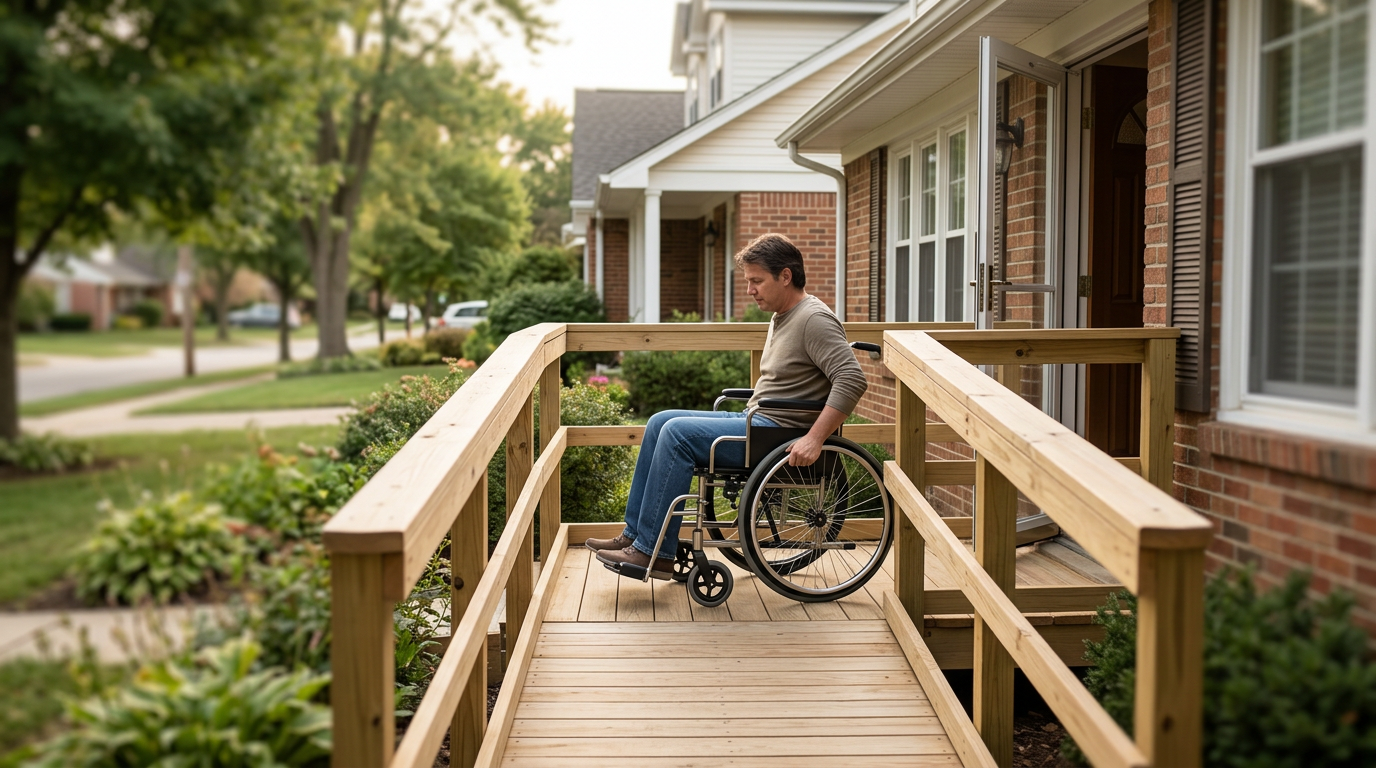
- Ramps or a no-step entry
- Doorways widened to roughly 32–36 inches of clear width
- Lever-style handles instead of round knobs
- Level, low-pile flooring
Bathrooms
This is usually the top-priority and highest-cost room:
- Roll-in (curbless) showers
- Grab bars at the toilet and shower
- Comfort-height accessible toilets
- Roll-under sinks with open space below
Kitchens
- Lowered counters and cabinets
- Roll-under sinks and cooktops
- Front-control appliances you can reach from a wheelchair
Whole-Home Access
- Stair lifts or a home elevator
- Ceiling track lifts to move between rooms (common at higher injury levels)
- Wider hallways
Bedroom and Daily Living
- Adjustable, accessible beds
- Voice-controlled lights, locks, and thermostats
- Environmental control systems for higher-level injuries such as C3–C5
In the catastrophic-injury cases our attorneys handle, the right changes turn a house that feels like a trap back into a home.
Adapting More Than the House: Vehicles, Care, and Daily Life
Recovery has to reach well past the house.
Vehicle modifications. A wheelchair-accessible van, hand controls, or a powered lift often costs tens of thousands of dollars. And the van itself must be replaced over time. For many people, this is the difference between staying home and rejoining the world.
In-home care and attendant services. Quadriplegia often needs daily help. That includes bathing, dressing, and moving in and out of bed. It also includes bowel and bladder care. Attendant care is often the single largest lifetime cost in a serious spine injury.
Durable medical equipment (DME). This means wheelchairs, cushions, lifts, and breathing equipment. They wear out. You must replace them again and again over a lifetime.
Lost independence. A claim should also reflect the work, hobbies, and daily activities a person can no longer do the same way.
For what to do right after the injury, see first steps after a serious back or neck injury.
Have questions about what happened?
Ask our team directly. The first conversation is free, confidential, and there is no obligation to continue.
Recovering Home Modifications After Spinal Injury Compensation
Did someone else’s negligence cause your injury? If so, you may be able to recover the cost of adapting your home and life. You would recover it from the at-fault party. This is true whether the injury came from a truck crash, an unsafe property, or medical negligence.
Recoverable damages in a catastrophic spine case often include:
- Home modifications
- Vehicle modifications
- Past and future medical and rehabilitation costs
- Future care, including attendant services
- Lost income and lost future earning power
- Pain, suffering, and loss of enjoyment of life
Home-modification compensation is not an extra or optional item. It’s a well-established part of these claims. The goal is to put you as close as possible to where you’d be if the injury had never happened.
Different accidents lead here through the same door: negligence. A truck crash comes from another party’s carelessness on the road. A negligent-security case comes from a property owner’s carelessness in keeping people safe.
Maybe you were assaulted, shot, robbed, or attacked on someone else’s property. This could be an apartment complex, a parking garage, a hotel, a bar, a gas station, or a store. Did it happen because the owner failed to provide basic safety? If so, you may have a claim against that owner. Basic safety means things like working locks and gates, lighting, cameras, or guards. Lawyers call this negligent security. You don’t need to know the term to have a case.
Every case is different. Florida Bar rules stop us from promising any specific result. What we can say is this: these costs belong in a properly built claim.
How Future Costs Are Calculated: The Life Care Plan
A life care plan is a professional, itemized list. It shows every cost a person will face over a lifetime. It’s the engine that drives full compensation.
Certified life care planners, physicians, and sometimes an economist build it together. An economist accounts for inflation and future value. They base it on your diagnosis, your daily needs, and your medical outlook.
A good plan captures two kinds of costs:
- One-time costs — the first home and vehicle modifications
- Recurring costs — replacing a wheelchair every few years, ongoing attendant care, DME, and even a future move to a more accessible home
This is why settling too fast is dangerous. Say you accept money before anyone maps your lifetime needs. You could run out long before the costs stop. And once you sign a release, you usually can’t reopen the case for more.
The National Spinal Cord Injury Statistical Center at the University of Alabama at Birmingham tracks the long-term national data that planners and economists rely on (NSCISC). This section is general information, not legal advice about your specific case.
Who Pays First — and How Your Settlement Is Protected
When negligence caused the injury, the at-fault party’s liability insurance is usually the first source of payment. But here’s the hard truth. Policy limits often fall far short of a lifetime of care. That’s why finding every responsible party matters.
In a truck crash, that may include the trucking company, its insurer, and a maintenance contractor — not just the driver. See truck accidents. In a negligent-security case, it may include the property owner and a separate management company.
Other sources can help while a claim moves forward:
- Health insurance
- Medicaid or Medicare Home and Community-Based Services (HCBS) waivers
- VA benefits for eligible veterans
- Nonprofit grant programs for home accessibility
Sometimes health insurance, Medicare, or Medicaid pays for your care first. When they do, they usually have a lien. A lien is a legal right to be repaid out of your settlement. Left unmanaged, liens can eat up much of your recovery. Part of a lawyer’s job is to coordinate the order of payment and negotiate those liens down. That way the money actually reaches your home, your van, and your care.
Florida law also sets deadlines and fault rules. For negligence claims that arise on or after March 24, 2023, you generally have two years to file suit (Fla. Stat. §95.11). Under Florida’s modified comparative-negligence rule, a person found more than 50% at fault generally recovers nothing (Fla. Stat. §768.81).
Frequently Asked Questions
What is the average settlement for a spinal cord injury?
There is no reliable average, and we won’t quote one. A case’s value depends on many things. These include the injury level, future care needs, who was at fault, and how much insurance exists. A T10 injury and a C4 injury carry very different lifetime costs. Any site that posts a fixed “average” is guessing. And Florida Bar rules stop us from making misleading claims about results.
Can I recover money if I already paid for modifications out of pocket?
Often, yes. You can usually claim medically necessary changes you already paid for as past damages. So keep every receipt, invoice, and assessment.
What if I don’t know who is responsible for my injury?
That’s normal. It’s part of what a lawyer investigates. An attorney can review crash reports, property records, past-incident histories, and other evidence. This helps identify every party that may be responsible.
Do you handle cases outside Florida?
Yes. CHG Personal Injury Lawyers is Florida-based but takes catastrophic-injury cases nationwide. We offer resources in English and Spanish.
Who pays for home modifications after a spinal cord injury?
When negligence caused the injury, the at-fault party’s insurance is usually the first source. Health insurance, Medicaid/Medicare waivers, VA benefits, or grants can sometimes fill gaps. This is subject to any repayment liens.

Want to know where you stand?
Tell us what happened and our team will walk you through the options available to you, at no cost.
Talk Through Your Situation With a Catastrophic Injury Attorney
Are you or someone you love facing life after a spinal cord injury? You don’t have to figure out the money alone. The right claim should cover your home, your vehicle, your care, and your future — for the rest of your life, not just today.
Our licensed attorneys are admitted to the Florida Bar and handle catastrophic-injury cases nationwide. We serve clients across Florida, including Miami, Orlando, Tampa, and Jacksonville, in English and Spanish.
A free case evaluation is confidential and comes with no obligation. We can’t promise a specific outcome — no honest lawyer can. But we can help you understand your options and next steps.
To keep reading, visit our pillar guide on catastrophic back and neck injuries, or learn more about paralysis injury claims and spinal cord injuries.
Home Modifications That May Be Part of Your Claim
Access & Entry
Wheelchair ramps, stair lifts, widened doorways, and level thresholds so you can move safely between rooms and in and out of your home.
Bathroom & Bedroom
Roll-in showers, grab bars, accessible sinks, and lowered fixtures that support daily care and independence after paraplegia or quadriplegia.
Controls & Technology
Voice- or switch-operated lighting, door openers, and environmental controls for high-level injuries that limit hand and arm function.
Caregiver Space
Modifications that make room for lifts, hospital beds, and the family members or aides who provide ongoing care.
Don't Pay Out of Pocket Before You Talk to a Lawyer
Insurers may offer a fast, low settlement before your full future needs are known. Once you accept, you usually cannot reopen the claim for modifications you discover later. Get your care and construction costs documented first.
How We Document the Cost of Your Home
Life Care Planning
We work with medical and rehabilitation professionals to map out your future needs — including the specific structural changes your home will require.
Licensed Contractor Estimates
Accessibility renovations are priced by qualified professionals so the figures in your claim reflect real, current construction costs, not guesses.
Connecting Fault to Cost
We build the link between the accident or negligence that caused your injury and the lifelong expenses that follow, including your home.