

Catastrophic Injury · Florida & Nationwide
Cauda Equina Syndrome Is a Medical Emergency — and It May Be Someone Else's Fault
When a serious accident or delayed medical care leads to permanent paralysis, loss of bladder and bowel control, or lasting nerve damage, you deserve answers. Our attorneys help families understand their rights after a life-altering injury.
Why Injured Clients Turn to CHG
Nationwide
Catastrophic injury cases accepted
Florida Bar
Licensed, admitted attorneys
Bilingual
English & Spanish support
$0
No fee to start your case review
By CHG Lawyers · Published July 31, 2026
Cauda Equina Syndrome After an Accident: A Medical Emergency and Your Legal Rights
Do you feel sudden numbness in your groin or inner thighs? Weakness in both legs? A new loss of bladder or bowel control? Stop reading and get emergency care right now. Cauda equina syndrome (CES) is a surgical emergency. That means it needs surgery fast. A delay can cause permanent paralysis. It can also cause lasting loss of bladder or bowel control.
This page explains the warning signs first. Then, when you’re ready, it covers your legal rights after a cauda equina syndrome accident claim.
Your health comes first. This page will still be here after you get care.

Not sure what your next step is?
Talk it through with our team — the first consultation is free, confidential, and carries no obligation.
If you have these symptoms right now, treat it as an emergency
Go to the emergency room or call 911 right away if you notice these signs. Do not wait for a regular doctor’s visit or an urgent-care slot. The nerve roots at the base of your spine can get compressed. That means they get squeezed. When that happens, the outcome often depends on how fast a surgeon relieves the pressure.
Watch for these cauda equina red-flag symptoms:
- Sudden loss of bladder or bowel control, or new trouble urinating
- “Saddle” numbness — numbness in the groin, buttocks, and inner thighs, the area that would touch a saddle
- Weakness or numbness in both legs, not just one
- New sexual dysfunction — loss of function or feeling
- Severe lower back pain along with any of the signs above
The Mayo Clinic lists loss of bladder or bowel control, numbness, weakness, and trouble walking as emergency warning signs of a spinal injury. It advises calling 911 (Mayo Clinic). Surgeons often try to relieve the pressure on the nerves fast to protect function. If you have these symptoms, the ER — not this website — is where you need to be.
This article is educational information, not medical or legal advice. If you are in crisis, seek emergency care first.
What is cauda equina syndrome?
Cauda equina syndrome happens when the bundle of nerve roots at the bottom of your spinal cord is badly squeezed. This cuts off signals to your lower body. “Cauda equina” is Latin for “horse’s tail.” That is the shape this fan of nerve roots forms. It sits below where the spinal cord itself ends.
These nerves carry signals to and from your legs, bladder, bowel, and sexual organs. When something presses hard on them, those signals stop getting through. That is why CES is catastrophic and not ordinary back pain. Without fast treatment, it can leave a person with permanent paralysis. It can also cause lasting loss of bladder and bowel control and a loss of independence.
CES is uncommon. That rarity is part of the danger. Most back pain is not an emergency. So the few cases that are can be mistaken for a routine strain. That is exactly why spotting the red flags above matters so much.
What causes cauda equina syndrome after an accident?
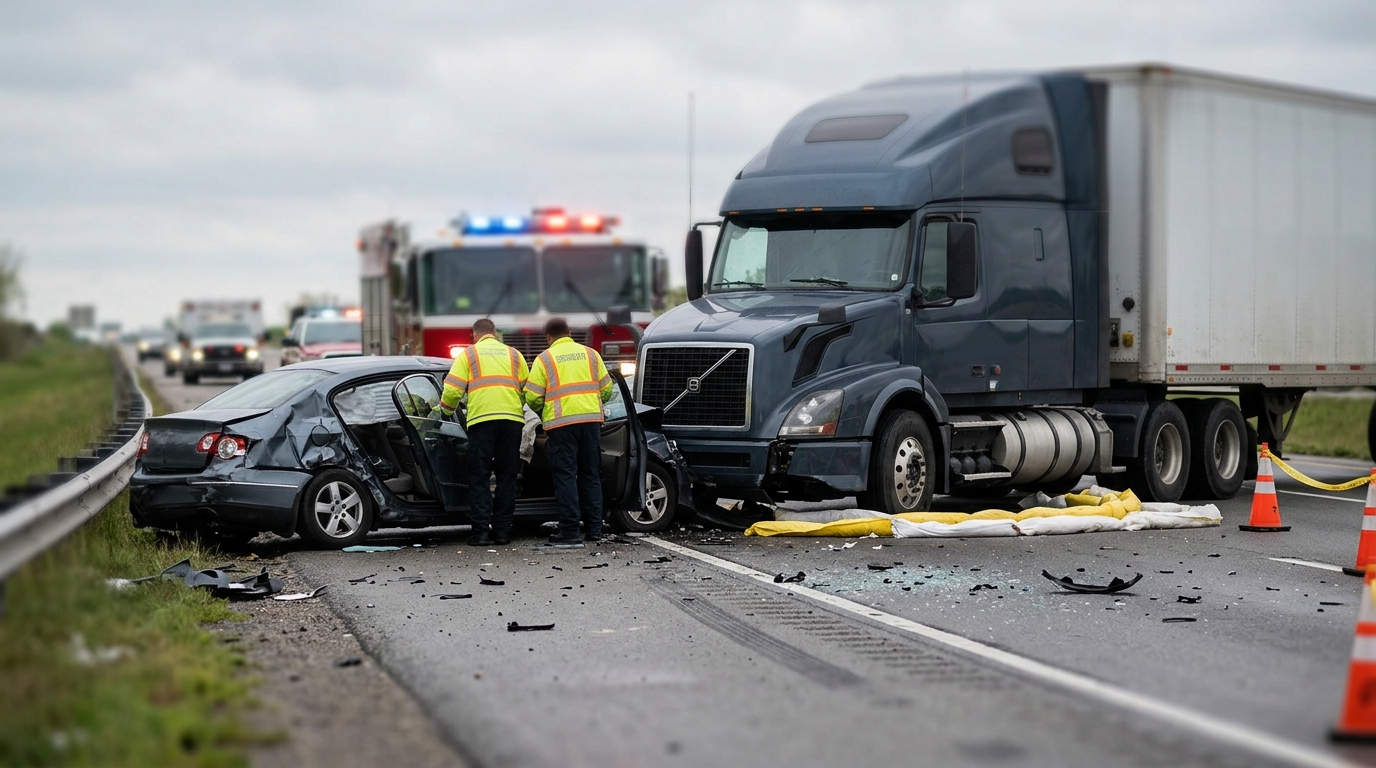
After a car or truck crash, CES usually happens when trauma to the lower spine drives disc material or broken bone into the nerve roots. A violent impact can push a herniated disc or a broken vertebra straight against the cauda equina.
Common traumatic causes include:
- Truck and car crashes, where a rear-end or high-speed impact loads the lower spine
- Falls from height, such as construction, roof, or ladder falls
- Crush injuries that break the vertebrae (the bones of the spine)
The Mayo Clinic names motor vehicle crashes and falls as leading causes of traumatic spinal cord injury (Mayo Clinic). A truck weighing tens of thousands of pounds hits with force a car cannot. That is one reason a serious crash can turn what first looked like a bad back strain into a spinal emergency within hours.
This is very different from a routine back injury. A minor strain heals on its own. CES is a catastrophic complication that usually needs emergency surgery. To learn about related harm, see our resources on spinal cord injuries and catastrophic back and neck injuries.
Have questions about what happened?
Ask our team directly. The first conversation is free, confidential, and there is no obligation to continue.
Cauda equina syndrome symptoms to watch for
The main symptoms are saddle numbness, weakness in both legs, bladder or bowel problems, sexual dysfunction, and severe low back pain. Any of these after an accident is a reason to go to the ER. Do not “wait and see.”
Here is what emergency doctors look for:
- Saddle anesthesia — numbness across the groin, buttocks, and inner thighs
- Weakness or numbness in both legs, not just one
- Urinary retention or incontinence — trouble emptying, or trouble holding, urine
- Bowel problems — loss of control
- New sexual dysfunction
- Severe lower back pain
Doctors sometimes call CES “incomplete” or “complete.” Incomplete means some feeling or function remains, often with trouble urinating. Complete means control is lost, with urinary retention. Early signs can be subtle. That is exactly why fast action matters. Catching it while it is still incomplete gives the best chance to protect function. That same subtlety is why CES is sometimes mistaken for a simple strain — a mistake that can carry permanent consequences.
When a delayed or missed diagnosis makes it worse
CES is time-sensitive. A delayed or missed diagnosis can turn a treatable emergency into permanent paralysis. Fast surgery to relieve the pressure can prevent lasting damage. Every hour the pressure stays on the nerves raises the risk.
The medical system can fail a CES patient in clear ways:
- Sending a patient home from the ER without ordering imaging
- Dismissing red flags as a routine back problem
- Delaying an MRI — the test that shows the compression
- Delaying surgery even after the diagnosis is confirmed
When that happens, the harm is not only the original injury. The harm is the delay itself. A patient who might have recovered with prompt care can instead be left permanently impaired.
That kind of failure may be medical negligence (often called medical malpractice). It is a separate legal question from the accident that caused the injury. It is worth understanding both.
Your legal rights: two possible paths to a claim
After cauda equina syndrome, you may have more than one way to hold someone accountable. There is the accident that caused the injury. And there is any medical negligence that made it worse. These are two separate legal paths.
Path 1 — the accident. Say a truck crash, a fall, or another accident caused your spinal injury. The at-fault party may be responsible for the harm. Our firm handles serious truck accidents and other catastrophic crashes.
Path 2 — medical negligence. Say providers failed to diagnose or treat your CES in time. And say that delay caused permanent damage. That may be a separate claim against the providers involved.
Sometimes both apply at once. A crash causes the injury, and a hospital’s delay makes it permanent. An attorney can review the facts. They can explain which path, or paths, fit your situation.
CHG Personal Injury Lawyers focuses on catastrophic, life-altering injuries. This includes those from truck accidents and medical negligence. The firm is based in Florida and takes cases nationwide.
What a cauda equina syndrome accident claim may cover
No two cases are alike. No lawyer can honestly promise a specific dollar amount. The value of a CES claim depends on how severe and permanent the injury is, and on the facts. Anyone who guarantees you a number is not being straight with you. Instead of a figure, it helps to understand the types of damages Florida law recognizes.
In catastrophic spinal cases, courts generally recognize:
- Economic damages — past and future medical bills, future surgeries and therapy, lost income, and lost earning ability
- Long-term care and home changes — attendant care, adaptive equipment, wheelchair ramps and accessible bathrooms, vehicle changes
- Non-economic damages — pain, suffering, and loss of the ability to enjoy life
The claim looks far beyond today’s bills for a reason. A permanent spinal injury creates costs for decades. The Christopher & Dana Reeve Foundation uses National Spinal Cord Injury Statistical Center (NSCISC) data. It reports that lifetime costs of a serious spinal cord injury can reach into the millions of dollars. The amount depends on the level and severity of the injury and the person’s age. A full valuation weighs those future costs, not just the emergency-room bill. You can read more in our resource on catastrophic back and neck injuries.
One Florida rule to know: the state follows modified comparative negligence (shared fault). Under Fla. Stat. §768.81, a person found more than 50% at fault generally recovers nothing. But sharing some blame does not automatically end your claim.
Want to know where you stand?
Tell us what happened and our team will walk you through the options available to you, at no cost.
Frequently asked questions
Can you get disability for cauda equina syndrome?
Yes. Permanent impairments from CES — such as paralysis or loss of bladder and bowel control — may qualify you for disability benefits. The rules are strict, so it helps to get guidance for your situation.
How much is a cauda equina claim worth?
There is no set figure. Value depends on how severe and permanent the injury is, and on your total losses. No honest lawyer can promise an amount. A claim can seek economic damages (medical costs, lost income, long-term care) and non-economic damages (pain and suffering).
Is there a deadline to file a claim?
Yes. Time limits called statutes of limitation apply. They vary by state and by claim type. In Florida, many general negligence claims that start on or after March 24, 2023 carry a two-year deadline under Fla. Stat. §95.11. Medical-malpractice deadlines have their own rules. Because deadlines can be short, acting quickly matters.
Can a car or truck accident cause cauda equina syndrome?
Yes. A serious crash can break the spine or drive a disc into the nerve roots, causing CES. The Mayo Clinic names motor vehicle crashes and falls as leading causes of traumatic spinal cord injury (Mayo Clinic).

How CHG Personal Injury Lawyers can help
Again — your health comes first. Get emergency care before anything else. When you are ready to look at your legal options, we are here.
CHG Personal Injury Lawyers are licensed attorneys admitted to The Florida Bar. The firm focuses on catastrophic, life-altering injuries. This includes spinal cord injuries, paralysis, and the crashes and medical negligence that cause them. We take cases nationwide from our Florida base. We offer support in English and Spanish.
We cannot promise a result. What we can do is review what happened. We can explain both possible paths to a claim. And we can answer your questions in plain language. To talk with our team, request a free case evaluation.
For more on related injuries, visit our pillar resource on catastrophic back and neck injuries.
Cauda Equina Syndrome Cannot Wait
If you or a loved one has sudden numbness in the groin or inner thighs, new loss of bladder or bowel control, or worsening leg weakness after an accident, seek emergency care immediately. Surgery within a short window can be the difference between recovery and permanent paralysis — and any delay in diagnosis may be central to your claim.
How CES Injuries Happen
Truck & Serious Crashes
High-force collisions can compress or damage the nerves at the base of the spinal cord, triggering permanent, life-altering impairment.
Delayed or Missed Diagnosis
CES is a surgical emergency. When symptoms are dismissed or care is delayed, treatable nerve damage can become permanent.
Falls on Unsafe Property
A catastrophic fall caused by a dangerous condition someone failed to fix can lead to severe back and spinal injury.
Lasting Impairment
Paralysis, chronic pain, and loss of bladder and bowel control can reshape every part of daily life for you and your family.
Common Questions After a Cauda Equina Injury
Can you get disability for CES?
Yes. Permanent impairments from CES — such as paralysis or loss of bladder and bowel control — may qualify you for disability benefits. The rules are strict, so it helps to get guidance for your situation.
How much is a CES claim worth?
There is no set figure. Value depends on how severe and permanent the injury is, your medical needs, lost income, and how the injury happened. An attorney can review the specifics of your case.
Who can be held responsible?
It depends on the cause — a negligent driver, a property owner, or a medical provider whose delay allowed treatable damage to become permanent. We investigate to identify who is accountable.
What are the first steps?
Get emergency care, keep all medical records, and speak with a lawyer before dealing with insurers. Early evidence often matters most in catastrophic-injury claims.