


Catastrophic Spine Injuries · Florida
A Burst Fracture Can Change Your Spine — and Your Life — in an Instant
When a serious accident crushes a vertebra, bone can push into the spinal canal and threaten permanent paralysis. Learn what a burst fracture is, why it matters, and how to protect your family's future.
Serious Injuries Are All We Focus On
Licensed
Florida Bar–admitted attorneys
Nationwide
Catastrophic-injury cases across the U.S.
Bilingual
English & Spanish support
Free
Confidential case evaluations
By CHG Lawyers · Published August 08, 2026
Vertebral Burst and Compression Fractures: When a Spine Fracture Becomes Catastrophic
A burst fracture is a serious spinal injury. A vertebra shatters under force. Broken pieces of bone can push backward into the spinal canal. This puts the spinal cord in danger.
Doctors call this backward movement retropulsion. It is what separates a burst fracture from a simple broken bone. It also explains why some spine fractures cause lasting paralysis. Others heal in a brace.
Did a doctor say the words “burst fracture” or “compression fracture” after a serious crash or fall? You are probably scared and trying to understand what it means. This page explains those terms in plain words. It focuses on the worst cases. These are fractures that hurt or threaten the spinal cord.
This is educational information. It is not medical or legal advice. For the full picture, see our main guide on catastrophic back and neck injuries.
Not sure what your next step is?
Talk it through with our team — the first consultation is free, confidential, and carries no obligation.
When a spine fracture is more than a broken bone
Most people hear “fracture” and picture a bone that heals in a cast. A spine fracture is different. That is because of what sits right behind the bone. It is your spinal cord — the bundle of nerves that carries every signal between your brain and body.
When a broken vertebra pushes on the cord, a painful injury can become permanent. In the catastrophic cases our attorneys handle, that one difference often decides everything. It can decide whether someone walks again or lives with paralysis.
So the label matters less than the severity. A fracture is catastrophic when it injures the cord, presses on nerves, or leaves the spine unstable.
How the spine protects — and can endanger — the spinal cord
Your spine is a column of bones called vertebrae. The thick, block-shaped front of each one is the vertebral body. It carries most of your weight. Behind it, a ring of bone forms the spinal canal. This is the protected tunnel where the cord runs.
This design works well. But a strong force can shatter a vertebral body. Broken pieces can then push backward into the canal. That is retropulsion.
Doctors can measure this on a CT scan. They call it canal compromise — how much of the canal is blocked. They often report it as the percentage of the canal filled by loose bone. A pushed-back fragment can bruise or crush the cord. That is the moment a fracture becomes catastrophic.
Where the break happens changes what is at risk:
- Cervical spine (neck): Injuries here can affect the arms, legs, and even breathing.
- Thoracic spine (mid-back): These bones attach to the ribs and are fairly stable.
- Lumbar spine (lower back): These carry heavy loads and absorb big forces in a crash.
- Thoracolumbar junction (T10–L2): This is where the mid-back meets the lower back. It is a weak point. It is also the most common site for burst fractures.
Compression fracture vs. burst fracture: what’s the difference?
A compression fracture happens when the front of the vertebral body collapses or wedges under downward force. Many are stable and heal with a brace.
A burst fracture is more violent. Under a strong downward (axial) load, the vertebra bursts apart instead of just crushing. It sends fragments outward. Some go toward the spinal cord.
Burst fractures are really a severe type of compression fracture. Spine research describes canal compromise from a pushed-back fragment as a key feature of the burst pattern (Rajasekaran et al., PMC). That is why they carry far more risk to the cord.
Do not assume the label tells you everything. A compression fracture can also be catastrophic if it is unstable or involves nerve injury. Severity decides how serious your injury is. The name does not.
What causes burst and compression fractures in accidents
Most burst fractures in a healthy spine come from high-energy trauma. Columbia Neurosurgery notes that in a healthy spine, burst fractures come from major trauma such as a car accident or a serious fall (Columbia Neurosurgery). These injuries need a lot of force. That is exactly what a serious crash delivers.
Crash research shows lumbar burst fractures usually need a strong downward load. They have been recorded in high-force crashes such as head-on collisions (Kaufman et al., Accident Analysis & Prevention).
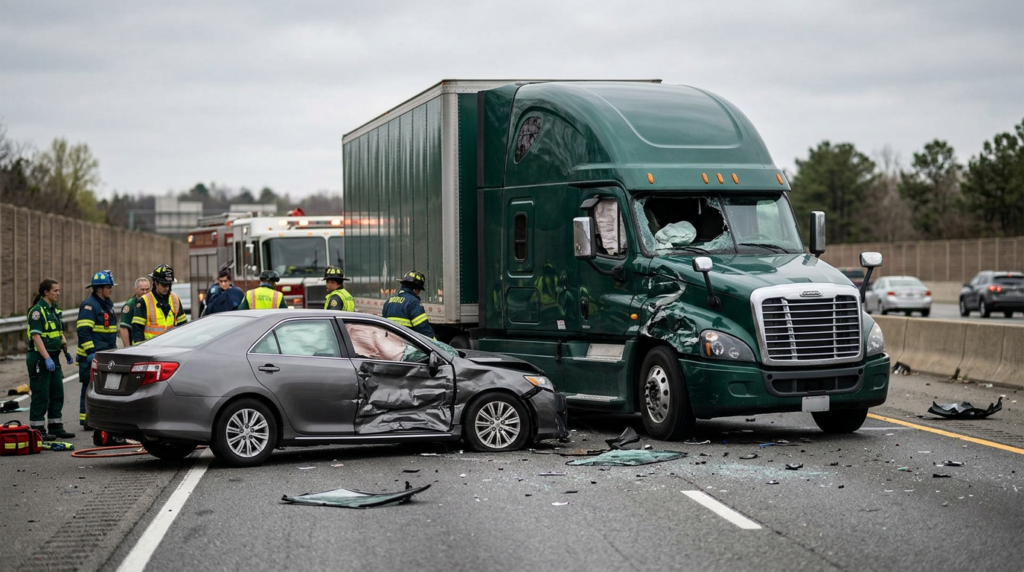
A fully loaded tractor-trailer can weigh 20 to 30 times as much as a car. That size gap delivers the kind of energy that shatters a spine. Did a negligent driver or trucking company cause your crash? Our truck accident resources explain how these cases work.
So what’s the most common spinal injury in a car crash? Compression fractures are common. Burst fractures are the more severe kind. They happen less often. But they are far more likely to threaten the spinal cord.
When a spine fracture becomes catastrophic
A spine fracture becomes catastrophic when it injures the spinal cord, presses on nerves, or leaves the spine unstable. These problems can cause permanent loss of movement or feeling.
Warning signs of cord or nerve damage include:
- Numbness or tingling below the injury
- Weakness in the arms or legs
- Loss of bowel or bladder control
- Paralysis below the level of the break
The Mayo Clinic explains that a spinal cord injury can cause loss of movement, loss of feeling, and loss of bowel or bladder control. It depends on the level and severity (Mayo Clinic).
A high neck injury can lead to quadriplegia. That is paralysis affecting all four limbs. A lower injury can cause paraplegia. That is paralysis of the lower body. Learn more on our page about paralysis, paraplegia, and quadriplegia.
How common is this? The Christopher & Dana Reeve Foundation estimates that about 5.4 million people in the United States — about 1 in 50 — live with some form of paralysis. New traumatic spinal cord injuries are tracked by the National Spinal Cord Injury Statistical Center (NSCISC) at the University of Alabama at Birmingham. This federal database has followed SCI cases for decades.
We cite these groups for the numbers because the right source matters. Statistics about paralysis and SCI come from different registries. Getting that straight is part of understanding your own situation accurately.
Is a spinal fracture a serious injury? When it involves the cord or leaves the spine unstable, yes. It can be permanent and life-altering.
Have questions about what happened?
Ask our team directly. The first conversation is free, confidential, and there is no obligation to continue.
Diagnosis: how doctors confirm the severity
Doctors confirm how severe a fracture is with imaging and a neurological exam (a test of your nerves). Each test does a different job:
- X-ray — a quick first look at how the bones line up.
- CT scan — fine bone detail. This is where doctors measure pushed-back fragments and canal compromise.
- MRI — shows the spinal cord, ligaments, and soft tissue. This lets doctors see whether the cord itself is injured.
Doctors also decide whether the fracture is stable (unlikely to shift) or unstable (likely to move and cause more harm). Unstable fractures are treated more urgently.
A neurological exam grades cord damage using the ASIA Impairment Scale. This is the international standard published by the American Spinal Injury Association (ASIA). The scale runs from A (complete — no movement or feeling below the injury) to E (normal). That grade strongly affects the outlook.
A clear, well-documented diagnosis matters twice over. It guides your treatment. It also creates the medical record that supports any future claim.
Treatment: from bracing to surgery
For a stable fracture with no cord injury, care may include a back brace, limited activity, pain management, and close monitoring over weeks to months.
Doctors consider surgery in a few cases. These include when the fracture is unstable, when bone crowds the spinal canal, when there is nerve damage, or when the spine is bending out of shape. Common approaches include:
- Decompression — removing bone or tissue that presses on the cord or nerves.
- Fusion and instrumentation — joining vertebrae with hardware such as screws and rods to rebuild stability.
Recovery from a serious thoracolumbar burst fracture can take many months. It usually includes physical rehabilitation. In catastrophic cases, some limits are permanent. Survivors may need special equipment and changes to their home or vehicle. Our page on home and vehicle modification costs explains what those expenses can look like.
Can you fully recover from a burst fracture?
If the fracture is stable and the cord is untouched, many people heal well with time and rehabilitation. But once the spinal cord is injured, function may not fully return.
The outlook depends on the injury level. It also depends on whether the injury is complete (no feeling or movement below it) or incomplete (some function remains) (Mayo Clinic).
No one can honestly promise a specific result. But one thing is clear. Catastrophic spine injuries carry long-term costs. These include rehabilitation, special equipment, lost income, and ongoing care. Those costs are why understanding your rights matters.
How a serious spine fracture affects your future and your legal rights
Did someone else’s negligence cause a catastrophic spine injury? The injured person or family may be able to seek compensation. That can cover medical care, lost wages, and the harm suffered.
When a spine injury is fatal, the family may bring a wrongful-death claim. This is a legal claim brought by the family after a death. It is the most catastrophic outcome of all. We handle these cases with dignity and a focus on the family left behind.
Two Florida rules matter here. First, Florida generally gives injury victims two years to file a negligence claim. This applies to claims arising on or after March 24, 2023 (Fla. Stat. §95.11).
Second, Florida uses modified comparative negligence. This means your payment is reduced by your share of the fault. A person found more than 50% at fault generally cannot recover damages (Fla. Stat. §768.81). Deadlines and details vary by state and by the facts. So it is worth confirming yours early.
Our cases are handled by licensed attorneys admitted to the Florida Bar. We serve clients across Florida — including Miami, Orlando, Tampa, and Jacksonville. We take catastrophic injury cases nationwide. We work with clients in both English and Spanish, so language is never a barrier to getting answers.
Want to know where you stand?
Tell us what happened and our team will walk you through the options available to you, at no cost.
Talk to a catastrophic injury attorney
Did a serious accident leave you or a loved one with a burst fracture or other catastrophic spine injury? We are here to listen. You can request a free case evaluation with no obligation. We handle the legal side so your family can focus on healing.
Related reading:
- Catastrophic back and neck injuries (pillar guide)
- Spinal cord injuries
- Paralysis, paraplegia, and quadriplegia
- Catastrophic injury claims
- Truck accidents

Frequently asked questions
Can you fully recover from a burst fracture?
Some people with a stable burst fracture and no spinal cord injury recover well. But those with cord damage may face permanent impairment. Outcomes depend on the injury’s level. They also depend on whether it is complete or incomplete.
What is the difference between a compression fracture and a burst fracture?
A compression fracture collapses the front of the vertebra. A burst fracture shatters it in many directions. It can push bone backward into the spinal canal (retropulsion). This makes it more dangerous.
Can a burst fracture cause paralysis?
Yes. If a burst fracture damages the spinal cord, it can cause paralysis. That means paraplegia in the lower body or quadriplegia in all four limbs. It depends on the injury level.
When does a burst fracture need surgery?
Surgery is usually considered in a few cases. These include when the fracture is unstable, when bone presses on the spinal cord, when there is nerve damage, or when the spine is bending out of shape.
Is a spinal fracture a serious injury?
It can be. When a spine fracture involves the spinal cord or leaves the spine unstable, it may cause permanent, life-altering harm.
This article is educational and is not legal or medical advice. Every case is different, and no outcome is guaranteed. For guidance on your specific situation, contact a licensed attorney.
Why a Burst Fracture Is Treated as a Catastrophic Injury
Bone Can Enter the Spinal Canal
Unlike a simple compression fracture, a burst fracture shatters the vertebra and can drive fragments toward the spinal cord — the source of lasting harm.
Risk of Permanent Paralysis
If the cord is damaged, the result can be paraplegia or quadriplegia. Outcomes depend on the level of the injury and whether it is complete or incomplete.
A Lifetime of Care
Surgery, fusion hardware, rehabilitation, adaptive equipment, and home modifications can mean costs that stretch across decades.
Evidence Fades Fast
Crash data, property records, and witness accounts disappear over time. Acting early helps preserve what your claim may depend on.
Follow Your Doctor's Restrictions — and Document Everything
A burst fracture that looks 'stable' today can worsen with movement. Keep every appointment, follow lifting and bracing instructions exactly, and save all medical records. These details matter for your recovery and for any claim.
How These Injuries Happen
Truck & Highway Crashes
The violent forces in a collision with a large truck can compress the spine with enough energy to burst a vertebra, especially in high-speed or rollover crashes.
Falls From Height
Falls onto the feet or seat can transmit crushing force up the spine, a common cause of burst fractures in the lower back.
Other Serious Impacts
Any accident that delivers a sudden, heavy axial load — sports collisions, workplace incidents, and more — can fracture a vertebra catastrophically.
When Someone Else Is at Fault
If a negligent driver, property owner, or company caused the accident, you may have a claim for medical bills, lost income, and long-term care.