

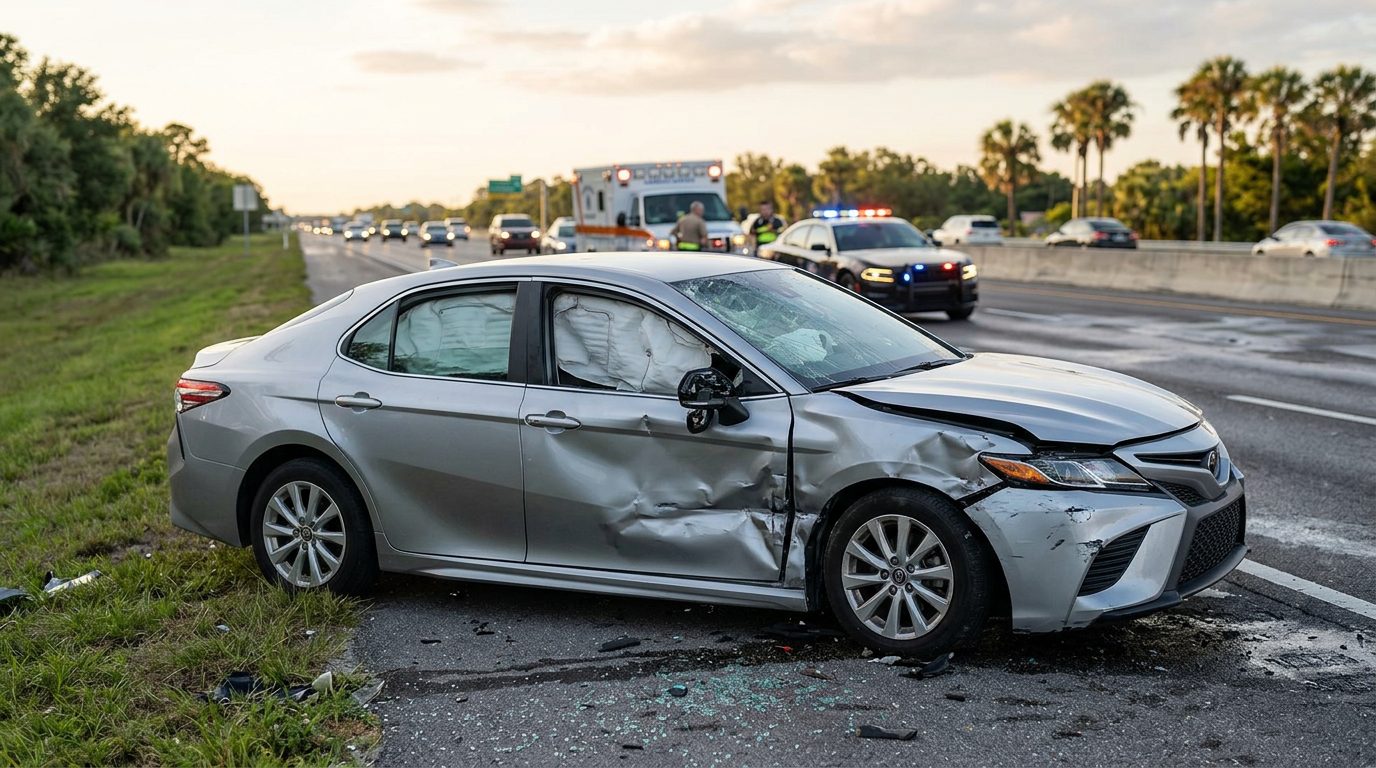
Florida Car Accident Guide
Hurt in a Car Accident in Florida? Know Your Rights Before You Talk to Anyone
Plain-language answers about injuries, insurance, and the steps that can protect you after a crash, from the Florida personal injury firm CHG Personal Injury Lawyers.
By CHG Lawyers · Published October 13, 2026
If you were injured in a car accident in Florida, you may have options even if you feel okay right now. Any physical harm from the crash can count as an injury, and some injuries take days to show up. Florida’s no-fault insurance rules, filing deadlines, and fault rules then shape what you can do next. This guide explains those rules in plain language. It is general information, not legal advice about your case, and the law can change.
What Counts as an Injury After a Car Accident?
Any physical harm caused by the crash counts as an injury. That includes bruises, sprains, whiplash, neck and back pain, headaches, and head injuries.
Some injuries show up late. Stiffness, dizziness, and numbness can take hours or days to appear. Adrenaline after a crash can also hide pain, so feeling fine on the day of the crash does not settle the question.
The most serious injuries can have hidden or delayed signs. A traumatic brain injury can cause confusion, memory trouble, or mood changes that appear later. A spinal cord injury can cause loss of movement or feeling below the injury site, according to the Mayo Clinic. Those signs may not be clear on the day of the crash.
See a doctor after any crash that hurt you, even if the pain seems mild. A medical record made close to the crash helps show what happened. For a broader view of claims in Florida, read our Florida car accident settlement guide.
If you're still sorting out symptoms, medical bills, and insurance calls after a Florida crash, our team can review your situation with you at no cost. Talk it through with our team — the first consultation is free, confidential, and carries no obligation.
Should I Say I Was Hurt at the Scene?
Yes, describe your symptoms honestly, and don’t guess. Say what hurts, where it hurts, and how it feels. Don’t say you’re fine just to be polite, and don’t say you’re badly hurt if you don’t know yet.
“I’m not sure yet” is an honest answer. Many injuries take time to show their full extent. You can say you’re getting checked and will know more later.
Do not admit fault. Don’t guess at speed, distance, or who had the green light. Those facts usually come out through the police report, photos, and witnesses.
Be careful with the other driver’s insurer. An adjuster may ask for a recorded statement. You can be polite and still decline until you understand the questions. Keep your answers short and factual.
Ask for the police crash report after the scene is cleared. It is a factual record of what officers saw and recorded. Keep a copy with your other records.
How Florida’s No-Fault (PIP) System Works
Florida is a no-fault state for most car injury claims. Your own auto insurance policy may include coverage that matters after a crash, so it helps to review it early. Under Fla. Stat. § 627.736, PIP pays up to $10,000 in medical and disability benefits. Under Fla. Stat. § 627.736, medical benefits are eighty percent of all reasonable expenses for medically necessary medical, surgical, X-ray, dental, and rehabilitative services, within a limit of $10,000 in medical and disability benefits.
Timing matters. Initial care generally must begin within 14 days of the crash to keep PIP medical benefits. Under Fla. Stat. § 627.736, medical benefits are limited to $2,500 unless a physician, dentist, physician assistant, or advanced practice registered nurse finds an emergency medical condition. Don’t wait to be seen.
PIP does not cover everything. It addresses injuries, not vehicle damage. It also may not pay all of your losses, so other coverage may matter.
Florida’s minimum insurance limits are also low. The FLHSMV insurance page lists minimum bodily injury liability of $10,000 per person and $20,000 per crash. Those minimums may not cover a serious injury.
When Can You Pursue Compensation Beyond PIP?
You can seek pain and suffering damages from an at-fault driver only if your injury meets a threshold set by Florida law. Under Fla. Stat. § 627.737, the injury must include one of these:
- significant and permanent loss of an important bodily function
- permanent injury within a reasonable degree of medical probability, other than scarring or disfigurement
- significant and permanent scarring or disfigurement
In plain terms, “permanent” means the harm is expected to last. An “important bodily function” is something like moving a limb, seeing, or breathing normally. Whether an injury meets this test depends on medical records and what doctors document over time.
The defense can ask the court, one time, to decide whether the plaintiff can present evidence meeting this threshold. That request comes 30 days before trial or the pretrial hearing, whichever is first. Careful, consistent medical records from the start matter for this reason.
People with severe injuries, such as spinal cord injuries, paralysis, amputations, burns, or brain injuries, often face questions about long-term impairment. Keep every record that tracks those effects.
What Kinds of Compensation Might Be Available?
Florida car injury claims generally fall into two groups. Economic losses include past and future medical bills and lost income, including lost earning ability. Non-economic losses include pain, suffering, mental anguish, and loss of enjoyment of life.
No web page can tell you what your claim is worth. Value depends on your injury, the medical proof, the insurance available, and the law applied to your facts.
Medical bills need careful proof. Fla. Stat. § 768.0427 defines terms such as “health care coverage,” which includes personal injury protection, and “factoring company.” Those rules consider what health coverage would pay, not only what a provider bills. They also require disclosure of whether treatment was received under a letter of protection, meaning the provider agreed to wait for payment from a future recovery.
Keep a file. Save bills, pay stubs, employer letters about missed work, and a daily log of what you can’t do. Those records make your losses concrete.
Florida Deadlines You Need to Know
Most Florida negligence claims from a car crash have a two-year limit. Under Fla. Stat. § 95.11, an action founded on negligence must be commenced within two years. Deadlines can depend on the facts of your case, so it is wise to confirm yours as early as possible.
Other deadlines can apply. Claims against government defendants, such as a city or county vehicle, often have shorter notice rules. Don’t assume the two-year date is the only one that matters.
Two timing points need attention now. One is the crash date. The other is the 14-day PIP treatment window. Write both down, along with first treatment dates, insurer letters, and any claim forms you receive.
Confirm current deadlines for your situation. Rules can change, and exceptions depend on the facts.
Not sure what your next step is?
Talk it through with our team — the first consultation is free, confidential, and carries no obligation.
How Fault Works in Florida
Florida uses modified comparative fault. Your recovery is reduced by your share of fault. Under Fla. Stat. § 768.81, a party found more than 50 percent at fault for their own harm may not recover any damages.
Insurers often argue the injured person was partly at fault. They may say you were speeding or braked too late. Your best answer is evidence. Photos of the scene and vehicles, witness names, and any dashcam or traffic camera footage can make the record clearer.
Some crashes involve more than one responsible party. Road hazards and work zones can involve contractors or agencies. Our page on construction zone crashes in Florida explains that situation.
Early offers are not always final. An offer made before you know the full extent of your injuries may not cover future care. Review any offer before you sign anything.
What to Do in the Days After a Florida Car Crash
Follow these steps in order, as far as you can:
- Get medical evaluation right away, and follow the treatment plan.
- Keep every bill, receipt, and note of medical trips.
- Photograph your injuries, the vehicles, and the scene.
- Request the police crash report.
- Keep a daily log of symptoms and daily limits.
- Keep social media posts about the crash to a minimum.
Limit recorded statements until you understand their purpose. Don’t sign broad medical authorizations or releases you haven’t read closely.
You can also ask the other driver’s insurer for policy details. Under Fla. Stat. § 627.4137, an insurer must provide a sworn statement of policy limits within 30 days of a written request.

Protecting Your Rights and Taking the Next Step
Your core rights are prompt medical care, your PIP coverage, the serious-injury threshold, the two-year deadline, and Florida’s fault rule. Each one can affect what happens after a crash.
Many people reading this are watching a family member recover. Others are juggling appointments, bills, and letters from insurers. Some are trying to decide whether an injury is serious enough to pursue. You don’t have to work through those deadlines and forms alone.
Quick Answers
How long do I have to file a Florida car accident injury claim? Under Florida law, most negligence claims have a two-year limit, so confirm your date.
What if I feel fine after a crash? Get checked anyway, because some injuries show signs later.
What is PIP? Under Fla. Stat. § 627.736, a qualifying auto policy must provide personal injury protection to the named insured, relatives in the same household, drivers and passengers of the insured vehicle, and certain people struck by it, up to $10,000 in medical and disability benefits.
CHG Personal Injury Lawyers is a Florida-based firm. Our practice focuses on serious and catastrophic injury cases, including car accidents. To review your accident and injuries, contact us for a free case evaluation.
Attorney advertising. No outcome can be promised. Past results do not predict future results, and a prospective client may not obtain the same or similar results. This page is general information, not legal advice.
How CHG Personal Injury Lawyers Can Help
Protecting Your Claim
We look closely at how the crash happened, who may be responsible, and what insurance may be available to you.
Support for Your Family
Serious crash injuries affect the people who love you too. We help families understand their options and plan for what comes next.
Clear Explanations
We explain Florida's insurance and claim process in everyday language, so you always know where your case stands.
Serving Florida
Our attorneys are admitted to The Florida Bar, and we represent injured people across Florida, from Miami and Orlando to Tampa and Jacksonville.
Do Not Assume You Are Fine
Some injuries, including concussions, neck and back strain, and internal injuries, may not show symptoms until hours or days after a crash. Get a medical evaluation as soon as you can, even if you feel okay, and keep records of every visit.
Steps to Take After a Florida Car Accident
1. Get Medical Care
Your health comes first. A prompt medical exam creates a record that connects your injuries to the crash.
2. Document the Scene
Photos of vehicles, roadway conditions, injuries, and the other driver's information can be valuable later.
3. Be Careful With Statements
Insurance adjusters may ask for recorded statements quickly. Speak with an attorney before giving one.
4. Talk With a Florida Attorney
A free case evaluation can help you understand your options based on the facts of your situation.