

Slip and Fall Attorney in Miami, FL
Restoring Your Security After a Life Changing Fall
Slip & Fall Attorney in Miami, FL
You fell in a Miami business. The manager handed you an incident report. You may have signed it. And you are not sure what comes next.
That incident report is the property's first piece of evidence. It was written by their employee, on their form, in the minutes after your fall — before you had representation, before you fully understood your injuries, and before you knew what you were signing. It is not the end of your case. But it matters, and so does everything that happens in the next 24 to 72 hours.
Florida's slip and fall law under F.S. 768.0755 gives you a path to full compensation — but only if evidence is preserved before it disappears and the right legal strategy is deployed against the 'we had no knowledge' defense that Miami property owners and their insurers use reflexively.
Free consultation, 24 hours, English and Spanish.
Surveillance footage deletes in 24-72 hours. Call us now to preserve it.
Get Your Free Case Review
Takes 30 seconds. Our team will respond in under 10 minutes.
Recent Recoveries for Accident Victims
Insurance Research Council data confirms that represented premises liability victims recover 3.5 times more than unrepresented victims — a gap driven almost entirely by the difference between accepting an early offer and building a complete case.
South Florida
Miami-Dade County
Vehicle Collision
About the incident report you already signed: Do not assume it ended your case. Call us — what matters is what the document actually says and what evidence exists beyond it.
Florida's Slip and Fall Law — What F.S. 768.0755 Requires
Florida's commercial slip and fall cases are governed by Florida Statute 768.0755, which requires plaintiffs to prove that the business had actual or constructive knowledge of the dangerous condition and failed to take action to remedy it. This statute is the reason slip and fall cases in Florida are won or lost on investigation — not on the fall itself.
Actual Knowledge vs. Constructive Knowledge
Actual knowledge means the business directly knew about the hazard — an employee created the condition, a customer reported the spill before your fall, or a prior incident occurred at the same location. Constructive knowledge is proven by demonstrating either that the dangerous condition existed long enough that a reasonable business should have discovered it through ordinary care, or that the condition occurred with such regularity that it was foreseeable. Even 15 to 20 minutes of an unaddressed spill can establish constructive knowledge under Florida's standard — but only if the evidence exists to prove the timeline.
How CHG Lawyers Defeats the 'Regular Inspection' Defense
Miami businesses — particularly Publix, Winn-Dixie, Sedano's, Target, and major hotel chains — maintain cleaning logs specifically designed to defeat constructive knowledge claims. Their insurers' standard argument: 'We inspect every 15 minutes — there is no way we could have known about this spill.'
CHG Lawyers defeats this defense systematically: We subpoena all surveillance footage to establish precisely how long the hazardous condition existed before your fall. We obtain complete maintenance and incident logs to identify whether similar conditions occurred previously at the same location, which establishes that the business had constructive awareness of a recurring hazard. We retain Florida Building Code and premises safety experts to evaluate whether the surface coating, drainage, or lighting met code standards. We identify any prior written complaints or incident reports that establish the business's constructive awareness of a repeating condition.
Florida's 2023 Tort Reform
Any plaintiff found more than 50% responsible for a fall recovers nothing. Don't let insurers use your early statements against you.
Florida's 2023 Tort Reform — How It Changed Miami Slip and Fall Cases
The 51% Comparative Fault Bar
Under Florida's modified comparative negligence standard (HB 837, effective March 24, 2023), any plaintiff found more than 50% responsible for a fall recovers nothing. Property owners and their insurers now aggressively argue that you were looking at your phone, wearing inappropriate footwear, failed to notice a visible warning cone, or entered a restricted area — specifically to push your fault above 51% and eliminate all recovery. CHG Lawyers builds comparative fault defense from day one: documenting the specific defect, gathering witness accounts of your attentiveness, and retaining safety experts to establish that the property's failure created an unreasonably dangerous condition regardless of any contributory factor.
The 2-Year Filing Deadline
Falls occurring after March 24, 2023 have a 2-year statute of limitations under the amended Florida Statute 95.11. Falls occurring before that date may carry the prior 4-year deadline. The practical deadline is evidence — surveillance footage and cleaning logs do not wait for either statute. Call us immediately regardless of when your fall occurred.
Miami's Most Dangerous Slip and Fall Locations
Supermarkets, Retail Stores, and Shopping Centers
Miami's high-volume grocery stores — Publix throughout Brickell, Coconut Grove, and Coral Gables; Sedano's and Presidente Supermarkets serving Little Havana and Hialeah; Winn-Dixie and Target throughout Miami-Dade — generate consistent slip and fall claims from spilled liquids in produce aisles, freshly mopped floors without adequate wet floor signage, and deteriorating cart area surfaces. Brickell City Centre and Dadeland Mall produce high-foot-traffic hazards in common areas, escalators, and food court zones.
Hotels, Restaurants, and Entertainment Venues
Brickell and South Beach hotel pool decks, lobby marble floors, and exterior entry areas create wet surface falls from Miami's humidity, ocean spray, and frequent rain. Wynwood's converted warehouse restaurants and gallery spaces have uneven concrete floors, inadequate lighting, and surface transitions that violate Florida Building Code standards. Bayside Marketplace near PortMiami generates waterfront slip and fall incidents from marine moisture and inadequate slip-resistant surfaces.
Damages Available in Miami Slip and Fall Cases
Florida premises liability law allows recovery of all past and future medical expenses, lost wages and loss of earning capacity, pain and suffering, emotional distress, loss of enjoyment of life, and permanent impairment. For catastrophic slip and fall injuries — hip fractures, spinal cord damage, traumatic brain injury, shoulder tears — lifetime care calculations can produce multi-million-dollar valuations requiring specialized expert testimony. For wrongful death from a fatal fall, survivors recover under Florida's 2-year Wrongful Death Act deadline.
Why CHG Lawyers for Your Miami Slip and Fall Case
Immediate evidence preservation from the first day of retention — formal litigation hold letters to the property, subpoenas for surveillance footage and cleaning logs before automatic deletion, and safety expert retention before the defense establishes its narrative.
F.S. 768.0755 expertise — the subpoena strategy that defeats cleaning log defenses, the prior-incident investigation that establishes recurring hazards, and the expert testimony that shows code violations regardless of how many times the floor was 'inspected.'
Bilingual English and Spanish representation — serving Miami's 69% Hispanic community with full legal advocacy by the attorneys on your case.
Contingency fee — no upfront costs, no fees unless we win.
Evidence is Deleting
Surveillance footage at Miami businesses deletes in 24 to 72 hours.
Preservation begins the moment you retain CHG Lawyers. We send formal litigation hold letters immediately.
Preserve Video EvidenceDid You Sign a Report?
The property manager's incident report is not the end of your case.
Do not speak to insurance adjusters. We investigate what the report actually says.
What to Do After a Miami Slip and Fall
Report in Writing
Request that the property complete a formal incident report. Get a copy.
Photograph Before Cleanup
The hazard, floor surface, wet floor signs, shoes, and visible injuries. Do this before it is touched.
Collect Witness Info
Names and numbers of anyone near the hazard. Witnesses establish the hazard's duration.
Request Video Preservation
Tell management you are requesting preservation of surveillance. Then call CHG to send formal letters.
Seek Evaluation within 24hr
Spinal injuries frequently worsen in 24 to 72 hours. Early records are the foundation of your case.
No Recorded Statements
Call us before speaking with any adjuster. Statements are used to push fault above 51%.
Why Miami Families Choose CHG Lawyers
Extensive trial experience. Complete confidentiality. Bilingual representation.
If I could give 5 more stars I would! Partner Igor Hernandez handled my case from the very beginning. He's knowledgeable, well versed in personal injury laws, and works diligently to achieve the best outcome.
These attorneys are amazing! I had a case with another lawyer I had to fire because he wouldn't pay attention to my case. CHG took my injury case over, got straight to work, and resolved it faster than expected.
I must say I had the best experience possible. Everyone I talked to was fantastic. John represented me and did an awesome job. I am very happy with the outcome.
Meet Your Personal Injury Team
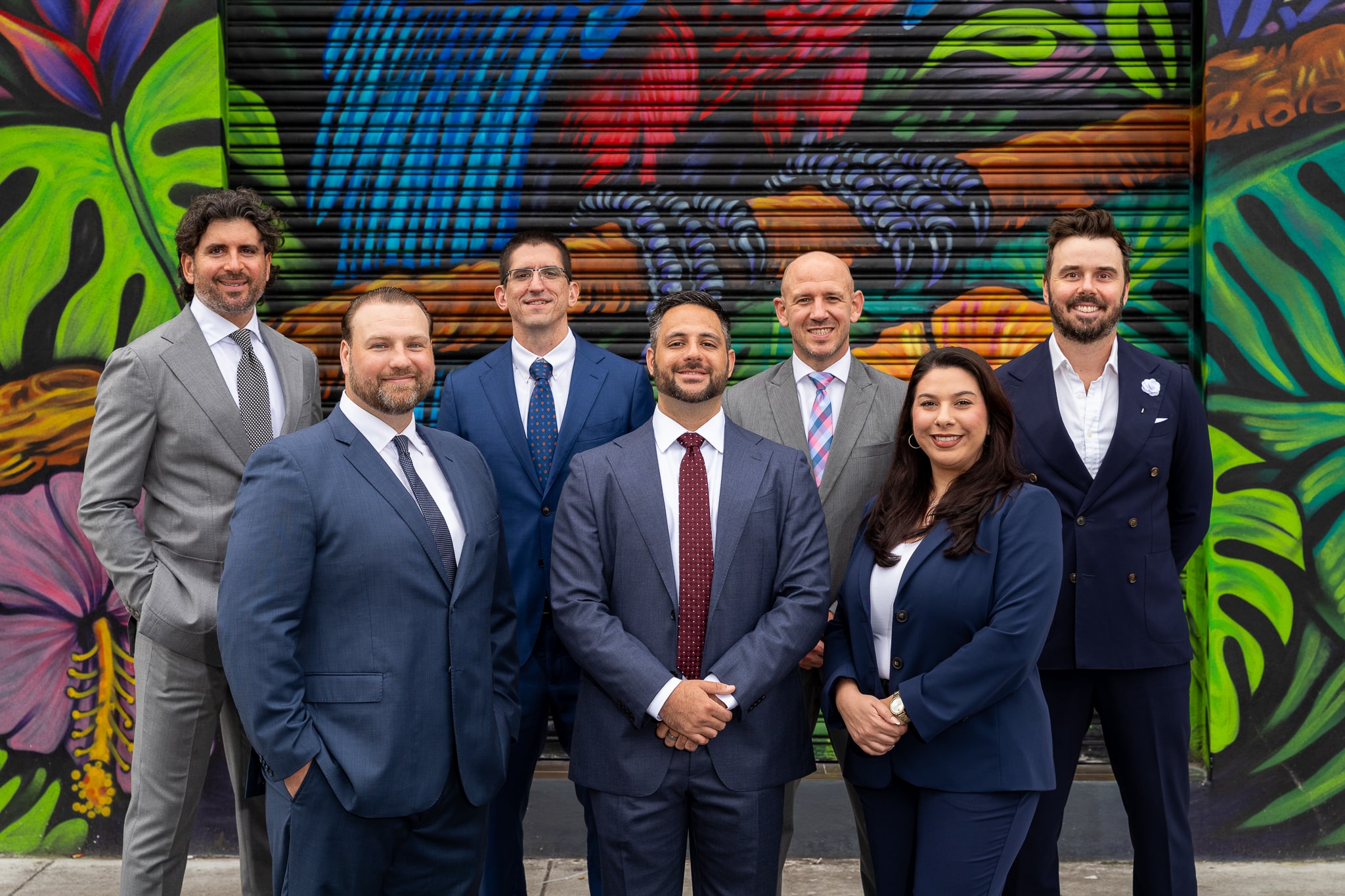
Let Us Fight For The Compensation That Is Owed To You
We’re here to fight for you, and we won’t rest until we get you the outcome you deserve.
Questions Miami Slip and Fall Victims Actually Ask
I signed the incident report at the scene. Did I hurt my case?
Not necessarily. Signing an incident report does not end your case — what matters is what the document actually says. Most manager-prepared incident reports describe the victim's account in the manager's words, minimize the hazard description, and note the presence of any warning signs in a way favorable to the property. What the incident report does not contain — surveillance footage showing how long the condition existed, cleaning logs showing when the area was last inspected, prior incident reports at the same location — is often what wins the case. Call us and describe what the report said. In many cases the incident report becomes a document we use against the property, not one that protects them.
There was a wet floor sign. Can I still sue?
Yes. A wet floor sign is not an automatic defense — it is a factor in the comparative fault analysis. The critical questions are whether the sign was placed at an appropriate distance and height to be visible from normal walking paths, whether the hazard was so large that a single sign was inadequate, whether the sign addressed the specific condition that caused your fall, and whether the property had a pattern of placing signs and leaving conditions unaddressed rather than actually fixing them. CHG Lawyers retains premises safety experts who evaluate whether a given warning cone placement met Florida Building Code standards and industry safety standards — in many cases it did not.
The property says I wasn't paying attention. What now?
This is the 51% comparative fault argument — the central defense strategy after Florida's 2023 tort reform. Property owners argue victims were distracted, using their phone, or wearing improper footwear specifically to push fault above 51% and eliminate all recovery. The counter-argument is built on evidence, not assertion: witness accounts of your attentiveness, the hazard's location in a normal walking path, the absence of adequate warning, the property's cleaning log showing the condition had been present for sufficient time that any reasonable inspection would have caught it. We investigate all of this from the first day.
How long does a Miami slip and fall case take?
Miami slip and fall cases that settle typically resolve in 6 to 18 months — longer for cases involving catastrophic injuries requiring full medical documentation of long-term impact, shorter for cases with clear constructive knowledge evidence and documented serious injuries. Cases that proceed to trial in Miami-Dade County typically require 18 to 36 months from filing. CHG Lawyers prepares every case for trial from day one — which is also why most cases resolve before they get there.
Can I still file if the fall happened several months ago?
Possibly — call us immediately. If your fall occurred after March 24, 2023, you have 2 years from the date of the fall. If it occurred before that date, the prior 4-year deadline may apply. But the evidence deadline is already past — surveillance footage, cleaning logs, and witness memories degrade with every month. The legal window may still be open. The evidentiary window may not be. Call now.
Contact Our Miami Slip and Fall Attorneys
The property's insurer is already building their case. Surveillance footage deletes in 24 to 72 hours. Call before the window closes.
Call (305) 501-8021 Now2525 Ponce de Leon Blvd., Suite 300, Coral Gables, FL 33134
Email: [email protected] · 24/7 · English & Spanish
CHG Law
With years of experience in the field of personal injury law, the attorneys at CHG Law in Coral Gables, Florida, near Miami, have a proven track record of success. They have helped clients recover millions of dollars in compensation, and they are ready to help you too.
-
2525 Ponce de Leon Blvd. Suite 300
Coral Gables, FL, 33134 - (305)-501-8021
- [email protected]
You Don't Pay Until We Win
Don’t be held back by your injuries. Give us a call or submit the simple form below to speak with a lawyer within 24 hours.