
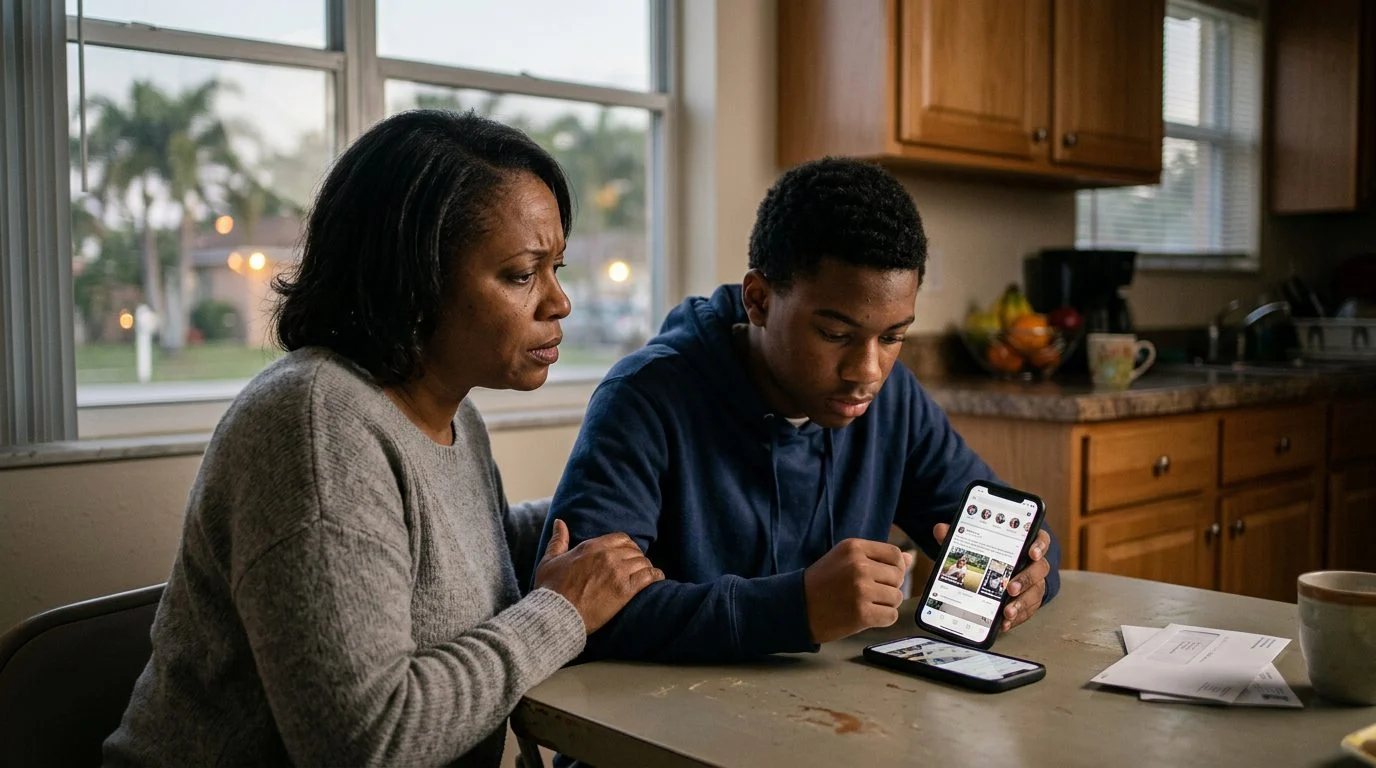
Is Your Child Struggling After Years on Social Media? You Have Questions, and You Do Not Have to Face Them Alone.
Parents in Miami Gardens and across Florida are asking whether social media platforms contributed to serious mental-health harm in their children. CHG Personal Injury Lawyers can explain what lawsuits allege and what your family may be able to do next.
By CHG Lawyers · Published November 3, 2026
A social media addiction lawsuit is a legal claim. It says a social media platform’s design seriously harmed a young person’s mental health. Parents in Miami Gardens and across Miami-Dade County often ask a hard question. Could their child’s struggles be part of that picture?
This page explains what these lawsuits allege. It also explains what a family can do next. It shows how a free consultation works.
The lawsuits make allegations. Courts decide what is proven.
What a Social Media Addiction Lawsuit Is and Who It Is For
A parent or guardian usually brings this kind of lawsuit. They bring it for a minor, which means a child under 18. They may also bring it for a young person.
The lawsuits allege that platforms designed to be addictive contributed to serious mental-health harm. The harms described include:
- Depression
- Anxiety
- Eating disorders
- Self-harm
- Suicide attempts
Companies named in these suits may dispute the allegations. Nothing on this page is a finding that any company is responsible.
If you are a parent, you do not need legal words to ask questions. You need to understand what happened. You also need to know what options may exist.
These cases may be referred to, or handled together with, another law firm. The role CHG Personal Injury Lawyers plays depends on the matter.
If your teen's mood, sleep, or schoolwork has changed and you wonder whether heavy social media use played a part, our team can talk through what you've noticed with you. Talk it through with our team — the first consultation is free, confidential, and carries no obligation.

Warning Signs Families Describe and Where to Turn Now
Families often notice changes in mood, sleep, school, and friendships. Many do not connect those changes to phone or app use until later.
Families commonly describe these changes:
- Trouble sleeping, or a major shift in eating habits
- Falling grades, skipped classes, or lost interest in activities
- Pulling away from family and friends
- Strong distress when a phone is taken away
- Talk of hopelessness, self-harm, or suicide
The U.S. Surgeon General’s HHS Surgeon General report describes an observed link. The report links heavy social media use to higher risks of depression, anxiety, and other mental-health problems.
A link is not proof that one thing caused another.
Rely on your child’s doctors and treatment team for medical decisions.
If your child is in crisis, or talks about suicide or self-harm, call or text the 988 Suicide & Crisis Lifeline (988) right away.
Keep a simple written timeline. Note symptoms, appointments, treatment changes, and how your child uses devices. This record can help a lawyer understand the story later.
What the Lawsuits Allege About Platform Design
The lawsuits focus on specific features. The claims say these features keep young users coming back. The claims describe design choices, not the content people post.
Features named in these claims include:
- Infinite scroll: content that loads without a natural stopping point.
- Autoplay: videos that start on their own.
- Push notifications: alerts that pull users back into the app.
- Algorithmic feeds: personalized feeds that software chooses.
The people bringing these suits are called plaintiffs. They contend that some platforms borrowed techniques from gambling. They allege that rewards at unpredictable times can encourage repeated checking. They say gambling-style products work the same way.
Research on teens is part of the public discussion. A peer-reviewed study on adolescent social media use looked at 830 participants. Peer-reviewed means other scientists checked the study before it was published. The study reported that peer pressure is associated with mobile social media addiction among adolescents.
Health research and legal liability are separate questions. A court decides whether any allegation is proven. Neither a study nor this page can make that decision.
How a Claim Is Evaluated and What Families Should Gather
A review usually looks at four things:
- The young person’s age
- Their diagnoses
- Their treatment history
- How and when they used the platforms
You do not need to prove the case before you call.
Useful information often includes:
- The child’s age and any documented diagnoses
- Treatment records, counselor notes, and school notes
- Which apps were used, and roughly when use began and grew
- A written timeline of symptoms and changes
During a review, the firm will ask about the timeline of symptoms. It will ask when treatment began. It will also ask about other stressors in the young person’s life. These answers depend on the facts of each family’s situation.
Fault rules also matter. Florida has a comparative fault statute. Under it, a party found greater than 50 percent at fault for their own harm may not recover any damages in a negligence action. This rule does not apply to an action for damages for personal injury or wrongful death arising out of medical negligence pursuant to chapter 766. Negligence means failing to use reasonable care. Each claim is evaluated case by case.
Device, account, and screen-time records may be requested during a case.
Where the Litigation Stands and Why Timing Matters
Court deadlines apply. Waiting can cost a family options.
Florida’s limitations statute sets the filing deadline. It sets a two-year period for an action based on negligence.
Other claim types have their own time limits. Do not assume one deadline fits every case.
Court status changes over time. Ask for the current status of your own situation. Do not rely on headlines or older reports.
A settlement or verdict in one case does not automatically cover other families. No one can promise that you will be included in a settlement. No one can promise any amount.
Please contact a lawyer promptly. Your options can be reviewed before any deadline passes.
As noted above, these matters may be referred to, or handled together with, another law firm.
What to Expect: Steps After You Reach Out
The process starts with a conversation. You choose each next step.
- Initial consultation. The first meeting is free and confidential. It comes with no obligation to continue.
- Timeline review. The firm reviews your family’s timeline and any records you can share. It explains what it sees and what remains unknown.
- Decision and agreement. If you decide to move forward, the firm explains how a case would be handled. That includes any referral to, or work with, another firm. You sign written agreements before work begins.
- Investigation. The firm may request records, gather information, and file where appropriate. Timelines vary by case. No particular length of time or result can be promised.
Not sure what your next step is?
Talk it through with our team — the first consultation is free, confidential, and carries no obligation.
Why Families in Miami Gardens Contact CHG Personal Injury Lawyers
CHG Personal Injury Lawyers is a Florida-based firm. We serve families across Florida. That includes Miami-Dade County communities such as Miami Gardens.
Igor Hernandez is the responsible lawyer for this page. Our lawyers are licensed in Florida and admitted to The Florida Bar.
The practice focuses on personal injury cases of every severity. These include car accidents, slip-and-fall incidents, catastrophic injuries, wrongful death, and mass-tort claims. The firm handles some mass-tort claims and refers others.
Our team also publishes bilingual English and Spanish educational content for prospective clients.
CHG charges no attorney’s fees and no case costs unless there is a recovery.

Questions Parents Ask Before Calling
Do I need proof of addiction before I call?
No. The consultation is where the firm reviews what you already have.
Will my child have to testify?
That depends on the facts and the stage of the case. The firm will explain what to expect.
Can a case be filed if my teen is now an adult?
Deadlines and eligibility depend on the facts. Contact the firm promptly so the timing can be reviewed.
Which platforms are named?
The lawsuits name specific companies. The firm will explain which ones may apply to your family’s situation.
Is there a cost to talk with the firm?
The first consultation is free and confidential. It comes with no obligation to continue.
If your teen’s mood, sleep, or schoolwork has changed, you may wonder whether heavy social media use played a part. You do not have to figure out the next step alone. You can reach out to CHG Personal Injury Lawyers for a free, confidential consultation.
How We Help Families Take the First Step
Plain-Language Answers
We explain the legal process in everyday terms, so you understand each step before you decide anything.
A Florida-Based Firm
CHG Personal Injury Lawyers is based in Florida and serves families throughout the state, including Miami Gardens.
Your Records, Reviewed
Bring what you already have, such as messages, school reports, and medical notes. We review them with you at no cost.
No Fees Unless There Is a Recovery
CHG charges no attorney's fees and no case costs unless there is a recovery. Our first consultation is free, confidential, and without obligation.
If Your Child Is in Crisis
If your child is talking about suicide, self-harm, or is in immediate danger, call or text the 988 Suicide & Crisis Lifeline (988) now, or call 911. Follow the care plan set by your child's doctors and counselors. Legal questions can wait until your child is safe.
Questions Parents Ask Us Most
Do I need proof of addiction before I call?
No. The consultation is where our team reviews what you already have and explains what else may be useful.
Will my child have to testify?
That depends on the facts and the stage of the case. We will explain what to expect, and we will talk with you about your child's comfort and well-being at every step.
Can a case be filed if my teen is now an adult?
Deadlines apply to these claims, and they can be complex. Please contact our firm promptly so we can review your teen's situation while your options are still open.
Who decides whether my family's case moves forward?
Our team reviews the facts, the records, and the harm your child has experienced. We will explain the possible paths, including any that may involve other law firms, before you make a decision.