

Slip and Fall Lawyer
Slip and Fall Injury Claims in Sunny Isles Beach
If you were injured on someone else's property due to negligence, you may have a claim. CHG Personal Injury Lawyers focuses exclusively on slip-and-fall cases and other serious injuries across Florida.
By CHG Lawyers · Published September 12, 2026
Slip and Fall Injury in Sunny Isles Beach: Florida Law, Evidence, and Your Claim
If you’ve slipped and fallen on someone else’s property in Sunny Isles Beach and suffered an injury, you may have a legal claim against the property owner. Whether you fell in a hotel lobby, a retail store, a restaurant, a parking lot, or a beachfront promenade, Florida law holds property owners responsible for maintaining safe conditions and warning visitors of hazards. This guide explains how slip-and-fall claims work under Florida law, what you need to prove, and what steps protect your rights.
If you were injured on someone else's property due to negligence, you may have a claim. Talk it through with our team — the first consultation is free, confidential, and carries no obligation.
The Four Elements of Negligence: What You Must Prove
A slip and fall becomes a legal claim when you can prove negligence. Florida law requires you to establish four specific elements:
1. Duty of Care The property owner owed you a legal duty to maintain reasonably safe conditions. If you were a customer, guest, or lawful visitor, this duty exists automatically. The owner doesn’t have to guarantee perfect safety—only that they exercise the care a reasonable person would under similar circumstances.
2. Breach of Duty The owner failed to meet that standard. They knew—or should have known—about a dangerous condition and either failed to fix it or failed to warn you. Examples include a wet floor without warning signs, broken stairs, poor lighting, debris in walkways, or uneven pavement.
3. Causation The breach directly caused your fall and injury. The hazard must have been the actual cause of your accident, not an unrelated factor.
4. Damages You suffered measurable harm: medical bills, lost wages, pain and suffering, or other quantifiable losses. Without damages, you have no claim, even if the owner was negligent.
All four elements must be present. If any is missing, your claim fails.
Florida’s Comparative Negligence Rule: You Can Recover Even If Partially at Fault
Florida recognizes comparative negligence under Fla. Stat. §768.81. This means you can recover damages even if you bear some responsibility for your fall—as long as you were less than 50% at fault.
Here’s how it works: Suppose you slipped on a wet grocery store floor with no warning sign. You were wearing shoes with poor traction, which contributed to the slip. A jury might determine you were 20% at fault and the store was 80% at fault. If your total damages are $10,000, you would recover $8,000 (your $10,000 award reduced by your 20% share of fault).
This rule is powerful: it means that even if you made a mistake, you’re not barred from recovery if the property owner’s negligence was the greater cause of your injury.
Slip and Fall Hazards Common in Sunny Isles Beach
Sunny Isles Beach presents specific property types and environmental conditions that create slip-and-fall risks.
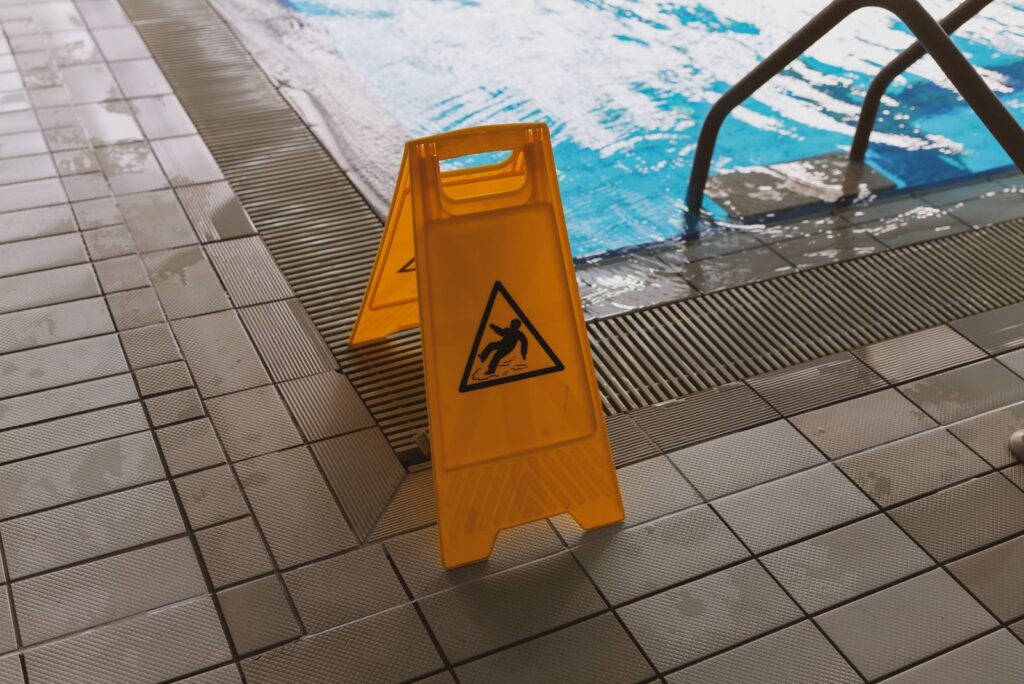
Beachfront hotels and resorts dominate the area. These properties create particular dangers: wet lobby floors from guest traffic and cleaning, slippery pool decks, outdoor walkways affected by ocean spray and salt water, and stairs near entrances where moisture accumulates. Seasonal weather, high foot traffic, and proximity to salt water create ongoing maintenance challenges. Guests and visitors rely on these properties to address these foreseeable hazards.
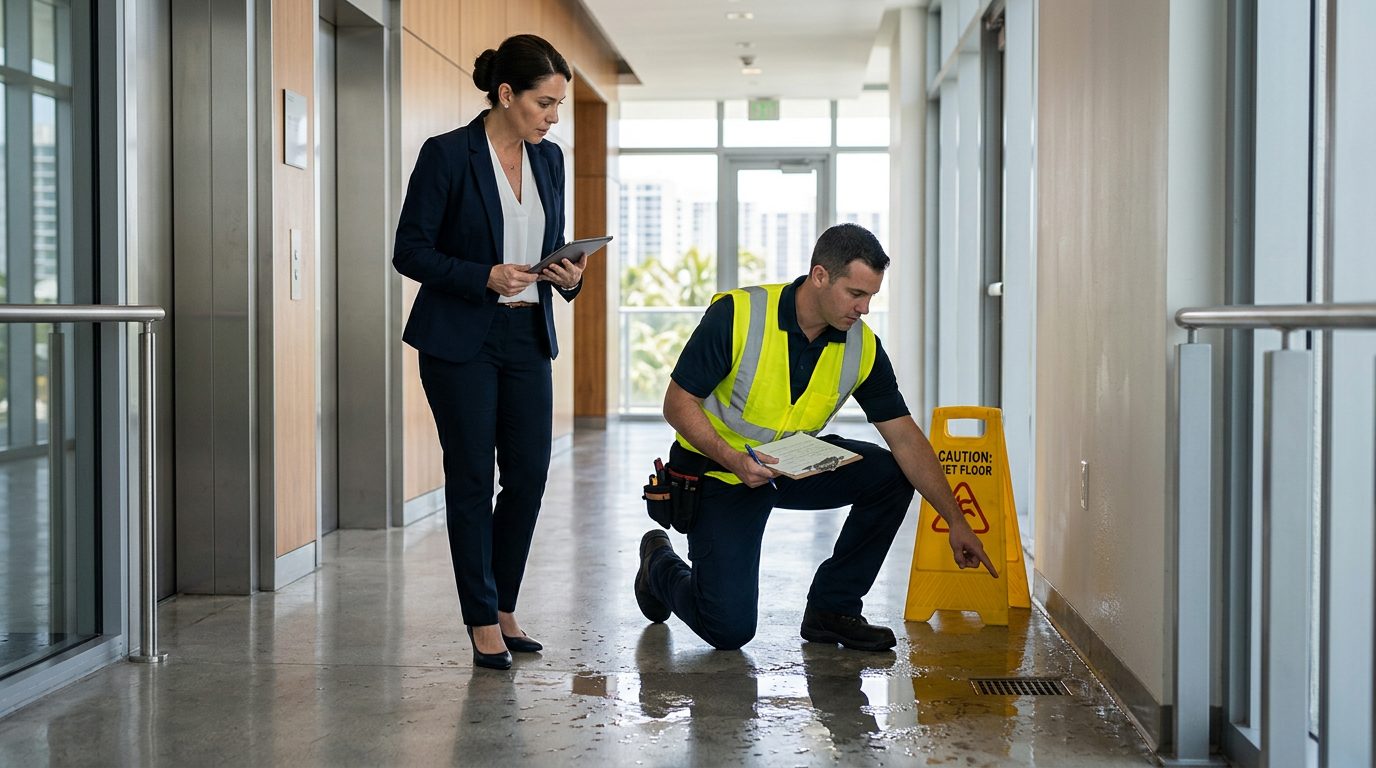
Retail and dining establishments—grocery stores, restaurants, cafes, and shops—frequently have wet floors from cleaning, weather, or inadequate drainage. Poor maintenance, failure to post warning signs, or inattentive staff can turn a routine shopping trip into a serious fall.
Parking areas and garages present uneven pavement, potholes, water pooling, and inadequate lighting at night. Falls in these areas often result in more severe injuries because the surfaces are hard and the lighting is poor.
Residential buildings in Sunny Isles Beach include common areas, stairwells, elevators, and entryways that may not be properly maintained or lit. Property managers have a duty to keep these shared spaces safe for residents and guests.
Public spaces like beachfront promenades and parks are sometimes maintained by the municipality or a property manager. If they fail to address hazards—cracked pavement, missing handrails, poor lighting—they may be liable for injuries.
Is It Worth Suing for a Slip and Fall? An Honest Assessment
Many injured people ask this question. The answer depends on your specific circumstances, but here’s the honest framework:
A slip-and-fall claim is worth pursuing if: – Your injuries required medical treatment – You incurred significant medical bills or lost income – The property owner’s negligence is clear and provable – You have evidence to support your claim – The property owner has liability insurance
Even injuries that seem “minor” can justify a claim if they caused ongoing pain, required ongoing treatment, or affected your ability to work or enjoy daily life. A broken wrist, a torn knee ligament, or a head injury may have long-term consequences that aren’t immediately obvious.
The value of your claim depends on:
- Severity of your injury. More serious injuries typically command higher settlements. A fracture requiring surgery has higher value than a bruise.
- Cost of medical care. Your past and future medical bills are a core component of damages.
- Lost wages. If you missed work or lost earning capacity due to your injury, that’s recoverable.
- Clarity of negligence. If the property owner’s failure to maintain safe conditions is obvious and well-documented, your claim is stronger.
- Strength of evidence. Photos, witness statements, incident reports, and maintenance records bolster your case significantly.
- Insurance coverage. The property owner’s liability insurance limits affect what you can recover. A property with a $1 million policy can pay more than one with a $100,000 limit.
Many slip-and-fall claims are resolved through settlement negotiations with the property owner’s insurance company, without the need for trial.
What Evidence Do You Need? A Practical Checklist
The strength of your claim depends on the evidence you can gather. Here’s what matters:
Immediate evidence (gather within hours or days): – Photographs of the hazard that caused your fall, taken from multiple angles – Photos of the surrounding area, showing lighting conditions and layout – Photos of any warning signs—or the absence of warning signs – The names, phone numbers, and email addresses of anyone who witnessed your fall – A written incident report from the property manager or owner (request this immediately) – Your own written account of what happened, recorded while details are fresh
Medical evidence (essential): – Medical records from your initial evaluation and all follow-up care – Receipts for medical expenses, prescription costs, and medical equipment – Imaging reports (X-rays, MRI, CT scans) if applicable – Documentation of any ongoing treatment or physical therapy
Financial evidence: – Pay stubs or tax returns showing lost income – Receipts for transportation to medical appointments – Documentation of any reduced earning capacity due to your injury
Photographic evidence over time: – Photos of your injuries as they heal (or fail to heal) – Documentation of visible scarring or permanent changes
Witness statements: – Written statements from anyone who saw your fall or the hazardous condition – Contact information for potential expert witnesses (e.g., a safety engineer who can testify about the foreseeability of the hazard)
Property records (obtained through legal discovery): – The property’s maintenance logs and cleaning schedules – Prior complaints or incident reports about the same hazard – Inspection reports or safety audits – Video surveillance footage if available
The more evidence you gather, the stronger your negotiating position with the insurance company.
If you've slipped and fallen on someone else's property in Sunny Isles Beach and suffered an injury, you may have a legal claim against the property owner. Talk it through with our team — the first consultation is free, confidential, and carries no obligation.
Steps to Take Immediately After a Slip and Fall
1. Seek medical attention. Even if your injury seems minor, get evaluated by a doctor. Some injuries worsen over time, and medical records are crucial evidence of causation and damages. Document everything the doctor finds.
2. Report the incident. Tell the property manager, store manager, or owner immediately. Ask for a written incident report and keep a copy. If they refuse to provide one, write down the names of anyone you spoke to and the date and time.
3. Document the scene. Photograph the hazard, the surrounding area, lighting conditions, and your injuries. If possible, return to the property within a few days and take additional photos showing the condition of the area.
4. Gather witness information. Ask anyone who saw your fall for their name, phone number, and email. Their account can support your claim. If witnesses leave before you can get their information, ask the property manager for security footage or other records that might identify them.
5. Preserve evidence. Keep the clothing and shoes you wore during the fall. Take photos of any visible injuries over time. Save all medical bills, receipts, and pay stubs.
6. Do not sign anything or make statements to the property owner’s insurance company without legal advice. Insurance adjusters are trained to minimize payouts. Anything you say can be used against you. A simple statement like “I’m not sure what happened” can be twisted to suggest you were careless.
7. Contact an attorney. A lawyer can advise you on your rights, help you gather evidence, negotiate with the insurance company, and represent you if litigation becomes necessary.
Florida’s Statute of Limitations: Don’t Miss the Deadline
Under Fla. Stat. §95.11, you generally have two years from the date of your injury to file a slip-and-fall lawsuit. This deadline is absolute. Missing it can bar your claim entirely, even if you have a strong case.
The clock starts on the date of your fall, not the date you discover your injury. If you’re injured on January 1, 2025, your deadline is January 1, 2029. After that date, you cannot file suit, and your right to compensation is lost forever.
This is why acting promptly matters. Even if you’re still recovering or unsure whether to pursue a claim, contact an attorney before the deadline approaches. An attorney can preserve your rights and advise you on your options.
Why Handling a Slip and Fall Claim Alone Is Risky
Property owners and their insurance companies have significant advantages over injured people acting alone. Here’s why you should have legal representation:
Insurance companies minimize payouts. Adjusters are trained to settle claims quickly for less than they’re worth. They may pressure you to accept a low offer before you understand the full extent of your injury or its long-term effects. They may deny your claim outright using technical arguments you may not anticipate.
You may not know what evidence to gather or how to preserve it. Missing or mishandled evidence can weaken your case significantly. For example, if you don’t photograph the hazard within days, it may be cleaned up or repaired, and you lose crucial proof. If you don’t obtain the property’s maintenance records through legal discovery, you may never know whether the owner knew about the hazard.
Legal rules are complex. Comparative negligence, statute of limitations, burden of proof, and procedural requirements all affect your outcome. A mistake—missing a deadline, saying the wrong thing to an adjuster, or failing to preserve evidence—can cost you thousands of dollars.
Property owners have lawyers. You deserve representation too. An attorney levels the playing field, communicates with the insurance company on your behalf, and protects your rights at every step.
An attorney often recovers more than you would alone. Most personal injury attorneys work on a contingency fee basis, meaning you pay nothing unless we recover compensation for you. The fee is typically a percentage of your recovery (often 33% to 40%), but the amount we recover is usually significantly higher than what you would negotiate on your own—enough to cover the fee and leave you with a larger net recovery.
What a Slip and Fall Attorney Actually Does
Investigation and evidence gathering. An attorney investigates the accident, interviews witnesses, obtains the property’s maintenance and incident records, reviews surveillance footage if available, and consults experts (e.g., a safety engineer) if needed.
Liability assessment. They determine whether the property owner’s conduct meets the legal standard for negligence and whether you have a viable claim under the four-element test.
Damages calculation. They add up your medical bills, lost wages, pain and suffering, and other losses to determine what your claim is worth.
Insurance negotiation. They communicate with the property owner’s insurance company, present evidence, and work toward a fair settlement. They know the tactics insurers use and how to counter them.
Rights protection. They ensure you don’t miss deadlines, don’t say anything that could harm your claim, and understand your options at every step.
Litigation and trial representation. If settlement fails, they represent you in court, preparing your case for trial, presenting evidence, and advocating for you before a judge or jury.
Not sure what your next step is?
Talk it through with our team — the first consultation is free, confidential, and carries no obligation.
CHG Personal Injury Lawyers: Here to Help You in Sunny Isles Beach
CHG focuses exclusively on personal injury cases, including slip and fall accidents throughout Florida and nationwide. We understand Sunny Isles Beach and the types of properties and hazards that cause injuries here—from beachfront hotels and retail centers to parking areas and residential buildings.
We handle the investigation, negotiation, and litigation so you can focus on healing. We work on a contingency fee basis: you pay nothing unless we recover compensation for you. We offer a free case evaluation to discuss your injury, answer your questions, and explain your options.
Frequently Asked Questions
How long do I have to file a slip-and-fall lawsuit in Florida?
You generally have two years from the date of your injury to file a lawsuit under Fla. Stat. §95.11. Missing this deadline can bar your claim, so contact an attorney promptly.
Can I recover if I was partially at fault for my slip and fall?
Yes. Under Fla. Stat. §768.81, you can recover even if you were partially at fault, as long as you were less than 50% responsible. Your recovery is reduced by your percentage of fault.
What should I do immediately after a slip and fall?
Seek medical attention, report the incident to the property owner, photograph the hazard and scene, gather witness information, and preserve evidence like the clothing you wore. Do not sign anything or speak to an insurance adjuster without legal advice.
How much does it cost to hire a slip-and-fall attorney?
Most personal injury attorneys, including CHG, work on a contingency fee basis. You pay nothing unless we recover compensation for you.
What is premises liability?
Premises liability is the legal responsibility of a property owner to maintain safe conditions and warn visitors of known hazards. If they breach this duty and you’re injured, you may have a claim.
If you’ve been hurt in a slip and fall on someone else’s property in Sunny Isles Beach—whether at a hotel, store, restaurant, or parking area—reach out for a free case evaluation. People in your situation contact us regularly, and we’re ready to discuss your rights and options. Contact CHG Personal Injury Lawyers today.
Why Choose CHG for Your Slip and Fall Claim
Focused Experience in Personal Injury
We focus exclusively on personal injury claims, including slip-and-fall accidents on residential, commercial, and public properties.
Thorough Investigation
We gather evidence—security footage, maintenance records, witness statements, and photos—to build a strong case on your behalf.
Direct Attorney Communication
You'll work with licensed Florida attorneys who understand the details of your injury and what recovery means for your future.
No Upfront Costs
We work on a contingency basis: no fees unless there is a recovery. You focus on healing while we handle the legal work.
Common Slip and Fall Scenarios We Handle
Wet Floors & Spills
Falls caused by unmopped spills, leaking pipes, or wet surfaces in stores, restaurants, offices, or apartment buildings.
Poor Maintenance
Injuries from cracked sidewalks, broken stairs, missing handrails, or neglected landscaping on a property owner's land.
Inadequate Lighting
Falls in dimly lit parking lots, stairwells, hallways, or outdoor areas where the owner failed to provide safe visibility.
Hazardous Conditions
Injuries from debris, obstacles, loose carpeting, or other dangerous conditions the property owner knew about or should have known about.
Time Matters
Florida law sets a deadline for filing a slip-and-fall lawsuit. The sooner you contact an attorney, the sooner we can investigate your claim, preserve evidence, and protect your rights.
What Happens Next
Free Consultation
Share the details of your fall and injury. We'll listen, answer your questions, and explain your options—at no cost.
Investigation & Evidence
We request maintenance records, security footage, incident reports, and medical documentation to understand how the fall happened.
Liability Assessment
We determine whether the property owner's negligence caused your injury and whether you have a valid claim.
Recovery Pursuit
We negotiate with insurers or prepare your case for trial to pursue fair compensation for your medical bills, lost wages, and pain and suffering.