

Catastrophic Spinal Cord Injury
The True Lifetime Cost of Ventilator-Dependent Quadriplegia Care
When a high spinal cord injury leaves someone unable to breathe on their own, the cost of a lifetime of care can reach into the millions. Understanding those numbers is the first step to protecting your family's future.
Why Families Turn to CHG
Nationwide
We take catastrophic cases across the country
Bilingual
Educational help in English & Spanish
Licensed
Florida Bar–admitted attorneys
$0
Free, no-obligation case evaluation
By CHG Lawyers · Published July 26, 2026
Ventilator-Dependent Quadriplegia: What Long-Term Care Really Costs
If you’re reading this, you’re probably a spouse, parent, or adult child. Someone you love now needs a ventilator to breathe after a spinal cord injury. You want to know what the next few decades of care will cost. And you want to know before you sign anything, sell anything, or agree to a settlement.
This page does something most search results won’t. The research on this topic lives in medical journals — Chest, Spinal Cord, and the Archives of Physical Medicine and Rehabilitation. It sits behind paywalls, in summaries written for doctors. We put that research into plain words you can use. We tell you honestly which numbers are out of date. And we show you how these costs become part of an injury claim.

Not sure what your next step is?
Talk it through with our team — the first consultation is free, confidential, and carries no obligation.
What ventilator-dependent quadriplegia actually means
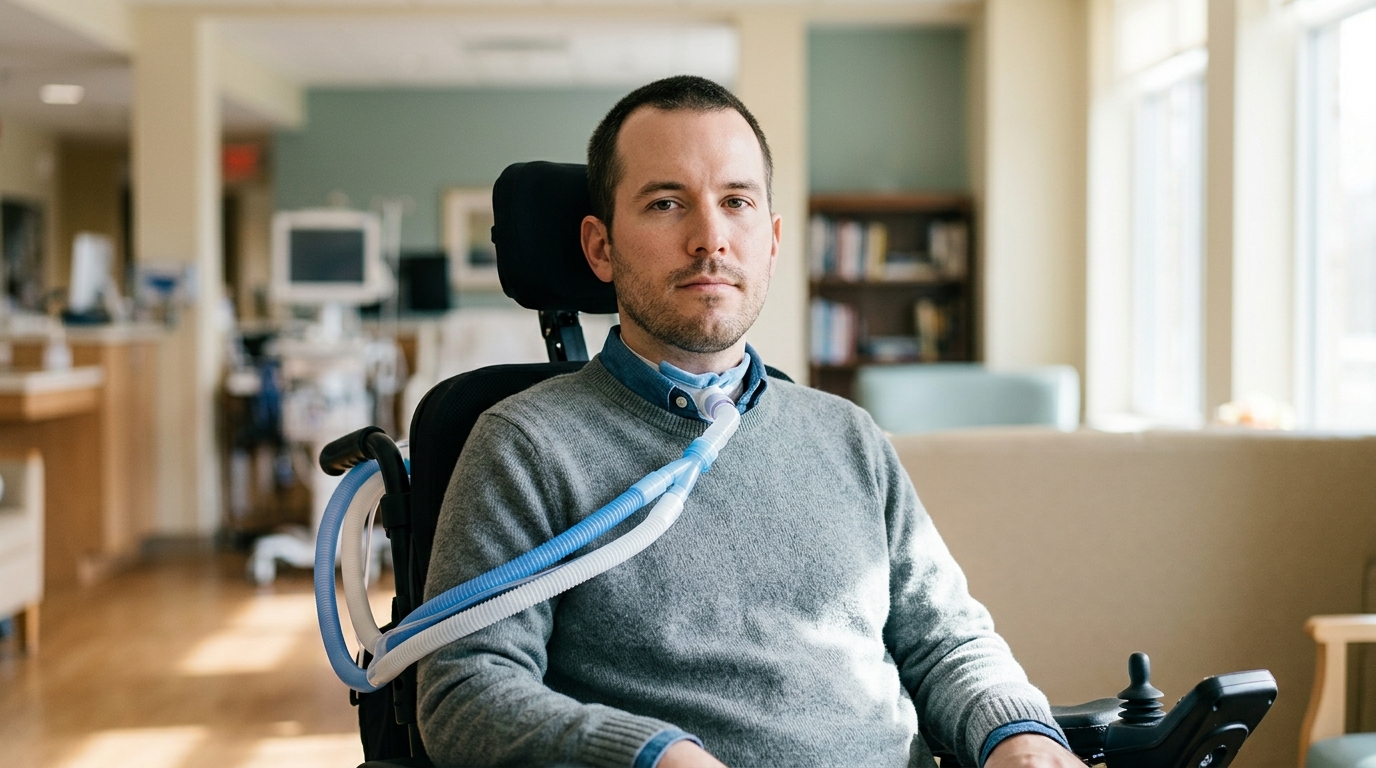
Ventilator-dependent quadriplegia means a high spinal cord injury has damaged the nerves that control breathing. A machine now has to move air in and out of the lungs.
The spinal cord carries signals between the brain and the body. The diaphragm is the main breathing muscle. It runs on the phrenic nerve. That nerve gets its signals from the C3, C4, and C5 parts of the spinal cord. An injury at C1 through C4 can cut off those signals. When that happens, the diaphragm can’t do its job.
The Mayo Clinic explains that high neck injuries can affect the muscles used for breathing. That is why these patients often need a ventilator and a tracheostomy. A tracheostomy is a small surgical opening in the neck for the breathing tube.
Doctors sort these injuries using the International Standards for Neurological Classification of Spinal Cord Injury (ISNCSCI). The American Spinal Injury Association publishes it. This scale grades two things. First, the level — where on the cord the injury is. Second, the completeness — how much function remains.
In medical writing, you’ll see this called “high tetraplegia.” Tetraplegia is simply the medical word for what most families call quadriplegia. To see how injury levels differ, read our guide on paraplegia vs. quadriplegia.
This is the most severe, life-altering kind of spinal cord injury. It needs the highest level of care. That is why the costs are what they are.
Why ventilator-dependent care is the most expensive spinal cord injury
The Christopher & Dana Reeve Foundation reports that high tetraplegia (C1–C4) has the highest estimated lifetime costs of all spinal cord injury types. Here is what drives that:
- Round-the-clock skilled care. Someone must watch the person’s breathing, clear the airway (called suctioning), and care for the tracheostomy. That means trained nurses or aides — not just family — 24 hours a day.
- Ventilator and breathing equipment. This includes a ventilator, a backup ventilator, a reliable power supply with a backup, and a steady flow of disposable supplies (circuits, filters, suction catheters, and tracheostomy tubes).
- Higher risk of serious problems. High-level injuries carry a greater risk of lung infections. These lead to repeat hospital stays and specialist visits.
- Care that never stops. Most of these costs come back every year, for the rest of the person’s life. That is what pushes lifetime totals into the millions.
In the catastrophic-injury cases our attorneys work on, the biggest single cost is almost always the round-the-clock human care — not the machines. Paying trained people to be present every hour of every day costs far more than any piece of equipment.
How much does ventilator-dependent quadriplegic care cost?
Here is the honest, careful answer, with the reasons behind it.
Treat every published figure as a range, not a promise. Costs change with the person’s age at injury, where they live, and whether care happens at home or in a facility. The National Spinal Cord Injury Statistical Center (NSCISC) at the University of Alabama at Birmingham tracks these figures with federal support. Its data show high tetraplegia at the top of the cost scale. The first year after injury costs far more than any year that follows. That first year includes the emergency hospital stay, surgery, inpatient rehab, and the one-time cost of setting up a home for a ventilator-dependent person.
Older studies must be adjusted for inflation — and many pages get this wrong. Some of the most-cited research on this topic came out in the 1990s and early 2000s. Common examples are the Chest research on the cost of home mechanical ventilation, and older Archives of Physical Medicine and Rehabilitation cost studies. Those dollar amounts reflect the year they were published.
Medical prices have risen much faster than general inflation for decades. So a figure from 1998 is not a current figure. It is a floor. You must bring it forward to today’s dollars using the U.S. Bureau of Labor Statistics CPI medical-care index. Be careful with any page that quotes a decades-old dollar amount as if it applied today. That is one of the most common errors we see online.
Headline numbers usually leave things out. Most published cost estimates cover medical care only. They often leave out lost wages and lost future earning power. For a young person who would have worked for decades, that loss can match or beat the medical costs.
So when someone asks “how much does quadriplegic care cost,” the honest answer is: it depends. But for ventilator-dependent care, families should plan for lifetime totals in the millions. A proper estimate for your situation matters far more than any headline figure. Later on this page, we explain the document that produces it.
The cost categories families need to plan for
Round-the-clock attendant and nursing care
This is almost always the single biggest expense. A ventilator-dependent person needs trained help 24 hours a day. That help comes from home health aides, licensed nurses, or a mix of both. Multiply an hourly nursing rate by 8,760 hours a year. Then multiply that across a lifetime. You quickly see why this dominates every cost estimate.
Ventilator and breathing supplies
This means the ventilator, a backup unit, tracheostomy supplies, suction equipment, and monthly consumables. Equipment also wears out and needs to be replaced over time.
Medications and complication management
The Mayo Clinic notes that spinal cord injury complications include breathing problems and pressure injuries (bedsores). Preventing and treating these takes ongoing medication and medical care.
Durable medical equipment
This includes a special power wheelchair, a hospital bed, and patient lifts. For a high-level injury, the wheelchair is often controlled by head, chin, or sip-and-puff. These items are costly and need to be replaced over the years.
Home and vehicle changes
A home may need ramps, wider doorways, and a roll-in shower. For a ventilator user, a backup generator is critical, so the machine never loses power. A vehicle may need major changes too. See our guide on home and vehicle modification costs.
Lost income and earning power
The injured person often can’t return to work. A family member frequently has to leave a job to provide or manage care. Both losses belong in a full cost picture.
Home care vs. facility care: how the setting changes the cost
The setting affects both cost and quality of life. Neither option is automatically cheaper.
In-home 24-hour care lets the person stay with family. It often supports a better quality of life. But paying for around-the-clock skilled nursing at home is expensive. The hourly cost repeats every hour of every day.
Facility care — a skilled nursing facility or long-term acute care (LTAC) hospital — bundles staffing and equipment together. It may cost less in some cases. But it usually means less independence and less family involvement.
Here is a hard truth families learn early: insurance rarely covers the full 24-hour need. Medicare, Medicaid, and private plans all have limits, caps, and gaps. They seldom pay for true lifetime, round-the-clock skilled care. The gap between what insurance pays and what care actually costs is exactly the gap a well-built injury claim is meant to close.
Have questions about what happened?
Ask our team directly. The first conversation is free, confidential, and there is no obligation to continue.
Life expectancy and the long-term outlook — and why it affects cost
We share this honestly and with respect. Families deserve real information, not comfort that isn’t true.
Research consistently shows a hard fact. People who stay ventilator-dependent after a spinal cord injury have a shorter life expectancy. This is compared with others at the same injury level who can breathe on their own. The NSCISC and the peer-reviewed Spinal Cord research both report this.
The real outlook depends heavily on age at injury and injury level. It also depends on something families can influence: the quality of ongoing care. Careful airway care and infection prevention genuinely improve both survival and quality of life.
What is the number one cause of death for people with high-level spinal cord injuries? Breathing complications — pneumonia and other lung problems. That is why suctioning, tracheostomy care, and skilled monitoring are not comfort measures. They are survival measures.
Why does life expectancy affect cost? Because the longer someone is expected to live, the more years of care must be paid for. A longer projected lifespan raises the total lifetime cost. That total sits at the center of valuing a catastrophic injury claim.
Sometimes, despite the best care, these injuries prove fatal. When a family loses a loved one, they may be able to bring a wrongful-death claim under Florida’s Wrongful Death Act, Fla. Stat. §§768.16–768.26. A death is the most catastrophic outcome there is, and the law recognizes it. If your family has faced this loss, an attorney can explain your options with the dignity your situation deserves.
How a life care plan turns these costs into a claim
A life care plan is a detailed document, prepared by professionals. It projects every future cost the injured person will face over their expected lifetime. It is the backbone of any serious catastrophic injury claim.
Two kinds of experts build it together. First, a physician or a Certified Life Care Planner (CLCP) projects the medical needs. That means hours of nursing, how often equipment must be replaced, and likely complications. Then a forensic economist turns those needs into future dollars. They adjust for medical inflation and the person’s projected life expectancy. They also reduce the future costs to a present value. The plan covers everything above: attendant care, equipment, supplies, medications, home changes, and lost earning power.
Why does this matter so much? With ventilator-dependent quadriplegia, future costs are the largest part of the claim — far larger than the bills already received. A quick guess won’t survive scrutiny from a defense insurer. A carefully built, expert-backed plan documents the real number and puts it on the record. For a fuller explanation, see our page on the life care plan.
When another party may be responsible for these costs
When someone else’s negligence caused the injury, that party may be legally responsible for the lifetime cost of care. Showing who is at fault can shift a crushing financial burden away from your family.
Catastrophic spinal cord injuries often come from:
- Truck accidents. The size and weight of a commercial vehicle can cause devastating harm. See our truck accident lawyer page.
- Medical negligence. A preventable error causes permanent injury.
- A violent attack on someone else’s property. Maybe your loved one was shot, assaulted, robbed, or attacked at an apartment complex, a parking lot or garage, a hotel, a bar, a gas station, or a store. Maybe it happened because the property owner failed to provide basic safety — like working locks and gates, good lighting, cameras, or security staff. If so, that owner may share responsibility. Lawyers call this negligent security, but you don’t need to know the term to have a case. Read more on our negligent security page.
In Florida, filing deadlines apply. Under Fla. Stat. §95.11, the general deadline to file a negligence claim is two years for cases arising on or after March 24, 2023. Florida also follows a modified comparative-negligence rule under Fla. Stat. §768.81. This means a person found more than 50% at fault generally cannot recover. Any recovery is also reduced by the injured person’s share of fault. Deadlines and fault rules differ from state to state, and this firm handles cases nationwide. So confirm the specifics of your case with an attorney.
Every case turns on its own facts, and no lawyer can promise a result. But when fault is clear, the goal is for the responsible party — not your family — to bear the lifetime cost.
Talk to a catastrophic injury attorney about your family’s situation
If your family is facing the cost of ventilator-dependent quadriplegia care, a talk with a lawyer can help. It can help you understand your rights and options. CHG Personal Injury Lawyers offers a free case evaluation with no obligation.
Our attorneys are licensed and admitted to The Florida Bar. We handle catastrophic injury cases nationwide. We help families in both English and Spanish. We know these injuries change everything. We treat every family with empathy and straight answers.
To learn more, visit our paralysis injury lawyer resource. When you’re ready, request your free case evaluation. There’s no cost to talk and no promised result — just clear information about the path forward.

Want to know where you stand?
Tell us what happened and our team will walk you through the options available to you, at no cost.
Frequently asked questions
How much does ventilator-dependent quadriplegic care cost?
Lifetime costs usually run into the millions. The care needs round-the-clock skilled help, breathing equipment, and lifelong medical management. High tetraplegia (C1–C4) has the highest estimated lifetime costs of any spinal cord injury type. The first year after injury is by far the most expensive. Treat every published figure as a range, not a guarantee. Be wary of decades-old numbers quoted as current.
How long can a quadriplegic live on a ventilator?
It varies widely. It depends on age at injury, injury level, and — significantly — the quality of ongoing care. Research shows a shorter life expectancy for ventilator-dependent patients than for others at the same injury level. But careful long-term care can improve both survival and quality of life.
What is the number one cause of death for quadriplegics?
Breathing complications, such as pneumonia and other lung problems, are the leading cause of death for people with high-level spinal cord injuries.
Does insurance cover the full cost of ventilator-dependent care?
Rarely. Medicare, Medicaid, and private insurance all have limits and gaps. They seldom pay for true lifetime, round-the-clock skilled care.
Why does a life care plan matter?
Future costs are the largest part of a catastrophic injury claim. A professionally prepared life care plan documents every lifetime expense in present-value dollars. A physician or Certified Life Care Planner builds it with a forensic economist. This puts the real number on the record.
This page is for general information and is not legal advice. For guidance on your situation, speak with a licensed attorney.
Be Careful With Online Cost Estimates
Treat every published lifetime-care figure as a range, not a guarantee. Many numbers circulating online are decades old and understate today's costs. A proper life-care plan built for your loved one's specific needs is the only reliable way to understand the real total.
What Drives the Cost of Ventilator-Dependent Care
Round-the-Clock Skilled Care
Ventilator dependence typically requires 24-hour attendant or nursing care to manage the airway, suction secretions, and respond to emergencies. This is often the single largest expense over a lifetime.
Breathing Equipment & Supplies
Ventilators, backup units, tubing, tracheostomy supplies, oxygen, and monitors all carry ongoing purchase, maintenance, and replacement costs that continue for life.
Lifelong Medical Management
Physicians, respiratory therapists, medications, and treatment of complications like infections and pressure injuries add up year after year.
Home & Vehicle Modifications
Accessible housing, power wheelchairs, lifts, and adapted transportation are usually necessary and must be replaced or updated over time.
Understanding the Numbers
Costs Reach Into the Millions
Lifetime costs for ventilator-dependent quadriplegia usually run into the millions of dollars once you account for care, equipment, and medical management.
The First Year Is the Most Expensive
Initial hospitalization, surgery, and rehabilitation make the first year after injury by far the costliest period.
High Tetraplegia Carries the Highest Costs
Injuries at the C1–C4 level, which most often lead to ventilator dependence, have the highest estimated lifetime costs of any spinal cord injury type.
The Family Bears the Burden Too
Beyond dollars, families often reorganize their entire lives to provide care. A full accounting of a claim should recognize that impact.