

Catastrophic Spinal Cord Injury
Ventilator-Dependent Quadriplegia: The Care, the Cost, and Your Right to Compensation
When a high-level spinal cord injury leaves someone unable to breathe on their own, the medical and financial demands last a lifetime. We help families understand what full, long-term care requires and how to pursue the resources to pay for it.
Representing Victims of Life-Altering Injuries
Nationwide
Catastrophic-injury cases accepted
Licensed
Florida Bar–admitted attorneys
Bilingual
English & Spanish support
Free
Confidential case evaluation
By CHG Lawyers · Published July 25, 2026
Ventilator-Dependent Quadriplegia: What Care, Costs, and Legal Claims Really Involve
Ventilator-dependent quadriplegia means a spinal cord injury has paralyzed all four limbs. It has also harmed the nerves that control breathing. So a machine must help the person breathe. This usually happens with the highest neck-level injuries. It changes every part of daily life for the injured person and their family.
We wrote this page for families — not for doctors or scholars. Most search results on this topic are clinical writing or sales pages for caregiver courses. Those sources rarely tell you what daily life really costs. They also skip your legal options when someone else caused the injury. This page covers both, in plain language. It is available in English and Spanish.
If your loved one has this injury, you likely want two answers. You want to know what it means medically. You also want to know how you will pay for the care ahead. We will cover the care, the outlook, and the lifetime costs. We will also explain how a legal claim may help when someone else’s carelessness caused the injury.

If you are facing the reality of ventilator-dependent quadriplegia, you do not have to sort out the legal side alone. Talk it through with our team — the first consultation is free, confidential, and carries no obligation.
What ventilator-dependent quadriplegia means
It is quadriplegia (also called tetraplegia) that also affects the muscles you use to breathe. So the person needs a machine to move air in and out of the lungs.
Quadriplegia affects all four limbs. When the injury sits very high on the spinal cord, it can also block the brain’s signals to the diaphragm. The diaphragm is the large muscle under the lungs that drives breathing. It gets its instructions through the phrenic nerves. These nerves leave the spinal cord at neck levels C3, C4, and C5. When an injury blocks those signals, the person may not be able to breathe on their own.
The Mayo Clinic explains that a higher injury on the spinal cord causes more impairment. Injuries in the cervical (neck) region can affect the muscles used for breathing. Doctors rate the level and completeness of an injury using the International Standards for Neurological Classification of Spinal Cord Injury (ISNCSCI). This grading system is kept by the American Spinal Injury Association.
Not everyone needs the same level of support. Some people rely on a ventilator full-time. Others breathe on their own during the day and use support only at night. Your loved one’s treating doctors — not a law firm — decide the exact level and needs.
Do all quadriplegics need a ventilator?
No. Whether a person needs a ventilator depends mostly on how high the injury sits on the spinal cord.
Injuries at the C4 level and above most often affect breathing. The highest injuries — C1, C2, and C3 — are the most likely to need full-time machine support. That is because the phrenic nerves that drive the diaphragm start at C3–C5. Lower neck injuries usually leave enough breathing function to breathe without a machine. But the person may still have serious paralysis.
Some people are slowly weaned off a ventilator as they heal. Their care team works with them over time. Others need permanent support. Again, this is a medical judgment made by doctors. It is based on the injury and the person’s overall health.
What daily care looks like
Care is intense and never stops. A ventilator-dependent quadriplegic usually needs skilled help available 24 hours a day.
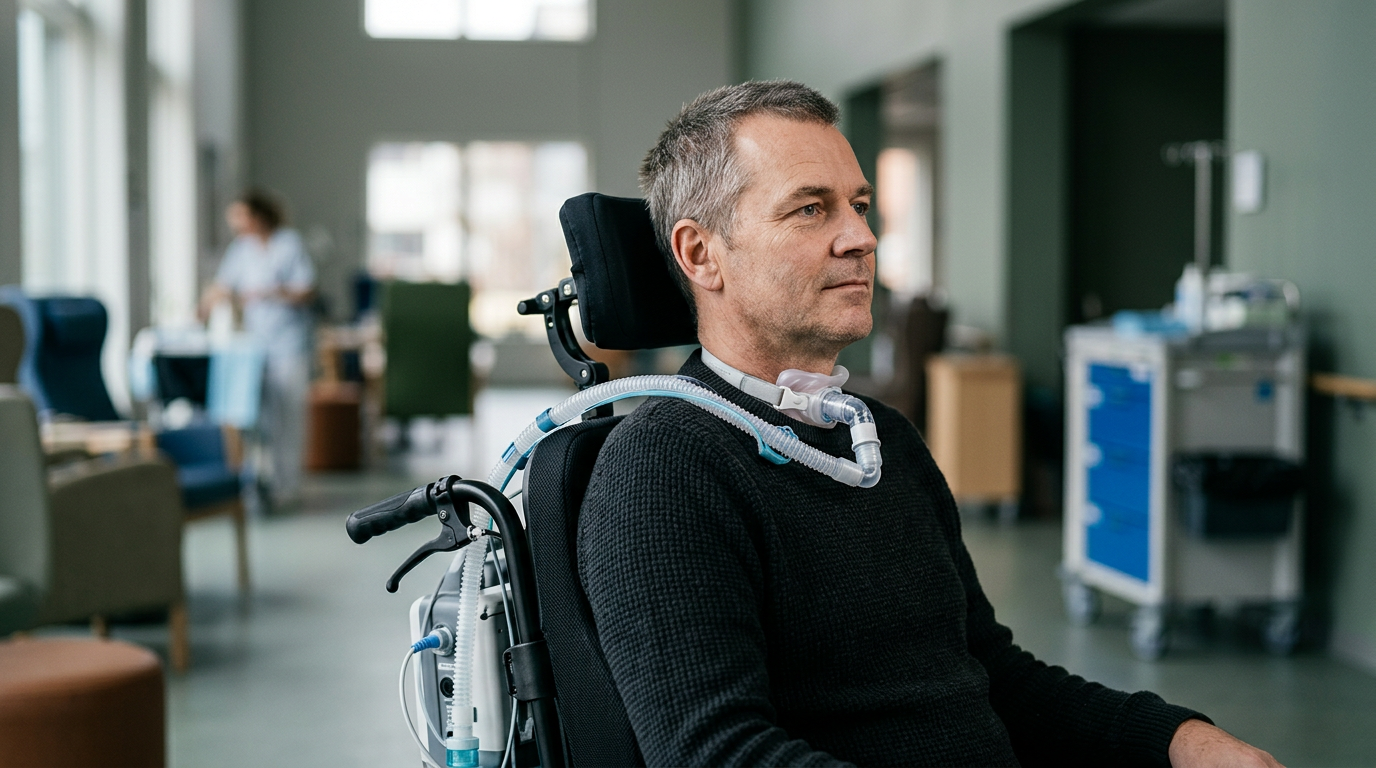
Most people on long-term ventilation breathe through a tracheostomy. This is a small opening in the neck connected to the ventilator. That airway must stay clear. Caregivers do suctioning to remove mucus so the person can breathe safely. This often happens several times a day and through the night.
The ventilator itself needs constant watching. A power failure, a slipped tube, or a blocked airway can become an emergency within minutes.
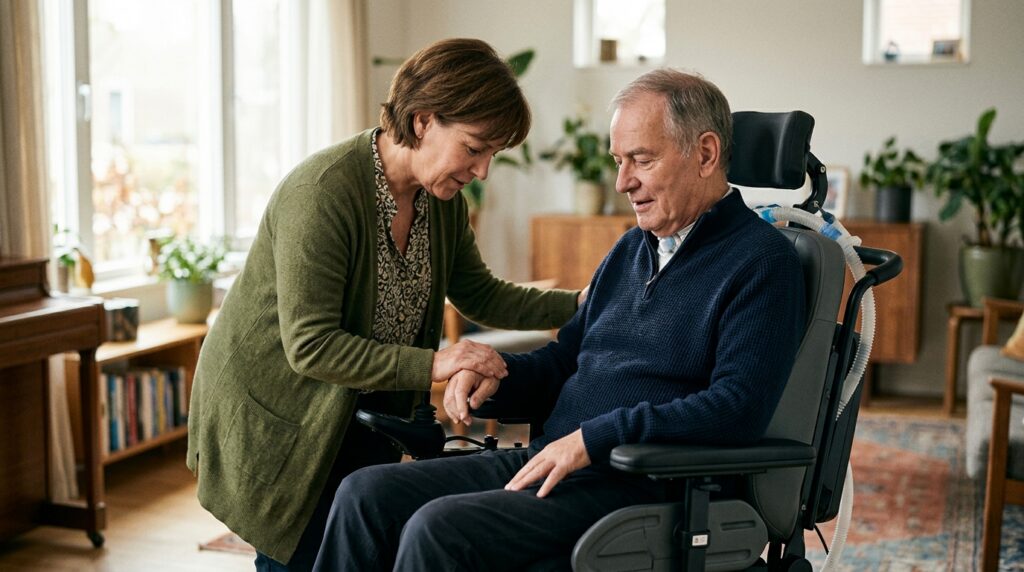
Because of these risks, families often need skilled nurses or trained home-care workers around the clock. When a spouse or parent tries to give that care alone, the toll is huge. It hurts physically, emotionally, and financially. Many family caregivers cut their hours or leave their jobs. That is its own hidden loss that a claim can account for.
Daily life also depends on technology:
- A power wheelchair with special controls gives mobility. These often use a sip-and-puff or head-array system.
- Environmental control systems let a person run lights, a phone, or a TV. They work using small movements, breath, or voice.
- Communication devices matter a lot when speaking is hard. This is especially true with a tracheostomy in place.
Some patients explore diaphragm pacing (also called a phrenic nerve pacemaker). This device stimulates the breathing muscles. It may cut time on the ventilator for some patients. Whether it is an option is a decision made with the medical team. Not every patient can use it.
Not sure what your next step is?
Talk it through with our team — the first consultation is free, confidential, and carries no obligation.
Long-term outlook and life expectancy
Honestly, the outlook varies widely. How long a person lives with this injury depends on several things. These include the injury level, age, and overall health. It also depends heavily on the quality and consistency of their care.
Medical research shows that many people live for years with high-level spinal cord injuries and modern breathing care. We will not give you a guaranteed number, because no honest source can. But one thing is clear. Well-funded, steady care lowers the risk of complications and improves quality of life.
That is why breathing health is the center of care. Breathing complications, especially pneumonia, are a leading cause of death after high-level spinal cord injury. The Mayo Clinic lists breathing problems and pneumonia among the serious risks tied to spinal cord injury. Good airway care, infection prevention, and prompt treatment all help reduce that danger.
Families sometimes ask, “How long is too long on a ventilator?” That is a deeply personal medical decision. It is made with doctors and the family. It is never a legal question, and never one a lawyer should answer. To learn how breathing and other complications factor into a case, see our guide to secondary complications in a paralysis claim.
The lifetime cost of ventilator-dependent care
High-level quadriplegia that needs a ventilator is among the most expensive injuries a person can live with. And the costs continue for the rest of the person’s life.
The expenses stack up across many categories:
- Around-the-clock skilled care — often the single largest cost, because it never pauses.
- The ventilator and supplies — machines, backup equipment, tubing, and tracheostomy supplies, replaced often.
- Medications to prevent and treat infections and other complications.
- Hospital stays when complications like pneumonia occur.
- Home changes — ramps, wider doorways, accessible bathrooms, and backup power for the ventilator.
- Accessible vehicles built to carry a power wheelchair.
- Equipment replacement over decades, since wheelchairs and devices wear out.
Beyond direct care, there is lost income. The injured person may never return to work. A family caregiver often loses income too. These economic losses are real and long-lasting.
To measure future needs, catastrophic cases rely on qualified professionals. A life-care planner maps out every service, device, and treatment the person will likely need for life. A forensic economist then figures out what those needs will cost over time. They adjust for inflation and life expectancy. We cannot promise any dollar figure. But documenting these needs early protects the family and any future claim.
How these catastrophic injuries happen
High-level quadriplegia usually results from sudden, violent trauma to the neck. And often, someone else’s carelessness is behind it.
Common causes include truck and other high-speed crashes, serious falls, and diving accidents. In the catastrophic cases our attorneys handle, we often see how one moment of carelessness leads to a lifetime of care. For fall and diving injuries, see our page on paralysis from a fall or diving accident.
These injuries can also come from violence. Maybe your loved one was shot, stabbed, or attacked on someone else’s property. This could be an apartment complex, a parking lot or garage, a hotel, a bar or nightclub, a gas station, a store, or an ATM. If they were hurt because the owner failed to provide basic safety measures, you may have a claim against that property owner. Basic measures include working locks and gates, good lighting, security cameras, and trained security staff.
Lawyers call this type of case negligent security (also known as inadequate-security premises liability). The key point is simpler than the term. A property owner who ignores obvious, foreseeable dangers may be responsible for the harm that follows.
When another party’s carelessness caused the injury, the family may have the right to seek compensation.
Can a legal claim help pay for lifetime care?
Yes. A catastrophic injury claim can seek money for medical and care costs, lost income, and the deep human losses this injury causes. It cannot undo the injury. And no lawyer can promise a specific result.
To recover, your case generally must show that someone else’s carelessness caused the injury. Florida uses a modified comparative-negligence (shared-fault) rule under Fla. Stat. § 768.81. Under that rule, a person found more than 50% at fault for their own injury generally cannot recover damages.
A claim can pursue two broad types of damages. Economic damages cover measurable losses. These include lifetime care, equipment, home changes, and lost earnings. Non-economic damages cover human losses like pain and the loss of enjoyment of life. To understand how those human losses are valued, read our guide to non-economic damages in paralysis cases.
Time matters. Under Fla. Stat. § 95.11, the deadline to file most Florida negligence claims is generally two years. This applies to claims arising on or after March 24, 2023 (the deadline was previously four years). Deadlines differ by state and by the type of claim. So if the injury happened outside Florida, ask a lawyer promptly. Acting early also helps preserve evidence — security video, maintenance records, and witness accounts — before it disappears.
Have questions about what happened?
Ask our team directly. The first conversation is free, confidential, and there is no obligation to continue.
Talking to a catastrophic injury lawyer
A free case evaluation is a no-obligation talk. You discuss what happened and what your options might be.
When you speak with any firm, these questions help you compare:
- Do your attorneys have experience with high-level spinal cord injury cases?
- Do you work with life-care planners and economists to document lifetime needs?
- How do you handle case costs while a case is pending?
Our licensed attorneys are admitted to The Florida Bar. We handle catastrophic injury cases and take cases nationwide from our Florida base. We publish resources in English and Spanish so families can understand their options clearly. This is a gap the clinical and course-based sources online rarely fill. In keeping with Florida Bar advertising rules, we make no promises about outcomes and cite no invented statistics. We tell you only what we can stand behind.
If you are facing the reality of ventilator-dependent quadriplegia, you do not have to sort out the legal side alone. You can contact us for a free case evaluation. To learn more about related injuries and claims, visit our paralysis injury resource hub.
Frequently asked questions
How long can a quadriplegic live on a ventilator?
It varies widely. It depends on injury level, age, health, and quality of care. Many people live for years with high-level injuries and modern breathing care. But no one can honestly guarantee a specific number.
What is the leading cause of death in quadriplegics?
Breathing complications, especially pneumonia, are a leading concern after high-level spinal cord injury. That is why careful, steady breathing and airway care is so important.
How long is too long for someone to be on a ventilator?
That is a personal medical decision. It is made with the person’s doctors and family. It is never a legal question, and no lawyer should answer it for you.
Do quadriplegics need a ventilator?
Not all of them. Ventilator dependence usually comes with the highest neck-level injuries, around C4 and above. Many lower injuries leave enough function to breathe without a machine.
Can we bring a claim if our loved one cannot speak for themselves?
Yes. A family member or legal representative can often pursue a claim for an injured person who cannot act for themselves. A catastrophic injury attorney can explain how this works in your situation.
This article is general information, not legal advice, and does not create an attorney-client relationship. For advice about your specific situation, speak with a licensed attorney.
Be Careful With Insurer Estimates of Future Care
Insurance companies often propose settlements that fall far short of what a lifetime of ventilator-dependent care actually costs. Before accepting any offer or signing any document, talk with an attorney who can work with life-care planners and medical experts to project the true, lifelong expense.
The Lifetime Costs Families Face
Round-the-Clock Care
Ventilator-dependent quadriplegia typically requires skilled nursing or trained caregivers 24 hours a day, every day, for the rest of a person's life.
Equipment & Supplies
Ventilators, backup units, suction machines, power wheelchairs, and a steady stream of consumable supplies must be maintained and replaced over time.
Home Modifications
Wheelchair access, widened doorways, accessible bathrooms, and backup power for life-support equipment often mean major renovations or a new home.
Ongoing Medical Care
Frequent physician visits, respiratory therapy, and monitoring for complications like pneumonia add up to substantial recurring costs.
How Our Firm Helps After a Catastrophic Spinal Cord Injury
Building the Full Picture of Loss
We work with medical and life-care planning experts to document the lifetime cost of ventilator-dependent care, so nothing is left out of a claim.
Identifying Who Is Responsible
Whether the injury came from a truck crash, a preventable accident, medical negligence, or unsafe conditions, we investigate who may be legally accountable.
Compassionate, Plain-Language Guidance
We explain your options clearly and handle the legal process so your family can focus on care and recovery.
Bilingual Support for Families
Our team communicates in English and Spanish, keeping every family fully informed at each step.