

Spinal Cord Injuries & Paralysis
Can You Recover From Paralysis? An Honest Guide
Facing paralysis after a serious accident raises one urgent question: will function ever come back? Here is a plain-language, honest look at what recovery can and cannot mean — and how to protect your future while you focus on healing.
Why Families Turn to CHG
Nationwide
Catastrophic-injury cases accepted across the U.S.
Bilingual
Guidance in English and Spanish
Licensed
Florida Bar–admitted attorneys
No fee upfront
Free, no-obligation case evaluation
By CHG Lawyers · Published August 02, 2026
Can You Recover From Paralysis? An Honest Answer About Complete vs. Incomplete Spinal Cord Injuries
“Will I walk again?” — or “Will my son, my wife, my father walk again?” This is almost always the first question after a spinal cord injury. You deserve a straight answer, not vague comfort.
Here it is. Some people do regain function. This happens most often with incomplete injuries. Many people with complete injuries do not walk again. The biggest factor is whether your spinal cord is fully or partly damaged. And in the first days, even doctors often can’t say for sure.
This page explains the medical picture honestly and in plain words. It gives you the terms to understand your own diagnosis. It does not promise any specific medical result. It is written for injured people and their families. Attorneys admitted to The Florida Bar who handle catastrophic-injury cases have reviewed it. (Disponible en español — pídanos la versión en español.)
Not sure what your next step is?
Talk it through with our team — the first consultation is free, confidential, and carries no obligation.
The honest short answer
Recovery from paralysis is possible for some people. But it is often partial. It is usually slow. And it is never guaranteed.
The Cleveland Clinic is blunt: there is no cure for permanent paralysis. Some temporary forms can improve or go away. Where a spinal cord injury falls on that range depends on the medical details. As the Mayo Clinic explains, the level and completeness of the injury largely decide what recovery is possible.
So the honest answer is not a clean yes or no. It is “it depends.” The details below are what it depends on.
Complete vs. incomplete: the words that decide your odds
If you learn only two terms, learn these.
- A complete injury means no movement (motor) or feeling (sensory) is left below the injury.
- An incomplete injury means some signals still cross the damaged area. So some movement or feeling survives.
Incomplete injuries carry a much better chance of some recovery than complete injuries. This is where some marketing-driven “recovery clinic” pages soft-pedal the truth. Complete injuries often do not improve. No amount of therapy or hope changes that biology. You deserve to know that going in.
The ASIA Impairment Scale, in plain English
Your doctor grades the injury using the ASIA Impairment Scale (AIS). It is part of the standards developed by the American Spinal Injury Association. It runs from A to E:
- AIS A — Complete. No movement or feeling in the lowest sacral segments (S4–S5).
- AIS B — Incomplete. Feeling is preserved below the injury, but no movement.
- AIS C — Incomplete. Some movement below the injury. But most key muscles are too weak to work against gravity.
- AIS D — Incomplete. Movement below the injury. And most key muscles can work against gravity.
- AIS E — Normal movement and feeling have returned.
Ask your care team which grade applies to you. It is the closest thing to a map of what may lie ahead. You have a right to understand it.
Hold onto one thing: “incomplete” does not mean “minor.” An AIS B or C injury is still catastrophic and life-altering. A person with an incomplete injury may still need lifelong care, therapy, and equipment.
Why early predictions can be wrong — spinal shock
Here is something most pages skip. Right after a serious injury, the body can enter spinal shock. This is a temporary shutdown of reflexes and function below the injury. During spinal shock, an injury can look complete when it is not.
That is why careful doctors avoid firm predictions in the first days and weeks. A person may score AIS A early on. Then they may regain some function as the shock wears off. The uncertainty is agonizing for families. But it is more honest than a false promise.
When recovery does happen, it is usually greatest in the first 6 to 12 months. Then it slows. Improvement can continue past a year. But the early window tends to be the most active.
A warning worth stating plainly: beware “cure” clinics
When you are desperate for hope, you become a target. Be very careful of any clinic that promises a “cure,” a “breakthrough,” or guaranteed results. These are often overseas and cash-only. They may push stem-cell injections or private treatments not offered through real research programs.
Real spinal cord recovery is slow. It is different for each person. And it is impossible to guarantee. No honest provider promises an outcome. Does a program guarantee you’ll walk again in exchange for a large up-front payment? Treat that as a red flag, not a lifeline. Real experimental options run through registered clinical trials and a spinal cord injury specialist — not a sales pitch. You can search trials at ClinicalTrials.gov.
What affects your prognosis
Beyond complete versus incomplete, the main factors are:
- Level of injury. A neck-level (cervical) injury affects more of the body than a mid-back (thoracic) or lower-back (lumbar) one. Higher injuries tend to be more severe.
- Age and overall health. Younger, healthier bodies sometimes adapt more.
- Time to emergency treatment. The Mayo Clinic notes the gap between injury and treatment can be critical.
- Secondary complications. Pressure sores, urinary infections, blood clots, and pneumonia can stall recovery. They are dangerous in their own right.
Have questions about what happened?
Ask our team directly. The first conversation is free, confidential, and there is no obligation to continue.
Can a quadriplegic (or paraplegic) ever walk again?
Some people with incomplete injuries regain the ability to walk. For many people with complete injuries, walking does not return.
Quadriplegia (tetraplegia) affects all four limbs. It comes from injuries in the neck (cervical spine). Paraplegia affects the legs and lower body. It comes from injuries lower on the spine. In both, completeness drives what is possible.
But we think “recovery” deserves a wider meaning than walking. For many people, real progress looks like:
- Regaining hand or arm control. For a person with a neck injury, this can mean the difference between depending on others and feeding yourself.
- Gaining more feeling, or regaining bladder and bowel control.
- Living more independently at home.
- Returning to work, school, or hobbies with changes and support.
Assistive technology restores independence too. This includes power wheelchairs, adapted vehicles, home changes, and communication tools. Walking is one goal. It is not the only one that matters.
How rehabilitation supports recovery
Steady, high-quality rehab makes a real difference. It affects how much function and independence a person regains.
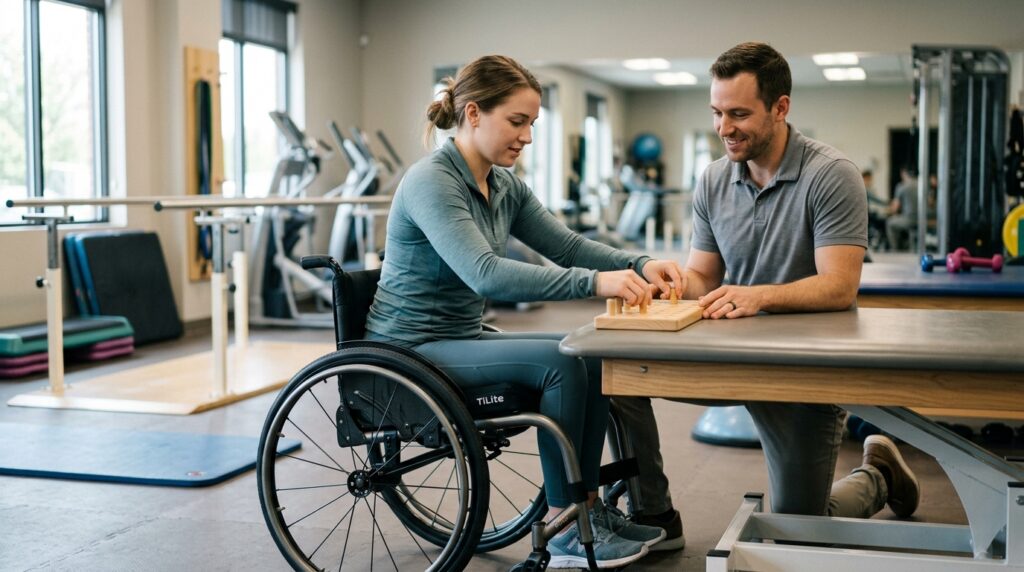
Physical therapy rebuilds strength and retrains movement. Occupational therapy helps people re-learn daily tasks — dressing, cooking, working. Specialized spinal cord injury centers use full care teams. That includes physiatrists (rehab doctors), therapists, nurses, and mental-health providers.
Part of how rehab works is neuroplasticity. This is the nervous system’s ability to form new pathways. Repeated, focused practice can help the body relearn or reroute some functions over time.
Now the hard reality: this care is expensive and lifelong. The Christopher & Dana Reeve Foundation and other patient groups have long shown that lifetime costs of a severe spinal cord injury can reach into the millions of dollars. Those costs come from inpatient rehab, ongoing therapy, equipment, and home changes. Access to good care often shapes outcomes as much as the injury itself. That is exactly why families need to understand who may be legally responsible for those costs.
Emerging and experimental treatments
Researchers are testing promising ideas. But these are research and specialized options — not proven cures.
The NIH has reported on funded work, including:
- Epidural electrical stimulation. This sends signals to the spinal cord to encourage movement.
- Robotic exoskeletons. These are wearable devices that support standing and stepping.
- Research into regrowing nerve connections across the damaged area.
These are genuinely exciting. But they are also early, limited, and not available to everyone. Are you curious about an option? Talk with a spinal cord injury specialist. Look it up on ClinicalTrials.gov — not an unverified clinic making bold claims.
The emotional and psychological side
Recovery is not only physical. Grief, anger, and a hard adjustment are normal. So is anxiety about the future. Counseling, peer support, and support groups help many people rebuild purpose and hope. Connecting with others who share the same injury can be powerful.
Families carry a heavy load too. Caregiving often falls on spouses, parents, and children. They suddenly become full-time helpers. This is exhausting, both emotionally and financially. In the catastrophic-injury cases our attorneys handle, this caregiving strain is one of the most overlooked costs of a paralyzing injury.
Want to know where you stand?
Tell us what happened and our team will walk you through the options available to you, at no cost.
When paralysis is caused by someone else’s negligence
Did your paralysis come from a truck crash, an unsafe property, or medical negligence? If so, the person or company at fault may be responsible for the cost of your lifelong care.
This is where the medical and legal pictures meet. Even an “incomplete” injury can require millions of dollars in lifetime care. That includes therapy, surgeries, equipment, home changes, and lost income. Those numbers are not dramatic. They are realistic for a permanent injury. A personal-injury claim can seek payment for them. We can’t promise any specific result, and no honest firm can. But understanding your options early matters, because Florida sets deadlines.
For most negligence claims that started on or after March 24, 2023, Florida generally gives you two years to file a lawsuit. This is under Fla. Stat. §95.11. Florida also uses a modified comparative-negligence rule under Fla. Stat. §768.81. This means a person found more than 50% at fault generally recovers nothing.
Were you hurt because a property owner failed to provide reasonable security? Maybe you were assaulted, shot, or attacked in a poorly lit parking garage. Maybe it was an apartment complex with broken gates, or a business with a known crime problem. If so, you may have a claim against that owner. Lawyers call this negligent security. Learn more in our guide to property-owner liability for violent attacks.
A free case evaluation with licensed attorneys can help your family understand what’s possible — with no obligation.
Key takeaways
- Recovery is possible for some people, especially with incomplete injuries. But it’s often partial and never guaranteed.
- Ask your care team your ASIA (AIS) grade. It’s the closest thing to a map of what may lie ahead.
- Early “complete” findings can shift as spinal shock wears off. That’s why doctors avoid firm early predictions.
- The first 6–12 months are often the most important window for improvement.
- Be wary of any clinic guaranteeing a “cure.”
- If negligence caused the injury, learning your legal options early can help protect access to lifelong care.
Learn more and get help
For a full overview of your legal options, see our main guide to paralysis injury claims. You may also find these helpful:
- Spinal cord injuries — causes, types, and next steps.
- How insurers value paralysis claims.
- Family caregiving and a paralysis claim.
CHG Personal Injury Lawyers represents people with catastrophic, life-altering injuries across Florida and nationwide. To talk through your situation, request a free, no-obligation case evaluation.

Frequently asked questions
Can you recover from paralysis?
Some people recover part or most function, especially with incomplete spinal cord injuries. But complete injuries are often permanent, and no outcome is guaranteed.
What’s the difference between a complete and incomplete spinal cord injury?
A complete injury leaves no movement or feeling below the injury level. An incomplete injury leaves some. Doctors grade this using the ASIA Impairment Scale (AIS), A through E.
Why won’t my doctor say whether I’ll walk again?
Early after injury, the body can enter spinal shock. This temporarily hides function and makes an injury look worse than it is. Honest doctors wait rather than guess.
Can a quadriplegic ever walk again?
Some quadriplegics with incomplete injuries regain walking ability. But for many with complete injuries, walking does not return. So recovery is often measured by independence.
Does an incomplete spinal cord injury mean it’s minor?
No. “Incomplete” only means some signals still pass through the injury. These are still catastrophic injuries that often need lifelong care.
Should I trust a clinic that guarantees a cure?
No. Real recovery can’t be guaranteed. Real experimental options run through registered clinical trials and a spinal cord specialist, not a cash-only sales pitch.
Who pays for lifelong care after a paralyzing injury?
If someone else’s negligence caused the injury, that at-fault party may be responsible. A personal-injury claim can seek payment for those costs.
Complete vs. Incomplete: Why It Matters
Complete Spinal Cord Injury
A complete injury means no movement or feeling below the level of the injury. These injuries are often permanent. Some people regain limited function through medical care and rehabilitation, but no doctor can promise recovery.
Incomplete Spinal Cord Injury
An incomplete injury leaves some signals passing through the damaged area. People with incomplete injuries have a wider range of possible outcomes and, in some cases, recover part or most of their function over time.
Every Case Is Different
Age, overall health, the location and severity of the injury, and how quickly care began all shape recovery. Beware of anyone — including a defendant's insurer — who claims to know your outcome for certain.
Be Cautious About Early Settlement Offers
The long-term cost of paralysis — surgeries, therapy, home modifications, equipment, and lost income — often becomes clear only over months or years. Settling before your medical picture is understood can leave you without the resources you'll need. Talk with a lawyer before signing anything.
How the Right Legal Help Supports Recovery
Documenting the Full Impact
We work with medical and life-care experts to capture the true, lifelong cost of a spinal cord injury — not just today's bills.
Standing Up to Insurers
You focus on rehabilitation. We handle the adjusters, paperwork, and negotiations on your behalf.
Care That Respects Your Situation
Paralysis reshapes daily life. We listen first and explain your options in plain language, in English or Spanish.
Holding the Right Parties Accountable
Whether your injury came from a truck crash, an unsafe property, or medical negligence, we identify who is responsible and pursue accountability.