
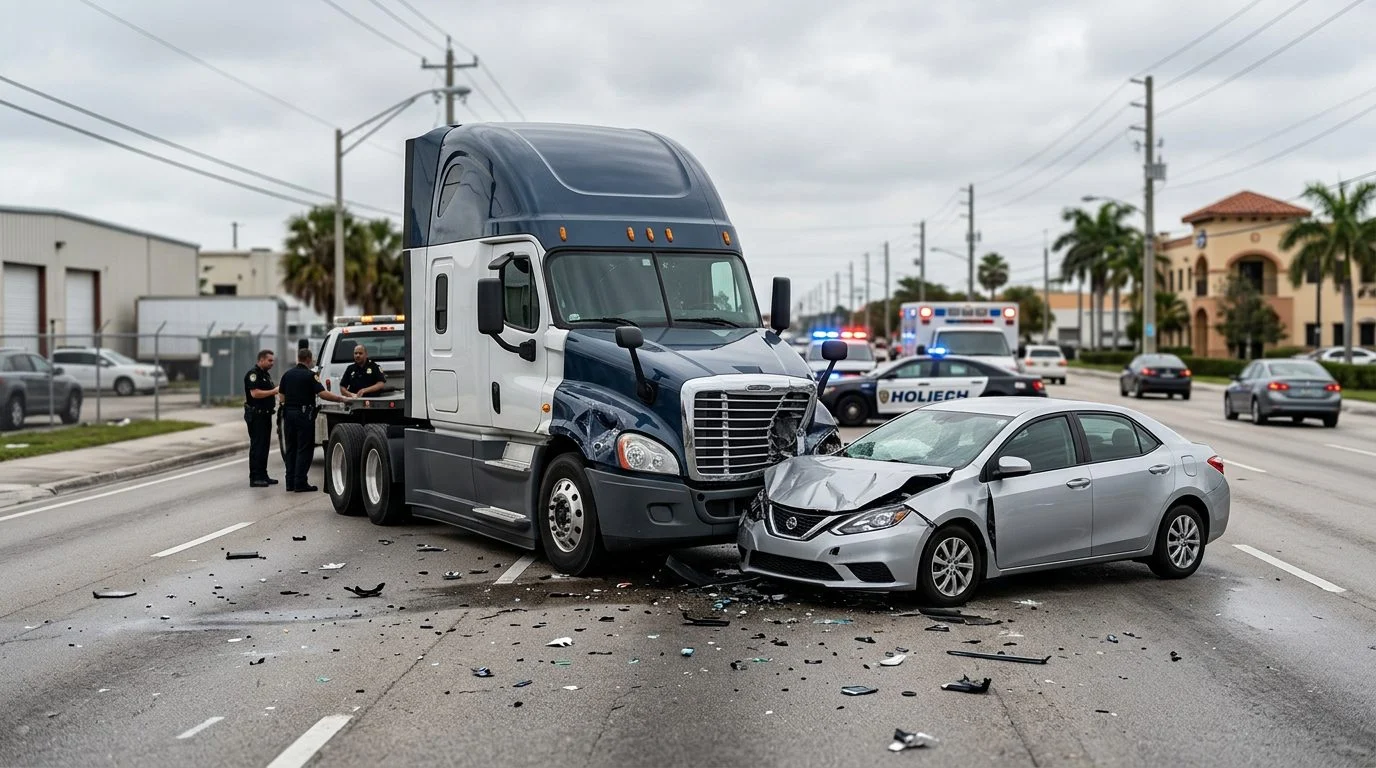
Hialeah | FedEx Truck Accidents
Hurt in a FedEx Truck Crash in Hialeah? Here Is What to Do Next
Plain-language steps for injured people and their families, from a Florida-based personal injury firm that handles truck accidents, including crashes involving FedEx trucks.
Why Families Contact CHG
Free
First consultation, confidential and without obligation
Florida
Florida-based firm serving clients throughout Florida
Licensed
Attorneys admitted to The Florida Bar
By CHG Lawyers · Published October 25, 2026
A crash with a FedEx truck can turn an ordinary day into a long, hard one. If you or someone you love was hurt in Hialeah or elsewhere in Miami-Dade, you may have a claim against the people responsible. This guide explains the first steps, the Florida rules that matter and what families can do after a fatal crash.
Why a FedEx Truck Crash in Hialeah Can Change Everything
A crash with a large delivery truck can cause more serious harm than a crash between two cars. A loaded truck weighs far more than a passenger vehicle, and that gap matters in a split second.
Hialeah drivers share busy roads with commercial trucks every day. Palmetto Expressway (SR 826), Okeechobee Road (US 27), I-75 and I-95 carry commuters, delivery vans and tractor-trailers in the same traffic. Hialeah Park, with its famous flamingos, sits at the heart of the city. A sudden collision on any of these routes can leave a family dealing with hospitals, insurance calls and lost paychecks all at once.
Physical injuries are often only part of the story. Many people also deal with fear behind the wheel, sleepless nights and worry about bills. Those burdens are real, and you don’t have to carry them alone.
For the broader Florida picture, read our FedEx truck accidents guide.
If you or someone you love was hurt in Hialeah or elsewhere in Miami-Dade, you may have a claim against the people responsible. Talk it through with our team — the first consultation is free, confidential, and carries no obligation.
What to Do in the First Days After a FedEx Truck Crash
The first days matter most for your health and your proof. Get medical care quickly, and follow the care plan your doctors give you. Some symptoms appear hours or days after a crash, so keep every appointment and tell your doctor about any new pain.
Next, request the crash report. Under Fla. Stat. § 316.066, a Florida Traffic Crash Report, Long Form, must be completed and submitted within 10 days after the investigating officer finishes the investigation of a crash involving death, personal injury, any indication of complaints of pain or discomfort, a violation of certain traffic laws, a vehicle that had to be towed from the scene, or a commercial motor vehicle. Under Fla. Stat. § 316.066(2)(a), crash reports that reveal personal information about the parties involved are confidential for 60 days after the date the report is filed. Under § 316.066(2)(b), those reports may be made immediately available to the parties involved in the crash and their legal representatives. Write down the report number the officer gives you.
Take photos if it’s safe to do so. Capture vehicle damage, road conditions, traffic signals and any company name, logo or trailer number on the truck. Write down the names and phone numbers of witnesses while memories are fresh.
Keep a daily journal. Note your pain, missed work, rides to medical visits and every out-of-pocket cost. A simple log can show later how the crash changed your daily life.
Be careful with insurance calls. An adjuster may ask for a recorded statement or offer a quick payment. Those requests can come before you know the full extent of your injuries, so take your time before you agree to anything.
Who May Be Responsible in a FedEx Truck Accident
More than one party may be responsible after a FedEx truck crash. The driver is one possibility. The company that employed or contracted the driver is another. Depending on the facts, the truck’s owner or leasing company, and anyone responsible for maintenance or loading, may also be part of the picture.
Many people assume the company that owns the truck is automatically to blame. That isn’t always the right place to start. Who owns the truck, who leases it and who employed the driver are separate questions, and each one needs checking.
Florida law divides fault among those found responsible. Under Fla. Stat. § 768.81, in a negligence action the court enters judgment against each liable party based on that party’s percentage of fault. In a negligence action, the court shall enter judgment against each party liable on the basis of such party’s percentage of fault and not on the basis of the doctrine of joint and several liability. This section does not apply to any action brought by any person to recover actual economic damages resulting from pollution, to any action based upon an intentional tort, or to any cause of action as to which application of the doctrine of joint and several liability is specifically provided by chapter 403, chapter 498, chapter 517, chapter 542, or chapter 895 (Fla. Stat. § 768.81). In plain terms, each responsible party answers for its own share.
Early investigation matters for this reason. Who played a role often becomes clear only after records, reports and witness accounts are reviewed. How responsibility is decided depends on the facts of each crash.
Evidence That Matters More in Commercial Truck Cases
Trucking companies keep detailed records, and those records can show what happened before a crash. Federal rules limit how long commercial drivers may work and drive. Under 49 CFR 395.3, a driver may not drive without first taking 10 consecutive hours off duty. Under 49 C.F.R. § 395.3, a driver may not drive after a period of 14 consecutive hours after coming on duty following 10 consecutive hours off duty.
Hours are usually recorded electronically. Under 49 CFR 395.8, motor carriers operating commercial vehicles must install and require drivers to use an electronic logging device to record duty status, though a carrier may require manual records instead for drivers in certain listed situations, such as certain driveaway-towaway operations or pre-2000 model vehicles. The driver certifies each entry by signing it. These logs can show whether a driver was rested or on the road too long.
Driver files matter too. Under 49 CFR 391.51, a motor carrier must keep a driver qualification file that includes the driver’s employment application, a motor vehicle record and a medical examiner’s certificate. Some of these records may be removed three years after the date of execution. Waiting can put proof at risk.
Other records that may matter include maintenance and inspection records, dispatch messages and onboard camera footage. Accident reconstruction engineers are sometimes used to explain how a crash happened. Records can be lost or overwritten when no one asks for them early.
Not sure what your next step is?
Talk it through with our team — the first consultation is free, confidential, and carries no obligation.
Recent FedEx Truck Crashes in Florida and What the Reports Say
News reports describe FedEx truck crashes in Florida, but they are not final findings. Each account reflects what officials or witnesses reported at the time.
WOGX reported a FedEx truck crash on Interstate 4 that shut down lanes in a story posted October 13, 2015 (WOGX report). CBS12 reported that a FedEx cargo truck crashed on southbound Florida’s Turnpike on a Tuesday morning in July 2018, and that the driver attributed the crash to heavy overnight rains (CBS12 report).
KPTV reported in 2025 that a truck driver was accused of causing a deadly crash on Florida’s Turnpike (KPTV report). An accusation is not a finding. Charges remain allegations until a court decides them.
Federal rules also govern testing after a deadly crash. Under 49 CFR 382.303, after a crash involving loss of life, the employer must test each surviving driver who was performing safety-sensitive functions for alcohol, as soon as practicable. If a controlled substances test is not given within 32 hours, the employer must stop trying and keep a record of the reasons.
How a Criminal Case Against a Driver Differs From a Civil Claim
A criminal case against a driver and a civil injury claim are separate paths with separate goals. The government brings a criminal case, and it focuses on punishment. A civil injury claim is brought by the injured person or family, and it seeks compensation for the harm.
This separation matters for families. The result of a criminal case does not, by itself, decide how much a civil claim is worth. It also does not decide who is responsible for the crash. The two cases can move at different speeds.
Remember that news reports and charging papers describe accusations. Until a court rules, those accusations remain open questions. Your own claim is built from your own records, your medical care and the evidence from the crash.
Keep copies of any court notices you receive. Questions about how a criminal case may affect your timeline are worth raising early, before key dates pass.
Florida Deadlines and Insurance Rules Readers Should Know
Florida sets deadlines for filing lawsuits, and the time limit depends on the type of claim. Those limits come from statute, including Fla. Stat. § 95.11, which lists the filing periods for different kinds of actions. Wrongful death claims have their own period under that same statute. Deadlines apply to your case, so don’t wait.
Fault matters too. Under Fla. Stat. § 768.81, in a negligence action, any party found to be greater than 50 percent at fault for his or her own harm may not recover any damages. This rule does not apply to medical negligence claims under chapter 766. The practical point is simple: how fault is shared can change what is recoverable.
Insurance adds another layer. Facing an insurance company alone can feel like a race with no finish line in sight. Keep copies of every letter, claim number and payment. Write down who you spoke with and when.
Have questions about what happened?
Ask our team directly. The first conversation is free, confidential, and there is no obligation to continue.
When a FedEx Truck Crash Takes a Life: Wrongful Death and the Family’s Next Steps
Florida law lets a family pursue a wrongful death claim after a fatal crash. Under Fla. Stat. § 768.19, when a death is caused by someone’s wrongful act or negligence, and the injured person could have sued had they lived, the responsible party may be liable for damages. Under Fla. Stat. § 768.20, the decedent’s personal representative brings the action for the survivors and the estate.
The damages the law recognizes are specific. Under Fla. Stat. § 768.21, a surviving spouse may recover for loss of companionship and protection and for mental pain and suffering. Minor children, and all children of the decedent if there is no surviving spouse, may recover for lost parental companionship, instruction and guidance. Each parent of a deceased minor child may recover for mental pain and suffering. A survivor who has paid medical or funeral expenses may recover them.
Families often face these questions while still grieving. Practical steps can help. Obtain the crash report, keep the loved one’s medical and funeral records, and store personal property safely until it has been reviewed. Keep a written record of the family’s losses, including lost income and household help.

Talk With Our Team About Your FedEx Truck Accident
If a FedEx truck crash has affected your family in Hialeah, you may have a claim worth reviewing. Florida law sets clear rules for who may sue and when, and the facts of your crash shape what those rules mean for you.
Where did the FedEx truck crash?
News reports have covered FedEx truck crashes on Interstate 4 and on Florida’s Turnpike. Each report describes the crash it covers.
How long do I have to file a claim?
Florida sets filing deadlines for injury and wrongful death claims, and the period depends on the type of claim. Because deadlines apply, act promptly.
Who can bring a wrongful death claim?
Under Florida law, the decedent’s personal representative brings the claim for the survivors and the estate.
Igor Hernandez is the responsible lawyer for this page. CHG Personal Injury Lawyers is a Florida personal injury firm that serves Hialeah, Miami-Dade and communities across Florida. CHG charges no attorney’s fees and no case costs unless there is a recovery. The first consultation is free, confidential and comes with no obligation to continue.
If you’re weighing whether to call about a FedEx truck crash, don’t wait for the paperwork to pile up. Contact our team to talk through your situation and your options.
First Steps After a FedEx Truck Crash
Get Medical Care Right Away
Some serious injuries do not show symptoms until hours or days later. Seek medical attention promptly and follow your doctors' care.
Write Down What You Remember
Note the date, time, location, weather, and what the truck and other vehicles were doing. Details fade quickly, so record them while they are fresh.
Keep Every Record
Save police reports, photos, medical bills, pay stubs, and any letters from insurers. Organized records help your case from the start.
Talk to a Lawyer Before Speaking with an Insurer
FedEx, its contractors, and insurance adjusters may contact you early. Speak with a Florida injury lawyer before giving a recorded statement or signing anything.
Be Careful With Early Requests
A trucking company or its insurer may ask for a recorded statement, a medical release, or a quick settlement. Please talk with a lawyer first so you understand what you are agreeing to.
How CHG Personal Injury Lawyers Can Help
Free, Confidential Consultation
Tell us what happened in a private, no-obligation conversation. There is no cost to find out how we can help.
Focus on Your Recovery
Our team handles the paperwork, insurance calls, and case details so you and your family can focus on healing.
No Fees Unless There Is a Recovery
CHG charges no attorney's fees and no case costs unless there is a recovery.
Serving Hialeah and Florida
We help people injured in truck accidents across Miami-Dade County and throughout Florida, in plain language and in English or Spanish.