
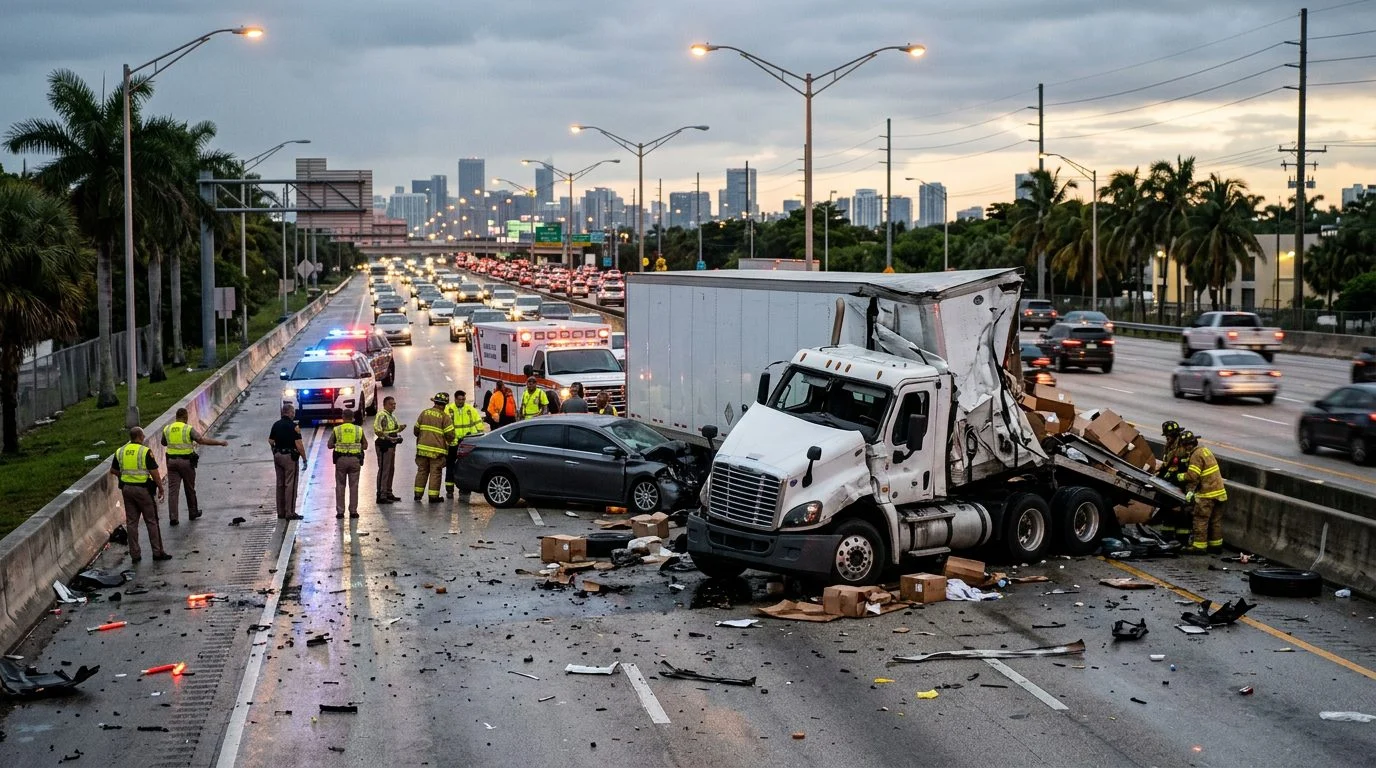
Commercial Truck Accident Statistics in Florida
By CHG Lawyers · Published November 27, 2026
If a commercial truck crash hurt you or someone you love, you may want numbers that explain what happened. Florida’s truck crash figures come from state crash reports and federal fatal-crash records. They count crashes, injuries, and deaths.
These numbers describe patterns across many crashes. They cannot tell you what happened in your crash.
This guide explains where the data comes from. It also explains what each figure measures. Finally, it shows how the numbers connect to the steps injured people and families take next.
For the wider picture, see our truck accident guide.
Why Florida’s Truck Crash Numbers Matter to Your Situation
Most people who look up truck crash statistics are dealing with a crash they did not choose. Some are recovering from surgery or therapy. Others are sorting through medical bills, insurance letters, and a damaged vehicle.
Many are caring for a parent, spouse, or child. That person may not be able to handle the paperwork alone.
Statistics can help you see the bigger picture. A crash count shows how often serious crashes happen across the state.
But a count does not show who was at fault in one crash. It does not show how badly one person was hurt. It also does not show what a claim may be worth.
The facts of your own crash answer those questions. These facts include the crash report, medical records, and witness accounts.
The rest of this page covers the main data sources. It explains what the figures measure and the causes crash reports often record. It also covers Florida deadlines and the steps that follow a crash.

Where Florida’s Truck Crash Data Comes From
Florida’s truck crash data comes from three main places:
- State crash reports
- State crash records
- Federal fatal-crash data
Each source measures something a little different. It helps to know which source you are reading.
Under Florida law, a Florida Traffic Crash Report, Long Form, must be completed and submitted for a motor vehicle crash that results in death, personal injury, or any complaint of pain or discomfort, or that involves a commercial motor vehicle. The report is due within 10 days after the investigating officer finishes an investigation of a crash that results in death, personal injury, or any complaints of pain or discomfort, or that involves a commercial motor vehicle. The Florida crash reporting statute sets that rule for crashes that result in death, personal injury, or any indication of complaints of pain or discomfort, that involve certain violations or require a wrecker, or that involve a commercial motor vehicle.
The Florida Department of Highway Safety and Motor Vehicles (FLHSMV) keeps the state’s crash records.
For fatal crashes, the National Highway Traffic Safety Administration runs the Fatality Analysis Reporting System (FARS). FARS is a federal database. It holds detailed records on deaths in motor vehicle crashes.
The Federal Motor Carrier Safety Administration (FMCSA) organizes commercial vehicle crash data. Its crash rate data measures fatal crashes per 100 million vehicle-miles traveled. A “vehicle-mile” is one mile driven by one vehicle.
A rate adjusts for how much driving happens. That makes it different from a raw count.
Why do totals differ? Each source uses its own rules. The rules cover:
- Which vehicles count as commercial
- When a crash is counted
- How a later death is linked to an earlier crash
Check the source and the year before you compare two numbers.
What the Florida Data Shows About Truck Crash Injuries and Deaths
Crash data sorts each crash into a few main groups:
- Fatal: At least one person dies.
- Injury: At least one person is hurt, but no one dies.
- Property-damage-only: Only vehicles are damaged, and no injury is reported.
These labels matter for real people. A crash listed as property-damage-only can still hide an injury. That injury may show up days later. A back or neck injury or a concussion can appear this way.
Symptoms that appear later are common. That is why following your doctors’ care matters.
Fatal crashes are counted separately because a death is permanent. Behind every fatal count is a family. That family faces a loss, funeral arrangements, and questions about what happened.
Florida law makes a person who causes a death through a wrongful act or negligence responsible for damages. Negligence means failing to use reasonable care. This rule applies even though the injured person died. The wrongful death statute sets out that rule. Our wrongful death guide explains how families approach that claim.
Injury counts also include many people with serious, long-lasting injuries. Spinal cord injuries, traumatic brain injuries, and amputations can change work, home life, and independence for years. A crash count cannot show those long-term effects.
Check the latest published FLHSMV and FMCSA figures. Always note the year on each one.
Common Causes Recorded in Truck Crash Reports
Crash reports record the factors investigators noted at the scene or afterward. Several factors come up often in truck crash cases:
- Distraction
- Fatigue
- Hours-of-service problems
- Speeding
- Following too closely
- Unsafe lane changes
- Improper loading
Some of these factors tie to federal rules. Drivers of commercial motor vehicles may not text while driving. The only exception is a narrow emergency.
Another fatigue rule bars a driver from operating a commercial motor vehicle when fatigue, illness, or any other cause leaves the driver’s ability or alertness so impaired, or so likely to become impaired, as to make it unsafe, except that in a grave emergency where compliance would increase the hazard, the driver may continue to the nearest place where that hazard is removed.
Driving-time limits also matter. The driving time rule sets those limits.
The duty status rule explains this requirement.
A recorded factor describes what investigators noted. It is not a legal finding of fault.
Crashes often involve more than one party. These can include:
- The driver
- The company operating the truck
- Another business tied to the load
Box Trucks, Delivery Vans, and Fleet Crashes in Florida
Box trucks and delivery vans are part of the commercial vehicle picture in Florida. Depending on the data source and how the vehicle is used, they may be counted differently from semi-trucks.
Many delivery crashes involve fleet vehicles. Large shipping companies run delivery routes across Florida. These routes run from Miami and Orlando to Tampa and Jacksonville.
When a FedEx or Amazon delivery truck is involved, the questions often reach past the driver. For example:
- Who set the route schedule?
- Did the company track driving hours?
- Was the vehicle inspected and maintained?
Those answers may sit in company records rather than on the crash report. Electronic logging devices can record driving time for covered vehicles. The FLHSMV electronic logging device page describes how those records work.
Whether a particular delivery vehicle falls under these rules depends on how it is classified. Our box truck and delivery van guide covers those details for Florida readers.
Answering Common Questions About Crash Shares and State Comparisons
A truck being involved in a crash is not the same as a truck causing it. Each question below needs a careful reading of the source behind it.
What are most accidents caused by? Crash research often tracks a “critical reason.” This is the factor most directly tied to a crash. The National Highway Traffic Safety Administration’s critical-reason research includes driver-related factors as one category. A critical reason is not a finding of fault.
What percent of accidents involve trucks? The answer depends on what you count. You might count trucks involved in crashes. You might count trucks recorded as the cause. FARS and FMCSA data count these differently. Check the year and the dataset.
Which state has the highest car crash deaths? State rankings change based on the measure. Total deaths, deaths per 100,000 residents, and deaths per vehicle-miles traveled can produce different orders.
How to Request a Florida Crash Report
You request a Florida crash report from the agency that handled the crash. Reports that reveal the parties’ identity, phone numbers, addresses, or other personal information may be confidential and exempt from public release under Florida law for a period after the report is filed. You must show valid identification. You must also sign a sworn statement for each report. You must show valid identification. You must also sign a sworn statement for each report.
The crash report statute sets out these steps:
- Show a valid driver license or other photographic identification, proof of status, or identification that demonstrates your qualifications to access that information.
- File a written sworn statement for each report you request. That statement says the report will not be used for commercial solicitation of accident victims or knowingly disclosed to any third party for the purpose of such solicitation.
Under the statute, parties to the crash, their legal representatives, their licensed insurance agents, their insurers or insurers to which they have applied for coverage, and others such as law enforcement agencies and victim services programs may access crash reports. The report usually lists the parties, the vehicles involved, and a narrative of the crash.
Ask for it promptly. It documents the crash while details are fresh.
A crash report is one piece of evidence. It works alongside medical records, photographs, and witness information.
If the report has an error or is incomplete, ask the agency that created it how corrections are handled.
Florida Deadlines and Who May Be Responsible
Florida’s general deadline for negligence claims is two years. Wrongful death claims fall under the same two-year category, except claims against a natural person for an intentional tort resulting in death from acts described in s. 782.04 or s. 782.07, which may be commenced at any time. The limitations statute sets a two-year deadline for an action founded on negligence. A statute of limitations is the legal deadline for filing a claim. Our statute of limitations guide explains how these deadlines work in practice.
Florida’s 2023 reform, Chapter 2023-15, provides that, except as otherwise expressly provided in this act, it applies to causes of action filed after the effective date of this act. Under Fla. Stat. § 768.81, in a negligence action to which that section applies, any party found to be greater than 50 percent at fault for their own harm may not recover any damages, although the statute lists exceptions, including claims based on an intentional tort. Fla. Stat. § 768.81 reads: “This subsection does not apply to an action for damages for personal injury or wrongful death arising out of medical negligence pursuant to chapter 766.” Under Florida’s comparative fault rules, fault can be divided among the parties involved in an accident.
Several parties can be named after a truck crash. These can include:
- The driver
- The vehicle owner
- The company operating the truck
Florida’s dangerous instrumentality doctrine can hold a vehicle owner responsible. This is a legal rule. It applies when the owner voluntarily lends the vehicle to someone. The borrower’s negligent driving must then injure another person. The Aurbach decision adopted that rule. Statutes and later decisions limit it. Each case turns on its facts.
Deadlines apply, so it helps to act early. Follow your doctors’ care. Do not delay medical treatment while you gather paperwork.
Talking With CHG Personal Injury Lawyers About Your Truck Crash
If you are gathering numbers after a crash that was not your choice, you are not alone. Wanting to understand the facts before you decide on next steps is a normal reaction.
Crash reports, deadlines, and medical records can feel overwhelming. This is especially true when you are caring for someone else.
CHG Personal Injury Lawyers is a Florida-based firm. It serves clients throughout Florida. Igor Hernandez is the responsible lawyer for this page. Our lawyers are licensed attorneys admitted to The Florida Bar.
CHG charges no attorney’s fees and no case costs unless there is a recovery. The first consultation is free and confidential. It carries no obligation to continue.
If you want to talk through your crash, the report, and the timing questions, you can reach CHG Personal Injury Lawyers here.
Frequently Asked Questions
Where can I find statistics on commercial truck crashes in Florida?
Federal crash data on large trucks is available from the National Highway Traffic Safety Administration’s Fatality Analysis Reporting System (FARS). The Florida Department of Highway Safety and Motor Vehicles maintains Florida crash reports. CHG Personal Injury Lawyers, a Florida firm, can help families understand how this information may apply to a specific crash.
Are crashes involving commercial trucks more likely to cause serious injuries or deaths?
Large trucks are much heavier than passenger vehicles. Crashes involving them often cause more severe injuries and deaths for people in the smaller vehicles. Federal crash data reflects this pattern. Every crash is different, though. A doctor should evaluate any injury.
How long do I have to file a truck accident claim in Florida?
Under current Florida law, most personal injury claims must generally be filed within two years. Wrongful death claims also have a two-year deadline in most cases. Exceptions can apply. Contact CHG Personal Injury Lawyers promptly for a free, confidential consultation with no obligation to continue.
Can my family bring a claim if a loved one died in a commercial truck crash?
Florida’s wrongful death law allows certain surviving family members to seek compensation for the loss of their loved one. Our lawyers at CHG Personal Injury Lawyers can explain who may be eligible and what deadlines apply.