

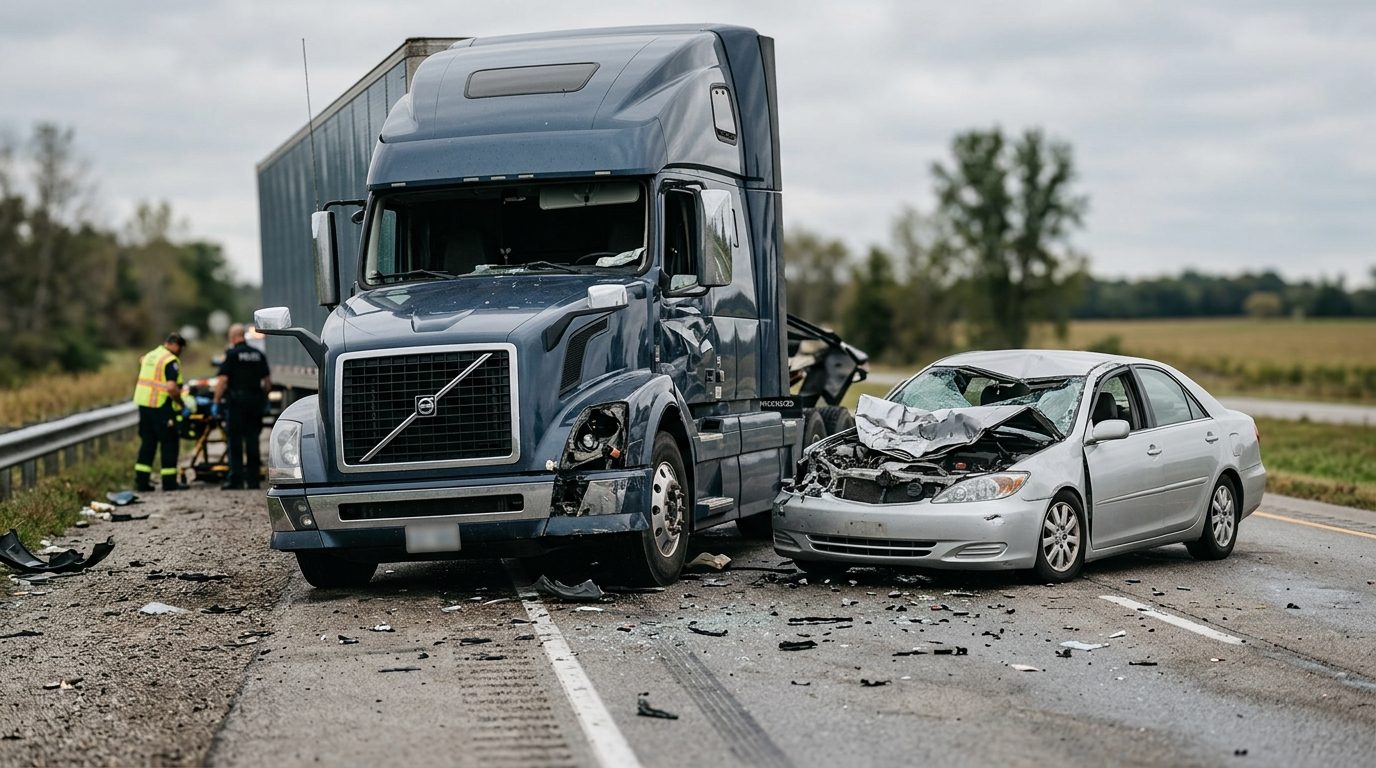
Truck Accident Claims
Trucking Company Liability Goes Beyond the Driver
When a truck crash injures you, the driver may not be the only party responsible. Learn how trucking companies can be held accountable for negligence, poor maintenance, inadequate training, and unsafe practices.
By CHG Lawyers · Published September 20, 2026
Trucking Company Liability Beyond Driver Negligence
After a catastrophic truck crash, injured people often assume the driver bears all responsibility. That’s not always true. Trucking company liability beyond driver negligence is common in serious accidents. The trucking company, freight brokers, maintenance contractors, and others can be held legally accountable.
Understanding who can be sued matters greatly. These other parties typically carry much larger insurance policies than individual drivers. That difference directly affects how much compensation is available to you.
This page explains the main ways trucking companies and third parties can be held liable beyond driver error. You’ll understand your options if you or a family member has suffered a life-altering injury in a truck crash.
If you or a family member has suffered a catastrophic injury in a truck crash, you are likely trying to understand who is responsible. Talk it through with our team — the first consultation is free, confidential, and carries no obligation.
The Driver Is Not Always the Only One at Fault
The truck driver’s negligence—speeding, reckless lane changes, or failure to brake—may have triggered the crash. But the driver alone is rarely responsible for a catastrophic collision.
They did so through their own negligent actions or inaction.
A company can be held liable in two ways:
- Vicarious liability: The company is responsible for what its employees do on the job.
- Direct negligence: The company itself failed to act reasonably.
Understanding this distinction opens multiple paths to recovery. It also increases total insurance coverage available.
Is the Truck Driver an Employee or Independent Contractor?
The first question is whether the driver works directly for the trucking company or is an independent contractor. This distinction affects whether the company is automatically liable for the driver’s negligence.
If the driver is an employee, the company is generally liable for the driver’s negligence under vicarious liability. The company is responsible for what its employees do on the job, even if the company itself did nothing wrong.
If the driver is classified as an independent contractor, the company may still be liable. It can be held responsible if it was negligent in hiring, training, or supervising that contractor. Many trucking companies misclassify drivers as independent contractors to avoid liability.
Courts often look past the label to the actual working relationship. If the company controlled how, when, and where the driver worked, the driver may be treated as an employee for liability purposes, regardless of what the contract says.
When Is the Trucking Company Directly Liable?
Beyond vicarious liability, a trucking company can be sued directly for its own negligence. This is often the strongest claim because it does not depend on the driver’s status or whether the driver was at fault.
Direct liability arises when the company itself failed to act reasonably. The company’s failure caused or contributed to the crash.
Negligent Hiring Practices
Trucking companies have a legal duty to hire safe, qualified drivers. A company can be held liable if it hired a driver with a history of reckless driving, DUIs, traffic violations, or safety violations.
This is especially true if a background check would have revealed these problems. If the company failed to verify a driver’s commercial license, medical certification, or driving record, and that driver caused a catastrophic crash, the company is liable for negligent hiring.
Inadequate Training and Onboarding
Drivers must be trained on safe operation, cargo handling, fatigue management, and emergency procedures. A company that fails to provide adequate training can be liable for crashes caused by the driver’s lack of knowledge or skill.
This is especially significant in catastrophic crashes involving improper braking, jackknifing, or loss of control. A driver who has not been trained on how to handle a fully loaded truck in emergencies is more likely to cause a severe collision.
Negligent Supervision of Truck Drivers
Trucking companies must monitor driver behavior, enforce safety rules, and respond to violations. A company that ignores a pattern of speeding, reckless lane changes, or safety violations can be liable for crashes caused by that driver.
Supervision also includes monitoring hours of service. Federal law limits how long a driver can work without rest. Under 49 C.F.R. § 395, drivers are limited to 11 hours of driving per 14-hour workday. They must take a 10-hour break before starting a new shift.
Drivers who work excessive hours become fatigued. They lose the ability to react quickly or make good decisions. A company that fails to enforce hours-of-service rules is negligent in supervision.
Negligent Maintenance and Repairs
Trucks must be regularly inspected and maintained. Brakes, tires, steering, lights, and other critical systems must work properly. Under 49 C.F.R. § 396, trucking companies must maintain their vehicles in safe operating condition. They must keep detailed maintenance records.
A company that fails to maintain its fleet or uses defective trucks can be liable for crashes caused by mechanical failure. If a crash was caused by brake failure, tire blowout, or steering malfunction, and the company knew or should have known the truck was unsafe, the company is directly liable.
Maintenance records and inspection logs are often critical evidence in these cases.
Improper Loading and Cargo Securement
Cargo must be loaded and secured properly. It must not shift, spill, or cause loss of control. Under 49 C.F.R. § 392.9, drivers and companies must ensure cargo is properly secured.
A company that fails to ensure cargo is properly loaded can be liable for crashes caused by cargo shift, jackknifing, or rollover. Overloaded or improperly secured cargo shifts the truck’s center of gravity. This makes it unstable on curves or during braking.
This is a common cause of catastrophic crashes. The company bears responsibility for the failure to secure it.
Undue, Profit-Driven Pressure on Drivers
Some trucking companies pressure drivers to meet unrealistic schedules. They skip required rest breaks or ignore safety protocols to maximize profit. A company that creates a culture of speed-over-safety can be liable for crashes caused by driver fatigue or rushing.
Federal regulations limit hours of service precisely to prevent fatigue-related crashes. A company that pressures drivers to violate these rules is negligent.
Can Both the Driver and Trucking Company Be Held Responsible?
Yes. In most catastrophic truck crashes, both the driver and the company share liability. For example, a driver may have been speeding while operating a truck with failed brakes. Both parties can be sued in the same case. Both can be ordered to pay damages.
This is important because it increases total insurance coverage available to compensate the injured person or family. A driver’s personal insurance may cover only $5,000 to $25,000. But the company’s policy is required by federal law to be much higher.
Under Fla. Stat. § 768.81, Florida follows a comparative-negligence rule. Even if the injured person was partially at fault, they can still recover damages from a more-at-fault defendant. This is true as long as they were not more than 50% responsible.
Not sure what your next step is?
Talk it through with our team — the first consultation is free, confidential, and carries no obligation.
Federal Insurance Minimums: What Coverage Is Required?
Federal law sets minimum insurance requirements for trucking companies based on cargo type:
- General trucking: At least $750,000 in liability coverage (49 U.S.C. § 31139)
- Hazardous materials: Up to $5 million or more, depending on cargo classification
These minimums are substantially higher than what individual drivers carry. By identifying all liable parties and their insurance coverage, your attorney can pursue claims against each. This maximizes the total recovery available.
Can Freight Brokers Be Liable for Truck Accident Injuries?
Freight brokers arrange transportation between shippers and trucking companies. They do not typically operate the trucks themselves. However, brokers can be held liable if they negligently hired an unsafe trucking company.
Brokers can also be liable if they failed to verify the company’s insurance or safety record. Recent court decisions have clarified that brokers can be held accountable for crashes caused by carriers they hired. This expands the pool of potentially liable parties and insurance coverage available.
What Compensation Can You Recover?
Damages in a catastrophic truck crash case can include:
- Medical expenses (past and future)
- Lost wages
- Loss of earning capacity
- Pain and suffering
- Permanent disability
In cases of wrongful death, the family can recover funeral expenses, loss of financial support, and loss of companionship.
Truck crashes often cause permanent, life-altering injuries. These include spinal cord injuries, paralysis, traumatic brain injury, amputation, or severe burns. Damages are typically substantial.
Frequently Asked Questions
What is vicarious liability?
Vicarious liability means the employer (trucking company) is legally responsible for the negligent acts of its employee (driver). This is true even if the company itself did nothing wrong. The company is liable simply because the driver was acting within the scope of employment.
Can I sue both the driver and the trucking company?
Yes. Both can be named as defendants in the same lawsuit. Both can be ordered to pay damages. This increases total insurance coverage available to you.
How do I know if a driver was properly trained?
Your attorney can request the company’s training records, driver qualification files, and safety records. If training records are missing or incomplete, that itself may be evidence of negligent training.
What if the truck had a mechanical defect?
If the crash was caused by brake failure, tire blowout, or other mechanical failure, the company is liable for negligent maintenance. This is true if it failed to inspect, maintain, or repair the truck properly. Maintenance records are key evidence.
How long do I have to file a claim?
Under Fla. Stat. § 95.11, you generally have 2 years from the date of the crash to file a negligence lawsuit in Florida. However, this deadline can vary depending on the circumstances. It’s important to act promptly.
Can a freight broker be held liable?
Yes. If the broker negligently hired an unsafe carrier or failed to verify the carrier’s safety record, the broker can be held liable for the crash.
Have questions about what happened?
Ask our team directly. The first conversation is free, confidential, and there is no obligation to continue.
Next Steps: Understanding Your Options
If you or a family member has suffered a catastrophic injury in a truck crash, you are likely trying to understand who is responsible. You may be wondering what your options are and whether you have a claim.
Determining liability requires investigation into the driver’s history, the company’s hiring and maintenance practices, the truck’s condition, the circumstances of the crash, and the insurance coverage available. It also requires understanding applicable laws, including Florida’s comparative-negligence rule and federal insurance minimums.
Many people in your situation reach out to discuss what happened and to learn whether they have a claim against the trucking company, the broker, or other parties.
If you are at that stage—unsure whether you have a case or wondering how to move forward—contact us for a free case evaluation. We can review the facts of your crash, identify all potentially liable parties and their insurance coverage, and explain your legal options without obligation.
Why Trucking Companies Bear Responsibility
Vicarious Liability
A trucking company is legally responsible for the negligent acts of its drivers when they are acting within the scope of employment—even if the company itself made no direct mistake.
Negligent Hiring & Retention
Companies can be liable if they hire drivers with poor safety records, fail to conduct proper background checks, or keep drivers on staff despite known violations or unsafe behavior.
Inadequate Training
Trucking companies must provide proper training on safe driving practices, cargo handling, and equipment operation. Failure to do so can make the company liable for resulting injuries.
Violations of Hours-of-Service Rules
Federal law limits how long drivers can work without rest. Companies that pressure drivers to exceed these limits or fail to enforce them may be held liable for crashes caused by driver fatigue.
Poor Vehicle Maintenance
Trucking companies are required to maintain their vehicles in safe condition. Brake failure, tire blowouts, and other mechanical problems caused by neglect can make the company liable.
Unsafe Policies & Practices
Companies that encourage speeding, overloading, or other unsafe practices—or that fail to enforce safety policies—can be held accountable for injuries their practices cause.
Common Questions About Trucking Company Liability
Can I sue the trucking company if the driver was at fault?
Yes. Under the legal doctrine of vicarious liability, the trucking company is responsible for the driver's negligence when the driver was acting within the scope of employment. You can pursue a claim against both the driver and the company.
What evidence shows a company is liable?
Evidence may include the driver's employment records, training documentation, vehicle maintenance logs, dispatch records, hours-of-service violations, prior safety complaints, and company policies. Your attorney will investigate to build your case.
Does the company have to be negligent itself?
Not always. Even if the company made no direct mistake, it can still be liable for the driver's negligence under vicarious liability. However, the company may also be directly liable if it hired poorly, failed to train, neglected maintenance, or ignored safety violations.
Why does this matter for my case?
Trucking companies typically carry much larger insurance policies than individual drivers. Holding the company liable often means access to greater compensation for your medical bills, lost wages, pain and suffering, and other damages.
Time Matters
Truck crash cases involve strict deadlines for filing claims and gathering evidence. The sooner you act, the sooner we can preserve critical evidence—including driver logs, maintenance records, and witness statements—before they are lost or destroyed.