

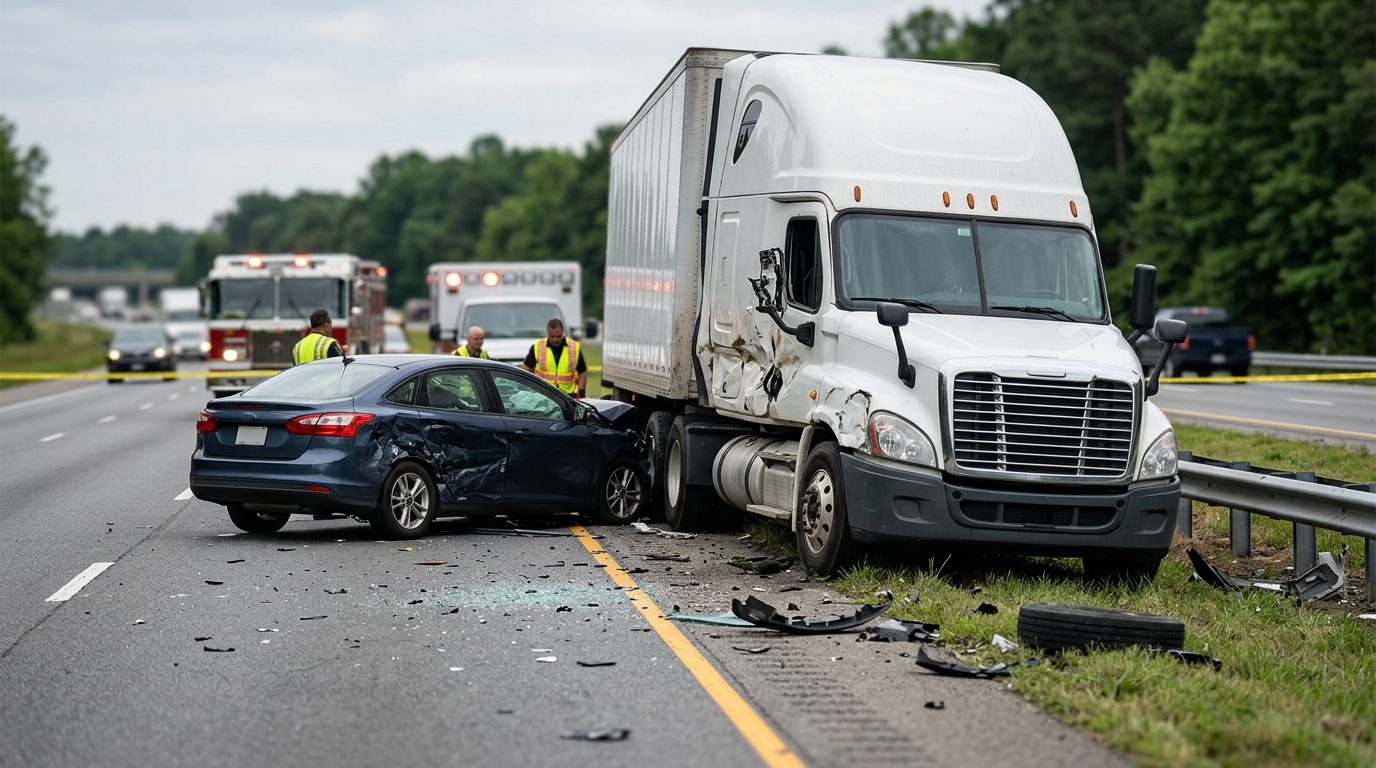
Wrongful Death & Fatal Truck Accidents
After a Fatal Truck Accident: What Your Family Should Know
You have legal rights and a limited window to act. A wrongful death claim can hold the responsible party accountable and help your family recover damages.
By CHG Lawyers · Published August 19, 2026
Steps After a Fatal Truck Accident: What Your Family Should Do Now
When a loved one dies in a fatal truck accident, the immediate aftermath is overwhelming. You’re in shock, grieving, and facing urgent decisions about evidence, insurance, and your legal rights—often all at once. The steps you take in the first hours and days directly protect your family’s ability to pursue a wrongful death claim and hold the responsible parties accountable.
This guide walks you through what to do now, what not to do, and why early legal guidance matters in fatal truck accident cases.
Not sure what your next step is?
Talk it through with our team — the first consultation is free, confidential, and carries no obligation.
The First Hours: Immediate Safety and Emergency Response
Your first priority is safety and emergency response—everything else follows from that.
If you’re at the accident scene, move to a safe location away from traffic and call 911 immediately. Cooperate fully with police and first responders. Do not move, touch, or disturb the truck, the other vehicle involved, or any debris at the scene. This evidence will be crucial later.
If you’re not at the scene—if you learn of the death through a hospital call, police notification, or another family member—your immediate task is different. You may be in a state of shock and disbelief. That’s normal. Focus on your own safety, notify other family members who need to know, and seek emotional support from someone you trust. Write down the date, time, and location of the crash as soon as you can, even if the details are incomplete. You’ll need this information later.
In the First Days: Documenting and Preserving Evidence
The days immediately following a fatal truck accident are critical for evidence preservation. Truck accident cases involve federal regulations, electronic devices, and records that can be lost or destroyed if not protected early.
Request the police report. Contact the investigating law enforcement agency—usually the state highway patrol or local police department—and request a copy of the accident report. This is public record. The report contains the officer’s observations, scene conditions, vehicle damage descriptions, and any citations issued. Ask for the report number and the investigating officer’s name and badge number.
Photograph the scene and damage. If it’s safe to do so, take photographs of the accident scene, vehicle damage, road conditions, traffic signals, and lighting. If you cannot safely return to the scene, ask the police for copies of their scene photographs. These images document the severity of the impact and road conditions at the time of the crash.
Collect witness information. If anyone witnessed the accident, get their names, phone numbers, addresses, and email addresses. Write down what they saw, even in brief notes. Witnesses are often the most credible evidence in a fatal truck accident case, and their recollections fade quickly.
Preserve the truck’s critical data. This is urgent and often overlooked by families unfamiliar with trucking regulations. Commercial trucks are required by federal law to contain electronic logging devices (ELDs) that record the driver’s hours of service under 49 CFR §395.8. Many trucks also have event data recorders—often called “black boxes”—that capture speed, braking, acceleration, and other data in the seconds before and after a crash. These records are essential evidence of driver fatigue, speeding, or mechanical failure. Send a written preservation notice to the trucking company immediately, stating that evidence must be preserved and not destroyed or altered. This notice creates a legal obligation to protect the evidence. Without it, critical data can be erased or lost.
Do not speak with the truck driver, trucking company, or their insurance representatives without an attorney present. This is essential. Insurance adjusters are trained to minimize liability, and anything you say—even if it seems innocent or sympathetic—can be used against your wrongful death claim later.
What Not to Tell Insurance Companies
Insurance adjusters often contact families within hours of a fatal accident. They may sound sympathetic and offer help. Their actual job is to protect their company’s interests and minimize the payout.
Do not give a recorded statement. Adjusters will ask you to record a detailed account of what happened. Decline politely. Say: “I’m not able to speak about this right now. Please contact my attorney.” You have no obligation to speak with them.
Do not sign any documents. Do not sign releases, waivers, or settlement agreements without reviewing them with an attorney first. Insurance companies sometimes ask families to sign documents that limit the family’s legal rights without the family realizing it.
Do not accept an early settlement offer. Insurance companies may offer money quickly—for funeral expenses, for example—in exchange for the family agreeing to settle the claim. Do not accept. Early offers are typically far below what the claim is actually worth.
Do not speculate about how the accident happened or assign blame. Even if you think you know what caused the crash, don’t say so to an insurance representative. Your understanding may be incomplete or incorrect, and your words can be twisted to suggest the deceased was partly at fault.
Do not discuss the case on social media or with anyone except your attorney and immediate family. Insurance companies monitor social media and may use your posts against your claim.
Have questions about what happened?
Ask our team directly. The first conversation is free, confidential, and there is no obligation to continue.
Understanding Wrongful Death: What It Means for Your Family
A wrongful death claim is a legal action brought by the family of someone killed due to another person’s or company’s negligence, recklessness, or wrongdoing.
In a fatal truck accident, wrongful death claims often arise from:
- Driver error: speeding, fatigue from hours-of-service violations, impairment, distracted driving, or reckless behavior
- Mechanical failure: brake failure, tire blowout, or steering defect
- Inadequate maintenance: the trucking company failed to maintain the vehicle properly in violation of 49 CFR §396 (vehicle maintenance standards)
- Violations of federal trucking regulations: hours-of-service violations under 49 CFR §395, improper loading, or failure to conduct required safety inspections
Wrongful death claims seek compensation for the family’s loss, including:
- Funeral and burial expenses
- Medical bills from the fatal injury
- Lost income the deceased would have earned over their lifetime
- Loss of companionship, guidance, and emotional support
- Pain and suffering
Florida law sets a strict deadline for filing a wrongful death claim. Under Fla. Stat. §95.11(3)(a), you have two years from the date of death to file a wrongful death lawsuit. If you miss this deadline, your claim is barred forever. There are very limited exceptions, and they are difficult to prove. Acting quickly protects your right to pursue this claim.
Coping with the Financial and Emotional Impact
Losing a loved one in a fatal truck accident is a catastrophic event. The emotional toll is immense—grief, shock, anger, and confusion are all normal. You may also face immediate financial pressure: funeral costs, which the National Funeral Directors Association reports average $7,848 to $12,000 nationally, lost household income, and medical bills.
A wrongful death claim can help recover these costs and provide financial stability for your family going forward. But pursuing a claim while grieving is exhausting. Consider seeking support from a grief counselor, therapist, or support group. Many communities offer free or low-cost grief services. Caring for your own emotional health strengthens your ability to make clear decisions about your claim.
Why Speaking with a Truck Accident Attorney Early Matters
Truck accident cases are among the most complex personal injury cases. They involve:
- Federal trucking regulations (hours of service under 49 CFR §395, maintenance standards under 49 CFR §396, driver qualifications under 49 CFR §391)
- Commercial insurance policies with high coverage limits and aggressive defense strategies
- Multiple liable parties: the truck driver, the trucking company, the vehicle maintenance contractor, the shipper, and sometimes the manufacturer
- Specialized evidence: ELD data, black box recordings, driver logbooks, maintenance records, and expert analysis
An attorney who focuses exclusively on catastrophic and fatal truck accidents understands these complexities. Early legal counsel ensures that:
- Critical evidence is preserved and not lost or destroyed
- You don’t accidentally say something to an insurance company that harms your claim
- All liable parties are identified and held accountable
- Your family’s full damages—including loss of companionship and future earnings—are properly valued
- You’re not pressured into an unfair settlement
Your attorney handles all communication with insurance companies and defendants, so you can focus on your family and your grief.
Next Steps: What Families Should Do Now
-
Gather and organize documents. Collect the police report, medical records, funeral expenses, proof of the deceased’s income, bank statements, and any correspondence from insurance companies or other parties.
-
Write down witness information. If you have names and contact information for anyone who saw the accident, write them down and keep them safe.
-
Send a preservation notice. If you haven’t already, send a written notice to the trucking company demanding that all evidence—including ELD data, black box recordings, driver logs, and maintenance records—be preserved and not destroyed.
-
Keep a record of all communications. Write down the dates, times, and names of anyone who contacts you about the accident. Save all letters, emails, and voicemails.
-
Do not sign anything or make any statements without legal advice. This includes insurance forms, settlement offers, and recorded statements.
-
Reach out to an attorney who focuses exclusively on fatal truck accidents and wrongful death claims. Many offer free consultations to discuss your situation, answer your questions, and explain your options. You don’t have to make decisions alone.

Want to know where you stand?
Tell us what happened and our team will walk you through the options available to you, at no cost.
Frequently Asked Questions
How long do I have to file a wrongful death claim after a fatal truck accident in Florida?
You have two years from the date of death to file a wrongful death lawsuit under Fla. Stat. §95.11(3)(a). Missing this deadline bars your claim permanently.
What if the deceased was partly at fault for the accident?
Florida follows a comparative fault rule. Under Fla. Stat. §768.81, if the deceased is found to be more than 50% at fault, the family generally recovers nothing. If the deceased is 50% or less at fault, the family’s recovery is reduced by their percentage of fault. An attorney can evaluate whether the deceased bore any responsibility for the crash.
Should I speak with an insurance adjuster before talking to an attorney?
No. Insurance adjusters are trained to minimize liability and obtain statements that can be used against your claim. It’s appropriate and necessary to decline to speak with them until you have legal representation.
What evidence should I preserve after a fatal truck accident?
Preserve the police report, scene photographs, witness statements, the truck’s electronic logging device (ELD) data, event data recorder (black box) recordings, driver logbooks, vehicle maintenance records, and any dashcam or traffic camera footage. Send a written preservation notice to the trucking company to ensure this evidence is not destroyed.
Can I recover compensation for loss of companionship in a wrongful death claim?
Yes. Florida law allows wrongful death claims to seek compensation for loss of companionship, guidance, and emotional support—not just economic losses like funeral expenses and lost income.
If your family lost someone in a fatal truck accident, you’re facing decisions you never expected to make—and the steps you take now directly affect your ability to pursue a wrongful death claim. Many families in your situation reach out to discuss what happened, what they should have done, and what comes next. We’re here to listen and to guide you through the process without pressure or judgment. Contact us for a free case evaluation.
Critical Deadline
Under Florida law, you have two years from the date of death to file a wrongful death lawsuit. Missing this deadline bars your claim permanently. Do not delay.
What Your Family Can Do
Understand Your Right to Sue
If a truck driver's negligence, recklessness, or a trucking company's failure to maintain safe operations caused the fatal crash, your family may have a wrongful death claim against them. This is separate from any criminal case.
Document Everything Early
Preserve evidence: police reports, witness statements, photos of the scene, the truck's maintenance records, and the driver's logbooks. The sooner this is secured, the stronger your claim.
Know What Damages You Can Recover
Wrongful death claims can cover funeral and medical expenses, lost income and benefits the deceased would have earned, loss of companionship and guidance, and pain and suffering of surviving family members.
Do Not Settle Quickly
Insurance companies often contact families within days, offering quick settlements. These are rarely fair. Consult an attorney before accepting any offer.
Why You Need Legal Guidance
Protection Against Pressure
Insurance adjusters and trucking companies have teams of lawyers. Your family needs an advocate who understands the law and will not let you be undervalued.
Complex Evidence & Liability
Fatal truck accidents involve federal trucking regulations, vehicle maintenance standards, driver hours-of-service rules, and often multiple liable parties. Identifying who is responsible requires expertise.
Time-Sensitive Investigation
Evidence disappears. Witnesses move. Truck companies destroy records. The sooner an attorney begins investigating, the better your family's position.
Compassionate Guidance
Losing a loved one in a fatal crash is devastating. You should not have to navigate the legal system alone while grieving. We handle the complexity so your family can focus on healing.