
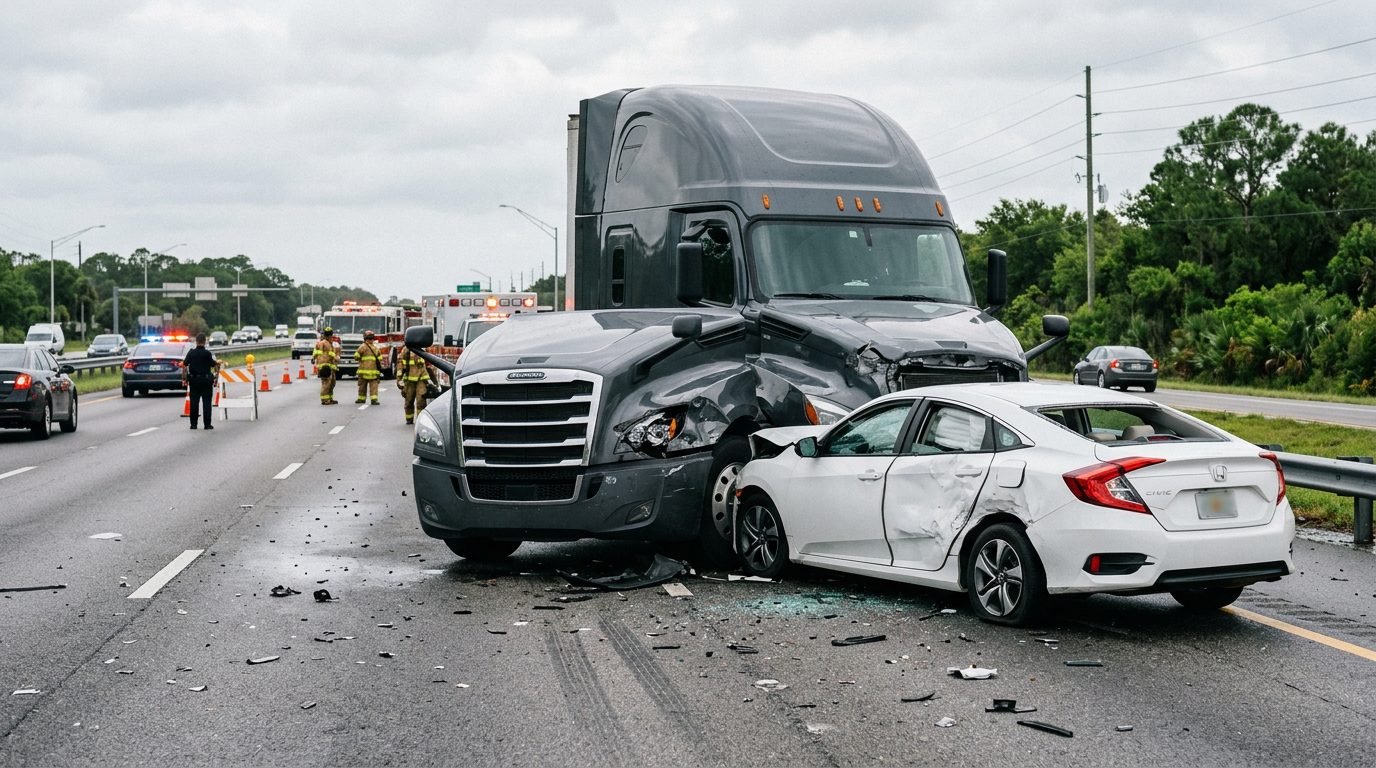
Truck Accidents | Serving Florida
Truck Accident Insurance Limits in Florida: What Happens When the Policy Isn't Enough
A commercial truck crash can cause injuries that cost far more than the insurance policy on the truck. Here is how policy limits work, where other coverage may come from, and how the Florida-based attorneys at CHG Personal Injury Lawyers can help your family understand your options.
By CHG Lawyers · Published November 1, 2026
Truck Accident Insurance Limits in Florida | CHG
A truck accident insurance limit is the most an insurance policy agrees to pay. This includes injuries and property damage. In plain terms, a policy limit is the maximum dollar amount available.
After a crash with a commercial truck in Florida, more than one policy may apply. Each policy has its own limit.
This guide explains who usually carries that insurance. It also explains what federal and Florida rules require. Finally, it covers what a family can do next.
If your family is facing a truck crash while handling hospital visits and bills, you do not have to sort out the insurance alone. Talk it through with our team — the first consultation is free, confidential, and carries no obligation.
Why Truck Insurance Limits Matter After a Crash in Florida
The question “who pays?” usually depends on the insurance the truck and its driver carried on the day of the crash.
Picture a family in Orlando. A parent is hurt when a semi-truck drifts into their lane on I-4. The hospital bills arrive. The parent cannot work.
Everyone asks the same question: who pays, and how much is available?
Two ideas help from the start.
First, Florida requires owners of most registered motor vehicles to keep insurance in place. This applies for the whole registration period. Florida calls this insurance “security.” The Florida security statute sets that rule.
Second, personal injury protection (PIP) covers medical benefits from your own auto policy. Under Florida’s PIP statute, PIP is a first layer of coverage. A serious injury can cost far more than PIP pays.
A policy limit is the most the insurer agrees to pay under that policy for covered claims. It is a ceiling. It is not a promise that the insurer will pay that full amount.
What Insurance a Truck Driver or Trucking Company Typically Carries
Most commercial trucks have primary liability coverage. The trucking company usually buys this coverage. Other policies may also apply.
- Primary commercial auto liability. This is the main policy. It covers bodily injury (physical harm to a person) and property damage that the truck causes.
- The driver’s own policy. Depending on how the driver was working, a personal policy may come into play.
- The owner or leasing party. If another company owns or leases the truck or trailer, that party’s coverage may be involved.
- Excess and umbrella coverage. These policies sit above the primary policy. They add another layer of limits.
- Cargo insurance. This protects the freight. It does not pay injured people.
Federal rules also require proof of coverage. Under 49 CFR 387.7, a carrier must keep proof of its financial responsibility at its principal place of business.
That proof is Form MCS-90, Form MCS-82, or a written FMCSA authorization to self-insure, and the self-insurance option applies only while the carrier maintains a satisfactory safety rating. The MCS-90 is an endorsement. An endorsement is an added document that changes a public liability policy.
Federal and Florida Minimum Insurance Requirements
Federal rules require most interstate for-hire trucking companies to carry at least $750,000 in public liability coverage. This applies to nonhazardous freight. Public liability coverage pays people hurt by the truck.
The federal schedule sets higher amounts for riskier cargo. Under 49 CFR 387.9, the tiers are:
- $750,000 for for-hire carriers in interstate or foreign commerce hauling nonhazardous property (vehicles rated 10,001 pounds or more).
- $1,000,000 for certain oil and hazardous materials
- $5,000,000 for certain bulk hazardous substances
The rules come from the federal financial responsibility statute. Under 49 CFR 387.7, no motor carrier may operate until it has the minimum coverage in effect.
Florida adds its own layer. Under Fla. Stat. § 316.302, commercial vehicle owners and drivers on Florida highways in interstate commerce must follow federal safety rules.
A minimum is a floor. It does not describe every truck. Many carriers carry more.
The route, the cargo type, and the vehicle weight all shape which rule applies.
Not sure what your next step is?
Talk it through with our team — the first consultation is free, confidential, and carries no obligation.
Why Truck Insurance Costs More, and When Payouts Can Exceed the Limit
An insurer generally pays up to its policy limit. Money above that limit usually comes from other policies or other legal paths.
Truck liability premiums tend to run higher than personal auto premiums. A premium is the price paid for insurance.
Large trucks are heavy, drive many miles, and can cause severe harm. Insurers set prices based on the fleet, its driving record, and the limits bought. A premium says little about what a claim is worth.
Money beyond the primary limit may come from:
- Umbrella or excess policies, if the carrier or another party has them.
- Other responsible parties. A recent U.S. Supreme Court case, Montgomery v. Caribe Transport II, LLC (2026), concerns how federal safety rules may interact with state-law claims against brokers who hire motor carriers; the full opinion should be read for its precise holding. A broker arranges shipments for carriers.
- Insurance companies handle claims in many different ways, and questions about how an insurer responded to a claim are worth raising with a lawyer early on. To settle means to resolve a claim by agreement.
These paths are not automatic. Each one depends on the policies and facts involved.
What a $1,000,000 Liability Policy Does and Does Not Cover
A $1,000,000 liability policy is usually a per-accident limit. That means it is the most available for all covered claims from one crash.
Consider a crash that injures a driver, a passenger, and a motorist. All three may have claims against the same policy. The $1,000,000 is shared among them.
A large claim by one person can leave less for the others.
A limit does not set the value of a claim. Value depends on injuries, medical care, lost income, and how the harm changes daily life. No formula sets a settlement. No amount can be predicted from the policy alone.
How a Florida Truck Crash Claim Looks Into the Insurance
The first step is to identify every insurer and policy that may apply. Florida law lets a claimant ask for that information in writing.
- Collect the basics. Note the date and location. Write down the truck’s USDOT number and carrier name if visible. Record the driver’s name. Gather photos or witness details you can safely collect.
- Preserve records early. Keep the police report, medical records, and bills. Trucking companies and insurers often move quickly.
- Request coverage in writing. Under Fla. Stat. § 627.4137, an insurer must give a sworn statement within 30 days of a written request. A sworn statement is a written statement signed under oath. It lists the insurer’s name, each insured’s name, the limits, and any policy or coverage defense the insurer reasonably believes is available. It also includes a copy of the policy.
- Compare limits with the harm. Set the policy limits against medical costs, lost income, and long-term needs.
- Plan the next steps. Decide how the claim will be presented and negotiated.
Serious cases often take longer than simple ones. Records and insurer responses take time.
Florida Filing Deadlines and Why Timing Matters
Florida law gives two years to sue for negligence. Negligence means carelessness that causes harm. The time limit appears under Fla. Stat. § 95.11.
Deadlines apply. Reaching out early gives more time to gather evidence.
Wrongful death claims follow their own statute. Under Fla. Stat. § 768.19, when a death is caused by the wrongful act, negligence, default, or breach of contract or warranty of any person, including on navigable waters, and the event would have entitled the person injured to maintain an action and recover damages if death had not ensued, the person or watercraft that would have been liable shall be liable for damages as specified in the statute, even though the injured person has died, although death was caused under circumstances constituting a felony. Families should review that timing promptly.
Filing an insurance claim and filing a lawsuit are separate steps, so it is wise to talk with a lawyer promptly about the timing of any legal action. Witness memories and records can also fade. Early review helps a family understand its options.
Have questions about what happened?
Ask our team directly. The first conversation is free, confidential, and there is no obligation to continue.
Frequently Asked Questions About Truck Accident Insurance Limits in Florida
Do trucks have a higher insurance rate?
Yes. Commercial truck liability premiums are generally higher. The reasons include size, weight, mileage, and crash severity.
Can insurance companies pay more than policy limits?
Sometimes. Umbrella or excess policies may add coverage. A bad-faith claim may apply in some cases. Neither one is automatic.
How much is a $1,000,000 liability policy?
The insurer sets the price. It is based on the carrier’s fleet, driving record, and coverage. Prices vary by company.
What is a good settlement amount for a truck crash?
No formula or average applies. Value depends on each person’s injuries and losses. No outcome can be predicted.
Does CHG charge fees?
CHG Personal Injury Lawyers charges no attorney’s fees and no case costs unless there is a recovery.
If your family is facing a truck crash while handling hospital visits and bills, you do not have to sort out the insurance alone. Igor Hernandez, a Florida lawyer admitted to The Florida Bar, can review which coverage may apply.
Contact CHG Personal Injury Lawyers for a free, confidential first consultation with no obligation to continue.
Why Insurance Limits Matter After a Truck Crash
Limits set a ceiling, not a guarantee
A policy states the most the insurer will pay under that policy. Serious injuries, long hospital stays and lifelong care can exceed that amount.
Several policies may be involved
The truck owner, the carrier, the driver, and the cargo or shipping company may each carry separate insurance that could apply to the same crash.
Other coverage may be available
Umbrella and excess policies, and other parties connected to the trucking operation, can sometimes add to the coverage available after a serious crash.
Early steps protect your options
Insurance companies often move quickly. Speaking with a lawyer before giving recorded statements or signing papers helps protect your rights.
Important: Do Not Assume the Policy Covers Everything
Many families learn only after a crash that the truck's policy has a limit that may not cover catastrophic medical costs, rehabilitation, or lost income. Do not sign a settlement release or accept an early offer until you understand the full picture. Follow your doctors' care at all times.
How We Help Families Understand Coverage
1. Review the crash facts
We look at what happened on the road, who was driving, and which companies were involved in operating or loading the truck.
2. Identify every policy that may apply
We work to find the primary policy, any umbrella or excess coverage, and other insurance tied to the trucking business.
3. Measure the full impact
We help document medical needs, future care, lost income, and the day-to-day changes your family faces, so the value of the claim is not understated.
4. Explain your choices in plain language
You will receive clear answers about what the coverage may mean for your case, so you can decide what comes next with confidence.