
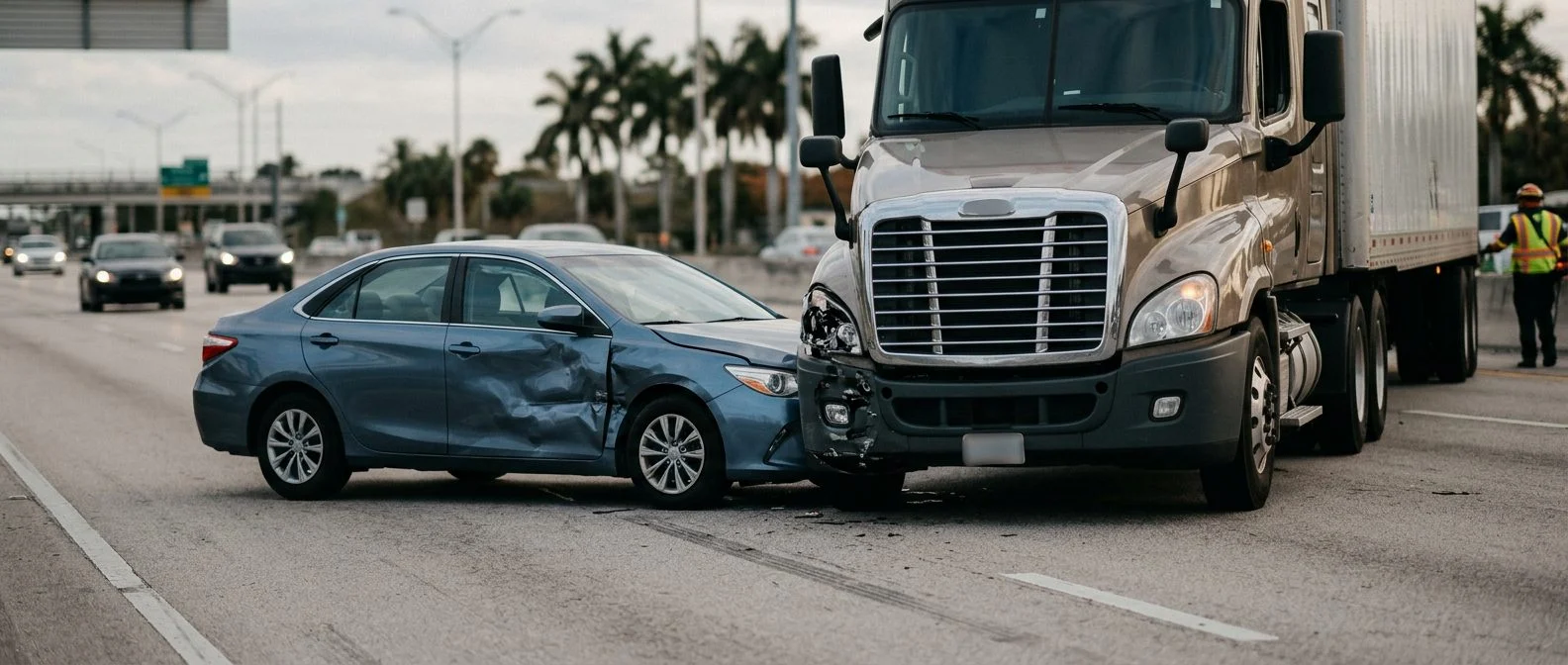
Tamiami & Miami-Dade County | Truck Accidents
Hurt in a Truck Crash in Tamiami? Here Is What to Do Next
A truck crash can change your life in seconds. CHG Personal Injury Lawyers, a Florida-based firm, offers plain-language guidance and a free, confidential first consultation to help you and your family understand your options.
By CHG Lawyers · Published October 25, 2026
If a truck crash on the Tamiami Trail hurt you or someone you love, you can take clear steps now. Get medical care first. Protect the evidence that disappears fastest. Talk with a lawyer before you give any statement to an insurer.
This guide explains those steps in plain language. It is written for families across Miami-Dade County.
The Tamiami Trail name also appears on a road in Sarasota. News about that road covers a different city. This page covers the Miami-Dade stretch of U.S. 41. Here, commercial trucks, delivery vans, commuters and pedestrians share busy lanes, turn bays and intersections.
Why Truck Crashes on the Tamiami Trail Often Cause Serious Injuries
Truck crashes often cause more serious injuries. A loaded truck weighs far more than a passenger car. When a heavy truck hits a car, the force on the people inside is much greater.
Trucks also need more distance to stop. That leaves less room to react in heavy traffic.
On a busy road like the Tamiami Trail, the mix of vehicles matters. Big rigs, box trucks, delivery vans, commuters and people crossing the road all share the same space. One late stop or lane change can turn an ordinary drive into a serious crash.
Many people search for this topic after they read about a crash. News reports can be useful. But they describe what happened that day. Fault comes from the facts, the records and the law. Sorting those out takes time.
This page explains the process and the questions families often face. It does not predict how any one claim will turn out. Every case depends on its own facts.

Not sure what your next step is?
Talk it through with our team — the first consultation is free, confidential, and carries no obligation.
The First Steps After a Truck Accident in Miami-Dade
Your first priority after a truck crash is medical care. This is true even if you feel only sore or shaken. Some serious injuries don’t show symptoms right away. Follow the care plan your doctors set for you.
Next, ask the responding officer for the crash report number. Also ask for the name of the investigating agency. A Florida Traffic Crash Report, Long Form, must be completed and submitted to the department by the investigating law enforcement officer within 10 days after the investigation is completed, for a crash that resulted in death of, personal injury to, or any indication of complaints of pain or discomfort by any of the parties or passengers involved in the crash, or that involved a commercial motor vehicle. This applies to crashes that involve injury or a commercial motor vehicle (Florida Statutes § 316.066).
If you can do it safely, note these details:
- The truck company’s name
- The DOT number
- The trailer markings
- The license plate
Write down the time, the place, the weather and the road conditions. Get the names and phone numbers of any witnesses. Take photos of your injuries, the vehicles and the scene.
Keep a simple written log. Record your symptoms, appointments, missed work and out-of-pocket costs.
Dealing with a trucking company’s insurer on your own can feel like a Miami Dolphins game where the other team has the whole playbook. Be careful with recorded statements. Talk with a lawyer before you sign any release (a document that gives up your right to sue).
Who May Be Responsible When a Truck Crashes in Tamiami
A truck crash can involve more than one party. These may include:
- The driver
- The trucking company
- The company that owns or leases the truck
- A maintenance contractor
- A cargo loader
- A parts maker
Each one may be a possible source of a claim, depending on the facts.
Lawsuits in truck cases often allege negligence (careless conduct that causes harm). Examples include driver fatigue, distracted driving, poor maintenance, improper loading or weak driver training. These are allegations. They become findings only when the evidence or a court establishes them.
Florida divides fault among the parties. A court enters judgment against each liable party based on that party’s percentage of fault.
Federal law can also shape who may be sued. In 2026, the U.S. Supreme Court held that a state-law negligent-hiring claim against a broker that selected an unsafe carrier falls within a federal safety exception. That means federal law does not block it (Montgomery v. Caribe Transport II, LLC).
Vehicle design questions, sometimes called crashworthiness issues (whether a vehicle’s design made injuries worse), can also arise. These are reviewed case by case.
Trucking Evidence That Can Disappear Quickly
The most useful records in a truck case are often held by the trucking company. Federal rules require each driver’s duty status to be recorded for every 24-hour period. For each change of duty status (for example, the place of reporting for work, starting to drive, on-duty not driving, and where released from work), the name of the city, town, or village, with State abbreviation, shall be recorded (49 CFR 395.8). These logs can show how long a driver had been working.
Other records can matter too. They include:
- Driver qualification files
- Maintenance and inspection logs
- Dispatch messages
- GPS data
- Dashcam video
Engine data, event recorders and video can be overwritten or lost over time.
Federal rules also require post-accident drug and alcohol testing of surviving drivers in certain crashes. These include crashes involving:
- Some crashes leave a vehicle too damaged to drive safely.
Federal rules also say nothing in this section requires delaying necessary medical attention for injured people (49 CFR 382.303).
A written request to preserve evidence helps protect these records. Send it promptly after a crash. The crash report, photos and witness accounts add to the picture. When a case calls for it, a lawyer can work with reconstruction professionals (people who rebuild how a crash happened) and medical professionals.
Have questions about what happened?
Ask our team directly. The first conversation is free, confidential, and there is no obligation to continue.
Catastrophic Injuries From Truck Crashes: Life After the Crash
Truck crashes can cause injuries that change a person’s life. These include:
- Spinal cord injuries
- Paralysis
- Traumatic brain injuries
- Amputations
- Severe burns
- Serious back and neck injuries
Some of these injuries are permanent.
Families often face a long road. Rehabilitation, adaptive equipment, home changes and changes at work can all follow. Some effects of a serious injury don’t become clear for months.
Keep a daily journal. Track how the injury affects sleep, mobility, work and family life. Ask your medical team to help you build a long-term care plan. Then follow the plan they give you.
Early legal guidance can help families plan for needs that may not be visible yet.
CHG Personal Injury Lawyers handles catastrophic injury claims, including spinal cord injury, paralysis, brain injury and amputation cases. Those cases often need careful planning from the start.
Wrongful Death and the Family Left Behind After a Fatal Truck Crash
A fatal truck crash changes a family’s life in ways no lawsuit can fully repair. We want to say that first.
Florida law also gives certain family members a way to seek recovery. Florida’s wrongful death law says that when a death is caused by a wrongful act, negligence, default, or breach of contract or warranty, and the event would have entitled the person injured to maintain an action and recover damages if death had not ensued, the person who would have been liable had the injured person lived shall be liable for damages (Florida Statutes § 768.19).
Under Florida’s wrongful death law, the liable person shall be liable for damages as specified in the act, and surviving family members may recover different losses under Florida Statutes § 768.21:
- A surviving spouse may seek loss of companionship and protection, plus mental pain and suffering.
- Minor children may seek lost parental companionship, instruction and guidance.
- A survivor who has paid medical or funeral bills may also recover those costs (Florida Statutes § 768.21).
Wrongful death claims have their own deadlines and rules. Don’t wait to ask questions. Keep the crash report. Collect medical and funeral bills. Save any letters from insurers. Take time for your family, too.
Florida Deadlines, Insurance and Fault Rules to Know
Florida sets filing deadlines for injury lawsuits. Missing one can end a claim (Florida Statutes § 95.11). Deadlines vary by type of claim and by the parties involved. A lawyer can tell you which deadline may apply to your situation.
Florida also uses a fault rule. In a negligence case, a person found more than 50 percent at fault for their own harm may not recover any damages (Florida Statutes § 768.81). Fla. Stat. § 768.81 reads: “This subsection does not apply to an action for damages for personal injury or wrongful death arising out of medical negligence pursuant to chapter 766.” Fault can be disputed, so the evidence matters.
A truck claim can involve several insurance policies. These include the trucking company’s commercial coverage. Insurers often move quickly. Keep every letter and every call note.
CHG charges no attorney’s fees and no case costs unless there is a recovery.

Want to know where you stand?
Tell us what happened and our team will walk you through the options available to you, at no cost.
Talk With CHG Personal Injury Lawyers About Your Tamiami Truck Crash
If a truck crash on the Tamiami Trail left you hurt, or a family member gone, the next questions can feel overwhelming. CHG Personal Injury Lawyers can help you understand what happened and what comes next.
How long do I have to file a truck accident lawsuit in Florida?
Florida sets filing deadlines that vary by claim. Talk with a lawyer promptly so you know which deadline may apply.
Can I get a copy of the crash report?
Should I give a recorded statement to the trucking company’s insurer?
Be careful. Speak with a lawyer before giving a recorded statement or signing a release.
Igor Hernandez is the responsible lawyer for this page. Our attorneys are licensed and admitted to the Florida Bar. CHG Personal Injury Lawyers is a Florida-based firm that serves people throughout Florida.
If a loaded truck has left you facing medical bills, a family to care for and an insurance adjuster on the phone, you don’t have to sort it out alone. Contact CHG Personal Injury Lawyers for a free, confidential first consultation, with no obligation to continue.
This page is general information, not legal advice. Results depend on the facts of each case, and no outcome can be promised.
Five Steps to Take After a Truck Accident
1. Get Medical Care Right Away
Some injuries, including brain and spinal injuries, may not show symptoms until later. Get checked by a doctor and follow your doctors' care plan.
2. Document the Scene
If you are able, take photos of the vehicles, the road, traffic conditions, and any visible injuries. Write down the truck's company name and any details you can recall.
3. Keep Your Records
Save police reports, medical bills, prescriptions, and records of lost work. Keep a simple journal of pain, limits, and daily challenges.
4. Be Careful With the Insurer
The trucking company's insurance representatives may contact you quickly. Speak with a lawyer before giving a recorded statement or signing anything.
Important: Do Not Sign Quickly
Insurance companies may offer a fast settlement before the full extent of your injuries is known. Speak with a lawyer before giving a recorded statement or signing a release.
Why Contact CHG Personal Injury Lawyers Early
Free First Consultation
Your first consultation is free, confidential, and comes with no obligation to continue.
Help Preserving Evidence
Early action can help protect crash reports, trucking records, and other evidence that may matter to your claim.
No Fees Unless There Is a Recovery
CHG charges no attorney's fees and no case costs unless there is a recovery.
Licensed Florida Attorneys
Our attorneys are licensed and admitted to The Florida Bar, and our team is here to explain each step in plain language.