

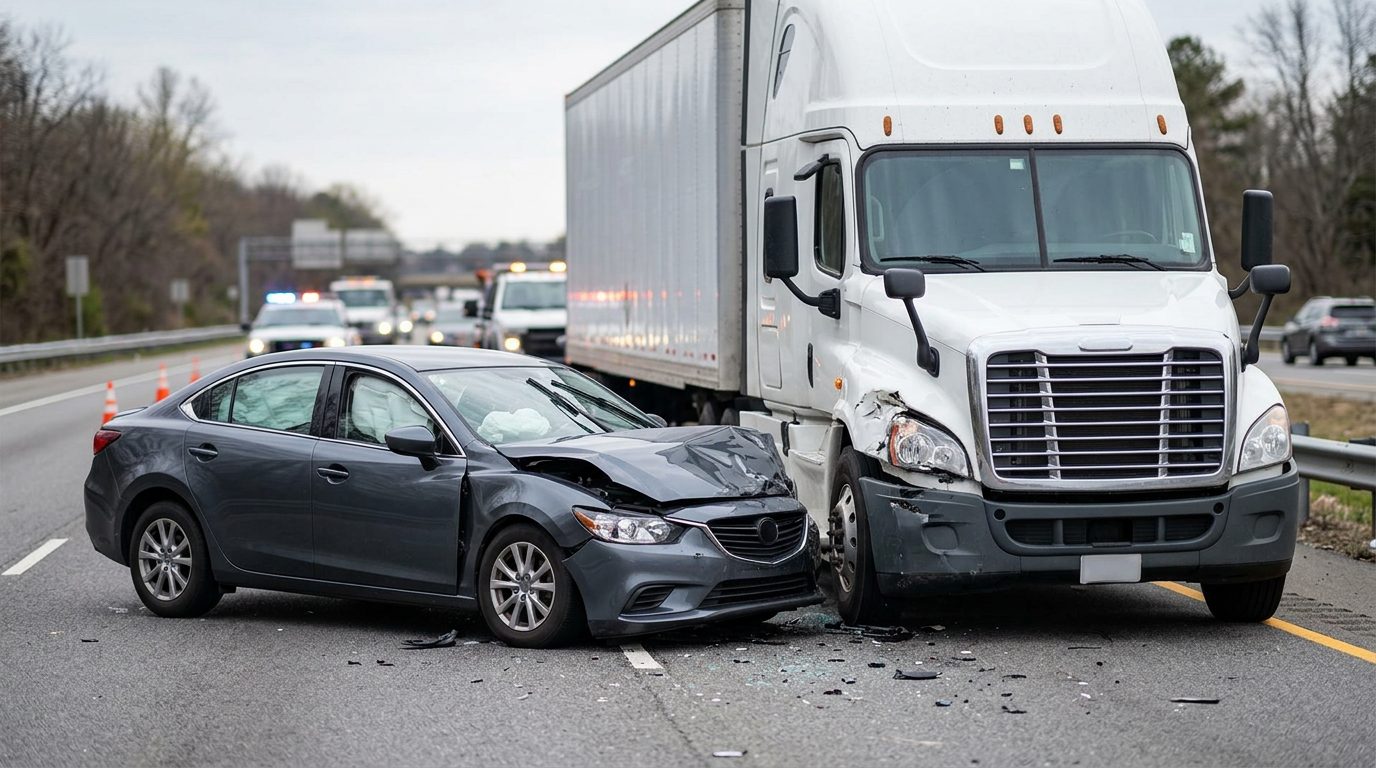
Truck Accident Claims
When Multiple Parties Are Responsible for a Truck Crash
Truck accidents often involve more than one negligent party. We investigate the full chain of responsibility and pursue claims against every defendant whose actions contributed to your injury.
By CHG Lawyers · Published September 06, 2026
Multiple Defendants in Truck Crashes: Who Is Liable?
Catastrophic truck crashes rarely involve just one at-fault party. When multiple defendants share liability, responsibility often spreads across the truck driver, trucking company, maintenance contractor, shipper, cargo loader, or parts manufacturer.
Understanding who is liable directly affects how much compensation you or your family can recover. This page explains the main parties who can be held responsible when multiple defendants cause a catastrophic truck crash.
Not sure what your next step is?
Talk it through with our team — the first consultation is free, confidential, and carries no obligation.
The Truck Driver
The truck driver is often the first party named in a truck accident case. Driver liability includes speeding, distracted driving, fatigue, impaired driving, improper lane changes, or loss of control.
Even if the driver is primarily at fault, other parties may share responsibility. A driver speeding on worn-out brakes bears some fault. But so does the trucking company that failed to maintain those brakes.
The Trucking Company and Liability
Trucking companies can be held liable for their own negligence, separate from the driver’s actions. This includes:
- Hiring unqualified or unsafe drivers
- Failing to conduct background checks
- Providing inadequate training
- Ignoring safety violations
- Pressuring drivers to violate hours-of-service rules
- Failing to maintain vehicles
- Operating unsafe equipment knowingly
Trucking companies are also liable under vicarious liability. This means they are responsible for the driver’s negligence because they employ and control the driver. This matters in catastrophic injury cases because trucking companies carry substantial commercial liability insurance.
Vehicle Maintenance and Repair Contractors
Third-party mechanics or maintenance companies hired to service the truck can be liable if poor maintenance caused the crash. Examples include:
- Faulty brake work
- Improper tire installation
- Failure to identify worn brakes or steering problems
- Negligent repair of critical systems
A catastrophic crash caused partly by brake failure may involve liability against both the trucking company and the maintenance contractor.
Shippers and Cargo Loaders
Improper cargo loading or securing can make a truck unstable, cause it to tip, or jackknife. A shipper or loading company can be liable if they:
- Overload the truck
- Fail to secure cargo properly
- Load cargo in a way that makes the truck unsafe
Catastrophic injuries from a rollover or jackknife often involve liability against the shipper or loader.
Parts Manufacturers
If a defective part caused or contributed to the crash, the manufacturer can be held liable. This is called a product liability claim.
Product liability does not require proving negligence. You only need to show the product was defective and caused injury. Defective parts are often discovered during investigation after a catastrophic crash.
Other Drivers or Parties
A passenger vehicle driver, another truck driver, or a third party may have caused or contributed to the crash. Multiple vehicle accidents often involve shared fault among drivers. Each at-fault party and their insurance may be liable for a portion of damages.
How Fault Gets Allocated Among Multiple Defendants
When multiple defendants share liability, the law determines what percentage of responsibility each party bears. This process is called comparative negligence (or comparative fault) (Fla. Stat. § 768.81(6)).
An investigation examines:
- Police reports
- Witness statements
- Vehicle damage
- Maintenance records
- Driver logs
- Cargo documentation
- Expert analysis
Each party’s percentage of fault is determined based on how much their actions or inactions contributed to the crash.
Example: If a truck driver was speeding (40% fault), the trucking company failed to maintain brakes (35% fault), and a shipper overloaded cargo (25% fault), each party is liable for their percentage.
In Florida, the law follows a modified comparative negligence rule. Under Fla. Stat. §768.81, a claimant who is more than 50% at fault generally recovers nothing. If you are 50% or less at fault, you can recover damages from other at-fault parties.
Have questions about what happened?
Ask our team directly. The first conversation is free, confidential, and there is no obligation to continue.
Joint and Several Liability: Why It Matters
In Florida, joint and several liability generally does not apply in negligence actions. Instead, the court enters judgment against each at-fault party based on that party’s percentage of fault.
This is especially important in catastrophic injury cases. Damages in catastrophic injury cases can include lifetime medical care, rehabilitation, lost income, and pain and suffering.
How Multiple Defendants Complicate a Case
More defendants mean more insurance companies, more lawyers, and more complex negotiations. Defendants often blame each other—called “finger-pointing”—which can delay settlement.
Each defendant’s insurance may dispute liability or argue that another party is primarily responsible.
Investigation becomes more thorough and time-consuming. You must identify and prove the negligence of each party. However, multiple defendants also mean multiple sources of compensation, which is critical for catastrophic injuries.
Identifying All Responsible Parties Enhances Recovery
A thorough investigation uncovers all parties who contributed to the crash. Missing a responsible party means missing a source of compensation.
In catastrophic injury cases, the difference between identifying all parties and missing one can be millions of dollars.
This requires expert investigation:
- Accident reconstruction
- Vehicle inspection
- Maintenance record review
- Driver history analysis
- Expert testimony
Experienced attorneys know where to look and what questions to ask. They also know how to preserve evidence before it’s lost or destroyed. Learn more about truck accident attorney representation and how trucking company negligence claims work.
How Litigation Proceeds With Multiple Defendants
Each defendant is served with a lawsuit and responds separately. Discovery (the exchange of evidence between parties) involves multiple parties and takes longer.
Defendants may file cross-claims against each other, blaming one another for the crash.
Settlement negotiations may occur with individual defendants or groups of defendants. If the case goes to trial, a jury hears evidence against all defendants and assigns fault percentages.
The timeline is longer with multiple defendants, but the potential recovery is greater.
The Insurance Coverage Problem
Each defendant has insurance (or should), but coverage limits vary widely. A truck driver may have personal auto insurance with low limits. The trucking company has commercial liability insurance with higher limits.
A maintenance contractor or shipper may have limited coverage or no coverage.
Insurance companies sometimes dispute coverage or deny claims. Identifying which insurance policies apply to which defendants is essential for maximizing recovery.
Avoiding Statute of Limitations Traps
In Florida, the statute of limitations for personal injury is generally 2 years. For wrongful death, it is 2 years from the date the cause of action accrues, according to Fla. Stat. §95.11.
With multiple defendants, you must file suit against all responsible parties within the deadline. Missing a defendant or filing late against a defendant can bar recovery from that party.
Early investigation and legal action are critical to preserve all claims.
Want to know where you stand?
Tell us what happened and our team will walk you through the options available to you, at no cost.
Why This Matters When a Truck Crash Causes Catastrophic Injury
Catastrophic injuries—spinal cord damage, paralysis, amputation, severe burns, or traumatic brain injury—require lifetime medical care, rehabilitation, assistive devices, home modifications, and ongoing support.
Damages in catastrophic cases often exceed $1 million, $5 million, or more.
A single defendant may not have enough insurance to cover the full cost of care. Multiple defendants and multiple insurance policies are often the only way to secure full compensation. Identifying all responsible parties is not optional—it is essential to the injured person’s future. Explore catastrophic injury lawsuits to understand your options.
What to Do If You’re Researching a Multi-Party Truck Crash
- Gather all available information: police report, photos, witness contact information, medical records, and any communications with insurance companies.
- Do not accept an early settlement offer without understanding the full scope of your injuries and damages.
- Do not assume you know who is responsible. Investigation often reveals parties you did not initially suspect.
- Do not delay. The statute of limitations is a hard deadline, and evidence can be lost or destroyed.
- Reach out to an attorney who focuses exclusively on catastrophic truck accident injuries. They have the resources and experience to investigate thoroughly and identify all responsible parties.
Frequently Asked Questions
Can you sue multiple defendants in a truck accident?
Yes. You can sue any party whose negligence or wrongdoing contributed to the crash—the driver, the trucking company, maintenance contractors, shippers, cargo loaders, parts manufacturers, and others.
How is fault determined when multiple defendants cause a truck accident?
An investigation examines police reports, witness statements, vehicle damage, maintenance records, driver logs, cargo documentation, and expert analysis. Each party’s percentage of fault is determined based on how much their actions or inactions contributed to the crash.
What is joint and several liability?
In Florida, the court enters judgment against each at-fault party based on that party’s percentage of fault, rather than against one party for the full amount of damages. This is critical in catastrophic injury cases where damages are enormous.
Can a trucking company be held liable for a driver’s negligence?
Trucking companies may be liable under vicarious liability for their employees’ negligence, but this generally depends on the driver being an employee acting within the scope of employment rather than an independent contractor. They are also liable for their own negligence in hiring, training, supervision, and vehicle maintenance.
How long do I have to sue multiple defendants in Florida?
Generally, 2 years for personal injury and 2 years for wrongful death. You must file suit against all responsible parties within the deadline, or your claim against that party is barred.
If a truck crash left you or a family member with a life-altering injury and you’re trying to understand who bears responsibility, reach out. People in your situation can contact us to explore their options and understand how multiple defendants and insurance policies can work together to fund the care and support they need.
Who Can Be Held Liable in a Multi-Defendant Truck Accident
The Truck Driver
Negligent driving—speeding, distracted driving, fatigue, impairment, or violation of hours-of-service rules—is often the most obvious source of liability. But it's rarely the only one.
The Trucking Company
Companies can be held liable for hiring unqualified drivers, failing to maintain vehicles, ignoring safety violations, pressuring drivers to violate regulations, or inadequate training and supervision.
Maintenance and Repair Contractors
Third-party mechanics and maintenance providers who fail to repair brakes, tires, steering, lighting, or other critical systems can share responsibility for a crash caused by mechanical failure.
Shippers, Loaders, and Cargo Companies
Improper loading, overloading, or failure to secure cargo can cause instability, rollover, or loss of control. These parties may be liable for their role in the accident.
How We Build a Multi-Defendant Case
Thorough Investigation
We obtain police reports, electronic data from the truck's onboard recorder, maintenance logs, driver records, dispatch communications, and safety violation histories to map every responsible party.
Expert Analysis
We work with accident reconstruction specialists, mechanical engineers, and trucking safety experts to establish how each defendant's negligence or wrongdoing contributed to your injury.
Coordinated Claims
We pursue liability against all defendants simultaneously—the driver, the company, contractors, and others—to maximize the sources of recovery and hold every responsible party accountable.
Strategic Negotiation
We navigate complex multi-party negotiations and insurance disputes to ensure you're not left bearing the cost of someone else's negligence.
Common Questions About Multi-Defendant Truck Cases
Can you sue multiple defendants in a truck accident?
Yes. You can pursue claims against any party whose negligence or wrongdoing contributed to the crash—the driver, the trucking company, maintenance contractors, shippers, cargo loaders, parts manufacturers, and others.
How is fault determined when multiple defendants are involved?
An investigation examines police reports, the truck's electronic data, maintenance records, driver history, dispatch logs, and safety violations. Expert analysis and evidence establish each party's degree of responsibility.
What if defendants blame each other?
That's common. Our role is to build an independent case showing how each defendant's actions or failures contributed to your injury, regardless of who tries to shift blame.
Does pursuing multiple defendants complicate my case?
It can add complexity, but it also expands the sources of recovery. We handle the coordination and negotiation so you don't have to—and so no responsible party escapes accountability.
Act Quickly
Evidence in truck accidents—electronic data, maintenance records, and witness statements—can disappear or be destroyed. The sooner we investigate, the stronger your case.