

Truck Accident Injuries
Jackknife and Underride Truck Crashes: Catastrophic Injuries and Your Rights
When a tractor-trailer loses control or a smaller vehicle slides beneath it, the results are often devastating. If you or a loved one was injured in a jackknife or underride collision, we can help.
By CHG Lawyers · Published September 20, 2026
Jackknife and Underride Truck Crash Injuries: Spinal Cord Injury and Paralysis
When a semi-truck jackknifes or underrides a smaller vehicle, the result is catastrophic. A fully loaded truck weighs 80,000 pounds. A passenger car weighs around 3,500 pounds. That weight difference creates crushing forces that cause spinal cord injuries, paralysis, traumatic brain injuries, amputations, severe burns, and wrongful death. This firm represents injured people and families throughout Florida in truck accident cases involving catastrophic injuries.
If you or a loved one was injured in a jackknife or underride collision, we can help. Talk it through with our team — the first consultation is free, confidential, and carries no obligation.
What Are Jackknife and Underride Truck Accidents?
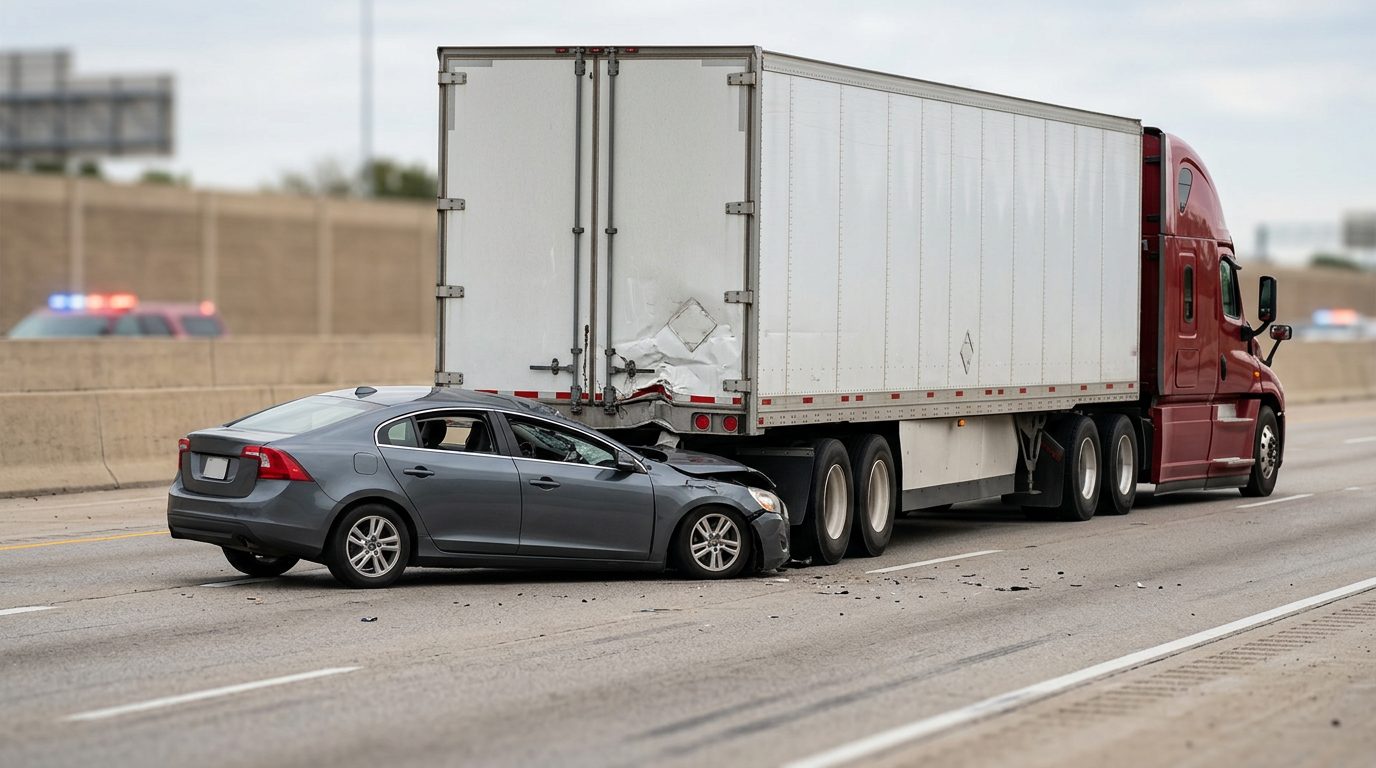
Underride accidents happen when a smaller vehicle slides under a semi-truck’s trailer. This usually occurs during a rear-end or side-impact collision. The roof and upper body of the smaller vehicle are crushed. Occupants have little to no protection. Underride crashes can result in fatal or serious injuries to the occupants of the smaller vehicle.
Jackknife accidents occur when a tractor-trailer loses control. The trailer swings perpendicular to the cab. This often causes multi-vehicle collisions across multiple lanes. The trailer may strike vehicles alongside or in front of it, creating a chain-reaction pileup.
Both types are uniquely catastrophic because of extreme forces:
- A passenger car weighs around 3,500 pounds.
- The weight difference creates crushing forces that occupants cannot survive without catastrophic injury.
There is no escape for occupants trapped in the crushing zone. Survivors often face permanent, life-altering injuries.
Catastrophic Injuries from Jackknife and Underride Truck Crashes
Underride and jackknife truck accidents produce some of the most severe injuries in personal-injury law.
Spinal Cord Injury and Paralysis
Crushing forces on the spine can sever or severely damage nerve fibers. This results in permanent loss of sensation and motor function below the level of injury. The Christopher & Dana Reeve Foundation reports that about 18,000 new spinal cord injury cases occur each year in the United States.
Paraplegia (paralysis of the lower body) and quadriplegia (paralysis of all four limbs) require lifelong medical care, adaptive equipment, and assistance with daily activities.
Traumatic Brain Injury (TBI)
Impact trauma can cause loss of consciousness, bleeding inside the skull (epidural or subdural hematoma), and permanent cognitive and physical impairment. Motor-vehicle crashes are among the causes of traumatic brain injury. TBI symptoms may not appear immediately. They can develop over days or weeks.
Cognitive effects include memory loss, difficulty concentrating, and impaired judgment. Physical effects include headaches, dizziness, and loss of balance.
Amputation and Limb Loss
Crushing injuries and compartment syndrome (tissue swelling that cuts off blood flow) often require surgical amputation. Survivors face phantom pain, infection risk, and the need for prosthetics and ongoing rehabilitation. Motor-vehicle crashes can lead to limb loss. Prosthetic limbs, physical therapy, and vocational rehabilitation are lifelong needs.
Severe Burns
Fuel leaks, fires, and explosions in multi-vehicle pileups can cause severe burns. These require skin grafts, reconstructive surgery, and years of treatment. Severe burns often result in permanent scarring, contracture (loss of joint mobility), and psychological trauma.
Catastrophic Back and Neck Injuries
Vertebral fractures, disc herniation, and nerve damage can result in chronic pain, loss of function, and permanent disability. Injuries to the cervical (neck) spine are particularly dangerous because they may affect breathing and arm function.
Wrongful Death
The most catastrophic outcome is death. Families lose income, support, and a loved one. A wrongful-death claim is filed by the personal representative of the deceased’s estate on behalf of surviving spouse, children, and parents.
Recovery from these injuries is lifelong. Medical care, rehabilitation, adaptive equipment, lost wages, and lost earning capacity add up to millions of dollars.
Who Is Liable in a Jackknife or Underride Truck Accident?
Liability investigation in truck accidents is complex. Multiple parties may bear responsibility.
Truck Driver
Negligence may include speeding, improper braking, fatigue, distraction, or failure to maintain safe following distance. The Federal Motor Carrier Safety Administration (FMCSA) enforces Hours of Service regulations (49 C.F.R. Part 395) that limit driver work hours. Violation of these rules is evidence of negligence.
Trucking Company
The employer may be liable for inadequate driver training, poor vehicle maintenance, pressure to meet unrealistic schedules, or Hours of Service violations. Under vicarious liability, the company is responsible for the driver’s negligence when the driver is acting within the scope of employment.
Truck Manufacturer
Defective brakes, steering, coupling systems, or failure to implement available safety technology (such as automatic emergency braking) may constitute product liability. The truck manufacturer has a duty to design and manufacture safe vehicles.
Trailer Manufacturer
An underride guard that fails to prevent underride is not automatically defective. Under Florida law, there is a rebuttable presumption that a product is not defective or unreasonably dangerous if, at the time the specific unit was sold, it complied with applicable federal or state standards. The National Highway Traffic Safety Administration’s Federal Motor Vehicle Safety Standard No. 224 (49 C.F.R. § 571.224) sets requirements for the installation of rear impact guards on trailers and semitrailers.
Third-Party Vehicles
In multi-vehicle jackknife pileups, other drivers may bear partial fault.
Identifying all liable parties requires expert analysis of accident reconstruction, vehicle maintenance records, driver logs, and federal safety regulations.
How Much Is a Semi-Truck Accident Settlement?
Settlement value in catastrophic truck accident cases depends on several factors.
Severity and Permanence of Injury
Spinal cord injury, paralysis, amputation, and severe TBI typically command higher settlements than minor injuries. A permanent, life-altering injury justifies compensation based on lifetime care needs.
Medical Costs
Lifetime medical care, rehabilitation, adaptive equipment, and ongoing treatment. For spinal cord injury, this includes hospitalization, emergency care, surgery, ongoing physician visits, nursing care, medications, and equipment such as wheelchairs, hospital beds, and accessible home modifications.
Lost Wages and Earning Capacity
Income lost during recovery and reduced earning ability for life. An injured person who cannot work again loses decades of earning potential. Vocational experts calculate this based on age, education, work history, and the nature of the injury.
Pain and Suffering
Negotiations sometimes use a multiple of medical expenses or a per-diem amount, though these are not legal formulas.
Multiple Liable Parties
Truck accidents often involve the driver, the trucking company, and the manufacturer—each with insurance coverage. This can increase total available compensation. A trucking company typically carries commercial liability insurance with limits of $1 million or more.
Wrongful Death
Includes funeral costs, loss of financial support, loss of companionship, and punitive damages in cases of gross negligence or intentional misconduct.
No two cases are identical. Settlement depends on facts, evidence, expert testimony, and jurisdiction. This firm does not predict a specific outcome. We pursue compensation based on the evidence and the law.
What Is the Hardest Injury to Prove?
Traumatic brain injury can be difficult to prove. Symptoms may not be immediately visible and may develop over time. Imaging such as CT or MRI may not always show TBI; diagnosis often relies on medical history, neuropsychological testing, and expert testimony. Psychological injuries—PTSD, depression, anxiety—from surviving a catastrophic crash also require expert medical testimony.
Spinal cord injury, amputation, and severe burns are typically easier to document. Spinal cord injury is confirmed by imaging (MRI or CT) and neurological examination. Amputation is evident. Severe burns are documented by photographs and medical records. This firm works with medical specialists to build a comprehensive case, even when injuries are complex.
Not sure what your next step is?
Talk it through with our team — the first consultation is free, confidential, and carries no obligation.
What Percentage Do Most Injury Lawyers Take?
Most personal-injury lawyers, including this firm, work on a contingency-fee basis. You pay no upfront cost. The attorney’s fee is typically a percentage of the settlement or judgment—commonly 25–40%, depending on case complexity and whether the case settles before or after suit is filed. If there is no settlement or recovery, you pay no attorney fee.
You are responsible for case costs (expert witnesses, medical records, accident reconstruction, court filing fees) regardless of outcome. Many firms advance these costs. Discuss fee structure and cost responsibility during your free case evaluation.
Can You Sue a Truck Driver?
Yes, you can sue a truck driver for negligence. However, the driver’s employer—the trucking company—is typically the primary defendant because the company carries commercial liability insurance with much higher limits than an individual driver. You may also sue the truck manufacturer, trailer manufacturer, or other third parties if their negligence or defective product contributed to the crash.
In catastrophic-injury cases, the goal is to identify all liable parties and pursue all available insurance coverage. This firm investigates thoroughly to ensure no responsible party is overlooked.
How This Firm Handles Underride Truck Accident Cases
Immediate Investigation
Evidence is preserved quickly. Police reports are obtained. Witnesses are interviewed. Vehicle and scene photographs are secured before evidence is lost or destroyed. We issue preservation letters to all parties to prevent destruction of critical evidence such as vehicle black boxes, maintenance records, and surveillance footage.
Accident Reconstruction
Experts analyze vehicle dynamics, braking systems, driver behavior, and road conditions. Accident reconstructionists use physics, vehicle data, and scene evidence to recreate the crash and identify the negligent party.
Medical Evaluation
We work with treating physicians and independent medical specialists to establish the full extent of injury, prognosis, and lifetime care needs. For spinal cord injury, this includes consultation with physiatrists (rehabilitation medicine specialists) and neurologists. For TBI, we engage neuropsychologists and neurologists. For amputation, we work with orthopedic surgeons and prosthetists.
Regulatory Compliance Review
Truck maintenance records, driver logs, Hours of Service violations, and federal safety regulations are examined. We obtain records from the FMCSA’s Safety and Fitness Electronic Records (SAFER) system to review the trucking company’s safety history and violations.
Insurance Investigation
All liable parties and their insurance coverage are identified. Claims are pursued against each. We investigate the limits of coverage for the driver, the trucking company, the manufacturer, and any other insured party.
Negotiation and Litigation
We pursue settlement through negotiation. If necessary, we file suit and proceed to trial to obtain fair compensation.
Lifetime Support Planning
For catastrophic injuries, life-care planners calculate long-term medical, rehabilitation, and adaptive-equipment costs. A life-care plan is a detailed, year-by-year projection of medical and support needs and costs over the injured person’s lifetime.
What to Do Next
If you or a family member suffered a spinal cord injury, paralysis, or other catastrophic injury in a jackknife or underride truck crash, contact this firm for a free case evaluation. We listen to your story, review available documents, and explain your legal options. There is no obligation, and no upfront cost.
Have questions about what happened?
Ask our team directly. The first conversation is free, confidential, and there is no obligation to continue.
Frequently Asked Questions
What is the difference between a jackknife and an underride truck accident?
A jackknife occurs when a tractor-trailer loses control and the trailer swings perpendicular to the cab. This often causes multi-vehicle collisions. An underride occurs when a smaller vehicle slides under a semi-truck’s trailer, typically during a rear-end or side-impact collision. Both cause catastrophic injuries.
How much is my spinal cord injury case worth?
Settlement value depends on the severity and permanence of the injury, lifetime medical costs, lost wages and earning capacity, pain and suffering, and the number of liable parties and their insurance coverage. Spinal cord injury cases typically result in higher settlements because lifetime care costs are substantial. This firm does not predict a specific outcome; we pursue compensation based on the evidence and the law.
Can I sue the trucking company if I was hit by a truck driver?
Yes. The trucking company is typically the primary defendant because it carries commercial liability insurance with much higher limits than an individual driver. The company may be liable for inadequate driver training, poor vehicle maintenance, pressure to meet unrealistic schedules, or Hours of Service violations. You may also sue the truck manufacturer, trailer manufacturer, or other third parties if their negligence or defective product contributed to the crash.
What injuries are most common in underride truck accidents?
The most common catastrophic injuries are spinal cord injury and paralysis, traumatic brain injury, amputation, severe burns, and catastrophic back and neck injuries. Wrongful death is also a tragic outcome. All of these injuries require lifelong medical care, rehabilitation, and adaptive equipment.
How long does a truck accident case take?
The timeline depends on the complexity of the case, the severity of the injuries, and whether the case settles or goes to trial. Most cases settle within 1–2 years, but some cases proceed to trial and take longer. During your free case evaluation, we can discuss the expected timeline for your case.
Understanding Jackknife and Underride Accidents
Jackknife Crashes
A jackknife occurs when a tractor-trailer loses control and the trailer swings perpendicular to the cab, often at a sharp angle. This can block multiple lanes, trigger multi-vehicle collisions, and trap occupants of smaller vehicles. The force and chaos of a jackknife frequently result in severe injuries.
Underride Collisions
An underride happens when a smaller vehicle slides under a semi-truck's trailer, typically during a rear-end or side-impact collision. The roof of the car may be sheared off, and occupants can suffer catastrophic head, neck, spinal cord, and fatal injuries. Underrides are among the most deadly truck accidents.
Common Causes
Jackknife and underride accidents often result from driver error, excessive speed, brake failure, poor maintenance, inadequate training, fatigue, or failure to secure cargo. Negligent trucking companies, maintenance providers, and manufacturers may share responsibility.
Injuries and Damages
Survivors face spinal cord injuries, paralysis, traumatic brain injuries, amputations, severe burns, and permanent disability. Families may pursue claims for medical care, lost income, pain and suffering, and the costs of lifelong care and adaptation.
Why CHG Personal Injury Lawyers Handles These Cases
Focused on Catastrophic Injury
We focus exclusively on the most serious accidents and injuries—including jackknife and underride truck crashes. We understand the medical, financial, and emotional toll these collisions take on families.
Thorough Investigation
We investigate the full chain of responsibility: the truck driver's actions, the trucking company's practices, maintenance records, vehicle defects, and industry violations. We work with accident reconstructionists and engineers to build a strong case.
Nationwide Experience
We represent clients nationwide and are familiar with federal trucking regulations, state laws, and the tactics used by large trucking companies and their insurers.
Compassionate Advocacy
We treat you and your family with dignity and respect. We handle the legal and financial complexities so you can focus on recovery and healing.
Act Quickly
Evidence from jackknife and underride accidents—including vehicle data, dashcam footage, and witness statements—can disappear or be lost. The sooner you contact an attorney, the sooner we can preserve critical evidence and begin building your case.