

Truck Accident Liability
Jackknife Truck Accidents: Understanding Liability and Your Rights
When a truck jackknifes, catastrophic injuries follow. Learn who bears responsibility and what you can do next.
By CHG Lawyers · Published August 30, 2026
Jackknife Truck Accident Liability: Who’s Responsible and How to Prove It
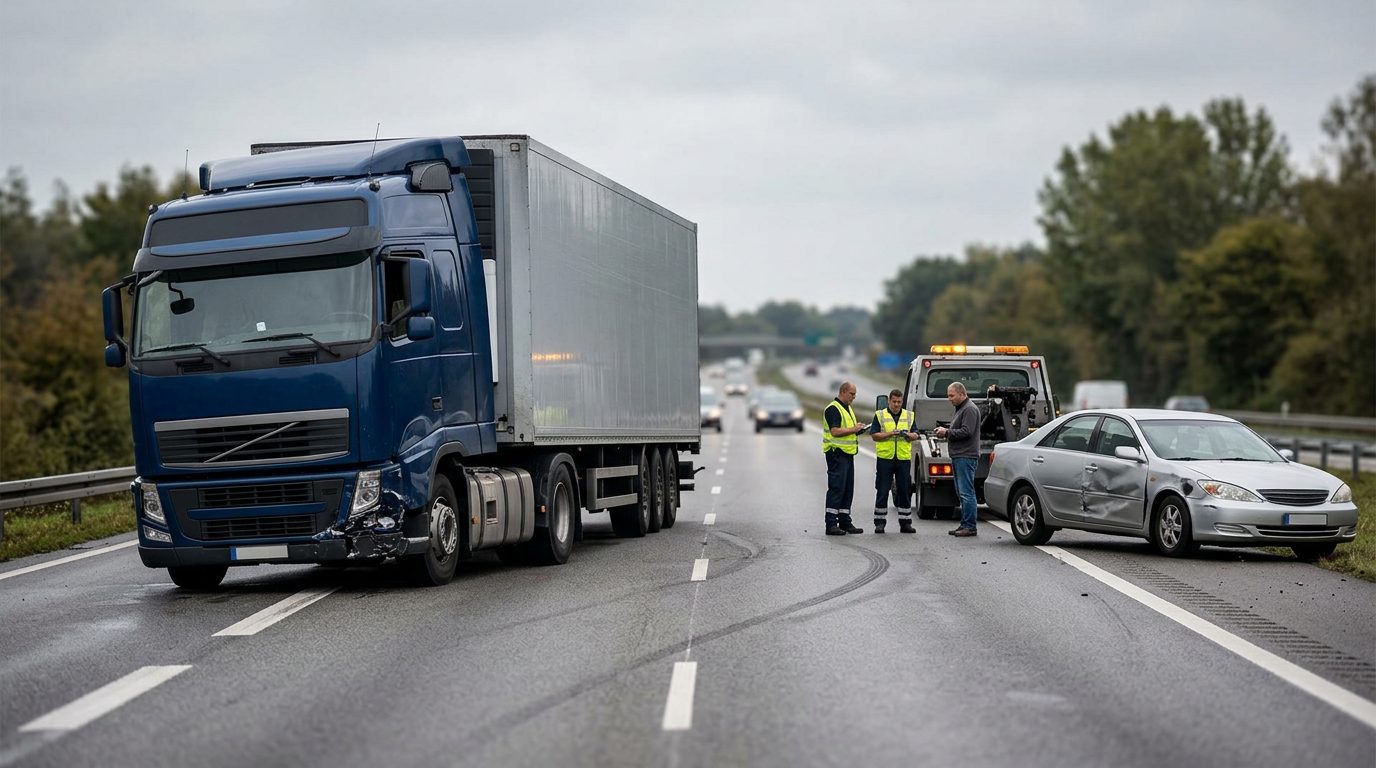
When a truck’s trailer swings out at a sharp angle to the cab—like a folding knife opening—the crash that follows can span multiple lanes and strike other vehicles with catastrophic force. A jackknife accident happens when the truck’s rear trailer loses grip on the road and pivots sideways relative to the cab. This is often triggered by sudden braking, mechanical failure, or poor road conditions. The result is frequently a spinal cord injury, paralysis, traumatic brain injury, or wrongful death for people in its path. Understanding what causes these crashes and who bears legal responsibility is the first step toward protecting your rights.
If you have a valid claim, you may be entitled to compensation for your losses. Talk it through with our team — the first consultation is free, confidential, and carries no obligation.
What Is a Jackknife Truck Accident?
A jackknife happens when a truck driver brakes hard or loses control. The trailer’s momentum causes it to swing out at a sharp angle to the cab. The trailer and cab form an acute angle, often blocking multiple lanes and creating a collision hazard for vehicles behind or beside the truck.
Unlike a minor fender-bender, a jackknife crash is catastrophic. An 80,000-pound truck traveling at highway speed delivers extreme force to any vehicle it strikes. Occupants often suffer spinal cord injuries and paralysis (paraplegia or quadriplegia), traumatic brain injuries, severe burns if fire results, amputations, and in the most tragic cases, wrongful death.
Jackknife crashes differ from two other severe truck-accident types:
- Rollover crashes: The truck tips onto its side or roof.
- Tire-blowout crashes: A tire fails suddenly and can trigger either a jackknife or rollover.
All three share similar causes—mechanical failure, driver error, poor maintenance—and all three cause catastrophic injuries. Understanding the distinction matters because it shapes how liability is proven and which parties may be responsible.
Common Causes of Jackknife Accidents
Jackknife crashes rarely happen by accident. Most result from negligence—either by the driver, the trucking company, or both.
Driver error is a leading cause. A truck driver who brakes too hard or too suddenly can lock the trailer wheels, causing it to skid sideways. Excessive speed for road conditions—especially on curves or in rain, ice, or gravel—makes jackknifing more likely. Fatigue and impaired driving also impair a driver’s ability to control the truck smoothly.
Mechanical failure is equally dangerous. Brake defects or failure prevent the driver from controlling the truck’s deceleration. A tire blowout can cause the driver to lose control instantly. Defective suspension or steering systems make the truck harder to steer and stabilize.
Poor road conditions contribute significantly. Ice, rain, loose gravel, potholes, and debris reduce tire traction and make the trailer more likely to skid when braking. A driver who knows the road is slippery but still brakes hard is negligent.
Improper cargo loading shifts the truck’s weight distribution, making it unstable and more prone to jackknifing during braking. An overloaded trailer or unevenly distributed cargo increases the risk.
Inadequate maintenance by the trucking company is a common hidden cause. Worn brake pads, under-inflated or damaged tires, and corroded suspension components make jackknifing more likely. If the company knew or should have known about these defects and failed to repair them before sending the truck back on the road, that’s negligence.
Identifying the cause matters because it determines who is liable. A driver’s sudden panic braking might point to driver negligence. Brake failure points to the trucking company’s maintenance failure or the brake manufacturer’s defect. A tire blowout might implicate the tire manufacturer, the trucking company’s failure to inspect, or both.
Rollover Truck Crashes: Causes and Liability
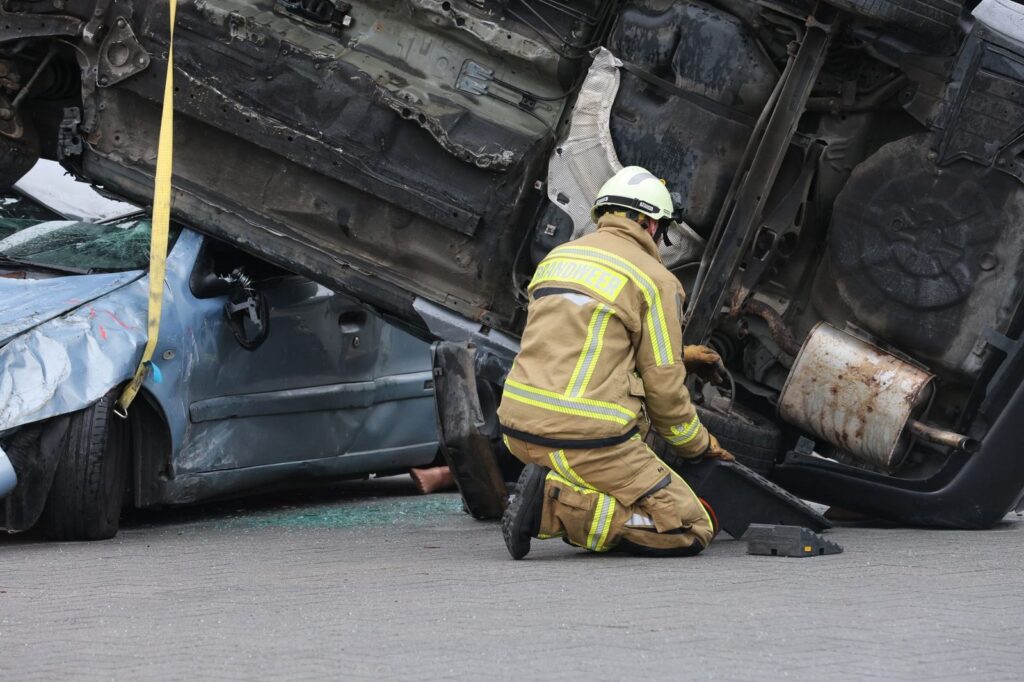
A rollover occurs when a truck tips onto its side or roof, often on a curve or when the driver swerves suddenly. While the mechanics differ from a jackknife, the causes and liability patterns overlap.
Excessive speed on curves is a primary cause. A truck traveling too fast for the road’s curvature can tip if the centrifugal force exceeds the truck’s stability. Uneven weight distribution—cargo shifted to one side—makes tipping more likely.
Defective suspension or tires can contribute. A weak suspension or under-inflated tires reduce the truck’s stability and increase rollover risk.
Trucking company negligence includes failure to maintain the suspension, tires, and steering systems; failure to train drivers on safe cornering speeds; and pressure on drivers to meet unrealistic schedules that encourages speeding.
Driver negligence includes speeding, fatigue, distraction, and failure to adjust speed for road conditions or the truck’s load.
Like jackknife crashes, rollovers cause catastrophic injuries: spinal cord damage, paralysis, traumatic brain injury, severe burns, amputation, and wrongful death. The liability analysis is similar—multiple parties may share responsibility depending on the cause.
Tire Blowouts and Catastrophic Truck Crashes
A tire blowout—sudden, catastrophic tire failure—can trigger a jackknife or rollover. The driver loses traction instantly and may overcorrect, causing the truck to skid or tip.
Causes of tire blowouts include:
- Defective tires (design or manufacturing defects)
- Under-inflation
- Overloading
- Lack of inspection
A tire that’s under-inflated generates excess heat and is more prone to failure. An overloaded truck puts more stress on each tire. A driver or company that fails to inspect tires before a trip may not catch visible damage or wear.
The tire manufacturer can be liable if the tire has a defect in design or materials that caused the blowout. Tire defects are often discoverable through expert analysis and testing.
The trucking company can be liable for failure to inspect tires, failure to maintain them (rotating, balancing, replacing worn tires), and failure to replace tires that show visible damage or excessive wear. The Federal Motor Carrier Safety Administration (FMCSA) requires trucking companies to inspect and maintain tires regularly.
The driver can be liable for failure to perform a pre-trip inspection that would have revealed a damaged or under-inflated tire.
Tire-blowout cases often offer strong evidence of liability because tire defects and maintenance failures are usually documented and can be proven through expert analysis.
Who Is Liable in a Jackknife, Rollover, or Tire-Blowout Crash?
Liability in these crashes is rarely one-sided. Multiple parties often share responsibility.
The truck driver may be liable for negligent operation: speeding, braking improperly, driving while fatigued or impaired, or failing to adjust driving for road conditions. However, a driver who brakes suddenly to avoid an obstacle may not be negligent—the liability may rest with the company or manufacturer for failing to maintain the truck.
The trucking company can be liable for:
- Negligent hiring (hiring an unqualified or unsafe driver)
- Negligent training (failing to train drivers on safe braking, load management, or fatigue awareness)
- Negligent maintenance (failing to inspect and repair brakes, tires, suspension, and steering)
- Negligent supervision (pressuring drivers to meet unrealistic schedules that encourage speeding or fatigue driving)
The company can also be liable for failure to repair known defects before sending the truck back on the road.
The tire manufacturer may be liable if the tire has a defect in design or materials that caused the blowout.
The truck manufacturer may be liable if the brakes, suspension, or other safety systems have a defect that contributed to the crash.
Third parties—other drivers, road maintenance entities, or property owners—may share liability if their negligence contributed to the crash. For example, a road maintenance crew that left debris on the highway might share liability if that debris caused a blowout.
Under Florida law, Fla. Stat. §768.81, comparative negligence (shared fault) applies. If you are more than 50% at fault, you generally cannot recover. If you are 50% or less at fault, you can recover damages reduced by your percentage of fault. This means that identifying all responsible parties and proving their negligence is critical.
Not sure what your next step is?
Talk it through with our team — the first consultation is free, confidential, and carries no obligation.
Trucking Company Negligence and Maintenance Failures
Trucking companies are required by the FMCSA to perform regular inspection and maintenance of their trucks. Failure to do so is negligence.
Federal regulations require trucking companies to inspect brakes, tires, suspension, steering, and other critical systems before each trip and at regular intervals. If a company fails to perform these inspections, or performs them but ignores defects, that’s negligence.
Failure to repair known defects is a major liability driver. If a maintenance log shows that a brake pad was worn or a tire was damaged, and the company sent the truck back on the road without repairing it, the company is liable for any crash that results.
Pressure on drivers to meet unrealistic schedules can lead to speeding, fatigue, and poor decision-making. If a company prioritizes delivery speed over safety, and a driver crashes as a result, the company shares liability.
Inadequate driver training or hiring of unqualified drivers also creates liability. A driver with a history of accidents or traffic violations, or a driver who has not been trained on safe braking and load management, is a liability risk.
In the catastrophic-injury cases our attorneys handle, maintenance records and inspection logs are often the smoking gun. A company that skipped inspections, ignored defects, or failed to replace worn tires is difficult to defend. These records are discoverable (obtainable through legal process) and often prove negligence clearly.
Injuries Caused by Jackknife, Rollover, and Tire-Blowout Crashes
The injuries caused by these crashes are severe and permanent.
Spinal cord injuries occur when the impact damages the nerves in the spine. Depending on the location and severity, a spinal cord injury can result in paraplegia (paralysis of the lower body) or quadriplegia (paralysis of all four limbs). According to the Christopher & Dana Reeve Foundation, approximately 17,700 new spinal cord injuries occur each year in the United States, and many result from motor-vehicle crashes. These injuries are permanent and life-altering, requiring lifelong medical care, home modifications, and assistive devices.
Traumatic brain injuries (TBI) range from moderate to severe. A severe TBI can cause permanent cognitive impairment, memory loss, difficulty with speech or movement, and personality changes. According to Mayo Clinic, TBI survivors often require long-term rehabilitation and ongoing medical care. The National Institute of Neurological Disorders and Stroke notes that recovery can take months or years, and some deficits may be permanent.
Severe burns can result if the truck catches fire. Burns covering large areas of the body require emergency care, surgery, skin grafts, and years of rehabilitation. Burn survivors often face permanent scarring, limited mobility, and psychological trauma.
Amputation or limb loss occurs when a limb is crushed or severed in the crash. Amputation survivors require prosthetics, physical therapy, and adaptation to a new way of living.
Catastrophic back and neck injuries can include fractures, disc herniation, or spinal cord damage that causes chronic pain, loss of function, and permanent disability.
Wrongful death is the most catastrophic outcome. A person loses their life, and surviving family members face grief, loss of financial support, and the need to rebuild their lives.
These injuries are not minor or temporary. They are permanent, and they require a lifetime of medical care, adaptation, and support. The financial and emotional burden on survivors and their families is immense.
How Liability Is Proven in These Cases
Proving liability in jackknife, rollover, and tire-blowout cases requires evidence and expert analysis.
Accident-scene evidence includes photographs of vehicle damage, skid marks, road debris, and the final resting positions of vehicles. Damage patterns often tell the story of how the crash happened. Skid marks show where braking occurred and can indicate whether the truck was traveling too fast.
Witness statements from other drivers, bystanders, or emergency responders can describe what they saw—the truck’s speed, whether the driver appeared to lose control, road and weather conditions.
Truck data from the electronic control module (ECM)—the truck’s onboard computer—shows the truck’s speed, acceleration, braking, and engine performance in the seconds before the crash. This data is often preserved and can prove or disprove claims about driver behavior.
Maintenance records and inspection logs show whether the company performed required inspections and whether known defects were repaired. A gap in inspection records or a note of a defect that was never repaired is powerful evidence of negligence.
Driver logbooks show whether the driver was within legal driving-hour limits or was fatigued. Logbook violations suggest negligence.
Regulatory violations of FMCSA or Department of Transportation (DOT) standards can establish negligence. For example, if a tire was worn below the legal minimum tread depth, that’s a violation and evidence of negligence.
Expert analysis by accident reconstructionists, mechanical engineers, and medical experts helps interpret this evidence. An accident reconstructionist can analyze the damage and skid marks to determine the truck’s speed and the sequence of events. A mechanical engineer can analyze brake or tire failure. A medical expert can link the crash mechanics to the injuries sustained.
Hiring experienced investigators and experts is critical. The trucking company will have its own experts and will try to minimize its liability. Strong evidence and expert analysis are necessary to overcome their defense.
What You Should Do After a Jackknife, Rollover, or Tire-Blowout Crash
If you or a family member has been injured in a jackknife, rollover, or tire-blowout crash, taking immediate action is critical.
Seek medical attention right away. Even if you feel okay, get evaluated by a doctor. Some injuries, like internal bleeding or spinal cord damage, may not be immediately apparent. Document all medical treatment and injuries.
Call law enforcement. A police report creates an official record of the crash and can include officer observations about road conditions, vehicle damage, and driver statements.
Preserve evidence. Take photographs of the crash scene, vehicle damage, road conditions, and weather. Collect contact information from witnesses. Note the time of day, road conditions, and any debris or obstacles.
Do not sign anything or give a recorded statement to the trucking company’s insurance adjuster without speaking to an attorney first. Insurance companies often try to get injured people to minimize their injuries or admit fault.
Request the truck’s maintenance records, inspection logs, and driver logbooks through your attorney. These documents are critical to proving negligence. The trucking company may try to destroy or hide these records, so it’s important to request them quickly through legal process.
Contact an attorney who focuses exclusively on catastrophic truck accidents before the evidence disappears or the statute of limitations runs. Under Fla. Stat. §95.11, you generally have two years from the date of the crash to file a lawsuit in Florida. However, the sooner you act, the better. Evidence fades, witnesses move away, and the trucking company may destroy records.
Have questions about what happened?
Ask our team directly. The first conversation is free, confidential, and there is no obligation to continue.
Compensation in Jackknife, Rollover, and Tire-Blowout Cases
If you have a valid claim, you may be entitled to compensation for your losses.
Medical expenses include emergency care, surgery, hospitalization, rehabilitation, ongoing treatment, medications, and assistive devices. For catastrophic injuries, these costs can reach hundreds of thousands or millions of dollars over a lifetime.
Lost wages and loss of earning capacity compensate you for income you lost because of the injury and for reduced earning potential if you cannot return to work or can only work part-time.
Pain and suffering compensates you for physical pain, emotional distress, and the loss of enjoyment of life.
Permanent disability and reduced quality of life are recognized as separate damages. If you are paralyzed, you can no longer engage in activities you once enjoyed. Your daily life is fundamentally changed.
Home and vehicle modifications are necessary if you use a wheelchair or have mobility limitations. These can include ramps, accessible bathrooms, specialized vehicles, and other adaptations.
Wrongful death damages include funeral and burial costs, loss of companionship, and loss of financial support. If the deceased was the family’s primary earner, surviving family members can recover for lost income.
The value of your claim depends on the severity of your injury, the strength of liability evidence, and the defendant’s ability to pay. A catastrophic spinal cord injury with clear liability evidence and strong maintenance-failure proof may be worth significantly more than a moderate injury with disputed liability.
FAQ
What’s the difference between a jackknife and a rollover?
A jackknife occurs when the trailer swings out at an angle to the cab; a rollover occurs when the truck tips onto its side or roof. Both are caused by similar factors and result in catastrophic injuries.
Can the tire manufacturer be liable if a blowout caused the crash?
Yes, if the tire had a defect in design or materials that caused the blowout, the manufacturer can be held liable.
How long do I have to file a lawsuit after a truck crash in Florida?
Under Florida law, you generally have two years from the date of the crash to file a personal-injury lawsuit (Fla. Stat. § 95.11(5)(a)).
What if I was partially at fault for the crash?
Under Florida’s comparative-negligence rule, you can still recover if you are 50% or less at fault, but your recovery is reduced by your percentage of fault (Fla. Stat. § 768.81(6)).
What should I do if the trucking company’s insurance contacts me?
Do not give a recorded statement or sign anything without speaking to an attorney first. Insurance companies often try to minimize your injuries or get you to admit fault.
If you’ve suffered a spinal cord injury, paralysis, traumatic brain injury, amputation, or other catastrophic injury in a jackknife, rollover, or tire-blowout crash, you’re facing medical, financial, and emotional challenges that demand experienced legal guidance. Our team focuses exclusively on catastrophic truck-accident cases and understands the evidence, the experts, and the tactics used by trucking companies and their insurers. Contact us for a free case evaluation to discuss your situation—many people in your position have already taken this step and are now moving forward with clarity about their rights and options.
Common Causes of Jackknife Accidents
Driver Error & Braking
Sudden braking, improper braking technique, or loss of control when a driver applies brakes too hard or unevenly can cause the trailer to swing out and jackknife.
Mechanical Failure
Defective brakes, worn brake pads, failed air brake systems, or malfunctioning anti-lock braking systems (ABS) prevent proper stopping and create jackknife conditions.
Speed & Road Conditions
Excessive speed combined with wet roads, ice, loose gravel, or debris reduces traction and makes jackknifing more likely, especially on curves or during lane changes.
Improper Loading
Cargo that is unevenly distributed, overloaded, or improperly secured shifts weight and destabilizes the trailer during braking or turns.
Who May Be Liable
The Truck Driver
Drivers who brake improperly, drive too fast for conditions, or fail to maintain control can be held responsible for the crash and resulting injuries.
The Trucking Company
Employers may be liable if they failed to hire qualified drivers, provide adequate training, enforce safety protocols, or maintain vehicles properly.
Maintenance & Repair Providers
Companies responsible for servicing the truck's brakes, suspension, or other systems can be liable if negligent maintenance contributed to the jackknife.
Tire & Equipment Manufacturers
If a defective tire, brake component, or other part caused or contributed to the accident, the manufacturer may bear liability for the defect.
Loading Companies
Third parties who loaded or secured cargo improperly can be responsible if improper loading caused instability or jackknifing.
Jackknife Accidents Cause Catastrophic Injuries
When a fully loaded tractor-trailer jackknifes, the force is enormous. Occupants of other vehicles often suffer spinal cord injuries, paralysis, traumatic brain injuries, amputations, and severe burns. Multiple parties may share fault, and determining liability requires a thorough investigation of the truck's maintenance records, driver logs, cargo documentation, and accident scene evidence.
Key Steps After a Jackknife Truck Accident
Seek Medical Attention Immediately
Catastrophic injuries from jackknife crashes may not be immediately obvious. Get a full medical evaluation and document all injuries and treatment.
Preserve Evidence
Photos of the accident scene, vehicle damage, road conditions, and skid marks are critical. Request the truck's maintenance records, driver logs, and black box data as soon as possible.
Report the Accident
File a police report and notify your insurance company. Request a copy of the official accident report, which will include the responding officer's observations.
Consult an Attorney
Jackknife accidents involve complex liability questions and often multiple defendants. An attorney can investigate the crash, identify responsible parties, and protect your rights.
Frequently Asked Questions
What's the difference between a jackknife and a rollover?
A jackknife occurs when the trailer swings out at an angle to the cab, often forming a V or L shape. A rollover occurs when the truck tips onto its side or roof. Both are caused by similar factors—excessive speed, sudden braking, and poor road conditions—and both result in catastrophic injuries.
Can the tire manufacturer be liable if a blowout caused the crash?
Yes. If a tire had a defect in design, manufacturing, or labeling that contributed to a blowout or jackknife, the tire manufacturer can be held liable for injuries and damages caused by the accident.
Is the truck driver always responsible?
Not necessarily. While driver error is a common cause, liability may rest with the trucking company (for inadequate training or maintenance), the truck manufacturer (for a defective part), a loading company (for improper cargo), or multiple parties. A thorough investigation is essential.
What damages can I recover?
Damages in catastrophic truck accident cases may include medical expenses, rehabilitation costs, lost wages, pain and suffering, and in cases of wrongful death, compensation for the family's loss. An attorney can evaluate your specific situation.