

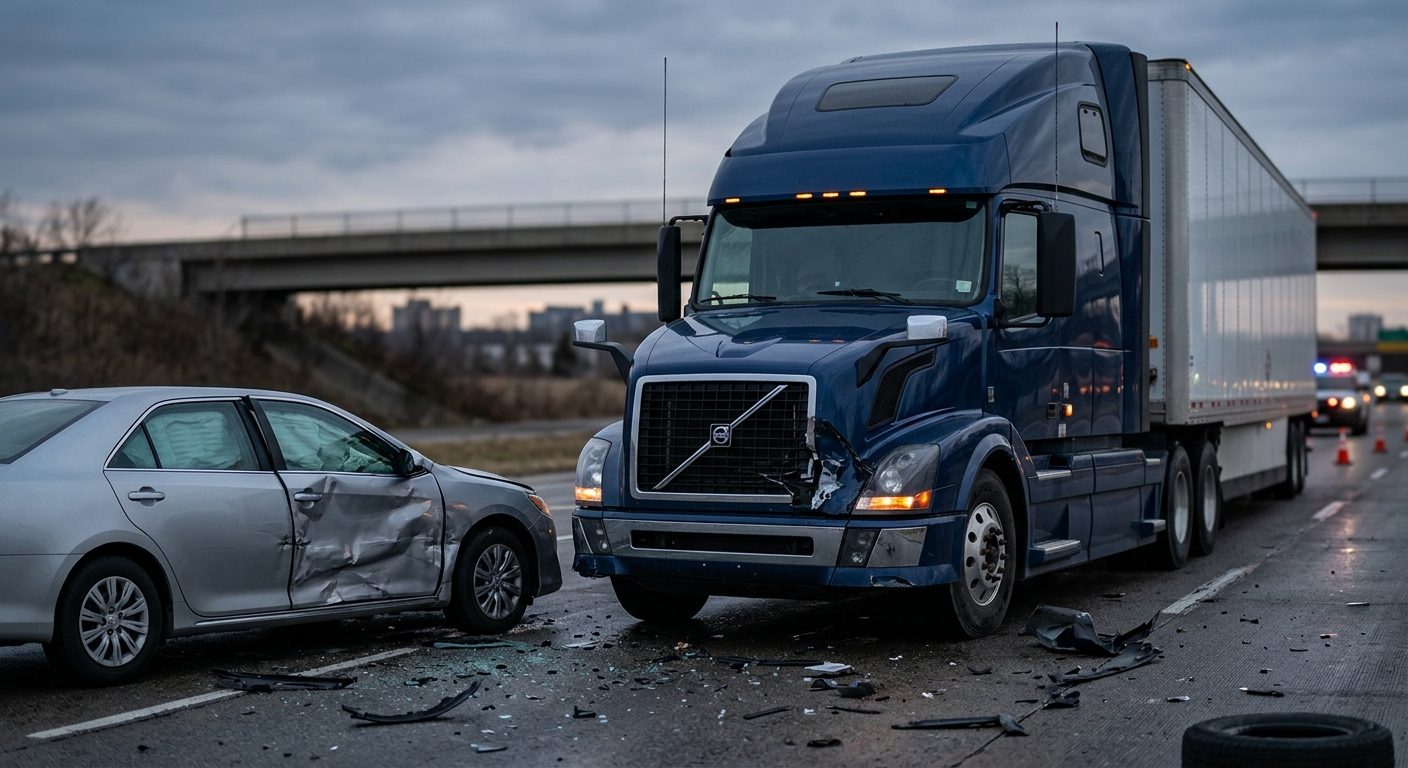
Truck Accidents
Hours-of-Service Violations and Catastrophic Truck Crashes
When a truck driver breaks federal rest and driving rules, the results can be devastating. Learn how these violations connect to serious injuries and what you need to know.
By CHG Lawyers · Published August 24, 2026
Federal Hours-of-Service Rules and Truck Accident Claims
When a truck driver crashes into your vehicle, the cause is rarely simple. But if that driver was fatigued—pushing through long hours without adequate rest—federal law may have been broken. The Federal Motor Carrier Safety Administration (FMCSA) sets strict hours-of-service (HOS) rules to prevent catastrophic crashes. These crashes leave people paralyzed, amputated, or dead. An hours-of-service violation in a truck accident is powerful evidence that the driver or company ignored a safety rule designed to protect you. Understanding these rules and how violations affect your claim is the first step toward holding the responsible party accountable.

Not sure what your next step is?
Talk it through with our team — the first consultation is free, confidential, and carries no obligation.
What Is the Federal Hours-of-Service Rule?
The federal hours-of-service rule limits how long truck drivers can drive without rest. The Federal Motor Carrier Safety Administration (FMCSA) enforces it under the U.S. Department of Transportation.
Here are the core rules:
- 11-hour driving limit: A driver may drive a maximum of 11 hours after taking 10 consecutive hours off duty.
- 14-hour on-duty window: A driver cannot drive after being on duty for 14 consecutive hours, even if they haven’t used all 11 driving hours.
- 60/70-hour weekly limit: A driver cannot drive after accumulating 60 hours on duty in 7 consecutive days, or 70 hours in 8 consecutive days.
- 30-minute mandatory break: After driving for 8 cumulative hours, a driver must take at least 30 consecutive minutes off before driving again.
These aren’t suggestions—they’re federal law. Every interstate commercial truck must comply. Violations can result in federal penalties, safety violations on the driver’s record, and civil liability in a personal injury or wrongful-death case.
Why Does the Federal Government Require Hours-of-Service Rules?
The FMCSA created HOS rules because driver fatigue causes crashes. Research from the National Highway Traffic Safety Administration (NHTSA) shows that fatigued driving impairs judgment, reaction time, and decision-making in ways comparable to alcohol impairment. A tired truck driver is more likely to miss hazards, misjudge stopping distance, and fall asleep at the wheel.
A fully loaded commercial truck weighs 80,000 pounds or more. It requires 300 feet or longer to stop from highway speed. When a fatigued driver loses focus—or consciousness—even for a few seconds, the results are catastrophic. Spinal cord injuries, traumatic brain injuries, amputations, severe burns, and wrongful death are not rare outcomes in fatigue-related truck crashes. HOS rules exist to prevent exactly these injuries.
Compliance isn’t optional. It’s a legal requirement designed to protect the public.
What Happens If a Truck Driver Violates Hours-of-Service Rules?
When a driver or company violates HOS rules, consequences follow on multiple levels.
Federal penalties: The FMCSA assesses fines against both the driver and the trucking company. Penalties vary by violation type and severity. Repeat violations result in higher fines. A single violation can cost hundreds or thousands of dollars.
Safety record impact: Violations are recorded in the FMCSA’s Safety Management System (SMS). They remain on the driver’s and company’s safety rating and can affect insurance rates, customer contracts, and the company’s ability to operate.
Civil liability: Most important for you: an HOS violation is evidence of negligence in a personal injury or wrongful-death claim, but it is not conclusive evidence of negligence.
How Do Hours-of-Service Violations Affect Your Truck Crash Claim?
An hours-of-service violation is evidence of negligence, but it is not conclusive evidence of negligence.
Here’s why it matters: The HOS rule was written specifically to prevent fatigue-related crashes. If the driver violated that rule and a crash occurred, the violation shows the driver or company ignored a federal safety requirement designed to prevent exactly the harm you suffered.
HOS violations also support claims against the trucking company itself. A company can be held liable for:
- Vicarious liability: The company is responsible for the driver’s violations because the driver was acting within the scope of employment.
- Negligent hiring and retention: If the company hired or kept a driver with a history of HOS violations, the company itself was negligent.
In the catastrophic-injury cases we handle, HOS violations often appear alongside other evidence of negligence. This includes unrealistic delivery schedules, pressure to meet impossible timelines, or a pattern of violations the company ignored.
Have questions about what happened?
Ask our team directly. The first conversation is free, confidential, and there is no obligation to continue.
What Are the Most Common Hours-of-Service Violations?
The violations we see most often in truck accident cases include:
- Driving beyond the 11-hour limit without a 10-hour rest break
- Exceeding the 14-hour on-duty window
- Violating the 60/70-hour weekly limit (driving too many hours in a week without a reset)
- Failing to take the mandatory 30-minute break after 8 hours of driving
- Falsifying logbooks or electronic logging device (ELD) records to hide violations
- Driving after being placed out-of-service by a DOT inspector
Some violations are honest mistakes. Others reveal a pattern of prioritizing profit or speed over safety—and that pattern is evidence of negligence.
How Do You Prove an Hours-of-Service Violation in a Truck Accident Case?
Proving an HOS violation requires evidence. The good news is that modern trucks create a detailed record of driving time and behavior.
Electronic logging devices (ELDs): Federal law requires ELDs on most commercial trucks. These devices automatically record driving time, rest breaks, and on-duty time. They cannot be easily altered and provide objective proof of violations.
The truck’s black box (engine control module): The truck’s ECM records engine data, speed, braking patterns, and other information. This data can reveal fatigue-related driving patterns—sudden speed changes, erratic braking, or lane drift—that suggest the driver was drowsy.
FMCSA inspection records: If the truck or driver was inspected by a DOT officer and violations were cited, those inspection records may help show what was found during the inspection.
Dispatch records and company communications: Emails, text messages, or dispatch logs that show pressure to meet unrealistic schedules can support a claim that the company encouraged violations.
Accident reconstruction and expert analysis: An expert can analyze crash data, vehicle damage, and road conditions to show how fatigue contributed to the crash.
The key is preserving this evidence quickly. ELD data can be deleted, black box files can be overwritten, and records can be lost. Early action protects your claim.
How Long Does an Hours-of-Service Violation Stay on a Driver’s Record?
HOS violations remain in the FMCSA’s Safety Management System for a set period. They can affect the driver’s and company’s safety rating for years. However, in a personal injury case, the age of a violation doesn’t matter if it’s relevant to the crash.
A pattern of violations over time is especially powerful evidence. It shows the driver or company had a history of ignoring HOS rules, making negligence foreseeable and strengthening your claim.
What Penalties Do Trucking Companies Face for Hours-of-Service Violations?
Federal fines for HOS violations are separate from the damages you may recover in a personal injury claim. But they’re important because they show the company knew—or should have known—about the risk.
Penalties include:
- Federal fines ranging from hundreds to thousands of dollars per violation
- Higher penalties for repeat violations
- Increased DOT scrutiny and inspection frequency
- Potential loss of operating authority for serious or repeated violations
In a personal injury case, a company’s history of HOS violations and federal penalties can support a claim for punitive damages (extra damages meant to punish the company for reckless conduct). It shows the company knew the risk and ignored it.
Want to know where you stand?
Tell us what happened and our team will walk you through the options available to you, at no cost.
Frequently Asked Questions
What is negligence per se?
Under Florida law, a violation of a safety regulation such as an HOS rule is evidence of negligence, but it is not conclusive evidence of negligence.
Can a trucking company be held liable for a driver’s HOS violations?
Yes. The company can be held liable through vicarious liability (responsibility for the driver’s actions) or negligent hiring and retention (hiring or keeping a driver with a history of violations).
How do I know if the driver violated hours-of-service rules?
An attorney can obtain the truck’s electronic logging device records, black box data, and FMCSA inspection records. These documents provide objective proof of violations.
Does an HOS violation guarantee I’ll win my case?
No. A violation is strong evidence, but your attorney will need to prove the violation caused or contributed to the crash and your injuries. That’s why evidence preservation and expert analysis matter.
What should I do immediately after a truck crash?
Preserve all evidence: medical records, crash reports, photos, witness statements, and any information about the driver’s condition or logbooks. Contact an attorney who understands truck accident evidence before records are lost or destroyed.

What to Do If You Were Injured in a Truck Crash Involving Fatigue or Hours-of-Service Violations
If you or a loved one suffered a catastrophic injury—spinal cord damage, paralysis, traumatic brain injury, amputation, severe burns, or wrongful death—in a truck crash, don’t wait to act.
Preserve evidence immediately. Medical records, crash reports, photos, witness statements, and any information about the driver’s logbooks or ELD records can disappear or be destroyed. Time is critical.
Don’t assume the crash was your fault. Fatigue-related crashes are often caused by driver or company negligence. HOS violations are evidence of that negligence.
Contact an attorney who understands truck accident law and federal HOS regulations. Your attorney can obtain ELD records, black box data, FMCSA inspection records, and dispatch logs before they’re lost. They can also retain accident reconstruction experts and fatigue specialists to analyze how the violation contributed to your crash.
Early action protects your claim and increases the likelihood of holding the responsible party accountable.
If you were severely injured or your family member was killed in a truck crash, and you believe hours-of-service violations or driver fatigue played a role, contact us for a free case evaluation. People in your situation reach out to us regularly—and we’re here to help you understand what happened and what your claim might mean for your future.
What Are Hours-of-Service Rules?
The Federal Motor Carrier Safety Administration (FMCSA) sets strict limits on how long truck drivers can drive without rest. Property-carrying drivers are limited to 11 hours of driving within a 14-hour window, and weekly limits apply (60 hours over 7 days or 70 hours over 8 days). These rules exist because fatigue impairs judgment and reaction time—just like alcohol. When a driver or company ignores them, the risk of a catastrophic crash rises sharply.
How HOS Violations Lead to Serious Crashes
Fatigue and Impaired Reaction Time
An exhausted driver cannot brake, steer, or avoid obstacles as quickly as a rested one. In a multi-ton truck traveling at highway speed, those lost seconds mean the difference between a near-miss and a catastrophic collision.
Negligence Per Se
When a driver or company violates an FMCSA hours-of-service rule, that violation can be treated as negligence per se—meaning the violation itself is evidence of negligence. You don't have to separately prove the driver was careless; the rule-breaking speaks to that question.
Company Liability
Trucking companies can be held responsible for their drivers' HOS violations through vicarious liability. Companies can also face direct liability if they pressured drivers to violate rules, falsified logbooks, or failed to enforce safety policies.
Documented Evidence
Electronic logging devices (ELDs) and paper logbooks create a clear record of when a driver was on the road and for how long. This documentation can be crucial in establishing what happened and why.
Why HOS Violations Matter in Your Case
Clear Legal Standard
FMCSA rules are federal law. A violation is not a gray area—it's a concrete breach of a safety requirement designed to protect the public.
Traceable Records
Modern trucks use electronic logging devices that record driving hours automatically. These records are difficult to dispute and provide a factual foundation for your claim.
Pattern of Negligence
A single HOS violation may indicate a one-time mistake. Multiple violations or a company's practice of ignoring the rules can show a pattern of recklessness that strengthens your case.
Educational Value
Understanding how fatigue and rule-breaking contributed to your injury helps you and your legal team build a complete picture of what happened and why.
What to Do If You've Been Hit by a Fatigued Truck Driver
Seek Medical Attention Immediately
Catastrophic injuries—spinal cord damage, traumatic brain injury, amputation, severe burns—may not be obvious right away. Get a full medical evaluation and follow your doctor's care plan. Keep all medical records and documentation.
Report the Crash to Police
A police report creates an official record of the accident. Request a copy and note the officer's name and badge number. The report may include observations about driver fatigue or condition.
Gather Information at the Scene
If you are able, collect the truck driver's name, company, license plate, and insurance details. Note the time of day and any visible signs of driver fatigue. Get contact information from witnesses.
Contact a Lawyer Who Focuses on Catastrophic Truck Injuries
Hours-of-service violations require investigation into federal regulations, logbook records, and company practices. An attorney who focuses exclusively on catastrophic truck accidents can help you understand your options and pursue a claim.
Do Not Delay
Evidence can disappear, memories fade, and records may be destroyed. The sooner you contact a lawyer, the sooner we can preserve critical evidence—including electronic logs, maintenance records, and driver history—and begin building your case.