

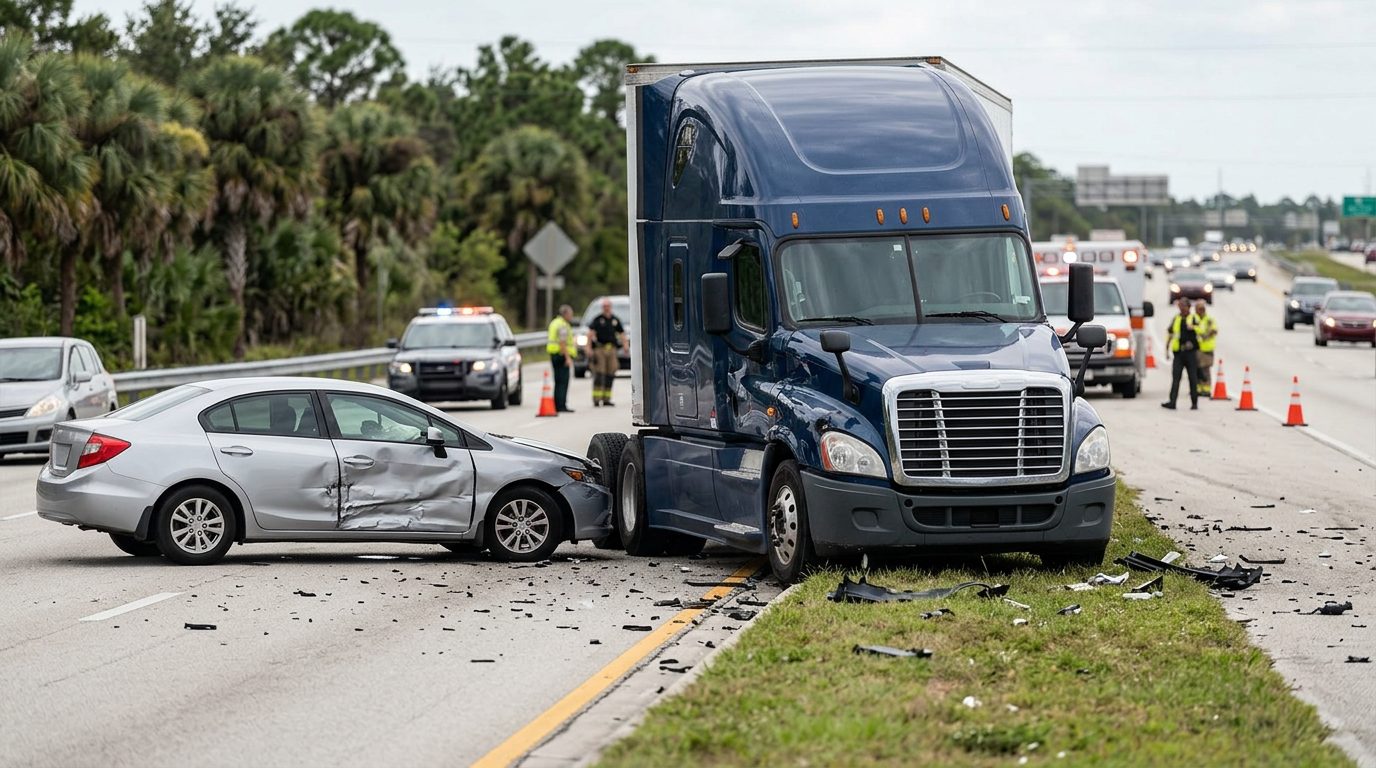
Fatal Truck Accidents | Florida
Fatal Truck Accident Statistics in Florida: What NHTSA FARS Data Reveals
Understanding the scale of catastrophic truck crashes and what families need to know after a fatal collision.
By CHG Lawyers · Published August 24, 2026
NHTSA FARS Data: What the Statistics Say About Fatal Truck Crashes in Florida
Fatal truck crashes are not random. They are often preventable outcomes of negligence, poor maintenance, driver fatigue, or unsafe practices. The data proves it. NHTSA’s Fatality Analysis Reporting System (FARS) is the gold-standard national database. It captures every fatal motor vehicle crash reported to law enforcement. For families who have lost someone in a fatal truck accident, understanding what the data reveals is the first step toward accountability.

Not sure what your next step is?
Talk it through with our team — the first consultation is free, confidential, and carries no obligation.
What NHTSA FARS Data Tells Us About Fatal Truck Crashes in Florida
FARS is maintained by the National Highway Traffic Safety Administration. It provides the most authoritative information on fatal crashes nationwide. Every fatal truck crash reported to law enforcement is recorded in FARS. This makes it the most reliable source for understanding truck accident deaths.
Florida’s truck crash fatality numbers are sobering. According to the National Safety Council’s Injury Facts database, Florida recorded 353 deaths from large truck crashes in 2024. This ranked Florida third nationally, after Texas (720 deaths) and California (391 deaths). These aren’t abstract numbers. Each represents a person and a changed family.
Trucks cause a disproportionate share of fatal crashes relative to how many trucks are on the road. While commercial trucks make up a small fraction of vehicles on Florida’s roads, they’re involved in a much larger share of fatal collisions. This reflects the physics of truck accidents. A fully loaded tractor-trailer can weigh up to 80,000 pounds. When it collides with a passenger vehicle, the outcome is often catastrophic.
Why does this data matter to families? Because it shows that fatal truck crashes are not accidents. They are foreseeable outcomes of negligence. Poor maintenance, driver fatigue, inadequate training, overloading, and unsafe practices by trucking companies cause these deaths. That preventability is the foundation of a wrongful death claim.
How Many People Die in Truck Accidents in Florida Each Year?
Florida’s annual fatal truck crash toll reflects the state’s unique risk factors. High population density, major commercial corridors (Interstate 75, Interstate 95, Interstate 4), tourism traffic, and construction zones all contribute to the state’s truck crash profile.
In 2024, Florida’s 353 large truck fatalities included deaths across multiple categories. These included occupants of passenger vehicles struck by trucks, truck occupants themselves, pedestrians, and cyclists. The majority of fatalities occur in passenger vehicles hit by trucks, not in the trucks themselves. This underscores a critical point: when a truck crashes, the people most likely to die are often innocent drivers and passengers in other vehicles.
Beyond fatal crashes, thousands of Floridians survive truck accidents but suffer catastrophic, life-altering injuries. Spinal cord injuries, traumatic brain injuries, amputations, and severe burns from truck crashes leave survivors permanently disabled. These non-fatal catastrophic injuries often carry costs exceeding those of fatal crashes when you account for decades of medical care, rehabilitation, and lost earning capacity.
FARS data typically has a reporting lag of 12–18 months after the calendar year. This means 2024 data becomes fully finalized in mid-2025 or later. Preliminary numbers may be available sooner, but final, verified figures take time to compile from law enforcement agencies across the state.
What Is the Deadliest Highway in Florida for Truck Crashes?
Certain Florida corridors see disproportionately high numbers of fatal truck crashes. Interstate 75 (running north-south through the state), Interstate 95 (the eastern coastal corridor), and Interstate 4 (connecting Tampa and Orlando) are among the highest-risk routes. The Florida Turnpike and US-27 also see significant truck traffic and corresponding crash rates.
Why are these routes more dangerous? Volume, speed, and truck traffic concentration all play a role. Interstate 75 carries enormous volumes of commercial traffic moving goods between the Midwest and South Florida. Interstate 4 is notoriously congested and complex, with multiple interchanges and lane shifts. Drivers making split-second decisions in heavy traffic are more likely to make mistakes. When a truck is involved, mistakes are fatal.
Construction zones represent a specific and preventable category of fatal truck crashes in Florida. Lane shifts, reduced visibility, inadequate signage, and driver inattention in work zones create perfect conditions for catastrophic collisions. Many of these crashes involve negligence by the construction company, the trucking company, or both. For more on this risk, see our guide to construction zone accidents.
Have questions about what happened?
Ask our team directly. The first conversation is free, confidential, and there is no obligation to continue.
Florida Truck Crashes in National Context
How does Florida’s fatal truck crash rate compare to the rest of the nation? Florida ranks third in absolute numbers of large truck fatalities, behind only Texas and California. Both of those states have larger populations and higher truck traffic volumes. When adjusted for population, Florida’s rate is closer to the national average, though still elevated in certain corridors.
Several factors drive Florida’s truck crash profile. The state is a major commercial hub with significant north-south and east-west trucking corridors. Tourism brings additional traffic, including rental vehicles and unfamiliar drivers. Weather—sudden thunderstorms, flooding, and high winds—creates hazardous conditions that increase crash risk. Florida’s aging population means more drivers with slower reaction times share the roads with high-speed commercial traffic.
What the Data Reveals About Truck Crash Causes
Fatal truck crashes don’t happen by chance. FARS data consistently points to preventable causes:
- Driver fatigue: Hours-of-service violations and inadequate rest periods are common factors. Tired drivers have slower reaction times and impaired judgment.
- Inadequate maintenance: Brake failure, tire blowouts, and mechanical defects are foreseeable and preventable through proper maintenance.
- Overloading: Trucks loaded beyond legal weight limits are harder to control and stop.
- Speed: Trucks traveling too fast for conditions cannot stop in time to avoid collisions.
- Failure to yield: Driver error, inattention, or aggressive driving by truck drivers or other motorists.
- Inadequate training: Drivers who lack proper training in vehicle control, load securement, or hazard recognition are more likely to crash.
Each of these causes points to a responsible party. This could be the trucking company, the driver, the maintenance contractor, the shipper, or another entity whose negligence created the risk. That’s why the data matters to families. It shows the crash was foreseeable and preventable. Someone is responsible.
Understanding the Human Cost Behind the Numbers
Statistics are powerful, but they can feel distant. Behind each fatal truck crash statistic is a family. A spouse lost a partner. Children lost a parent. Parents lost a child. Behind each catastrophic injury statistic is a survivor facing permanent disability, pain, and dependence on others for basic care.
When negligence causes a fatal truck crash, families have the right to pursue a wrongful death claim. These claims seek compensation for the loss of the loved one. This includes funeral expenses, lost income, lost companionship, and the family’s pain and suffering. A wrongful death claim is also a mechanism for accountability. It forces the responsible parties to answer for their negligence.
Survivors of non-fatal catastrophic truck crashes face different but equally profound challenges. A spinal cord injury resulting in paraplegia or quadriplegia means permanent paralysis and lifelong dependence on mobility aids and personal care. A traumatic brain injury can alter personality, cognition, and the ability to work or live independently. An amputation means loss of a limb and the need for prosthetics, ongoing medical care, and psychological support. Severe burns require years of surgical reconstruction and pain management.
Life-care planning for survivors of catastrophic truck injuries can cost millions of dollars over a lifetime. These costs include medical care, rehabilitation, home modifications, assistive devices, and lost earning capacity. Families pursuing claims for catastrophic truck injuries must account for these long-term costs.
Data Sources and How to Verify These Numbers
If you want to verify the statistics cited here, several authoritative sources are available to the public:
NHTSA FARS: The Fatality Analysis Reporting System is searchable by state, year, and crash type. You can access raw data and build custom reports.
Florida Highway Safety and Motor Vehicles (FLHSMV) Crash Reports: FLHSMV publishes annual crash statistics and maintains a crash dashboard with real-time data on Florida crashes.
Federal Motor Carrier Safety Administration (FMCSA) Crash Statistics: FMCSA tracks commercial motor vehicle crashes and publishes data by state and carrier.
National Safety Council – Injury Facts: NSC compiles and publishes truck crash fatality data from FARS and other sources.
Why multiple sources? Cross-verification builds confidence in the numbers. FARS data is the most authoritative for fatal crashes. FLHSMV and FMCSA data provide additional context and can reveal patterns that FARS alone might not highlight. Understanding the source of a statistic and its reporting timeline helps you interpret it correctly.
Want to know where you stand?
Tell us what happened and our team will walk you through the options available to you, at no cost.
What Families Should Know After a Fatal Truck Crash
A fatal truck crash is often the result of negligence. Not fate, not bad luck, and not an unavoidable accident. The data shows these crashes are preventable.
If your family lost someone in a fatal truck crash, you have legal options. A wrongful death claim allows you to pursue accountability and compensation from the responsible parties. This could include the trucking company, the driver, the maintenance contractor, the shipper, or others whose negligence caused the crash.
First steps matter:
- Preserve evidence from the crash scene (photographs, debris, vehicle damage).
- Gather witness information and contact details.
- Obtain the crash report from law enforcement.
- Document your loved one’s medical records, employment history, and relationships.
- Consult with an attorney as soon as possible.
Why early legal consultation? Several reasons. Florida’s statute of limitations for wrongful death claims is two years from the date of death. Evidence can be lost or destroyed. Insurance companies move quickly to investigate crashes and may pressure families to settle prematurely. An experienced attorney can protect your family’s rights, preserve evidence, and build a strong claim.
If you survived a catastrophic truck injury—spinal cord injury, traumatic brain injury, amputation, or severe burns—you also have legal options. A personal injury claim can recover compensation for medical care, rehabilitation, lost income, and pain and suffering. Learn more about catastrophic truck accident injuries.

Frequently Asked Questions
How do I access NHTSA FARS data myself?
NHTSA’s FARS database is publicly searchable online. You can filter by state, year, vehicle type, and crash characteristics to build custom reports.
What’s the difference between FARS, FLHSMV, and FMCSA data?
FARS captures all fatal crashes reported to law enforcement nationwide. FLHSMV publishes Florida-specific crash data including non-fatal crashes. FMCSA focuses on commercial motor vehicle crashes. Each source has different reporting timelines and coverage.
How long do I have to file a wrongful death claim after a fatal truck crash in Florida?
Florida law allows two years from the date of death to file a wrongful death claim. Do not wait. Consult an attorney immediately.
Are most fatal truck crashes preventable?
Yes. The vast majority of fatal truck crashes result from preventable causes: driver fatigue, inadequate maintenance, overloading, speed, or driver error. This is why families can pursue claims based on negligence.
What should I do if I survived a catastrophic truck injury?
Document your injuries, seek immediate medical care, gather evidence from the crash scene, obtain the crash report, and contact an attorney. Your claim will need to account for long-term medical costs, rehabilitation, lost income, and pain and suffering.
If your family lost someone in a fatal truck crash in Florida, or if you survived a catastrophic injury from a truck accident, the statistics show these crashes are often the result of negligence and preventable failures. Families regularly reach out after losing a loved one or facing permanent disability. You don’t have to navigate this alone. Contact us for a free case evaluation to discuss what happened and explore your legal options.
Key Data Sources on Fatal Truck Crashes
NHTSA FARS Database
The Fatality Analysis Reporting System captures all fatal motor-vehicle crashes reported to law enforcement across the United States. FARS data is publicly searchable and allows filtering by state, year, vehicle type, and crash characteristics—making it a primary source for understanding fatal truck accidents in Florida.
Florida Highway Safety and Motor Vehicles (FLHSMV)
Florida's state highway safety office publishes crash statistics specific to Florida roads. FLHSMV reports complement FARS data and provide additional context about fatal crashes within the state.
Federal Motor Carrier Safety Administration (FMCSA)
The FMCSA tracks crashes involving commercial trucks and motor carriers. This data is essential for understanding the role of truck driver behavior, vehicle maintenance, and carrier compliance in fatal collisions.
Why These Databases Matter
When a family loses a loved one in a fatal truck crash, understanding the circumstances—vehicle type, driver factors, road conditions—is the first step toward accountability. These public datasets help identify patterns and establish what went wrong.
Fatal Crashes Are Catastrophic Injuries
A fatal truck accident is the most severe outcome a crash can produce. When a family loses a loved one due to another party's negligence—a truck driver's recklessness, a carrier's failure to maintain the vehicle, or unsafe road conditions—the family may have a claim for wrongful death. Time matters in these cases.
What Families Should Know After a Fatal Truck Accident
Public Data Tells a Story
NHTSA FARS and FMCSA records document the crash scene, vehicle involvement, and contributing factors. This data becomes evidence in a wrongful-death claim and helps establish liability.
Accountability Matters
Truck operators, carriers, and manufacturers can be held responsible for negligence. Understanding the crash data is the foundation for pursuing a claim on behalf of your family.
Time Is Critical
Wrongful-death claims are subject to strict deadlines. Gathering evidence, obtaining crash reports, and filing a claim requires prompt action after a fatal accident.
You Don't Navigate This Alone
A law firm that focuses exclusively on catastrophic injuries can help your family understand the data, identify liable parties, and pursue the claim you deserve.