

Jet Ski Accidents
How to Prove Negligence in a Jet Ski Collision
Understanding the four legal elements you must establish to hold a negligent operator accountable for your catastrophic injury.
By CHG Lawyers · Published August 30, 2026
How to Prove Negligence in a Jet Ski Collision: Florida Law & Liability
Proving negligence in a jet ski accident requires establishing four distinct legal elements: duty of care, breach of that duty, causation, and damages. All four must be proven with evidence; if even one is missing, your negligence claim fails. Understanding what each element means and what evidence supports it will help you know whether you have a viable claim and what your case may involve.

Not sure what your next step is?
Talk it through with our team — the first consultation is free, confidential, and carries no obligation.
The Four Elements You Must Prove in a Jet Ski Negligence Claim
Element 1: Duty of Care — What the Jet Ski Operator Owed You
Every jet ski operator has a legal duty to operate their craft safely and responsibly. This duty includes following boating laws, maintaining a reasonable speed for conditions, watching for other watercraft and obstacles, and not operating under the influence of alcohol or drugs. If the operator was renting the jet ski, the rental company also had a duty to maintain the equipment, provide proper safety gear, and give clear instructions on safe operation.
In the catastrophic-injury cases we handle, we often see accidents where the operator’s breach of this basic duty—speeding in crowded waters, operating while intoxicated, or ignoring navigation rules—directly caused the collision. Even if the operator was a friend or family member, they owed you a duty of care on the water. Maritime law recognizes these duties as a baseline standard that all operators must meet.
Element 2: Breach of Duty — How the Operator Failed That Duty
A breach occurs when the operator’s actions fell below the standard of reasonable care. Examples include operating at excessive speed, failing to yield the right of way, operating while intoxicated, ignoring navigation rules, or failing to maintain the jet ski properly. Breach can also mean failing to warn passengers of known hazards or risks.
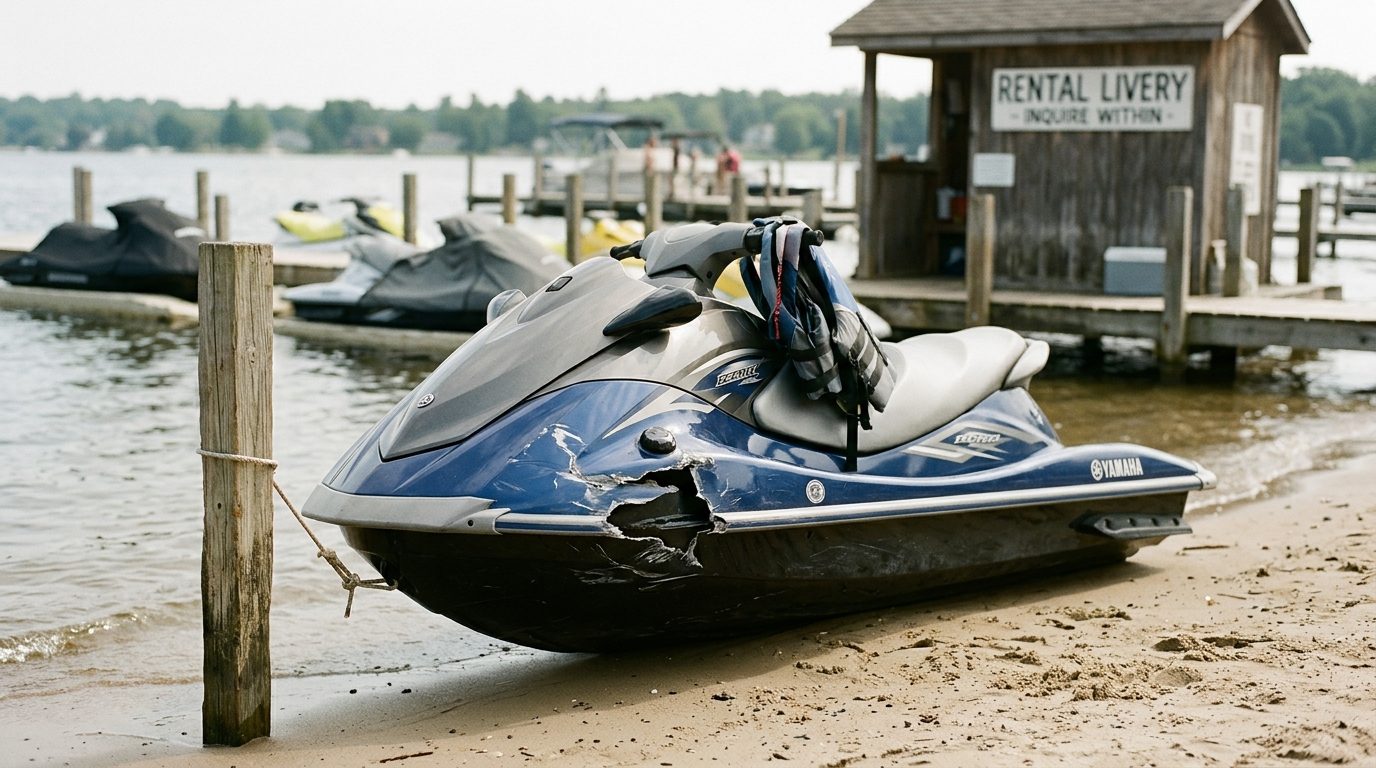
Evidence of breach might include witness statements from other boaters or people on shore, the operator’s own admissions or statements to police, police reports from the waterway authority, or the physical condition of the jet ski at the time of the collision. If the jet ski had faulty steering, bad brakes, or an engine problem the rental company knew about or should have caught, that’s also a breach of the rental company’s duty.
Element 3: Causation — Proving the Breach Caused Your Injury
You must show a direct link between the operator’s breach and the collision that injured you. For example, if the operator was speeding and couldn’t stop in time to avoid you, the speeding caused the collision. Causation has two parts: “but-for” causation (the accident would not have happened but for the breach) and proximate cause (the injury was a foreseeable result of the breach).
Medical records, accident reconstruction by an expert, and testimony from doctors often establish causation in jet ski cases. If multiple factors contributed to the accident, you may still prove causation if the operator’s breach was a substantial factor in what happened. In the spinal cord injuries, paralysis, traumatic brain injuries, amputations, and severe burns we see from jet ski collisions, causation is often clear: the operator’s reckless conduct directly caused the catastrophic impact.
Element 4: Damages — Proof of Your Actual Injury and Losses
You must prove you suffered real, measurable harm as a result of the collision. Damages include medical expenses, lost income, pain and suffering, permanent disability, and in the most severe cases, wrongful death. Medical records, hospital bills, wage statements, and testimony from doctors and loved ones document your damages.
In catastrophic jet ski injuries—spinal cord damage, paralysis, traumatic brain injury, amputation, or severe burns—damages are often substantial and long-term. Damages also account for future medical care, ongoing rehabilitation, assistive equipment, and loss of quality of life. The more severe the injury, the greater the damages you may recover.
Evidence That Proves Negligence in a Jet Ski Collision
To prove all four elements, you’ll need concrete evidence:
- Police reports and incident documentation from the waterway authority or law enforcement who responded to the accident.
- Witness statements from other boaters, passengers, or people on shore who saw the collision happen.
- Photos and video of the accident scene, the jet skis involved, the injuries, and the surrounding water conditions at the time of impact.
- Medical records and expert testimony from doctors about the nature, severity, and cause of your injuries.
- Maintenance records for the jet ski (or the lack of them), showing whether the operator failed to maintain the craft or whether defects existed.
- Toxicology reports or breathalyzer results if alcohol or drugs were involved.
- Expert reconstruction of the collision, showing speed, trajectory, and how the accident occurred.
- The operator’s prior violations, accidents, or complaints, if available through public records.
- Rental or tour company records showing failure to provide safety equipment, instructions, or warnings.
Florida’s Comparative Negligence Law and Your Recovery
Under Florida Statute §768.81, a claimant who is more than 50% at fault generally recovers nothing. This is called comparative negligence (shared fault). If you were partially at fault for the collision, your recovery may be reduced by your percentage of fault—but you can still recover if you were 50% or less at fault.
For example, if a jury finds you 20% at fault and the operator 80% at fault, and your total damages are $100,000, you would recover $80,000. This rule applies in Florida and in many other states where we handle cases nationwide. Understanding your own potential liability is important to assessing the strength of your claim.
Have questions about what happened?
Ask our team directly. The first conversation is free, confidential, and there is no obligation to continue.
Who Can Be Held Liable for a Jet Ski Collision?
The operator of the jet ski that hit you may be held responsible for the collision. But liability often extends beyond the operator alone:
- A rental company may be liable if they failed to maintain the jet ski, failed to provide proper safety equipment, or rented to someone they knew was intoxicated or incompetent.
- A tour operator may be liable for the actions of their employees or for failing to supervise the activity adequately.
- An establishment that served alcohol may be liable under Florida’s dram-shop statute, Fla. Stat. 768.125. Serving an intoxicated adult does not by itself create liability. Liability applies only where the establishment willfully served an underage person or knowingly served a habitual addict.
- A property owner or event host may be liable if they failed to provide adequate safety measures or warnings about known hazards.
Multiple parties can be liable in a single accident. Your claim may name all responsible parties, and each may carry insurance that could cover your damages.
Maritime Law and Jet Ski Negligence: What Is Different?
Jet ski accidents that occur on navigable waters are often governed by maritime law, not ordinary state negligence law. Maritime law imposes strict duties on vessel operators and has its own standards for negligence and liability. Liability limits and insurance requirements differ under maritime law. The statute of limitations for maritime claims may also be different from state law.
Under Florida law, the statute of limitations for filing a personal-injury negligence claim is two years from the date the cause of action accrues under Florida Statute §95.11. However, maritime claims may have different deadlines, and jurisdiction and venue rules are also different for maritime cases. Missing the deadline can bar your claim entirely, so timing is critical. An attorney experienced in maritime claims can navigate these differences and ensure your claim is filed correctly and on time.
What Happens After You Prove Negligence?
Once negligence is proven, the defendant is liable for your damages. Your damages are typically paid by the defendant’s insurance policy. If the defendant’s insurance is insufficient, you may pursue the defendant’s personal assets. In cases of gross negligence or intentional misconduct, punitive damages may be available to punish the defendant and deter similar conduct in the future.
Most negligence claims are resolved through settlement negotiations, where the defendant’s insurance company agrees to pay a sum to resolve the claim. Some proceed to trial if a settlement cannot be reached. Either way, proving all four elements is the foundation of your claim.

Want to know where you stand?
Tell us what happened and our team will walk you through the options available to you, at no cost.
Next Steps If You Were Injured in a Jet Ski Collision
If you or a family member were injured in a jet ski collision, start by gathering and preserving all evidence immediately: photos of the scene and the jet skis, medical records, witness contact information, police reports, and any documentation of the accident. Seek immediate medical attention if you have not already; your medical records are critical evidence of both your injury and its cause.
Report the accident to the appropriate waterway authority or law enforcement if you haven’t done so. Do not discuss the accident with the other operator’s insurance company without legal counsel—anything you say can be used against your claim.
Contact our firm for a free case evaluation. People injured in jet ski collisions can reach out to us when they’re in the early stages of understanding their situation and need guidance on what evidence matters, what your claim might be worth, and what comes next. We focus exclusively on catastrophic injury claims. We can help you evaluate your case, preserve critical evidence, and understand your rights under Florida law and maritime law.
The Four Elements of Negligence
Element 1: Duty of Care
Every jet ski operator has a legal duty to operate their vessel safely and responsibly. This includes following navigation rules, maintaining reasonable speed, staying alert, and avoiding reckless behavior that endangers others on the water.
Element 2: Breach of Duty
A breach occurs when the operator fails to meet that standard of care. Examples include speeding in congested areas, operating under the influence, ignoring navigation markers, failing to maintain the vessel, or operating recklessly without regard for other watercraft or swimmers.
Element 3: Causation
You must show a direct link between the operator's breach and your injury. This means proving that the negligent conduct directly caused the collision and your resulting harm—not that it merely happened at the same time.
Element 4: Damages
You must prove you suffered actual, measurable harm: catastrophic injury, permanent disability, medical expenses, lost income, pain and suffering, or loss of life. Without documented damages, you have no claim.
What Evidence Supports Your Negligence Claim
Accident Reports & Records
Police reports, Coast Guard documentation, and incident reports filed at the time of the collision create an official record of what happened and who was at fault.
Witness Testimony
Statements from other boaters, swimmers, or bystanders who saw the collision firsthand can corroborate your account of the operator's negligent behavior.
Vessel Maintenance Records
Documentation showing the jet ski was poorly maintained, had known defects, or was operated beyond safe limits strengthens a negligence claim.
Medical Evidence
Your medical records, imaging, surgical reports, and ongoing treatment documentation prove the severity of your injury and its permanent impact on your life.
Expert Analysis
Accident reconstruction specialists, marine engineers, and medical specialists can testify about how the collision occurred and the extent of your harm.
Operator History
Prior violations, citations, or complaints about the operator's reckless behavior can establish a pattern of negligence.
Act Quickly to Preserve Evidence
Jet ski collision evidence—witness contact information, vessel condition, water conditions, and operator statements—can disappear or become unreliable with time. Photographs, video, and written accounts taken immediately after the accident are far more valuable than recollections months later.