

Spinal Cord & Catastrophic Back/Neck Injuries
The Medical Records That Prove a Life-Altering Spine Injury
A serious spinal cord, back, or neck injury changes everything. Strong medical evidence connects your injury to what caused it — and shows the lasting toll on your life. Here's what matters, and why.
By CHG Lawyers · Published August 01, 2026
How Doctors Diagnose and Document a Catastrophic Spine Injury for Your Claim
Medical evidence is the written record doctors create. They make it when they diagnose, treat, and track your spine injury over time. It proves three things. First, that the injury is real. Second, that a specific accident or property owner’s failure caused it. Third, that it will affect your life for good.
Maybe you or someone you love suffered paralysis. Or maybe it was a life-changing back or neck injury. You face a hard road. And if your family is grieving a loved one who did not survive, you face something even harder.
This page explains how doctors diagnose these injuries. It uses plain language. It also shows how each part of the medical record becomes proof. This is general information, not legal or medical advice. You don’t have to gather or make sense of these records alone.

Not sure what your next step is?
Talk it through with our team — the first consultation is free, confidential, and carries no obligation.
Why medical evidence is the foundation of a spine injury claim
A catastrophic spine injury claim rises or falls on the medical record. Insurers and courts want solid proof. They will not rely only on your account of pain and loss.
Strong medical evidence answers three questions. Does the injury exist? What caused it? And how will it change your life for good?
For a spinal cord injury, the effects reach far beyond movement. The Mayo Clinic explains that a spinal cord injury can cause loss of movement and feeling. It can also disrupt bladder and bowel control, breathing, blood pressure, and other functions the body once handled on its own. Documenting each one shows the true scope of the harm.
This page covers only serious, permanent, life-changing spine injuries. That means spinal cord injuries, paralysis, and catastrophic back and neck injuries. When a spine injury causes a death, the family may bring a wrongful-death claim. The same medical evidence still matters. In fact, the hospital and autopsy records often become the heart of that case.
How doctors diagnose a catastrophic spine injury
Doctors diagnose a spine injury through a physical exam. Then they confirm it with imaging. The process usually starts in the emergency room after a serious accident.
First comes stabilization. Paramedics and ER teams hold the spine still to prevent more damage. This is routine after truck crashes, high falls, and violent attacks on unsafe property. That early care is often the first written evidence in your file. It captures your condition before anyone had a reason to dispute it.
The neurological exam
Next, doctors run a neurological exam. This exam tests feeling, movement, and reflexes. It maps where the spinal cord is hurt and how badly. The Mayo Clinic notes that this exam, paired with imaging, confirms a spinal cord injury.
This is also where a catastrophic injury stands apart from a minor strain. A pulled muscle heals. A spinal cord injury that erases movement or feeling below the injury does not. This page addresses only the permanent, life-changing kind.
The ASIA Impairment Scale (ISNCSCI)
Doctors classify the injury using a standard international system. The American Spinal Injury Association’s International Standards for Neurological Classification of Spinal Cord Injury (ISNCSCI) produces the ASIA Impairment Scale (AIS). It grades an injury from A through E.
- AIS A means a complete injury. No movement or feeling remains below the injury.
- AIS B through D describe incomplete injuries. Some feeling or movement remains.
- AIS E means normal function.
This exam also finds the neurological level of injury. An example is a C5 or T10 injury. That level predicts a lot about a person’s abilities and lifelong needs. This is why insurers and courts treat an ASIA classification as a precise, medically accepted measure of harm. It is not just a complaint about how you feel.
Diagnostic tests that document the injury
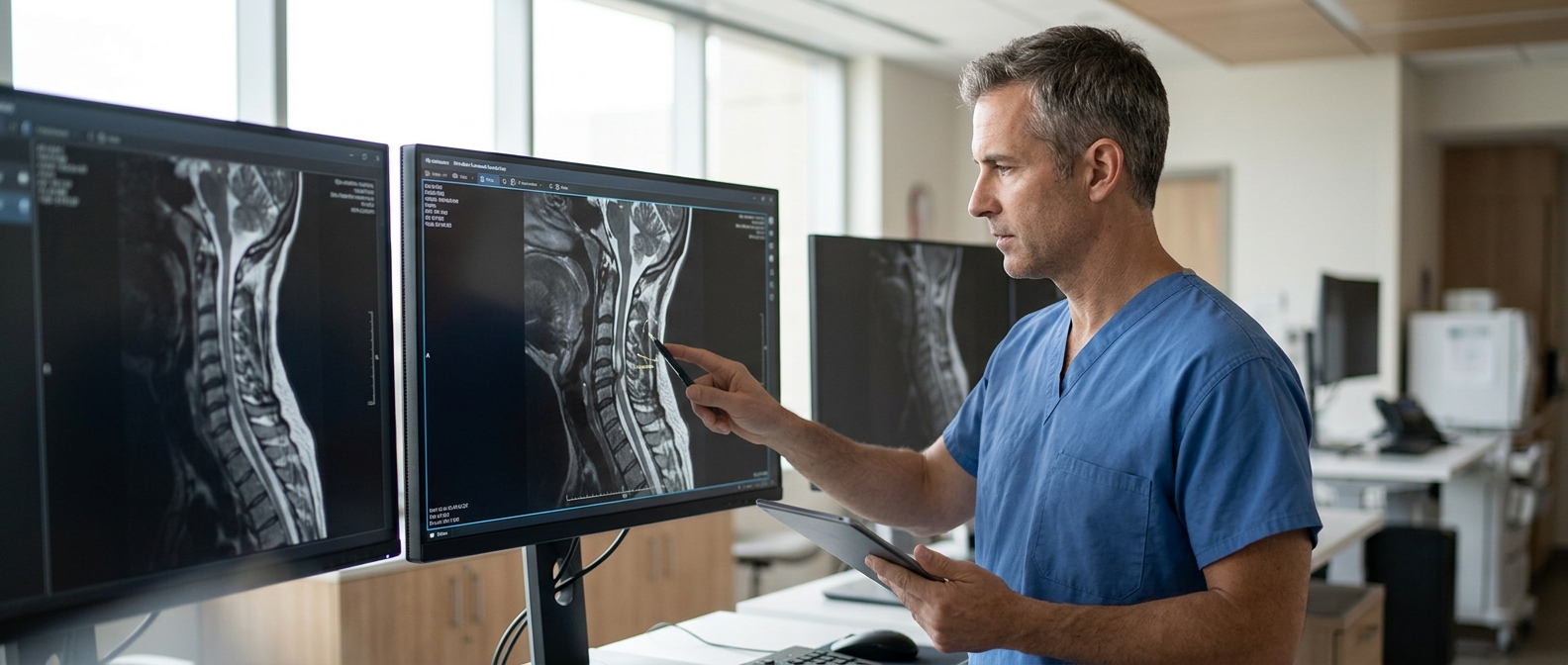
Imaging turns a diagnosis into hard evidence. It shows damage no one can see from the outside.
- X-rays reveal broken bones and dislocated vertebrae (spine bones).
- CT scans show detailed bone and vertebral damage in fine slices.
- MRI captures the spinal cord itself, along with discs, ligaments, and soft tissue. These images reveal a squeezed or damaged cord.
- Electromyography (EMG) and nerve conduction studies measure how well nerves carry signals.
Objective imaging carries real weight. An insurer can argue about how much pain you feel. It is far harder to argue with an MRI showing a squeezed cord or a CT showing a shattered vertebra. In the catastrophic-injury cases our attorneys handle, clear imaging often becomes the anchor of the whole claim.
Key medical records that become evidence for your claim
Every stage of care creates a record. Each one becomes evidence. Together they tell the full story of your injury.
The most important records include:
- Ambulance/EMS and emergency room records showing your condition right after the accident.
- Surgical and operative reports describing what surgeons found and repaired.
- Physician and specialist notes from a neurosurgeon, orthopedic surgeon, or physiatrist (a physical medicine and rehabilitation doctor).
- Imaging reports — a radiologist’s written reading of each scan.
- Rehabilitation and physical therapy records tracking progress and lasting limits.
- Medication and pain-management records showing ongoing treatment.
No single document proves everything. The strength comes from the full picture, kept consistent from day one.
Are catastrophic back and neck injuries hard to prove?
Catastrophic back and neck injuries are often easier to prove than minor ones. The damage shows clearly on imaging. A cut or squeezed cord is visible. Paralysis and lost function can be measured on exam.
Even so, insurers push back. Common challenges:
- Pre-existing conditions. They may claim your spine was already damaged.
- Degenerative changes. They may say age or wear, not the accident, caused the problem.
- Gaps in treatment. They may argue that missed appointments mean you weren’t really hurt.
The best answer is consistent, prompt care. When you seek treatment right away and follow your doctors’ plans, your records line up and build trust. You can learn more about the full range of these injuries on our catastrophic back and neck injuries page.
Have questions about what happened?
Ask our team directly. The first conversation is free, confidential, and there is no obligation to continue.
Establishing causation: linking the accident to the injury
Proving the injury exists is not enough. You also have to connect it to the specific accident. Or you must connect it to the property owner’s failure to protect you. Lawyers call this causation.
Several records help show it. Accident and police reports fix the facts of what happened. EMS records show your condition minutes after the event. Timing matters too. Paralysis or severe weakness that starts right after a truck crash or an assault points straight to the cause.
Your treating doctor’s opinion often carries the most weight. A neurosurgeon may write in the record that the crash caused your spinal cord damage. That gives your claim a firm medical link.
What about a pre-existing condition?
A prior back problem does not automatically end your claim. Florida follows the “eggshell plaintiff” principle. In plain terms, someone who hurts you takes you as they find you.
Say an accident greatly worsens an old condition. Or say it turns a manageable issue into permanent paralysis. That new harm can still be paid for. Records showing your condition before and after the accident become key evidence. To understand who can be held responsible, see our page on who is liable for a catastrophic injury.
Documenting the future: prognosis, permanency, and life-care needs
Catastrophic spine injuries don’t end when you leave the hospital. Some of the most important evidence looks forward. It documents a lifetime of needs. This is exactly where competitor content tends to stop short.
Doctors write prognosis reports. These describe expected recovery and the long-term outlook. They may assign a permanency rating confirming the injury will not fully heal. These records show the injury is permanent, not temporary.
A life-care plan goes further. A qualified life-care planner prepares it — often a nurse or physician with special training. It is a detailed, itemized projection. It covers everything the injury will need over a lifetime. That can include repeat surgeries, wheelchairs and adaptive equipment, home and vehicle changes, and medications. For many people with paralysis, it also includes paid help with daily tasks.
Those lifetime costs are real. The National Spinal Cord Injury Statistical Center (NSCISC) is the federally funded body that maintains the country’s main SCI database at the University of Alabama at Birmingham. It publishes average lifetime cost estimates that reach into the millions of dollars. The amount depends on the person’s age at injury and their neurological level. It is highest for high tetraplegia. A life-care plan turns a person’s specific ISNCSCI classification into those real, documented numbers. The Christopher & Dana Reeve Foundation also documents how many U.S. families live with paralysis every day.
Records that show permanent paralysis or lost function support full and fair payment for the years ahead. That means more than the bills already paid. Wondering whether a back or neck injury can lead to paralysis? Our page on whether a back or neck injury can cause paralysis explains how. Documented permanent impairment also shapes what a claim is worth. See how much a catastrophic injury claim is worth.
Additional evidence that supports the medical record
Medical records are the core. But other evidence backs them up.
- Accident and incident reports showing what happened.
- Witness statements from people who saw the crash or attack.
- Photographs and scene evidence of the vehicles, the property, or a dark, unsecured parking lot.
- Expert witnesses — medical, vocational, and economic experts who explain cause and lifetime cost.
- A personal injury journal — your own dated notes about pain and daily limits.
Sometimes a person is assaulted, shot, or attacked. This can happen because a property owner failed to keep the property reasonably safe. Lawyers call this a negligent security claim. In these cases, scene evidence matters a great deal. Broken locks, burned-out lights, and missing or broken cameras can support the claim alongside your medical records. Learn more on our negligent security claims page.
What to do to protect your medical evidence
You protect your evidence mostly by protecting your health. The two go hand in hand.
- Get care and keep going. Follow your treatment plan and go to every appointment.
- Keep copies. Save records, bills, and notes from every provider.
- Be honest and complete. Tell each doctor the full story of your pain and limits.
- Avoid gaps. Missed care can hand an insurer an argument.
You also don’t have to manage this alone. An attorney can request records and organize them. They can also work with medical experts and life-care planners to explain what they mean.
In Florida, timing matters. Under Fla. Stat. §95.11, the statute of limitations (the legal deadline to file) for most negligence claims is generally two years. This applies to claims arising on or after March 24, 2023. Waiting too long can end a claim before it starts.
Florida also follows a modified comparative-negligence rule under Fla. Stat. §768.81. Under this rule, a person found more than 50% at fault generally recovers nothing. Solid medical evidence helps push back on attempts to shift blame onto you.
Want to know where you stand?
Tell us what happened and our team will walk you through the options available to you, at no cost.
How CHG Personal Injury Lawyers can help
At CHG Personal Injury Lawyers, we help injured people and grieving families. We help them gather and make sense of complex medical evidence for a spine injury claim. We work with treating doctors, independent experts, and life-care planners. Together we build a clear, honest picture of the injury, its cause, and its lifelong effect.
We’re a Florida-based firm that takes catastrophic-injury cases nationwide. We offer support in English and Spanish. We can’t promise a specific result — and no honest lawyer can. What we can do is stand with you. We handle the records and the experts. That gives you room to focus on healing.
If you’d like someone to review your situation, contact us for a free case evaluation.

Frequently asked questions
What medical evidence do I need to prove a spine injury claim?
Records that show the injury, its cause, and its lasting effects. Key items include ER and imaging records, surgical reports, specialist notes, an ASIA/ISNCSCI classification, and long-term prognosis or life-care plans.
Are catastrophic back and neck injuries hard to prove?
Not usually. Serious spinal damage shows clearly on MRI and CT scans. It can also be measured on a neurological exam. Prompt, consistent treatment makes your evidence stronger.
How do doctors diagnose a spinal cord injury after an accident?
Doctors run a neurological exam to test feeling, movement, and reflexes. Then they confirm the injury with X-rays, CT scans, or MRI. They classify severity using the ASIA Impairment Scale from the ISNCSCI standards.
How do I prove the accident caused my spine injury and not a prior condition?
Accident reports, EMS records, and the timing of symptoms link the injury to the event. Your treating doctor’s opinion helps too. So do records showing your condition before and after. And Florida’s “eggshell plaintiff” rule means a worsened pre-existing condition can still be compensable.
How long do I have to file a spine injury claim in Florida?
Generally two years for most negligence claims arising on or after March 24, 2023, under Fla. Stat. §95.11. Talk to a lawyer promptly to protect your rights.
Can my family file a claim if a spine injury caused a death?
Yes. When a catastrophic spine injury leads to death, the family may bring a wrongful-death claim. The same medical evidence supports it.
The Core Medical Evidence in a Spine Injury Claim
Emergency & Imaging Records
ER intake notes, X-rays, CT scans, and MRIs document the injury from the earliest moment and help tie it to the accident that caused it.
Surgical & Specialist Reports
Operative reports, neurosurgeon and orthopedic notes, and rehabilitation records describe the severity of the damage and the treatment required.
ASIA / ISNCSCI Classification
For spinal cord injuries, this standardized exam grades the level and completeness of paralysis — a precise, respected measure of how the injury affects you.
Prognosis & Life-Care Plans
Long-term prognosis, functional assessments, and life-care plans project future medical needs, equipment, and care so your claim reflects the full lifetime cost.
Don't wait to build the record
Gaps in treatment or long delays between the accident and care can make it harder to connect your injury to what happened. Keep every appointment, follow your doctors' instructions, and save all records and bills.
How CHG Personal Injury Lawyers Helps
We Gather the Full Record
We collect and organize your ER, imaging, surgical, and specialist records so nothing that proves your injury gets left out.
We Work With Medical Experts
When a case calls for it, we coordinate with treating physicians and life-care planners to document the lasting impact of your injury.
Licensed, Florida-Admitted Attorneys
Our lawyers are admitted to the Florida Bar and focus on catastrophic, life-altering injuries — including spine and spinal cord cases nationwide.
Answers in English or Spanish
We explain the process in plain language, in the language you're most comfortable with, so you always understand your options.