


Catastrophic Back & Neck Injuries
How to Prove a Serious Back and Neck Injury
When a spinal injury changes your life permanently, the strength of your claim depends on the evidence. Here is what proof matters most — explained in plain language.
Focused on Life-Altering Injuries
Nationwide
Catastrophic injury cases accepted
Bilingual
English & Spanish resources
Licensed
Florida Bar–admitted attorneys
Free
Case evaluations
By CHG Lawyers · Published August 04, 2026
How to Prove a Serious Back or Neck Injury: MRIs, Imaging, and Medical Proof
To prove a serious back or neck injury, you need objective medical evidence. It must show three things. The injury is real. It is serious and lasting. And the accident caused it.
That proof comes from a few sources. You need a physical and neurological exam. You need imaging (X-ray, CT, and MRI). And you need consistent records that connect your injury to the crash or the attack.
Here is what matters for people with catastrophic spine injuries. A minor strain may not show up on a scan. But serious injuries usually show up clearly on imaging. Fractures, dislocations, spinal cord damage, and disc injuries that pinch nerves are objective findings. A doctor can see, measure, and document them.
Below, we explain how doctors diagnose these injuries. That includes the clinical scale specialists use to grade them. We also show how that medical picture becomes the proof your case relies on.
Reading this in pain, or for someone you love who is in the hospital? Take it one section at a time. We define every medical and legal term in plain words. Estamos disponibles en español.

Not sure what your next step is?
Talk it through with our team — the first consultation is free, confidential, and carries no obligation.
When a back or neck injury is “serious” — and why diagnosis matters
A serious spine injury causes permanent or life-altering harm. It is not a temporary ache. Think of fractured or dislocated vertebrae, spinal cord damage, or paralysis. Or a herniated disc pressing right on a nerve. These are very different from a routine strain that heals in a few weeks.
A clear medical diagnosis is the foundation of everything that follows. It guides your treatment. It protects your health. And it creates the record a claim depends on. Without a diagnosis, you cannot show how severe your injury is. You also cannot show what it will cost you over a lifetime.
This page explains the medical side of proving a serious spine injury. For the full overview, see our pillar guide on catastrophic back and neck injuries.
Warning signs a neck or back injury is serious
Certain warning signs point to a serious injury. They mean you need care right away. According to the Mayo Clinic, red-flag symptoms after spine trauma include:
- Numbness, tingling, or a “pins and needles” feeling in your arms or legs
- Weakness or loss of movement
- Loss of bladder or bowel control
- Pain that radiates down an arm or leg
- Trouble walking, balancing, or breathing
Do you have any of these after an accident? Treat it as an emergency. Call 911 or go to the ER.
Here is something many people don’t know. Symptoms can be delayed. Swelling and inflammation build over hours or days. You might feel “okay” right after a crash. Then you wake up unable to turn your neck. That is why you should be checked, even if you feel fine at first. Waiting can hurt your recovery and your claim.
The first medical step: the physical and neurological exam
Diagnosis usually starts with a hands-on exam. This is a physical and neurological exam. In the ER or at your first visit, the doctor asks how the accident happened. Then the doctor tests your reflexes and muscle strength. The doctor also checks your ability to feel touch, pressure, and temperature.
This exam does two jobs. It measures how much nerve function you have lost. And it guides which imaging tests to order next. A patient who cannot feel their legs gets very different tests than one with neck stiffness.
The accident details you share become part of the medical record. Say you tell the doctor, “a truck rear-ended me and my head snapped forward.” That note helps link your injury to the crash later. So be accurate and complete. This record is written before anyone is thinking about a lawsuit. That is exactly why it carries weight.
Imaging tests that reveal a spine injury
Imaging is where a serious spine injury becomes visible and objective. Doctors use several tests. Each one has a different strength.
X-ray
This is often the first image taken. It shows bone problems well. That means fractures, dislocations, and misaligned vertebrae. Its limit: it does not show soft tissue. So it can miss disc, nerve, and spinal cord damage.
CT scan
A CT scan gives a much more detailed view of bone. Doctors often order one when they suspect a fracture an X-ray cannot fully capture. It can show the exact shape and location of a break. One example is a “burst” fracture, where bone fragments push toward the spinal canal.
MRI
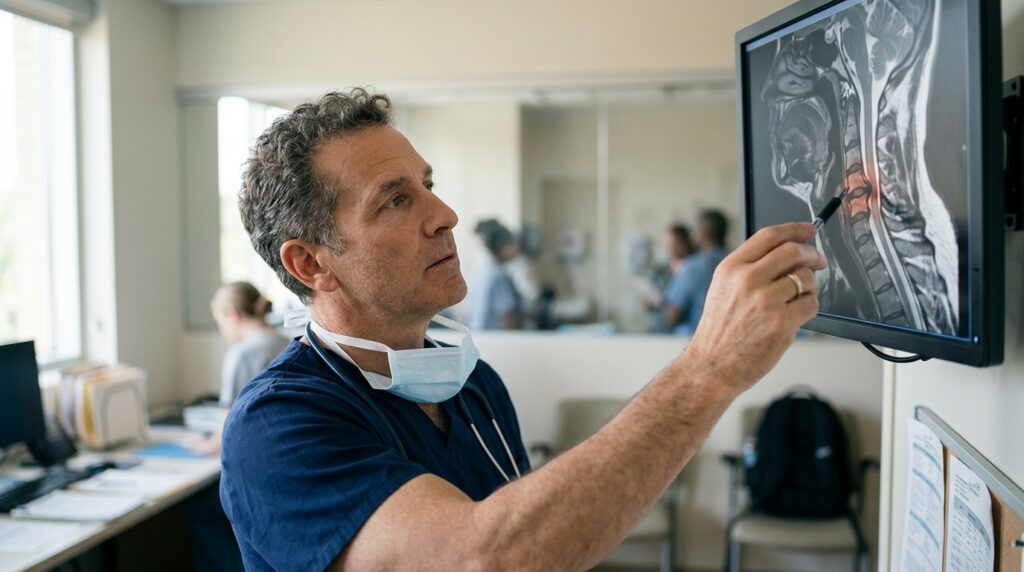
An MRI is the key tool for serious spine cases. It shows soft tissue — discs, nerves, ligaments, and the spinal cord itself. It can reveal a herniated disc pressing on a nerve. It can also show swelling inside the cord or bleeding around it. This is why MRI results carry so much weight. They turn “my back hurts” into a documented image of real, physical damage.
EMG and nerve conduction studies
These tests measure how well your nerves and muscles are working. An electromyography (EMG) checks the electrical activity in muscles. Nerve conduction studies measure how fast signals travel along nerves. Together, they give objective proof of nerve damage. That proof cannot be faked or exaggerated.
How specialists grade a spinal cord injury: the ASIA Scale
For a suspected spinal cord injury, imaging is only part of the picture. Spine specialists also grade the injury using a recognized clinical standard. Most law-firm pages never mention it. It is called the International Standards for Neurological Classification of Spinal Cord Injury (ISNCSCI). It is better known as the ASIA Impairment Scale, published by the American Spinal Injury Association.
In plain terms, a clinician tests strength in specific muscle groups. The clinician also tests sensation at points across the body. Then they assign a grade from A to E:
- AIS A (complete): no motor or sensory function is preserved below the injury level.
- AIS B, C, D (incomplete): some function is preserved — more feeling than movement (B), or usable but weakened movement (C and D).
- AIS E (normal): function has returned to normal.
The scale also pinpoints the neurological level. That is the lowest point on the body with normal function. Why does this matter for your claim? An objective A-through-E grade and a documented injury level describe two things. They show how severe and how permanent the injury is. And they use the same standardized language doctors, insurers, and courts recognize. This is far more precise than “the injury is bad.” It also directly informs the lifetime care and cost analysis a serious case depends on.
Objective vs. subjective evidence: is a neck injury hard to prove?
The honest answer: it depends on the injury. A soft-tissue-only injury with normal imaging can be harder to prove. There is little for a scan to show. That is one reason minor strains are difficult cases. And they are not the kind of catastrophic injury this guide is about.
Serious injuries are different. Fractures, dislocations, herniated discs with nerve compression, and spinal cord damage typically show on imaging. A spinal cord injury can also be graded on the ASIA scale. These findings are objective, measurable, and documented in your records. In the catastrophic-injury cases our attorneys handle, this imaging and classification evidence is often the backbone of the medical proof.
Consistent treatment strengthens the picture. Gaps in care hurt your case. Long stretches with no doctor visits give the other side an argument. They can claim you were not really hurt. So follow your treatment plan and keep every appointment.
Have questions about what happened?
Ask our team directly. The first conversation is free, confidential, and there is no obligation to continue.
Building the medical proof for a serious back or neck injury
Strong medical proof is a complete, consistent paper trail:
- ER and hospital records from right after the accident
- Imaging reports — the actual X-ray, CT, and MRI results and the radiologist’s readings
- Specialist notes from neurosurgeons, orthopedic surgeons, and physiatrists (rehabilitation doctors)
- Any ASIA/ISNCSCI classification in the chart for a spinal cord injury
- Treatment history — surgeries, injections, physical therapy, and medications
Your treating physicians describe what is wrong and how it limits you. Doctors also document permanent impairment — the lasting loss of function that will not fully heal. And when your condition stabilizes, they document maximum medical improvement (MMI). That is the point when further recovery is not expected.
Finally, records should show how the injury affects daily life. Can you lift your child? Return to work? Sleep through the night? These real-life limits, backed by medical notes, show the true weight of a serious spine injury.
Proving the accident caused the injury (causation)
Causation means linking your specific injury to the specific accident. It is not enough to show you are hurt. You must show the crash, fall, or attack caused the harm.
Doctors and records establish this through timing and mechanism. Say your neck was fine before the accident. Then an MRI days after a truck crash shows a fresh disc herniation with cord swelling. That timing supports causation. The mechanism matters too — that is how the forces of the accident match the injury.
Pre-existing conditions are handled honestly. Many people have some prior wear in their spine. Under Florida law, an accident can make a prior condition worse. This is called aggravation. When it happens, you may still recover for that added harm. Trying to hide a past injury backfires. Full honesty is stronger.
Prompt care after the accident is one of the best ways to support causation. It closes the time gap. And it shows the injury and the accident are connected.
How a catastrophic-injury attorney uses your medical proof
An attorney gathers and organizes this evidence into a clear, connected story. They collect complete records and imaging so nothing is missing. Records scattered across five providers become one organized file.
Lawyers also work with medical specialists. These specialists explain your injuries and long-term needs in plain terms. A serious spine injury often means a lifetime of care. The National Spinal Cord Injury Statistical Center (NSCISC) and the Christopher & Dana Reeve Foundation both document how life-changing paralysis and spinal cord injury can be. Connecting your diagnosis and ASIA grade to those documented lifetime costs is a core part of building a claim.
Timing is a hard rule, not a suggestion. Under Fla. Stat. § 95.11, most Florida negligence claims that accrued on or after March 24, 2023 must be filed within two years. Miss that window and the court can dismiss even a well-documented case.
Florida also follows a modified comparative-fault rule under Fla. Stat. § 768.81. Here is how it works. A person found more than 50% at fault generally recovers nothing. And any recovery is reduced by your share of fault. This is one reason thorough, objective medical proof matters. It helps keep the focus on the other party’s negligence.
We cannot promise any specific outcome. A free case evaluation lets you understand your options with no obligation, in English or Spanish.
Common questions about serious spine injuries
Can a neck fracture heal on its own?
Some neck fractures can heal. But they need medical management to heal safely. That often means a brace, and sometimes surgery. Only a treating doctor can decide the right care for your specific fracture.
How long before a spine injury is considered permanent?
There is no single timeline. Doctors typically reach maximum medical improvement (MMI) when your condition stabilizes and stops improving. This can take months or longer, depending on the injury. For a spinal cord injury, doctors often reassess the ASIA grade over time. This tracks what function is preserved.
What if my imaging looks normal but my symptoms continue?
Talk to your doctor. Ask about more testing, such as an MRI or EMG. Some nerve or soft-tissue problems do not appear on a basic X-ray. So persistent symptoms deserve a closer look.
What is the ASIA Impairment Scale, and why does it matter to my case?
It is the standardized A-through-E grading system spine specialists use. It classifies how complete a spinal cord injury is. Doctors, insurers, and courts all recognize it. So an objective grade gives your claim a precise, credible way to describe the injury’s severity and permanence.
Want to know where you stand?
Tell us what happened and our team will walk you through the options available to you, at no cost.
Next steps and related resources
Explore these related resources:
- Catastrophic back and neck injuries (main guide)
- Spinal cord injuries
- Paralysis: paraplegia and quadriplegia
Did you or a loved one suffer a serious spine injury in an accident? You do not have to sort this out alone. CHG Personal Injury Lawyers offers a free, no-obligation case evaluation in English and Spanish. Contact us today to learn about your options.
This article is general information, not legal or medical advice. Only a treating physician can diagnose your condition. And only a consultation can address the details of your case.
The Evidence That Builds a Strong Spine Injury Claim
Diagnostic Imaging
MRIs, CT scans, and X-rays that show fractures, herniations with nerve involvement, cord damage, or structural harm to your spine.
Treating Doctor Records
Notes from the physicians actually caring for you carry real weight. They document the severity of your injury and the care it requires.
A Consistent Treatment Timeline
Gaps in care can be used against you. Ongoing, documented treatment helps show the injury is serious and lasting.
Proof of Permanent Impairment
When a doctor reaches maximum medical improvement, their opinion on lasting limitations helps establish the full scope of your losses.
How Your Life Has Changed
Testimony from family, coworkers, and you about lost mobility, work, and daily independence puts the human impact on the record.
Don't Wait to Get Medical Care
Delaying treatment or downplaying your symptoms can weaken both your recovery and your claim. See a doctor promptly, follow the treatment plan, and let the medical record tell the truth about how serious your injury is.
Common Questions About Serious Back and Neck Injuries
Can a neck fracture heal on its own?
Some can, but they need medical management to heal safely — often a brace, and sometimes surgery. Only a treating doctor can decide the right care for your specific fracture.
When is a spine injury considered permanent?
There is no single timeline. Doctors typically wait until you reach maximum medical improvement before assessing whether lasting impairment remains.
What makes a back or neck injury 'catastrophic'?
Injuries that cause permanent impairment — like spinal cord damage, paralysis, or lasting loss of function — differ from minor strains and are treated very differently under the law.
Do I need every record myself?
No. An attorney can help gather imaging, treatment notes, and expert opinions and organize them into evidence that reflects the full extent of your harm.