
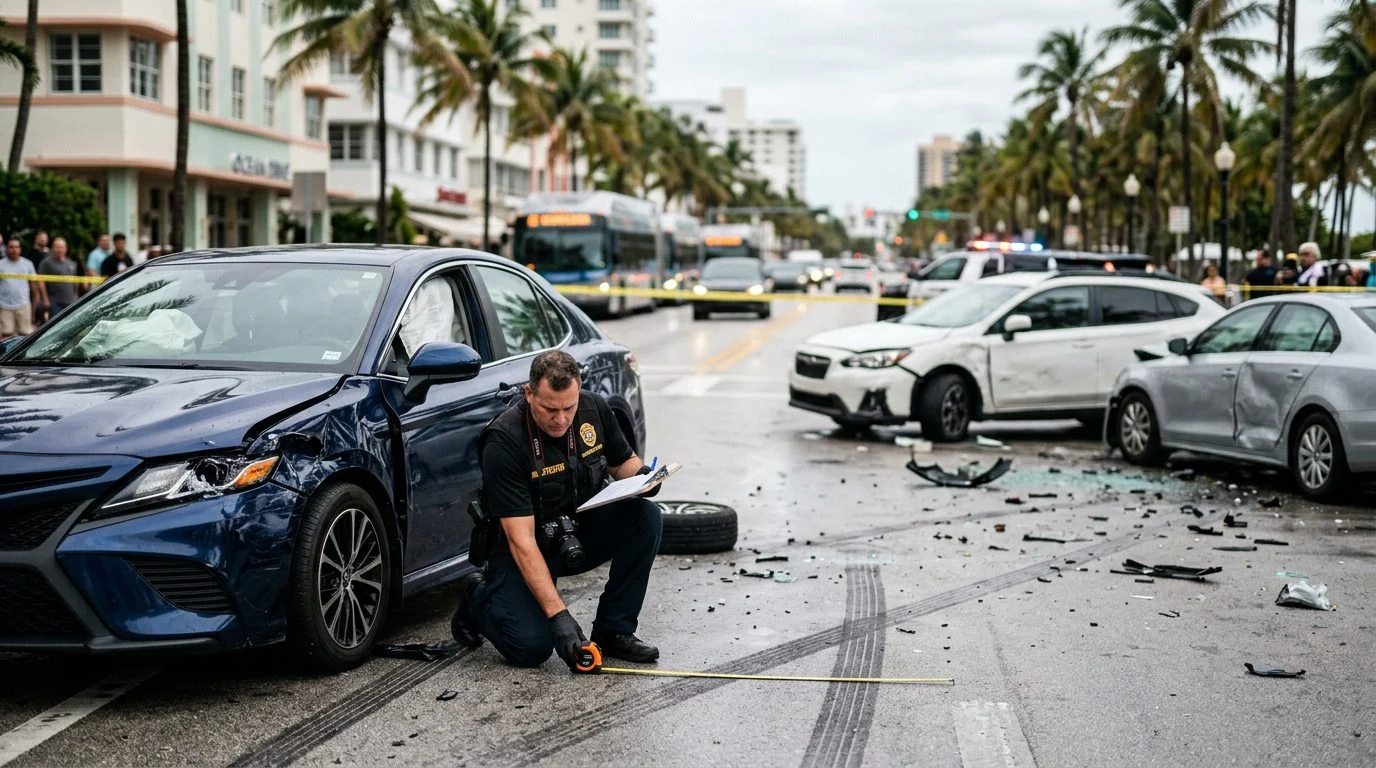
Car Accidents | Miami Beach, Florida
Hurt in a Miami Beach Car Accident? You Don't Have to Face the Insurance Companies Alone.
CHG Personal Injury Lawyers helps people and families across Florida after serious crashes. Our Miami Beach-area clients get clear answers, patient guidance, and a free, confidential first consultation with no obligation to continue.
Miami Beach Car Accident Lawyer: What Florida Law Means for Your Claim
By Igor Hernandez, Florida-licensed attorney, CHG Personal Injury Lawyers, Coral Gables, Florida
If you were hurt in a car crash on Miami Beach, Florida law may give you options. Whether you have a claim depends on the facts of your crash and on Florida law. This page explains those rules in plain language.
Traffic on Miami Beach moves across causeways, busy avenues and crowded streets. Rental cars and delivery vehicles add to the traffic. A crash here can cause injuries. Those injuries can change daily life for months or years. Learning the basic rules early can help you make better decisions.
Not sure what your next step is?
Talk it through with our team — the first consultation is free, confidential, and carries no obligation.
Who This Page Is For
This page is for drivers, passengers, pedestrians and cyclists. They were hurt in a crash on Miami Beach or on nearby roads.
It also covers families facing a fatal crash.
CHG Personal Injury Lawyers is a Florida personal injury firm. Our practice focuses on car accidents, truck accidents, motorcycle and rideshare crashes, and catastrophic injury claims.
What a Car Accident Lawyer Does for You
A car accident lawyer reviews several things:
- How the crash happened.
- Who may be responsible.
- Which insurance may apply.
- How your injuries affect your health and work.
A lawyer may help with these tasks:
- Fact review: Your lawyer looks at the crash details, photos, witnesses and records.
- Insurance review: Your lawyer identifies the insurance that may apply to the crash.
- Deadline tracking: Your lawyer watches the filing deadlines that apply to your claim.
- Communication: Your lawyer handles calls and letters from insurers. This lets you focus on recovery.
Florida Rules That Shape a Miami Beach Car Accident Claim
Florida law sets deadlines, fault rules and insurance requirements. These rules can shape every car accident claim.
The rules below are general. They do not decide any specific case.
How long you have to file
Deadlines apply to personal injury lawsuits in Florida, and the time limit for a specific case depends on its facts and applicable Florida law.
The deadline comes from Florida’s limitations statute. A statute is a law passed by the Florida Legislature.
Deadlines have exceptions. The date that starts the clock depends on the facts. Act promptly so you do not miss important dates.
Shared fault
Florida applies comparative fault rules, and how they apply to a case depends on the facts and applicable Florida law (Fla. Stat. § 768.81(6)). This means shared fault. Each person’s share of blame can affect their claim.
Under Florida’s comparative fault statute:
- A person found more than 50% at fault for their own harm recovers nothing.
- How fault is divided among the people involved can affect the compensation a person may be able to pursue, and the details depend on the facts and applicable Florida law.
Damages means money awarded for harm caused by an injury.
Personal injury protection (PIP)
PIP is a type of no-fault coverage. No-fault means benefits are paid no matter who caused the crash.
Florida’s personal injury protection law requires certain policies to provide:
- Under Florida’s personal injury protection (PIP) law, medical benefits can reach $10,000 only if a qualifying provider determines the person had an emergency medical condition; otherwise they are capped at $2,500, and disability benefits are 60% of lost income (Fla. Stat. § 627.736).
- Up to $5,000 in death benefits.
- Under Fla. Stat. § 627.736, personal injury protection medical benefits cover eighty percent of all reasonable expenses for medically necessary medical, surgical, X-ray, dental, and rehabilitative services. This applies when the person gets initial care within 14 days after the crash.
PIP benefits are primary. This means they are paid first, before other sources, under the statute and its rules.
The injury threshold for pain and suffering
Pain, suffering, mental anguish and inconvenience are types of damages. To recover these damages, your injury must fit one of these categories under Florida’s injury threshold statute:
- Significant and permanent loss of an important bodily function.
- Permanent injury within a reasonable degree of medical probability, other than scarring or disfigurement.
- Significant and permanent scarring or disfigurement.
- Death.
This rule is about the type of injury. It is not a rule about money. Your medical team’s guidance matters here.
Speed and work zones
Florida’s speed statute bars driving faster than is reasonable and careful for the conditions.
- The maximum speed is 30 mph in business and residence districts, unless a lower limit applies.
- Drivers may not go over the posted limit in a work zone.
Alcohol and drug defense
Florida’s alcohol and drug defense statute can bar recovery. Recovery means getting money for your harm.
- The statute can apply when a plaintiff was impaired and more than 50% at fault.
- A plaintiff is the person who files the claim.
Nightlife areas and late-night travel make this rule relevant to some Miami Beach crashes. Each case turns on its own facts.
Uninsured drivers
Florida’s uninsured motorist coverage law covers a situation drivers may not expect. This coverage may matter when the at-fault driver does not have enough insurance.
Insurance information requests
Under Florida’s insurer disclosure statute, a liability insurer must answer a written request from a claimant within 30 days.
- A liability insurer is the insurer that covers harm caused by the at-fault driver.
- A claimant is the person making the claim.
- The answer is a sworn statement. This means it is made under oath.
- It identifies the insurer and each insured person.
- It also lists the coverage limits and includes a copy of the policy.
Government vehicles
If a government vehicle was involved, different rules may apply.
As of the date of this page’s most recent update, Fla. Stat. § 768.28(5) sets recovery limits of $200,000 per person and $300,000 per occurrence for the covered claims, and the Legislature can change these figures. An occurrence means one incident, such as one crash. Florida’s sovereign-immunity limits in Fla. Stat. § 768.28 apply to tort claims against the state and its agencies and subdivisions, including cities and counties, not only to automobile claims; these claims may require written pre-suit notice and a statutory waiting period, separate time limits may apply, and a judgment above the caps may need further action by the Florida Legislature through a claim bill to be paid, although the statute also allows the state or an agency or subdivision to settle a claim above the caps, within the limits of insurance coverage it has provided, without further legislative action.
Commercial trucks
Crashes with commercial vehicles can involve state safety rules and enforcement. The Florida Department of Highway Safety and Motor Vehicles describes its commercial vehicle safety enforcement program.
Who owned or operated the vehicle
Florida’s motor vehicle definitions define the owner and operator of a vehicle. The owner and the operator can be different people. Who may be responsible can depend on these roles.
Rental cars and rideshare vehicles can raise these questions.
Have questions about what happened?
Ask our team directly. The first conversation is free, confidential, and there is no obligation to continue.
How Miami Beach Crashes Can Differ
Crashes on Miami Beach can involve visitors who are unfamiliar with local roads. They can also involve:
- Rental cars.
- Rideshare vehicles.
- Delivery trucks.
- Causeway traffic.
Each setting can change which parties and insurers may be involved. A lawyer can look at those details for your crash.
First Steps After a Crash
The first steps after a crash can affect your health and your claim. Getting medical care comes first.
- Get medical care. Follow your doctors’ care. Keep every appointment and bill.
- Find out about a crash report. The state’s crash reporting guidance explains when law enforcement must be notified. It also explains how to get crash details.
- Write down the details. Note the date, location, road conditions, witnesses and insurance information.
- Save photos and records. Keep images of vehicles and injuries. Save receipts and records of time missed from work.
- Ask questions before you sign. Talk with a lawyer before you give statements or sign insurance papers.
How a Car Accident Claim Moves Forward
The steps below are general. Timelines vary with each case.
- Consultation: You describe the crash and your injuries. This happens during a free, confidential call or meeting.
- Case review: The firm reviews the crash facts, insurance and medical records.
- Insurance requests: Written requests for policy information may be sent to insurers under Florida law.
- Negotiation or filing: The firm may negotiate with insurers. Negotiating means working toward a deal. The firm may also file a lawsuit when deadlines require it.
- Resolution: The case ends through a settlement or a court decision.
Why Work With CHG Personal Injury Lawyers
- Florida-based: CHG Personal Injury Lawyers represents clients throughout Florida from its Coral Gables office.
- Licensed Florida attorney: Igor Hernandez is a Florida-licensed attorney. He is the responsible lawyer for this page.
- Focused practice: The firm focuses on personal injury cases. These include car accidents, truck accidents, motorcycle crashes and catastrophic injury claims.
- Support team: Our team of support staff helps manage records, calendars and communications.
- Bilingual resources: The firm publishes educational content in English and Spanish.
- Fees: The first consultation is free, confidential and carries no obligation to continue. CHG charges no attorney’s fees and no case costs unless there is a recovery.
Want to know where you stand?
Tell us what happened and our team will walk you through the options available to you, at no cost.
Frequently Asked Questions
How long do I have to file a car accident lawsuit in Florida?
Florida law sets deadlines for filing personal injury lawsuits, so prompt contact with the firm is important. Which rules apply to a particular claim depends on the facts of the case and the Florida law in effect at the time, so it is important to speak with a lawyer promptly. Exceptions exist, so act promptly.
Can I recover damages if I was partly at fault?
Florida’s shared-fault statute bars recovery when you are more than 50% at fault. How much fault is assigned to each party can affect what a person may be able to recover, and the outcome depends on the facts and applicable Florida law.
What is personal injury protection?
PIP is no-fault coverage that Florida law requires certain policies to provide. Under Fla. Stat. § 627.736, PIP coverage has a combined limit of $10,000 for medical and disability benefits, subject to the statute’s conditions. It covers 80% of reasonable expenses for medically necessary medical services and 60% of lost gross income, and medical benefits are payable only if the injured person receives initial services and care within 14 days after the crash. The full $10,000 is available for medical benefits only when a qualifying provider determines that the person had an emergency medical condition; without that determination, the limit for medical benefits is $2,500. Subject to the statute’s conditions, PIP may also provide a death benefit of up to $5,000.
Does the type of injury matter?
Yes. Under Fla. Stat. § 627.737, a plaintiff may recover damages for pain, suffering, mental anguish, and inconvenience because of bodily injury arising from the ownership, maintenance, operation, or use of a motor vehicle only in the event that the injury or disease meets the conditions set out in the statute.
Can I ask an insurer for policy information before filing a lawsuit?
You can make a written request. Florida law requires the liability insurer to answer under oath within 30 days.
Do I need a police report after a crash?
The state’s crash reporting guidance explains when law enforcement must be notified. It also explains how to get crash details.
If a crash on Miami Beach has left you hurt, and you are unsure who may be responsible, we can help. We can help you understand the next steps. Contact CHG Personal Injury Lawyers for a free, confidential consultation.
Why Clients Contact CHG Personal Injury Lawyers
Florida-Based Firm
We represent people injured in car accidents throughout Florida, including Miami Beach and nearby communities.
Licensed Florida Attorney
Igor Hernandez is licensed to practice law and is admitted to The Florida Bar.
Free, Confidential Consultation
Your first consultation is free, confidential, and comes with no obligation to continue.
No Fees Unless There Is a Recovery
CHG charges no attorney's fees and no case costs unless there is a recovery.
Act Promptly
Florida law sets deadlines for filing injury claims, and the rules that apply depend on the facts of your case. Waiting can make it harder to protect your rights. Contact our office as soon as you can after a crash.
After a Miami Beach Car Accident, Focus on These Steps
Get Medical Care
See a doctor or go to an emergency room, even if you feel you have only minor pain. Follow your doctors' care and keep every appointment.
Document the Scene
If you are able, take photos of vehicles, road conditions, traffic signals, and visible injuries. Write down the names and contact details of anyone involved.
Keep Your Records
Save police or crash reports, medical bills, prescriptions, and records of time missed from work. Organized records help explain what happened.
Talk to a Lawyer
Before you give recorded statements or sign insurance forms, speak with CHG Personal Injury Lawyers.