

Negligent Security | Apartment Complex Assault
Attacked at Your Apartment Complex? You May Have a Claim Against the Property Owner.
When an apartment complex fails to provide reasonable security—working locks, lighting, cameras, or guards—and you are assaulted, robbed, or shot as a result, the owner may be liable for your injuries. CHG Personal Injury Lawyers investigates these cases nationwide and fights for fair compensation.
By CHG Lawyers · Published September 21, 2026
Apartment Complex Assault Lawsuit: Hold Negligent Property Owners Accountable
You were attacked in a dark parking lot at 11 p.m. The lights had been broken for three months—the property manager knew it. Or someone forced through a gate that hadn’t locked properly in six weeks. Or you were assaulted in a hallway where two robberies had occurred the year before, and management never installed cameras or hired a guard.
Two parties caused your harm: the attacker and the property owner’s failure to provide basic security.
You have legal recourse. The property owner may be liable for your injuries through what the law calls negligent security. This is a civil claim that holds them accountable for failing to keep you safe. It is separate from any criminal case against the attacker. It focuses on the property owner’s responsibility to you.
Not sure what your next step is?
Talk it through with our team — the first consultation is free, confidential, and carries no obligation.
Your Situation: How This Happens
You were assaulted, robbed, shot at, sexually assaulted, or attacked at an apartment complex, parking garage, residential building, or similar property. The attack succeeded because the property owner failed to provide or maintain reasonable security:
- Entry locks were broken, missing, or left unrepaired for weeks or months.
- Lighting in parking areas, hallways, stairwells, or entryways was burned out or absent.
- Security cameras were missing, non-functional, or never monitored or maintained.
- Security guards were absent despite prior assaults, robberies, or break-ins at the property.
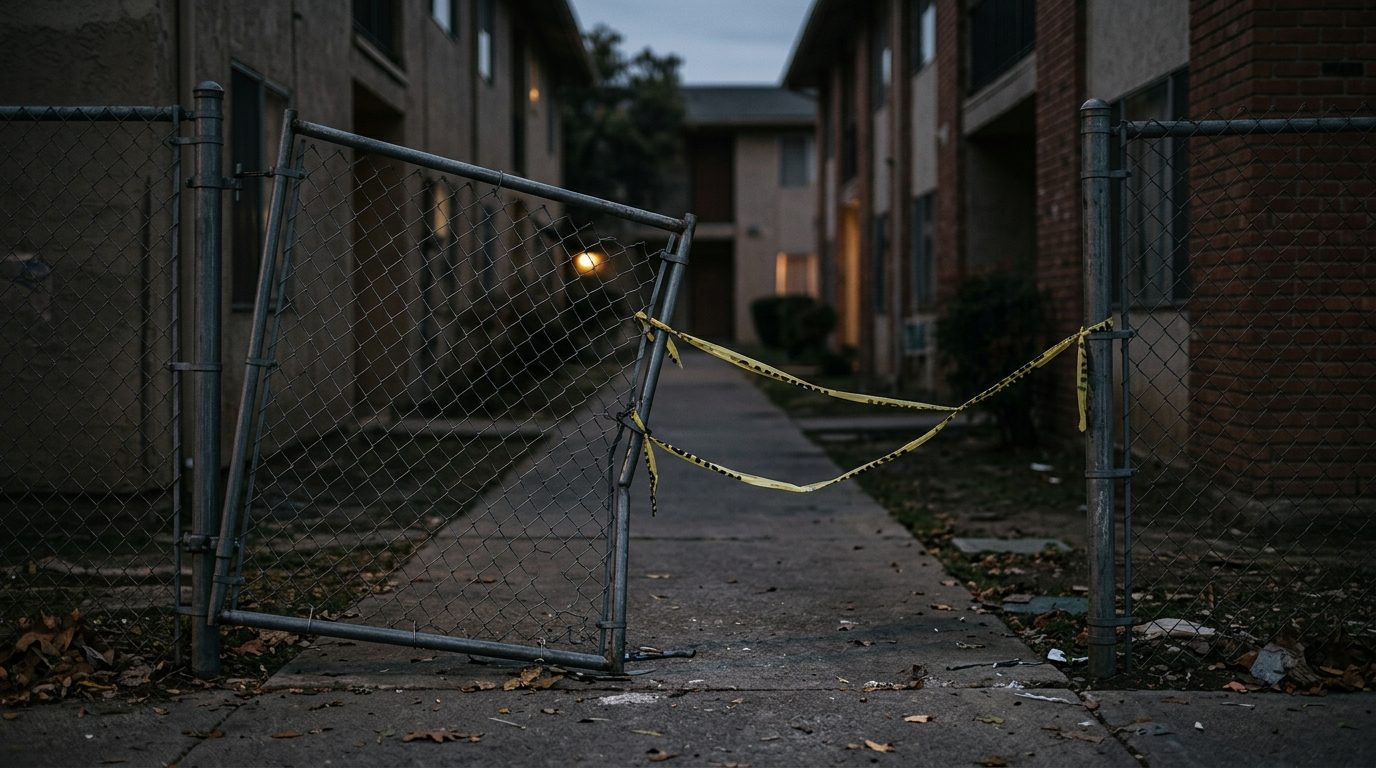
- Gates or fencing were unsecured or left propped open, allowing anyone to enter.
- Prior crimes occurred at the property, and management took no action to improve security.
- Visitor policies were unenforced, allowing strangers to move freely through the building.
- Emergency call boxes or panic buttons were absent from common areas or parking facilities.
Because of these failures, an attacker reached you and caused serious harm. You suffered physical injury, psychological trauma, lasting pain, lost income, or lost a loved one.
The legal term for this is negligent security. It applies to attacks in your unit, hallways, stairwells, parking lots, garages, or any area the property owner controlled and had a duty to protect.
Who This Is For
This page is for you if:
- You were assaulted, robbed, shot, or attacked at a residential or commercial property.
- The attack happened because the property owner failed to maintain reasonable security.
- You suffered serious injury: physical trauma, psychological harm, lasting pain, disability, or the loss of a loved one.
- You want to understand your legal claim, your rights, and what comes next.
What You Can Recover: Damages Explained
If you prove negligent security, you can recover damages for:
Medical expenses: Past and future treatment, hospitalization, emergency care, surgery, rehabilitation, physical therapy, mental health counseling, and psychiatric care.
Lost income and earning capacity: Wages lost during recovery and reduced earning potential if injuries prevent you from working at your previous level or at all.
Pain and suffering: Compensation for physical pain, emotional distress, trauma, anxiety, post-traumatic stress disorder (PTSD), sleep disruption, and diminished quality of life.
Permanent disability or disfigurement: Damages if the assault caused lasting harm affecting your ability to work, care for yourself, or enjoy daily activities.
Wrongful death damages: If a loved one was killed, the family may recover funeral and burial expenses, loss of companionship, loss of financial support, and loss of parental guidance under Florida Statute §768.19.
Punitive damages: In cases of gross negligence or intentional misconduct, courts may award additional damages to punish the property owner and deter similar conduct.
How Negligent Security Claims Work: The Legal Framework
1. Duty of care. Property owners have a legal obligation to maintain reasonably safe conditions. They must protect tenants and guests from foreseeable criminal acts. Florida law establishes this duty.
2. Breach of duty. The owner failed to provide adequate security. Examples include broken locks left unrepaired, inadequate lighting, missing or non-functional cameras, no security guard despite prior crimes, or failure to respond to known security risks.
3. Causation. Because of the security failure, an attacker reached and harmed you. Proper security—working locks, adequate lighting, cameras, or a guard—would likely have prevented the attack or deterred the attacker.
4. Damages. You suffered real, quantifiable harm: medical bills, lost wages, psychological injury, disability, or death.
In catastrophic cases, the connection is direct and clear. A broken gate allows unauthorized entry. Darkness conceals attackers and prevents identification. Ignored prior crimes show the owner knew the risk but chose not to act.
Common Security Failures That Create Liability
Courts recognize that apartment complexes, parking garages, and residential buildings are attractive targets for crime. Property owners must take reasonable steps to prevent foreseeable violence. Negligent security typically includes:
- Broken or missing locks on entry doors, gates, or garage doors left unrepaired for weeks or months despite complaints.
- Inadequate or burned-out lighting in parking areas, hallways, stairwells, entryways, or common areas where tenants and guests travel.
- Missing or non-functional security cameras in high-risk areas, or cameras that exist but are never monitored, maintained, or recorded.
- No security guard despite a pattern of assaults, robberies, or break-ins at the property.
- Failure to respond to prior crimes or improve security after known incidents—a strong indicator that the owner knew the risk.
- Unsecured gates and fencing that allow unauthorized entry or are left propped open.
- Failure to screen tenants or address known dangerous individuals living at the property.
- Lack of emergency call boxes or panic buttons in common areas or parking facilities.
- Failure to enforce visitor policies or control building access during evening and night hours.
- No security protocols for after-hours entry, suspicious activity, or emergency response.
Prior crimes are critical. If assaults, robberies, or break-ins occurred at the property before your attack, this fact strengthens your claim significantly. It shows the owner knew the risk was foreseeable and failed to act.
Have questions about what happened?
Ask our team directly. The first conversation is free, confidential, and there is no obligation to continue.
The Two-Year Deadline: Act Now
In Florida, the statute of limitations for negligence is two years from the date of the assault. You have two years to file a lawsuit. After two years, your claim is barred—you lose the right to recover anything, regardless of how strong your case is.
Do not wait. Contact an attorney immediately. The sooner we investigate, the better we can preserve evidence, obtain security footage before it is deleted, interview witnesses while memories are fresh, and obtain maintenance and incident records.
Comparative Fault: How Your Own Conduct Affects Recovery
Florida follows a comparative negligence rule under Florida Statute §768.81. This means:
- Even if you were partially at fault for the assault or your injuries, you can still recover damages.
- Your recovery is reduced by your percentage of fault.
- For example, if you were found 20% at fault and the property owner 80% at fault, and your total damages are $100,000, you would recover $80,000 (your award reduced by 20%).
- However, if you are found more than 50% at fault, you cannot recover anything.
What does “at fault” mean in an assault case? Examples include:
- Ignoring obvious, extreme security warnings and entering a known high-crime area alone at night.
- Being intoxicated to the point of incapacity and unable to protect yourself.
- Provoking or escalating a confrontation that led to the assault.
They controlled the property and had a duty to protect you. Your presence at the property does not eliminate their responsibility. An experienced attorney will ensure comparative fault is applied fairly and will challenge any attempt to blame you for the attacker’s criminal conduct (Fla. Stat. § 768.81(6)).
The Process: What to Expect
Step 1 – Free Case Evaluation
You meet with an attorney to discuss what happened, your injuries, the property’s security failures, and any prior crimes at the location. The attorney reviews your claim’s viability, answers your questions, and explains your options. This evaluation is free and confidential.
Step 2 – Investigation
We investigate the property’s security history, prior incidents, maintenance records, and your assault. We obtain:
- Police reports and incident records.
- Security footage (if available and not deleted).
- Maintenance logs and repair requests.
- Prior crime reports at the property.
- Witness statements.
- Property management communications.
- Analysis of security standards and foreseeability.
This investigation often reveals evidence the property owner hoped would remain hidden.
Step 3 – Demand and Negotiation
The attorney prepares a detailed demand letter to the property owner’s insurance company. It outlines the negligent security, your injuries, the foreseeability of the attack based on prior crimes, and damages sought. Most cases settle during negotiation without trial.
Step 4 – Litigation (if necessary)
If settlement fails, the case proceeds to court. Discovery occurs—both sides exchange documents and evidence. Depositions are taken—witnesses and experts are questioned under oath. Expert reports are prepared. The case may go to trial before a judge or jury.
Step 5 – Resolution
The case concludes through settlement or judgment. You receive compensation for your damages.
Timeline: Most cases take 1–3 years from filing to resolution, depending on complexity, the strength of evidence, and whether the case settles or proceeds to trial.
How Much Money Can You Recover?
Damages vary based on:
- The severity and permanence of your injuries.
- Your age and earning capacity before the assault.
- The strength of evidence of negligent security.
- The foreseeability of the attack (prior crimes at the property).
- The clarity and egregious nature of the property owner’s security failures.
- Whether the attack caused catastrophic, permanent injury or death.
Economic damages (medical bills, lost wages, rehabilitation) are calculated from receipts and records. Non-economic damages (pain, suffering, emotional distress, trauma) depend on injury severity and are negotiated or decided by a jury.
Catastrophic injuries—permanent paralysis, traumatic brain injury, severe burns, amputation, or wrongful death—typically result in substantial compensation. An attorney can review your circumstances and provide a realistic recovery assessment.
Frequently Asked Questions
Is it hard to sue an apartment complex for negligent security?
Not if facts support your claim. If the property owner failed to maintain reasonable security and that failure allowed an assault, you have a claim. Our investigation often uncovers records—maintenance logs, prior incident reports, repair requests—that the property owner prefers to keep private. Prior crimes at the property are especially powerful evidence.
Can I sue for emotional distress and trauma alone, without physical injury?
Yes. Emotional distress, trauma, anxiety, and PTSD are compensable damages. This is especially true with medical evidence—therapy records or psychiatric diagnosis from a mental health professional. However, physical injury strengthens your claim.
What if I was partially at fault for the assault?
Florida follows comparative negligence rules (Fla. Stat. § 768.81(6)). Even if partially at fault, you may recover damages. Your award is reduced by your percentage of fault. However, if you are found more than 50% at fault, you cannot recover. In most assault cases, the property owner’s negligence is the dominant factor. An attorney will ensure comparative fault is applied fairly.
Do I need a police report?
Yes. A police report is essential evidence. It documents the crime, creates an official record, and establishes that the property owner should have known about security risks. File one immediately if you haven’t already. Obtain a copy for your attorney.
How long do I have to file a lawsuit?
In Florida, the statute of limitations for negligence is two years from the assault date. This deadline is strict. Do not delay—contact an attorney immediately to protect your rights and preserve evidence.
Does this firm only handle cases in Florida?
No. We handle negligent security cases nationwide. Premises liability law varies by state, and we understand those differences. If you were assaulted at a property outside Florida, contact us to discuss your claim.
Want to know where you stand?
Tell us what happened and our team will walk you through the options available to you, at no cost.
Why CHG Personal Injury Lawyers
Exclusive focus on catastrophic injuries. We focus exclusively on serious, life-altering injuries—including those caused by negligent security. We understand the gravity of what you’ve experienced and the long-term impact on your life.
Nationwide case handling. We represent clients across the country. We understand how premises liability law and negligent security claims vary by state and jurisdiction.
Florida Bar admission. Our attorneys are licensed and admitted to the Florida Bar. We bring extensive knowledge of Florida premises liability law, local court procedures, and insurance practices.
Thorough, in-house investigation. We investigate every aspect of the property’s security history, prior incidents, maintenance failures, and your assault. Our attorneys and investigators handle the work directly—we do not outsource critical investigation.
Compassionate, trauma-informed representation. We understand assault’s lasting impact on victims and families. We listen, advocate fiercely for your rights, and keep your recovery and healing at the center of everything we do.
No upfront costs. We work on contingency. You pay nothing unless we recover compensation for you.
What to Do Now
Seek medical attention immediately if you haven’t already. Document all injuries and treatment. This creates a medical record and establishes the severity of your harm.
Report the assault to police and obtain a copy of the police report. This creates an official record and is essential evidence in your civil claim.
Preserve evidence: – Take photos of security failures (broken locks, dark areas, missing cameras, unsecured gates). – Save all medical records, receipts, bills, and documentation of treatment. – Keep pay stubs and documentation of lost income. – Save all written communications with property management or the property owner. – Preserve any communications about prior crimes or security complaints.
Do not sign any settlement from the property owner, their insurance company, or their attorney without consulting an independent attorney first. Early settlement offers are often far below what your claim is worth.
Contact an attorney as soon as possible. The sooner we investigate, the better we preserve evidence, interview witnesses while memories are fresh, and obtain maintenance and incident records before they are destroyed or lost.
If you were assaulted at an apartment complex, parking garage, or residential property because of security failures, you may have a legal claim against the property owner. You deserve accountability and compensation for your injuries, trauma, and losses.
Contact CHG Personal Injury Lawyers today for a free case evaluation. Our attorneys are here to listen, answer your questions, and fight for your rights. We handle negligent security cases nationwide.
Time Matters
Property owners and their insurers move quickly to secure evidence and limit liability. The sooner you contact a lawyer, the sooner we can preserve critical records—maintenance logs, prior incident reports, security footage, and police reports—that prove negligence.
What We Investigate in Negligent Security Cases
Prior Crimes at the Property
A history of assaults, robberies, or shootings at the same location is powerful evidence that the owner knew—or should have known—about the danger and failed to act.
Broken Security Systems
Non-functioning locks, gates, cameras, or lighting that the owner knew about (or should have known about) and did not repair strengthens your claim.
Inadequate Staffing or Patrols
Insufficient security personnel, no guards on duty, or failure to monitor common areas like parking lots, stairwells, and entryways can show negligence.
Maintenance and Repair Records
Logs showing ignored maintenance requests, deferred repairs, or complaints about security defects often reveal the owner's knowledge and indifference.
Why Choose CHG Personal Injury Lawyers
Focused on Catastrophic Injury Claims
We focus exclusively on serious personal injury cases, including those arising from violent crime and negligent security. We understand the lasting impact of assault and the full scope of damages you deserve.
Thorough Investigation
Our team uncovers records—maintenance logs, prior incident reports, repair requests, police reports, and security footage—that property owners prefer to keep private. We build a strong foundation for your claim.
Nationwide Experience
Compassionate Advocacy
We treat you with respect and dignity. We listen to your story, answer your questions, and fight for fair compensation so you can focus on recovery.
Common Questions About Apartment Complex Assault Claims
Is it hard to sue an apartment complex for negligent security?
Not if the facts support your claim. If the property owner failed to maintain reasonable security and that failure allowed an assault, you have a claim. Our investigation often uncovers records—maintenance logs, prior incident reports, repair requests—that the property owner prefers to keep private. Prior crimes at the property are especially powerful evidence.
What damages can I recover?
You may recover compensation for medical expenses, lost wages, pain and suffering, permanent scarring or disfigurement, mental health treatment, and other losses caused by the assault. An attorney will evaluate your specific situation and the full extent of your injuries.
Do I have to pay upfront?
No. We work on a contingency basis, which means no attorney’s fees unless there is a recovery. You pay nothing out of pocket while we investigate and pursue your claim.
What if I was injured at a parking garage, hotel, or other property?
The same principles apply. Property owners have a duty to provide reasonable security. If they fail to do so and you are harmed, you may have a claim. We handle negligent security cases at apartment complexes, parking lots and garages, hotels, bars, gas stations, stores, and other commercial properties.